
Unearthing Universal Truths: "The Treasury of Folklore" Unites Global Narratives in a Definitive Volume
FOR IMMEDIATE RELEASE
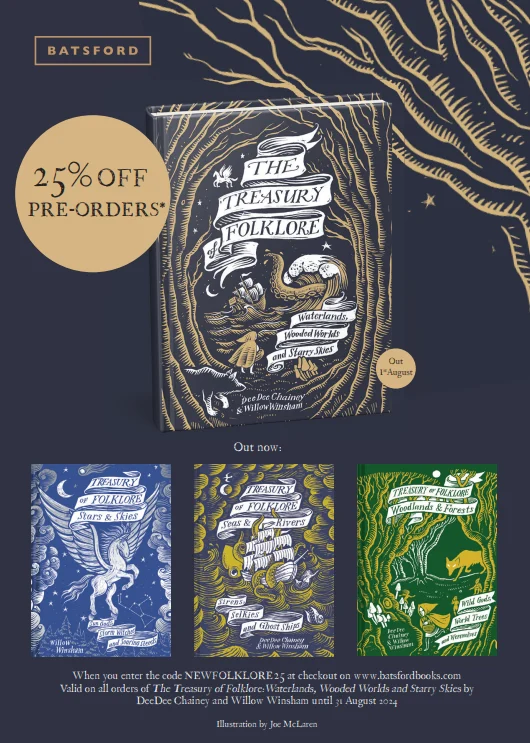
London, UK – July 23, 2024 – A decade-long journey into the heart of global storytelling culminates this August with the release of "The Treasury of Folklore: Waterlands, Wooded Worlds and Starry Skies." This eagerly anticipated volume, available for pre-order now and launching on August 1st, 2024, is a magnificent compilation that brings together the most captivating tales and beliefs from the acclaimed "Treasury of Folklore" series. Far more than a mere collection, this hefty tome represents the original vision of its creators: a single, comprehensive exploration of how humanity crafts meaning from the diverse landscapes of our world, revealing profound, shared truths that transcend cultural boundaries.
The new compilation draws from the widely popular individual titles – Seas and Rivers, Trees and Woodlands, and Stars and Skies – and is beautifully presented with the original, evocative illustrations by Joe McLaren. While not introducing new material, it offers readers a unique opportunity to experience the unifying tapestry of human imagination, presented as a cohesive and elegantly bound artifact designed to be a cherished addition to any library.
The Genesis of a Global Narrative: A Decade of Discovery
The inception of "The Treasury of Folklore" series nearly a decade ago was driven by a singular, ambitious vision. Its creators initially conceived of a single, monumental work that would span the breadth of human habitation, from the deepest oceans to the highest heavens, charting the customs, beliefs, and tales interwoven with these environments. However, the sheer volume and richness of the material unearthed during their extensive research quickly demonstrated that such a comprehensive undertaking could not be confined to a solitary book. This revelation led to the development of three distinct, yet interconnected, volumes: Seas and Rivers, Trees and Woodlands, and Stars and Skies, each dedicated to exploring folklore through the lens of a specific natural domain.
This expansive project was significantly influenced by the vibrant online community fostered by the #FolkloreThursday hashtag, a global phenomenon that showcased an overwhelming outpouring of shared narratives and cultural heritage. Inspired by this collective enthusiasm and the inherent universality of folklore, the authors embarked on a mission to create something meaningful and lasting – a series that would not only document but also celebrate the unifying threads that bind human experience across the globe. The subsequent popularity of the initial three books proved to be both a delightful surprise and a heartwarming affirmation of the project’s resonance with a broad audience, prompting immense gratitude from the authors to their readers.
Exploring Shared Human Experiences: The Universal Fabric of Folklore
At the core of the "Treasury of Folklore" lies a profound philosophical exploration: how humans across diverse cultures and geographies construct meaning around the places they inhabit. Through meticulous research and compelling narrative, the series unveiled a fundamental truth – that beneath the myriad surface details of customs and beliefs, humanity shares an inherent sameness. The authors discovered universal primal fears and dreams that manifest in countless forms, irrespective of geographical location, societal attire, or the names ascribed to the monsters and deities of local myths and legends.
Whether gazing across a vast ocean, longing for distant treasures, or huddling around a campfire in a darkened forest, dreading the unknown, humans consistently grapple with similar existential questions. The awe inspired by the eternity of time under the ancient stars, prompting contemplation of life’s brevity and an unwritten future, is a sentiment echoed in folklore worldwide. This shared psychological landscape forms the bedrock of the entire series, illuminating how our collective imagination seeks to understand, explain, and navigate the complexities of existence.
A Curated Compendium: Reimagining the Original Vision
The proposition to distill the essence of the three original books into a single compendium was met with immediate enthusiasm by the authors. This presented a unique opportunity to realize their initial ambition: to present this wealth of folklore within a singular, overarching narrative. The process was far from a simple collation; it involved a painstaking behind-the-scenes effort. The authors revisited their own well-known words with fresh eyes, engaging in a meticulous curation process to determine what to include and what to omit, ensuring the final volume would seamlessly span shared landscapes across both time and place.

The result, by the authors’ own admission, has been nothing short of astonishing. They express being "utterly thrilled" by the end product, a testament to the dedication invested in its creation. The physical manifestation of this vision is a truly remarkable object: a "hefty tome" distinguished by its impressive size, a cover that artfully combines the themes of its constituent parts, and the tactile pleasure of its beautiful cream paper. It is crafted not just as a book to be read, but as an experience to be savored, a tangible link to the rich tapestry of human storytelling.
It is important for readers to note that while this compilation offers a fresh presentation, it contains text taken directly from the existing three books of the series. There is no new, previously unreleased material within its pages. Nevertheless, its design and curated content position it as an ideal "beautiful addition to any book case or coffee table," serving as an engaging conversation starter and a conduit for connecting with the enduring power of folklore. The Treasury is thoughtfully organized into three distinct sections, each presenting extracts from the original books and showcasing the wonderful, distinctive illustrations of Joe McLaren, whose artwork has become synonymous with the series.
Voices from the Depths: Water Horse Lore
To truly appreciate the breadth of the collection, one need only delve into the compelling extracts offered from the compilation. The segment on "Water Horses" immediately transports the reader to the perilous edges of lakes and waterways, where majestic yet malevolent steeds lurk beneath the surface. These creatures, whether believed to be real or serving as cautionary tales, underscore humanity’s ancient apprehension of the unknown dangers hidden in natural environments.
One of the most renowned examples is the Scottish Kelpie. While often conflated with other water horses, the Kelpie holds a distinct place in Scottish folklore, typically inhabiting rivers. It is infamous for luring unwary travelers onto its back before dragging them to a watery demise. Yet, tales also speak of temporary taming, often through a bridle marked with a cross, allowing the Kelpie to be put to work, though its control was always fleeting. The possibility of killing a Kelpie, as demonstrated by the use of red-hot iron, highlights the human struggle to exert dominance over formidable natural forces. The enduring cultural significance of the Kelpie is vividly expressed in modern Scottish landscapes, most notably through the colossal 30-meter-tall sculptures near Falkirk, visible from the M9 motorway since 2013. Its presence in contemporary literature, from Lari Don to J.K. Rowling’s Fantastic Beasts and Where to Find Them, further attests to its lasting grip on the collective imagination. Interestingly, this specific variant of water horse is conspicuously absent from English folklore, suggesting a unique regional development of the myth.
Across the border in Wales, the narrative of the Ceffyl Dwr redresses this deficit. A staple of Welsh folkloric belief well into the 19th century, the Ceffyl Dwr displayed a variability in appearance and purpose. In northern Wales, it was a shapeshifting spirit prone to violence, while in the south, it consistently appeared as an enchanting, small horse, luring individuals onto its back. Stories consistently emphasize its incredible speed, capable of covering vast distances in impossibly short periods before vanishing, leaving its hapless riders to drown. A curious exception to this grim fate was granted to clergymen of any creed, who were said to be able to ride the Ceffyl Dwr unharmed, often arriving at their destination while their companions met a less fortunate end.
Further afield, Scandinavian folklore presents the Bäckahäst, or "brook horse." Most frequently sighted in foggy conditions, this creature is described as a majestic and luminous being. Like its Celtic counterparts, it beguiles riders into mounting, only to plunge them beneath the water to their death, rendering them unable to dismount. Often, the victims in these tales are children, perhaps to amplify the sense of peril and tragedy. A popular narrative recounts a group of boys on a frozen river who climb onto a beautiful Bäckahäst. The last child’s accidental mispronunciation of a phrase, inadvertently invoking the name of Christ, causes the horse to disappear, saving the boys. While predictions of drowning are common, many Bäckahäst tales end with the riders surviving, and like the Kelpie, it could sometimes be tricked into servitude.
Guardians of the Verdant Wilds: Forest Deities and Spirits
Moving from the watery depths to the "verdant greenery of the forest," the compilation introduces the fascinating domain of the "Lords of the Wild," where shapeshifting gods and spirits reign supreme. These figures encapsulate humanity’s complex relationship with untamed nature, embodying both its nurturing and fearsome aspects.
In Finnish mythology, Tapio, also known as Metsähine or Hiisi, stands as the revered king of the forest realm. Depicted as tall and thin, with a coat of ermine fur or moss, and a moss-covered hat, he bears a striking resemblance to the "Green Man" or foliate heads found in other European traditions, often peering out from bushy eyebrows and a great beard of moss or straggling black hair. Like the Hulder of Scandinavia, he is said to appear fully human from the front but reveals a gnarled tree-like back. As the personification and protector of the forest, hunters traditionally sought his blessing before a chase, pledging respect for the land and its creatures in return for a plentiful haul. Tapio’s family includes his benevolent wife Mielikki (or Kuurikki when malevolent), his son Nyrikki who guides hunters, and his daughter Tulikki who directs prey. The Estonian equivalent of this god shares similar attributes but is notably one-eyed, echoing the Norse god Odin.

Slavic folklore introduces the Leshy (also Leshii or Lyeshy), a tutelary spirit of the woods, protector of trees and animals, though some specify its guardianship over wolves or its servitude to bears. Like bears, the Leshy hibernates in winter. Known by numerous names, all implying a connection to the forest and sometimes dominion by a woodsman or the Devil, Leshies are often likened to Greek satyrs, possessing human upper bodies but sporting horns, claws, and a bushy beard, sometimes described as forest green or entirely covered in moss. These are master shapeshifters, capable of altering their size and form at will, appearing taller than a tree or as small as a blade of grass, or conversely, huge from a distance but tiny up close. They can mimic any familiar forest inhabitant, animal, or plant. In human form, they are distinguishable by the absence of eyelashes or brows, shoes worn on the wrong feet, or clothing wrapped in an inverse manner to local fashion. Some are one-eyed, all are covered in wild hair, and possess the cloven feet reminiscent of fauns or even the Devil. Regional variations describe them with wings, a black-furred tail, or dressed in white with swollen eyes.
The Leshy’s powers extend to wielding natural forces; their bellowing can whip up great winds, causing all creatures to flee in terror. Intruders into their domain who disregard their warnings – shrieking laughter, clapping, or howling – risk being lost in the wilds by morning, disoriented and led astray from their path. As quintessential trickster figures, Leshies can mimic voices to lure victims, sometimes to their deaths by tickling. Their voices can also manifest as creaking branches or rustling leaves. Crossing a Leshy can lead to illness, and they are known to abduct women for marriage or children cursed by their parents. Their wrath could extend to entire farms, sucking milk from cattle, prompting annual sacrifices of cows in some Russian districts to ensure herd welfare. Conversely, those who offer prayers or leave offerings of bread and tobacco are said to be safe. Leshies are believed to live alone or with their wives (lesovikha) and children in woodland huts, and are not above battling their own kind with clubs, ripping up trees in their wake. A Vologda District Leshy was even reputed to frequent taverns with his wolf pack, consuming entire buckets of vodka. They are also notorious gamblers, often bartering with squirrels or playing cards (though avoiding clubs, due to their resemblance to the Christian cross). Protection against Leshies, much like other fae folk, involves turning clothes inside out or wearing shoes on the wrong feet, which is said to provoke laughter and return the lost to their rightful path. More drastic measures include stripping naked and redressing backwards, or swearing remorselessly to banish them. Making the sign of the cross is another, less entertaining, method of banishment. For those daring enough to summon a Leshy, the process is simple: cut young birch trees, arrange them in a circle with tops touching, stand in the center devoid of Christian symbols, and call out to the "grandfather of the forest."
Celestial Reflections: The Enduring Myth of the Moon Hare
Finally, the compilation invites readers to gaze skyward, to the enduring fascination with the moon and the myriad tales woven around the faces and images perceived upon its surface. Among these, the motif of a rabbit or hare living on the moon is remarkably widespread across diverse cultures. The Sea of Tranquillity is often identified as the rabbit’s head, while the seas of Fertility and Nectar form its ears.
In the Buddhist Sasa-Jātaka story, a hare, accompanied by his friends – an otter, a jackal, and a monkey – advocates for giving alms. On a fast day, the deity Sakka, disguised as an old beggar, tests their generosity. While the otter, jackal, and monkey readily offer food, the hare, having only grass, offers himself as a meal by leaping into a fire. For this ultimate act of faithfulness, Sakka saves the hare, plucks him from the flames, and places him in the moon for all eternity. Some versions elaborate that Sakka used the essence of a squeezed mountain to draw the faithful hare’s image on the lunar surface. Similar self-sacrificing hare narratives are found in other cultures, often with variations in the animal companions.
A tale from Sri Lanka recounts Buddha, lost and hungry in a wood, being offered assistance by a hare. When Buddha laments his inability to pay, the hare immediately offers himself as food. As Buddha builds a fire, the hare throws himself into it, only for Buddha to use his powers to save the selfless creature and send him to the moon. Japan also possesses a similar story, where the rabbit, known as Tsuki no Usagi, sacrifices itself on a fire for the Man in the Moon (disguised as a beggar). The beggar then reveals his true form and takes the rabbit to live with him, in recognition of its selflessness. This popular Japanese tale is frequently recounted to children in September, coinciding with the Harvest Moon and the Mid-Autumn Festival, highlighting the hare’s association with abundance and sacrifice.
In a starkly different vein, a tale from South Africa attributes the unfortunate fate of human mortality to the hare. The Moon dispatches the Hare to deliver a message to humankind: just as she, the Moon, "dies" and returns each month, so too would humanity. However, the flighty Hare misdelivers the crucial message, stating only that humans would die permanently. Enraged upon discovering this error, the Moon attacks the Hare with a hatchet, intending to cleave him in two. She only succeeds in splitting his lip. In retaliation, the Hare lashes out with his claws, scarring the Moon’s face – scars that, according to the legend, are still visible in the dark shapes on the moon today. This narrative beautifully illustrates how celestial bodies become canvases for explaining fundamental aspects of human existence, from self-sacrifice to the inevitability of death.
The Enduring Legacy of Folklore: A Call to Connection
"The Treasury of Folklore: Waterlands, Wooded Worlds and Starry Skies" is more than just a collection of stories; it is a testament to the enduring power of human imagination and our innate need to connect with the world around us. By bringing these diverse narratives together in a single, beautifully crafted volume, the authors and publisher offer readers a unique opportunity to explore the shared psychological landscape of humanity.
Folklore, in its myriad forms, serves as a vital reflection of our collective primal fears, dreams, and our awe-filled relationship with the natural world. It preserves ancestral wisdom, explains the inexplicable, and offers comfort or caution in a world both wondrous and dangerous. This compilation underscores the critical importance of preserving and celebrating these narratives, not just as historical curiosities, but as living traditions that continue to inform and enrich our understanding of ourselves and our place in the universe.

As a conversation starter, a source of wonder, and a means of forging connections across cultures and generations, this "hefty tome" is an invitation to engage with the timeless art of storytelling. It reminds us that no matter where we live or what we believe, the threads of our shared humanity are intricately woven into the myths and legends we tell.
"The Treasury of Folklore: Waterlands, Wooded Worlds and Starry Skies" is now available for pre-order and will be released on August 1st, 2024.
Pre-order now: https://www.amazon.co.uk/Treasury-Folklore-Waterlands-Wooded-Worlds/dp/1849949212
Special Offer: Enjoy 25% off "The Treasury of Folklore" when you order directly from Batsford Books using the code NEWFOLKLORE25.
### END ###


Leave a Comment