
The Portrait of Transience: Navigating the Intersection of Corporate Culture, Family Dynamics, and the Politics of Autonomy

In the modern professional landscape, the line between institutional belonging and sudden erasure has become increasingly thin. An anecdote from a veteran journalist—recalling a break room bulletin board where staff mugshots were maintained with such ruthless efficiency that employees often vanished from the wall before they had even cleared their desks—serves as a poignant metaphor for the volatility of contemporary life. This "disappearing act" is no longer confined to the backrooms of local newspapers; it has permeated the highest levels of the American executive branch and the very fabric of social discourse regarding parenting and reproductive rights.
As we examine the current socio-political climate, several disparate threads emerge: the weaponization of office décor in the Department of Justice, the evolving depictions of motherhood in popular media, and a burgeoning legal crisis regarding personal autonomy. Together, these elements paint a picture of a society grappling with the boundaries of authority, both in the home and in the halls of power.
Main Facts: The Symbols of Power and the Reality of Erasure
The recent turmoil within the Department of Justice (DOJ) under the brief and contentious tenure of Attorney General Pam Bondi has highlighted how symbolic gestures can trigger professional upheaval. Reports indicate that Bondi’s administration moved to demote staff members who were deemed "insufficiently prompt" in removing portraits of the previous administration—specifically President Biden and Vice President Harris.
However, the ephemeral nature of political favor was quickly realized. Following Bondi’s own departure, DOJ insiders reported a retaliatory efficiency. Her portrait was not merely removed; it was reportedly documented in a state of discard—photographed in a trash bin—and circulated among staff. This incident underscores a growing trend of "performative purging" in political institutions, where the physical icons of leadership are treated as battlegrounds for ideological dominance.
Simultaneously, the cultural conversation has shifted toward the domestic sphere. As the nation observes Mother’s Day, the "Juxtaposition of the Day" in editorial circles has focused on the distinction between physical presence and genuine emotional involvement. This discourse is set against a backdrop of tightening legal restrictions on women’s health, specifically the controversial 2026 court rulings blocking mail-order access to mifepristone, a move that critics argue represents the ultimate intrusion of the state into the private lives of families.
Chronology: From 1984 to the Present Crisis
To understand the current tension between religious imposition and secular governance, one must look back to 1984. That year, New York Governor Mario Cuomo delivered a landmark speech at the University of Notre Dame. Cuomo, a devout Roman Catholic, articulated a philosophy of "Religious Belief and Public Morality" that served as a cornerstone for pluralistic governance for decades. He argued that while his personal faith informed his private life, he could not, as a public official, "force his beliefs on others," lest he invite a future where others forced their beliefs upon him.
For nearly forty years, this "Cuomo Doctrine" provided a framework for Catholic politicians and secular leaders alike to navigate the divide between church and state. However, by the mid-2010s, the consensus began to fracture. The 2012 era of comic strips like Stone Soup captured a moment where the "modern family"—often divorced, struggling with work-life balance, and navigating "free-range" vs. "helicopter" parenting—was the primary focus of social observation.

By 2026, the trajectory shifted from social observation to legal confrontation. The recent appellate court decisions regarding mifepristone mark a departure from the "live and let live" philosophy of the 1980s. We have entered an era where specific religious interpretations regarding "repopulation" and "traditional family structures" are being codified into law, effectively dismantling the wall of separation that Cuomo sought to protect.
Supporting Data: The Cultural Mirror of the Comic Strip
Art often reflects the anxieties of its era more accurately than data points. The "Juxtaposition of the Day" highlights several key works that illustrate the current American psyche:
- The Parenting Gap: Garry Trudeau, creator of Doonesbury, recently explored the divide between "helicopter parents" and "free-range parenting." Trudeau, who grew up in the rural Adirondacks, notes that his childhood of "free-range" exploration is increasingly at odds with the urban reality of 2026, where parental anxiety is at an all-time high.
- The Absence of Involvement: The Other Coast and Baldwin’s cartoons have recently tackled the "absentee parent" trope—the idea that being in the same room as a child (or a pet) is not synonymous with engagement. This mirrors a broader societal concern that as work demands increase, the quality of familial connection is being sacrificed for the appearance of stability.
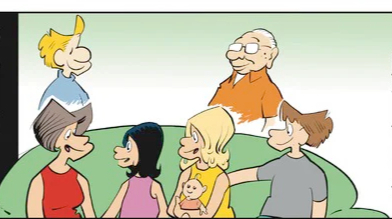
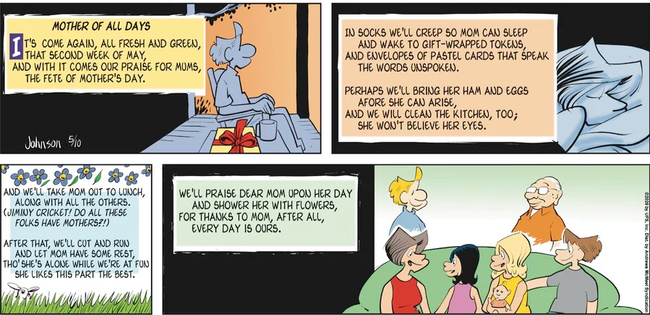
- The Sentimentality Trap: Jimmy Johnson’s Arlo & Janis has been praised for avoiding the "mawkish sentimentality" often associated with Mother’s Day. By focusing on "straight affection" rather than commercial clichés, Johnson highlights a growing desire for authenticity in an era of performative social media presence.
These cultural artifacts suggest a population that is increasingly skeptical of institutional "norms" and is searching for deeper, more genuine connections amidst a landscape of professional and political instability.
Official Responses and Philosophical Shifts
The response from the legal and religious communities to the current restrictions on autonomy has been polarized. Proponents of the "repopulation" movement—a conservative niche concept that emphasizes high birth rates to maintain specific demographic and cultural balances—argue that the state has a vested interest in promoting traditional family units.
Conversely, civil liberties organizations have pointed to the mifepristone ban as a "radical assault" on personal autonomy. They echo Mario Cuomo’s warning from forty years ago: that the price of seeking to force beliefs on others is the eventual loss of one’s own freedom.
In the Department of Justice, the official stance on the "portrait controversy" remains one of "administrative procedure," yet the internal leaks suggest a culture of fear and retaliation. Insiders describe an environment where loyalty is measured by the speed at which one can erase the past, a practice that many veteran civil servants find corrosive to the department’s long-term mission.
Implications: The Burden of Intrusive Repression
The implications of these shifts are most heavily felt by women, who find themselves at the center of both the political and domestic storms. The "intrusive repression" mentioned by contemporary commentators refers to a dual burden: the expectation to maintain "perfect" parenting standards (avoiding both the "helicopter" and "absentee" labels) while simultaneously navigating a legal system that is increasingly hostile to their bodily autonomy.
Furthermore, the "repopulation" rhetoric carries troubling undertones of racial and religious exclusivity. By moving away from the pluralistic ideal—where a Catholic protects the rights of a Jew, a Protestant, or a non-believer to ensure their own rights are protected—the nation risks descending into a "zero-sum" cultural war.

As we look toward the future, the lessons from the break room bulletin board remain relevant. Whether in a local newspaper or the Department of Justice, the "disappearing act" of individuals and their rights is a symptom of a deeper instability. The challenge for the coming years will be to reclaim a sense of permanent dignity that is not subject to the whims of a publisher’s secretary or an outgoing Attorney General.
In celebrating Mother’s Day and the diverse connections people share with the next generation, there is a call to recognize those who "refuse to abandon the struggle" for autonomy. As the song goes, and as Nina Simone famously sang, "I got my hair, I got my head, I got my brains… I got my life." In 2026, the struggle to retain that sense of "life" and self-ownership remains the defining battle of the era.
Conclusion
The intersection of office politics, parenting philosophies, and high-stakes legal battles reveals a society in flux. From the petty removals of portraits in the DOJ to the profound legal challenges regarding mifepristone, the theme is one of control versus autonomy. As we move forward, the "Cuomo Doctrine" of mutual respect and the "free-range" spirit of the Adirondacks offer a potential path back to a more balanced existence—one where individuals are not simply mugshots on a board, waiting to be taken down, but are valued participants in a stable and respectful democracy.



Leave a Comment