
The Surrealist Architecture of Gary Larson: Analyzing the Comedic Masterpieces of The Far Side
In the pantheon of American humor, few figures loom as large or as strangely as Gary Larson. From 1980 to 1995, Larson’s syndicated panel, The Far Side, served as a daily window into a world where the mundane was consistently subverted by the macabre, the scientific, and the utterly absurd. Larson was not merely a cartoonist; he was an undisputed "GOAT-level" humorist who fundamentally altered the landscape of visual comedy. By blending a biologist’s eye for detail with a philosopher’s sense of the existential, he produced thousands of comics, hundreds of which are now regarded as "perfect" examples of the medium.
This analysis explores the highest levels of comedic achievement found within The Far Side. These are not merely "best-of" selections; they are testaments to a specific brand of genius that thrived on the "What the?" factor—comics that outdid even Larson’s own high standards for wit and composition.
Main Facts: The Anatomy of a Larson Masterpiece
Gary Larson’s success was built on a foundation of intellectual curiosity and a refusal to talk down to his audience. Unlike the character-driven narratives of Peanuts or the political bite of Doonesbury, The Far Side was a single-panel universe where the "stars" were often cows, scientists, or hapless men in thick-rimmed glasses.
The core of Larson’s genius lies in three primary elements:
- Visual Storytelling: The ability to convey a complex narrative before the reader even looks at the caption.
- Subversion of Expectations: Taking a familiar trope—a desert island, a laboratory, a suburban home—and introducing a single, jarringly illogical element.
- The Logic of the Absurd: Larson’s world has its own internal rules. Once the reader accepts that a dog can build a robot or that cows have tools, the punchline becomes a logical, albeit hilarious, conclusion.
Chronology of Excellence: Case Studies in Comedic Perfection
To understand the evolution of The Far Side, one must examine the specific panels that defined its eras. Each of the following cartoons represents a pinnacle of Larson’s craft, demonstrating how he pushed the boundaries of the single-panel format.
"Cow Tools" (October 28, 1982): The Zenith of Confusion
Nearly 45 years after its publication, "Cow Tools" remains perhaps the most discussed cartoon in history. It features a cow standing before a table of crudely shaped, inexplicable objects. The caption simply reads: "Cow tools."
This panel is a masterpiece because of its audacity. It forced readers to overthink a simple premise: if cows made tools, they wouldn’t be sophisticated; they would be "cow-like." The public’s reaction—thousands of letters demanding an explanation—proved that Larson had tapped into a level of abstract humor that the average reader wasn’t yet prepared for. It is the ultimate "Far Side" comic because it encapsulates Larson’s singular, uncompromising style.
"Animal Self-Help" (August 7, 1984): Layered Satire
In this 1984 classic, Larson explores the anthropomorphic mirror. By placing animals in a bookstore’s self-help section, he satirizes human insecurity. The brilliance here is the density of the joke. Larson doesn’t stop at one gag; he layers them: a gazelle studying How To Avoid Natural Selection and an anteater reading Do It by Instinct. It’s a masterclass in using every inch of the frame to build a world.
"Red Handkerchief" (May 11, 1985): The Visual Monologue
Compositionally, this panel is an outlier. Larson uses an excessively large speech bubble to dominate the frame, creating a sense of "rambling" before the reader even finishes the text. As a man in bandages tells a story at a bar about a bull and a "red handkerchief," the reader notices a bull in a trench coat sitting right next to him. The dramatic irony—knowing the protagonist is about to be gored again—is perfectly timed.
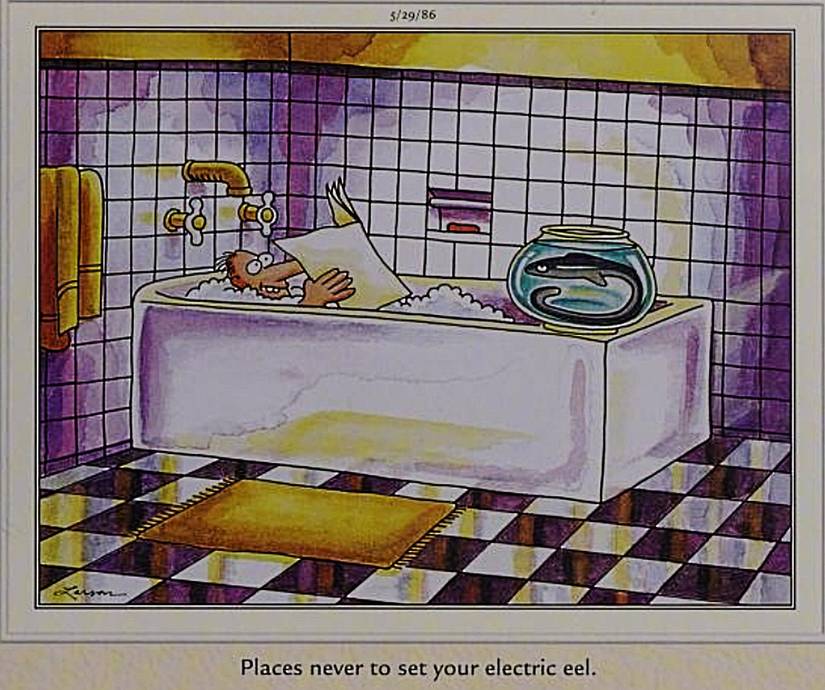
"Eel Bathtime" (May 29, 1986): The Cliffhanger
Caption: "Places never to set your electric eel." This comic relies entirely on the viewer’s anxiety. The image of a man soaking in a tub while an eel bowl balances precariously on the edge is a "silent" joke. It asks more questions than it answers, a recurring Larson technique that forces the reader to participate in the absurdity.
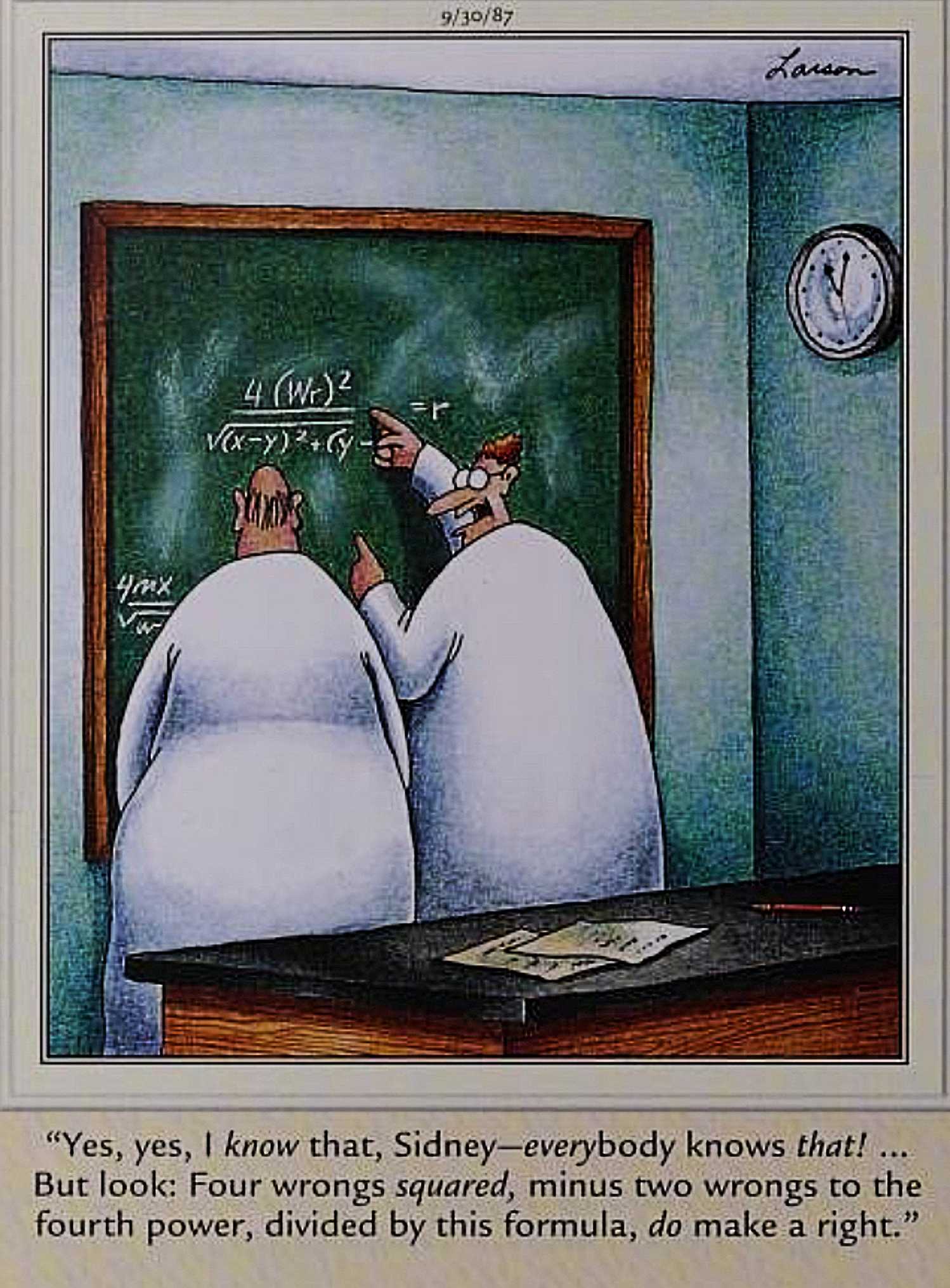
"Moral Math" (September 30, 1987): The Scientific Absurd
Larson frequently placed scientists at chalkboards, but "Moral Math" is the definitive entry in this subgenre. By calculating exactly how many "wrongs" make a "right," Larson treats morality as a branch of physics. It takes a familiar childhood lesson and subjects it to the cold, hard logic of the laboratory.
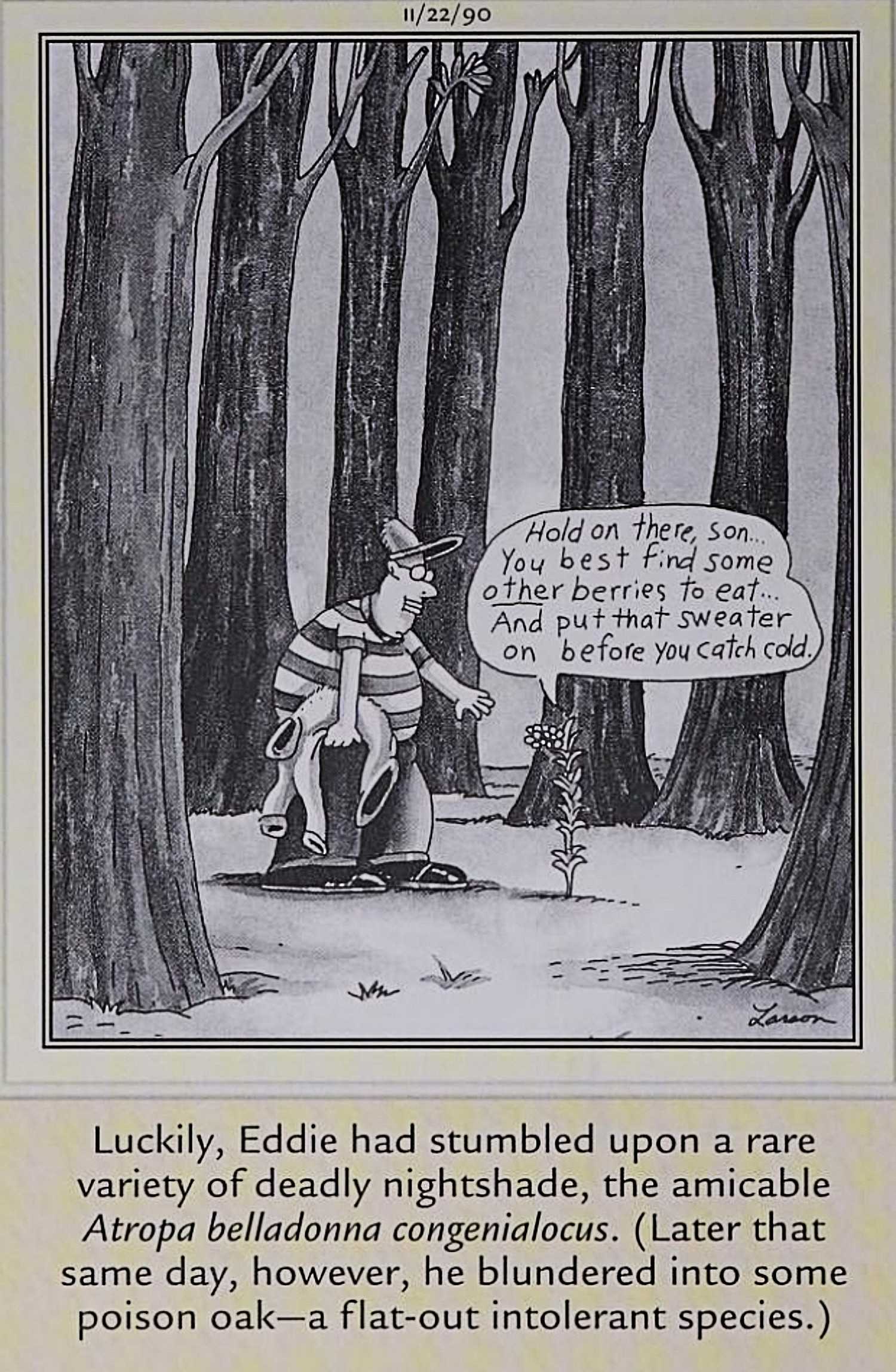
"Friendly Nightshade" (November 22, 1990): The Narrative Frame
By the 1990s, Larson’s captions became more verbose and literary. In "Friendly Nightshade," he tells a complete survival story in two sentences. The juxtaposition of a "deadly" plant that is actually "super friendly" (telling a lost boy to put on a sweater) is quintessential Larson—weird, wholesome, and slightly threatening all at once.
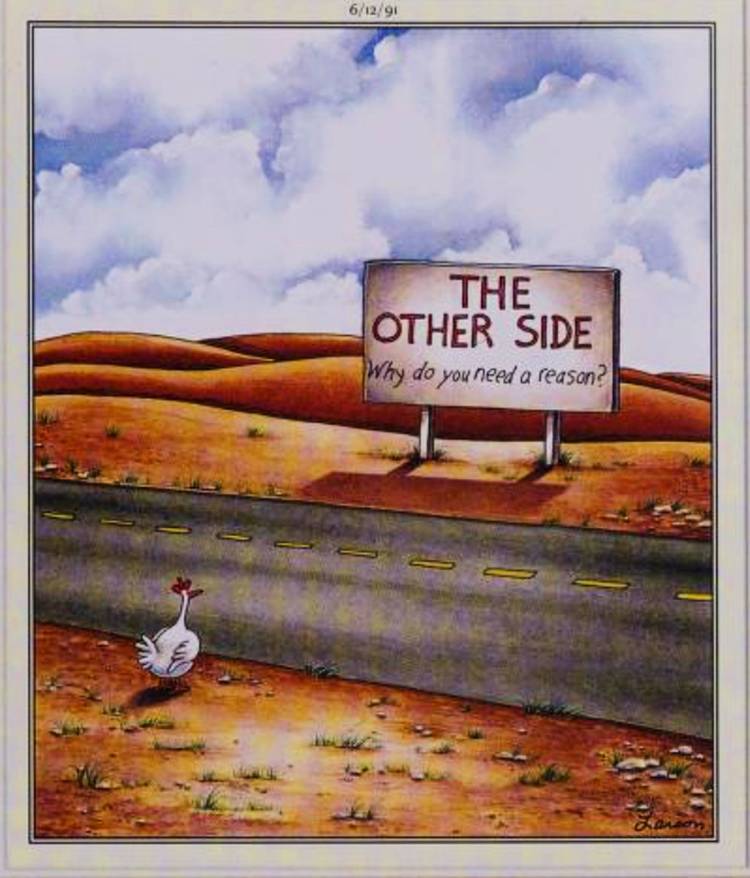
"The Other Side" (June 12, 1991): Meta-Humor
This panel features a chicken staring at a billboard for "The Other Side" that asks, "Why do you even need a reason?" It is a 10/10 pop culture reference that deconstructs the world’s oldest joke while simultaneously mocking the "mask-off" nature of modern advertising.
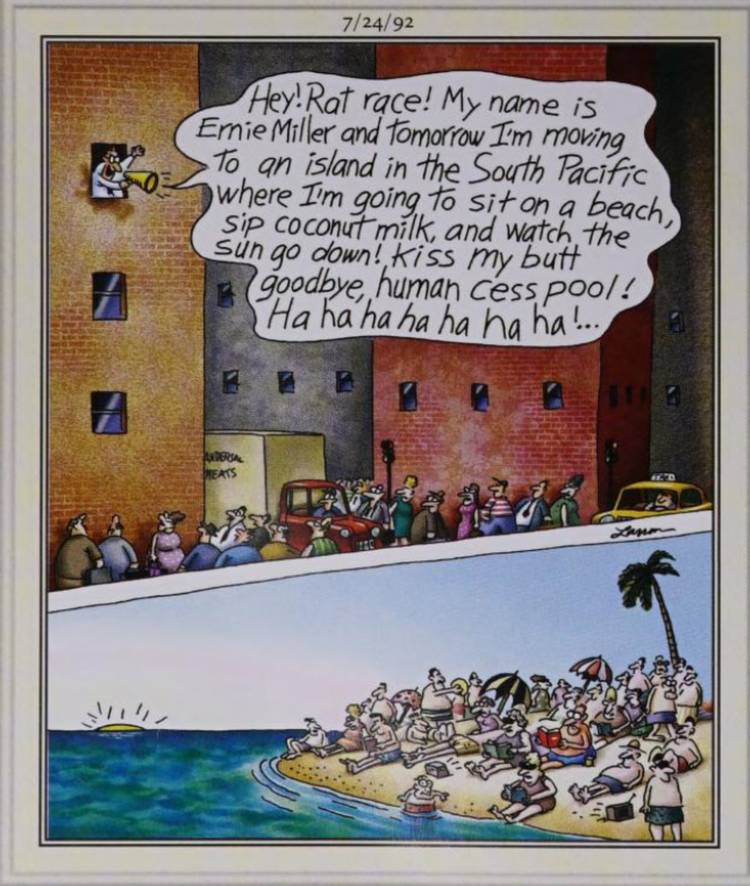
"Ernie’s Folly" (July 24, 1992): The Smash Cut
Larson perfected the "before/after" joke with Ernie. We see a man shouting at the city "cesspool" as he leaves for a tropical retreat, only to find the beach in the next frame more crowded and miserable than the city he left. It is a cynical, hilarious take on the impossibility of escape.
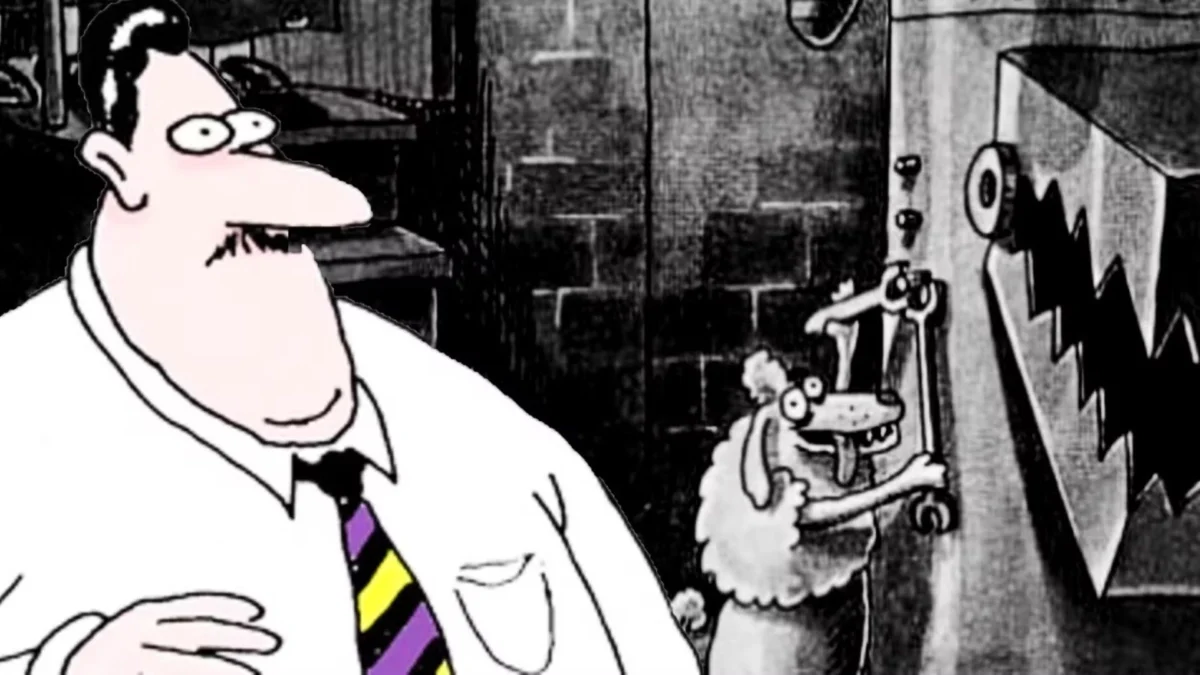
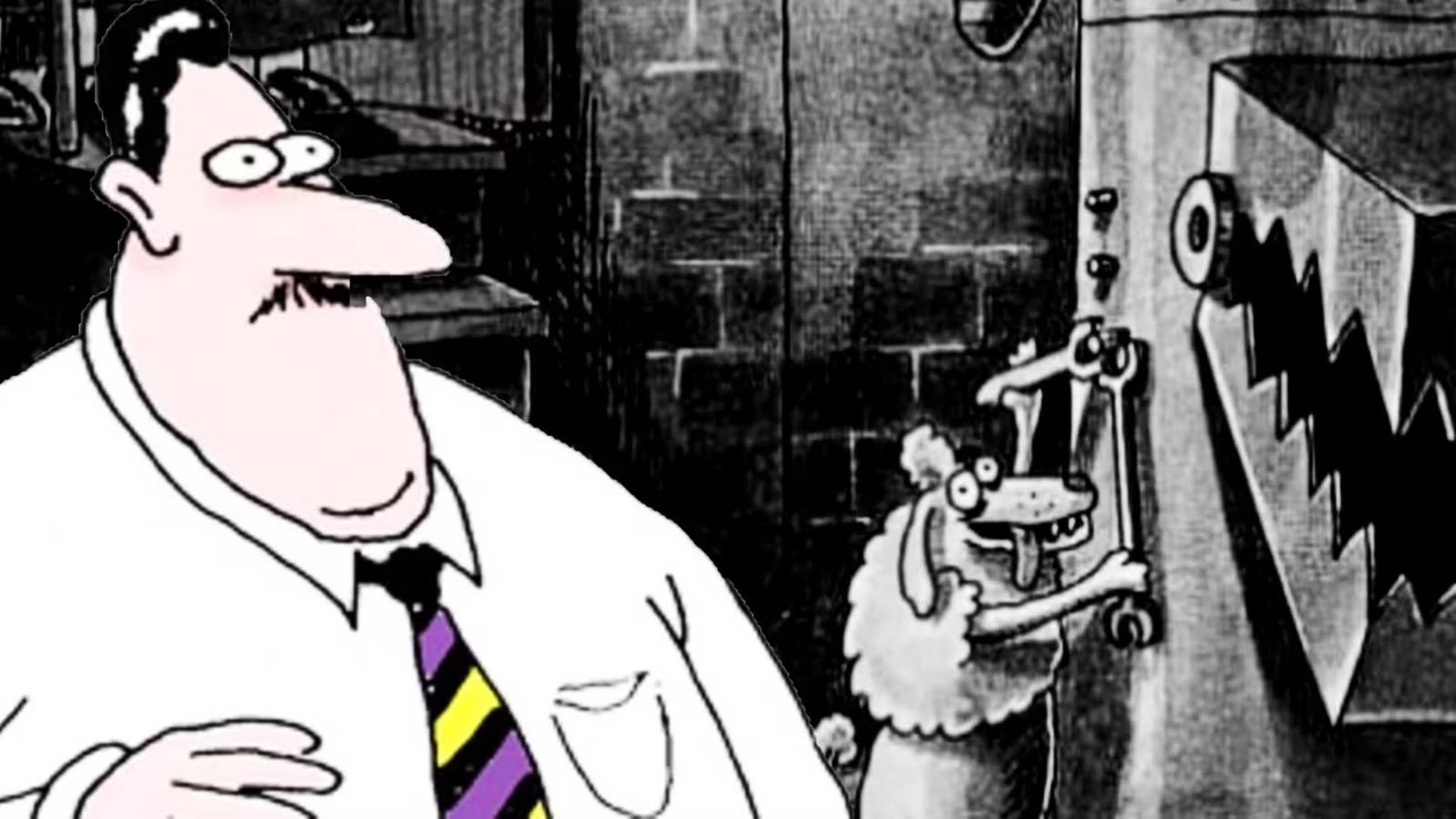
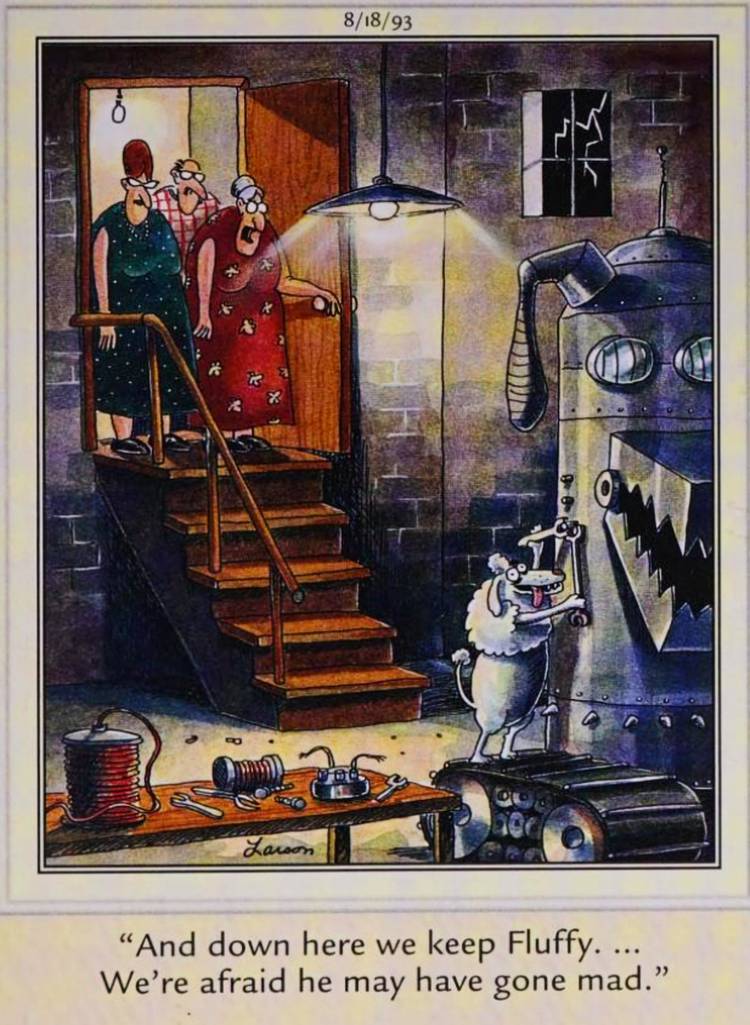
"Fluffy’s Masterpiece" (August 18, 1993): The Final Form
Towards the end of the strip’s run, Larson revisited his "Deathbot" trope. In this iteration, the creator is a poodle. The detail of the "unhinged" look in Fluffy’s eyes as he completes a giant killer robot is a comedic coup de grâce. It represents Larson at his most confident, taking a recurring gag and pushing it to its absolute limit.
Supporting Data: The Impact of the "Larson Style"
The effectiveness of Larson’s work can be measured by its ubiquity in specific professional circles. While most comics are found on refrigerators, The Far Side became the unofficial mascot of the scientific community.
- Scientific Recognition: Larson’s work was so respected by biologists that a species of chewing louse found only on owls was named Strigiphilus garylarsoni in his honor.
- Museum Exhibits: In 1985, the California Academy of Sciences curated an exhibit of his work, recognizing the "natural history" underlying his bizarre creatures.
- Syndication Power: At its peak, the strip appeared in over 1,900 newspapers worldwide, translated into dozens of languages, proving that his brand of "weird" was a universal human experience.
Official Responses: Interpretations and Critical Legacy
The "official" response to Larson’s work often fluctuated between confused outrage and academic praise.
The "Cow Tools" Incident: When "Cow Tools" was published, the syndicate’s phones were overwhelmed. Larson eventually had to issue a press release—a rare move for a cartoonist—explaining that the joke was simply that "cows lack the dexterity to make sophisticated tools." This event is now studied in communications courses as a prime example of "audience decoding."
The Scientific Community: Unlike many who mocked science, Larson was seen as "one of them." Paleontologists famously coined the term "Thagomizer" to describe the spiked tail of a Stegosaurus based on a Far Side cartoon where a caveman (Thag Simmons) meets a grizzly end. The term is now used in actual scientific textbooks.
The Peer Review: Fellow cartoonists like Bill Watterson (Calvin and Hobbes) and Matt Groening (The Simpsons) have cited Larson as a revolutionary figure who broke the "setup-punchline" mold of the 20th-century funny pages.
Implications: The Lasting Legacy of the Far Side
The implications of Gary Larson’s work extend far beyond the nostalgia of the 1980s and 90s. He taught a generation of readers how to appreciate the "confusing" and the "unresolved."
- The Rise of Internet Humor: The DNA of The Far Side is visible in modern internet memes. The "random" and "surreal" humor that defines Gen Z and Millennial digital culture owes a direct debt to Larson’s "What the?" panels.
- The Single-Panel Standard: Larson proved that a single image could be more narratively dense than a multi-panel strip. He cleared the path for modern successes like The New Yorker cartoons to become more experimental.
- Environmental and Biological Awareness: By frequently placing humans in the position of the "prey" or the "specimen," Larson subtly encouraged a more humble, ecological perspective on the world.
In conclusion, the "perfect" cartoons of The Far Side deserve their status as comedic masterpieces. Gary Larson did more than just make people laugh; he invited them to look at the world from "the far side"—a place where the rules of reality are suspended, but the rules of comedy are absolute. Whether it is a poodle building a robot or a cow holding a nonsensical tool, Larson’s work remains a testament to the highest level of humor: the kind that makes you laugh, then think, and then ask "What the?" all over again.




Leave a Comment