
The Unforeseen Mathematical Harmony in Van Gogh’s "Starry Night"
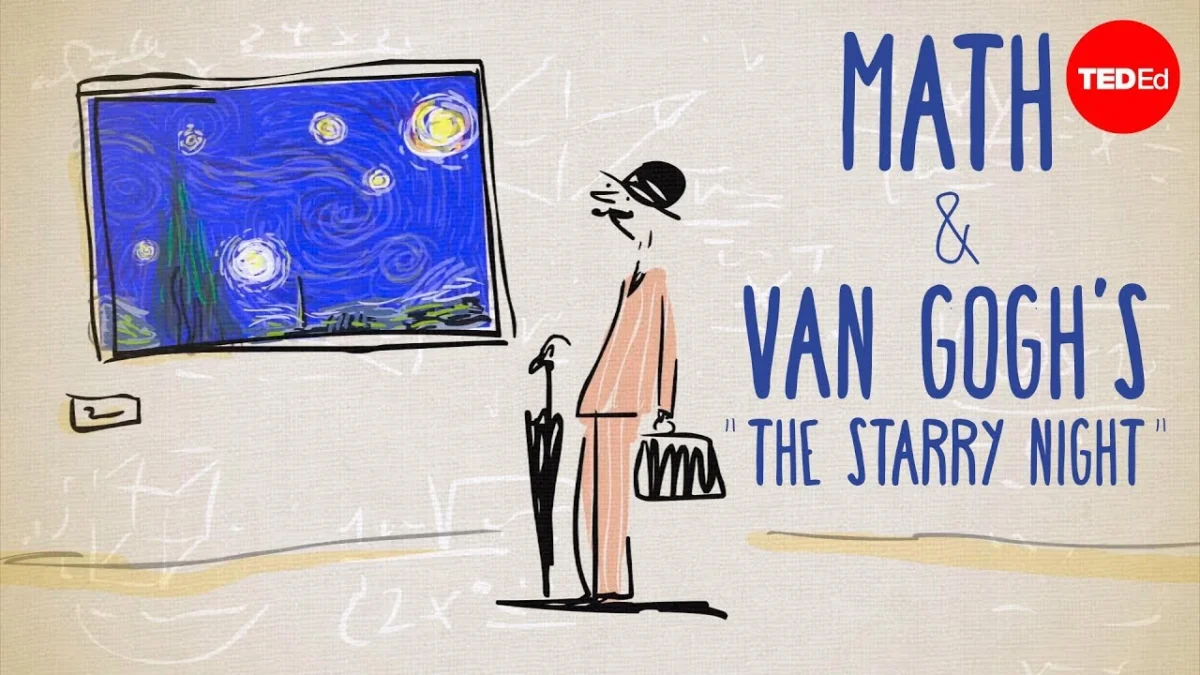
May 28th, 2026 – Vincent van Gogh’s iconic masterpiece, "The Starry Night," painted in 1889, continues to captivate art enthusiasts and scholars alike. Housed at the Museum of Modern Art (MoMA) in New York City, the painting is celebrated for its "symbolic landscape full of movement, energy, and light," as described by the museum. The juxtaposition of the tranquil village with the dynamic, swirling sky, rendered through Van Gogh’s signature impasto technique, creates a palpable sense of motion. However, recent analyses, illuminated by a compelling TED-Ed lesson, reveal that Van Gogh’s artistic genius may have inadvertently touched upon profound scientific principles, specifically the complex phenomenon of turbulence.
The Artistic and Scientific Nexus of "Starry Night"
"The Starry Night" is universally acknowledged for its groundbreaking portrayal of movement. Van Gogh’s ability to infuse his canvases with a vibrant, almost kinetic energy was a hallmark of his Post-Impressionist style. The thick, textured application of paint, known as impasto, not only adds a tactile dimension but also contributes to a rhythmic visual flow that makes the artwork seem alive. This artistic achievement, while celebrated for centuries, is now being re-examined through the lens of modern scientific understanding.
The TED-Ed lesson, a collaborative effort by math artist and teacher Natalya St. Clair and animator Avi Ofer, delves into how Van Gogh managed to capture the "deep mystery of movement, fluid and light in his work." The video specifically highlights his depiction of turbulence, a complex and often chaotic pattern of fluid motion. According to the analysis presented, Van Gogh’s portrayal of the swirling sky in "The Starry Night" exhibits a sophistication and accuracy that remarkably aligns with how physicists and mathematicians describe turbulence in their scientific papers. This suggests that Van Gogh, through his intuitive artistic process, may have intuitively grasped and visually represented principles that took scientific inquiry centuries to formalize.
A Chronology of Discovery: From Artistic Vision to Scientific Recognition
The creation of "The Starry Night" in June 1889, during Van Gogh’s voluntary stay at the asylum in Saint-Rémy-de-Provence, marks a pivotal moment in art history. The painting, inspired by the view from his asylum window (though largely painted from memory and imagination), has been interpreted in numerous ways, often reflecting the artist’s emotional state and his profound connection to nature.
For decades, art historians focused on the emotional and symbolic interpretations of the swirling sky, the cypress tree, and the tranquil village. The impasto technique, the vibrant color palette, and the expressive brushstrokes were analyzed as expressions of Van Gogh’s inner turmoil and his search for solace in the natural world.
The scientific investigation into the patterns observed in nature, particularly fluid dynamics and turbulence, gained significant momentum in the 20th century. Concepts like the Navier-Stokes equations, which describe fluid motion, and the study of chaotic systems became central to understanding phenomena like weather patterns, water flow, and even the movement of stars and galaxies.
The convergence of art and science in understanding "The Starry Night" is a more recent development. The TED-Ed lesson, first published in 2014 and revisited in this 2026 article, represents a significant effort to bridge these disciplines. It draws parallels between Van Gogh’s visual representations and the mathematical models of turbulence. The video posits that Van Gogh’s swirling brushstrokes, the eddies and vortices depicted in the sky, are not merely artistic flourishes but uncannily accurate visual metaphors for turbulent flow.
The fact that this artistic depiction of turbulence predates its rigorous scientific formalization is a testament to Van Gogh’s extraordinary observational and expressive capabilities. The creators of the TED-Ed lesson suggest that this discovery might have occurred, perhaps by coincidence, during the "turbulent last years of Van Gogh’s life," a period marked by his mental health struggles and intense artistic output.
Supporting Data: The Science of Turbulence and Van Gogh’s Brushstrokes
The scientific concept of turbulence is characterized by chaotic, irregular, and unpredictable fluid motion. It involves eddies, vortices, and a wide range of spatial and temporal scales. Mathematically, turbulence is notoriously difficult to model due to its non-linear nature. Physicists often describe turbulent flow using concepts such as energy dissipation, intermittency, and fractal dimensions.
The TED-Ed lesson, as described in the original article, focuses on the concept of "Kolmogorov’s theory of turbulence," which describes how energy is transferred from larger eddies to smaller ones in a turbulent flow. This cascade of energy is believed to follow specific statistical patterns. While Van Gogh was not a mathematician or physicist, his application of paint in "The Starry Night" exhibits a similar hierarchical structure of swirling patterns. The brushstrokes appear to mimic the interconnectedness and cascading nature of turbulent eddies.
The visual evidence presented in analyses of the painting often involves overlaying mathematical models of turbulence onto sections of "The Starry Night." These comparisons highlight striking similarities in the shapes and distribution of the swirling forms. The density and direction of Van Gogh’s brushstrokes in the sky create a visual impression that mirrors the complex, multi-scaled patterns observed in fluid dynamics simulations.
For example, the prominent swirls in the sky can be seen as analogous to large-scale eddies in a turbulent fluid. These then break down into smaller, more intricate swirls, much like the energy cascade described by Kolmogorov. The artist’s ability to convey this complex motion with such visual coherence, without explicit mathematical knowledge, is what makes the connection so compelling. It suggests an innate understanding of natural phenomena that transcends conventional artistic expression.
Official Responses and Interpretations
The Museum of Modern Art, in its description of "The Starry Night," emphasizes the painting’s "movement, energy, and light." This official recognition of the artwork’s dynamic qualities provides a foundation for the subsequent scientific interpretations. While MoMA’s primary focus remains on its art historical significance, the emergence of scientific analyses adds a new layer of appreciation.
The creators of the TED-Ed lesson, Natalya St. Clair and Avi Ofer, have been instrumental in bringing this interdisciplinary perspective to a wider audience. Their work aims to demonstrate how art can serve as a conduit for understanding complex scientific principles and how scientific inquiry can illuminate artistic creations. Their TED-Ed lesson, as a part of a widely recognized educational platform, has garnered significant attention, prompting discussions and further exploration into the mathematical underpinnings of famous artworks.
While there may not be a formal "response" from scientific institutions in the traditional sense, the recognition of this connection within educational and popular science circles signifies an acceptance of the validity of such interdisciplinary insights. The fact that this TED-Ed lesson has been highlighted and discussed in art and culture publications suggests a growing appreciation for the unexpected intersections between seemingly disparate fields.
Implications and Future Directions
The discovery of mathematical principles, particularly those related to turbulence, within Van Gogh’s "Starry Night" has several significant implications.
Firstly, it underscores the profound interconnectedness of art and science. It suggests that artistic intuition and scientific observation can, at times, arrive at similar understandings of the natural world, albeit through different methodologies. Van Gogh’s genius lay in his ability to translate his perception of natural forces into a visually arresting form, a feat that science has taken centuries to quantify.
Secondly, it offers a new lens through which to appreciate Van Gogh’s work. Beyond its emotional and symbolic resonance, "The Starry Night" can now be seen as a visual treatise on fluid dynamics, a testament to the artist’s remarkable ability to perceive and represent complex natural phenomena. This can enrich the experience of viewers and provide new avenues for art historical and scientific research.
Thirdly, it highlights the potential of interdisciplinary education. The TED-Ed lesson serves as an excellent example of how complex scientific concepts can be made accessible and engaging through artistic representation. This approach can inspire future generations of students to explore the synergies between different fields of knowledge.
Looking ahead, this discovery may encourage further investigations into other artworks. Are there other masterpieces that, upon closer scientific scrutiny, reveal similar unexpected mathematical or scientific underpinnings? The exploration of fractal patterns in the works of artists like M.C. Escher is a well-established example. The findings related to "The Starry Night" suggest that similar avenues of inquiry could be fruitful for a broader range of artistic creations.
Furthermore, this analysis could influence how art is taught and interpreted. By incorporating scientific perspectives, art education can become more holistic, demonstrating that creativity and analytical thinking are not mutually exclusive but can be deeply intertwined.
In conclusion, Vincent van Gogh’s "The Starry Night" continues to reveal its profound depths. What was once admired solely for its artistic brilliance is now also being recognized for its surprising alignment with scientific principles of turbulence. This remarkable convergence serves as a powerful reminder of the universal quest to understand the universe, a quest that can be pursued with equal passion and insight through the brushstroke of an artist or the equations of a scientist. The swirling sky of Saint-Rémy, immortalized by Van Gogh, now offers a captivating glimpse into the mathematical harmony that underlies the visible world.

Leave a Comment