
The Enduring Haunt: Unpacking North America’s "Indigenous Burial Ground" Trope
In North American popular culture, the spectral claim that a haunted location rests upon an "Indian burial ground" has become a pervasive urban legend, a foundational element of horror narratives, and eventually, a comedic cliché and internet meme. This trope, deeply embedded in the cultural imagination, is far more than a simple scary story; it represents a complex interplay of historical anxieties, cultural appropriation, and the persistent misrepresentation of Indigenous peoples and their spiritual traditions.
While often invoked to explain inexplicable phenomena, the "Indigenous burial ground" narrative frequently lacks historical or archaeological basis, instead serving as a convenient, albeit harmful, narrative device. This article will delve into the origins and evolution of this problematic trope, examining its popularization through media, its problematic implications, and the vital Indigenous perspectives that challenge its validity.
The Genesis of a Ghost Story: Early Accounts and the Amityville Phenomenon
The fear of Indigenous spirits long predates the modern "burial ground" trope. Historical records reveal anxieties among colonists, particularly evident during the late 19th century. Newspapers in 1890, for example, captured settler dread as the Ghost Dance movement gained momentum across North America. This ceremonial dance, intended by Indigenous communities to invoke the spirits of deceased tribe members for protection against colonial injustices, was met with fear by settlers. This fear tragically culminated in the Wounded Knee Massacre, where the U.S. Army killed an estimated 150-300 Lakota people, predominantly women, children, and Elders, demonstrating a profound fear of "resurrected ghosts" that paradoxically overshadowed any compunction about creating new ones.
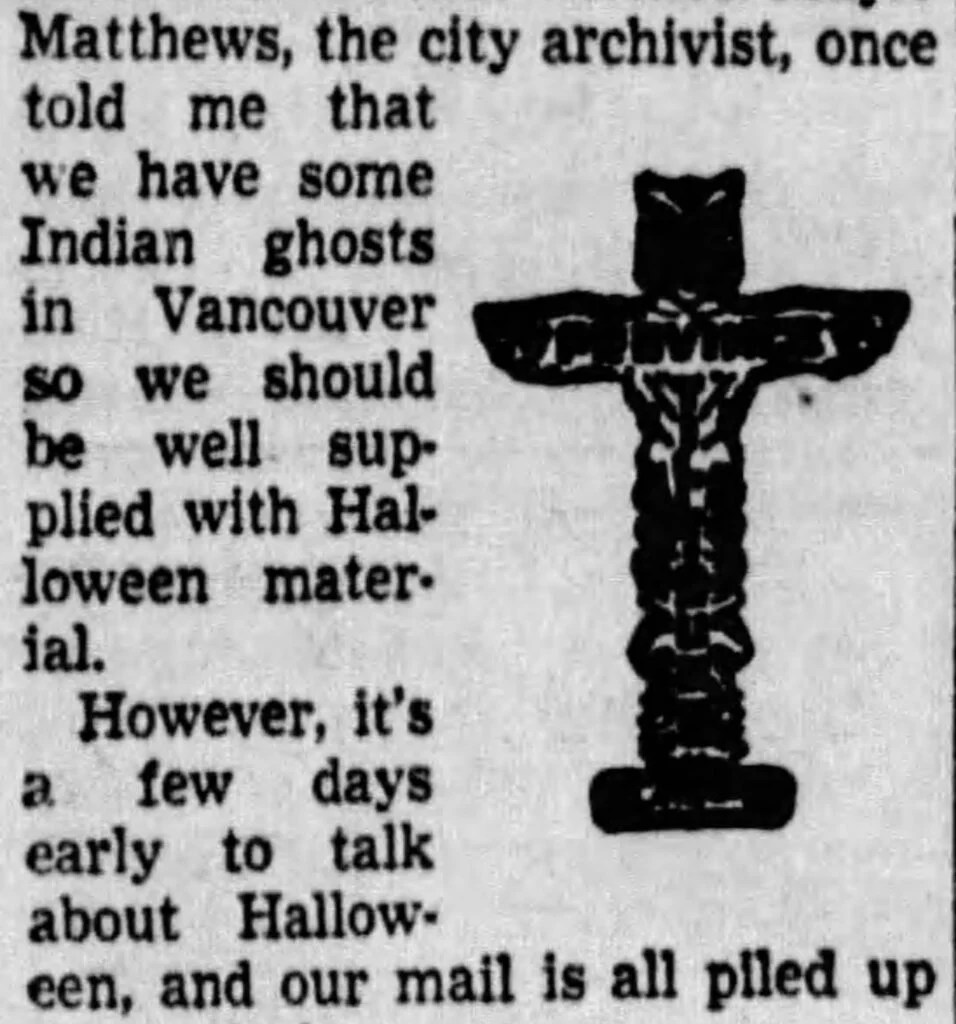
Isolated accounts of hauntings attributed to Indigenous graves emerged in the early 20th century. In British Columbia, a 1924 Victoria Daily Times report detailed seven road builders abandoning their camp after four nights of unexplained "whishing" and rapping noises, concluding their site was built on the grave of a "Red Indian." Similarly, a 1940 Province reporter mentioned Vancouver’s "Indian ghosts," though without elaboration. An intriguing 1946 Vancouver Sun story reported sightings of a headless woman’s ghost near the rumored secret burial site of Tecumseh, the renowned Shawnee chief who united Indigenous groups against American expansion and allied with the British during the War of 1812. These early reports, while less sensationalized, laid some groundwork for the later trope.
The modern "Indigenous burial ground" trope, however, found its most significant popularizer in Jay Anson’s 1977 bestseller, The Amityville Horror: A True Story. Anson’s narrative claimed the infamous Amityville house was built on a Shinnecock "enclosure for the sick, mad, and dying," where individuals were left to perish from exposure, though not buried. He asserted the Shinnecocks avoided burying their dead there due to a belief that the land was "infested with demons." This specific, though unfounded, claim would set a precedent for later sensationalized narratives.
The Amityville story gained further traction later that year when celebrity TV ghost hunter Hans Holzer, alongside medium Ethan Johnson Meyers, investigated the house. Holzer’s account introduced a new, highly problematic element: Meyers allegedly channeled the ghost of an Indigenous chief who confessed to possessing Ronald DeFeo Jr., compelling him to murder his family. This narrative shifted blame from the actual perpetrator, DeFeo, to a spectral Indigenous figure, effectively demonizing Indigenous spirits. The 1979 Amityville Horror movie adapted these unsubstantiated claims, cementing the trope in mainstream horror.
Cultural Saturation: From Disney to King and Beyond
The late 1970s and early 1980s witnessed the trope’s rapid infiltration into diverse forms of popular culture, exposing millions to its problematic premise. Disney theme parks launched their Big Thunder Mountain Railroad rides in California (1979) and Florida (1980). While specific story details have evolved, the ride is consistently depicted as a runaway train navigating a haunted mine and ghost town supposedly built on Indigenous burial grounds. A 2020 Disney blogger reported an employee claiming Indigenous spirits could be heard chanting on the ride, though the blogger only heard drums. This widespread exposure, reaching hundreds of thousands annually, normalized the "Indigenous burial ground" concept for a broad audience.
Stephen King, a titan of modern horror, significantly amplified the trope’s reach. In his 1983 novel Pet Sematary, King explicitly used an Indigenous burial ground as a central literary device, also appropriating a version of the Algonquian wendigo story. The book’s immense popularity, followed by its film adaptation, cemented this narrative in the horror canon. Renee L. Berland, in The National Uncanny: Indian Ghosts and American Subjects, notes that while early American writers had a fascination with Indigenous ghosts, King’s Pet Sematary became one of the most widely read novels to feature this motif. Interestingly, a similar concept appeared earlier in Stanley Kubrick’s 1980 adaptation of King’s The Shining, and was even explicitly dismissed as the cause of haunting in the 1982 film Poltergeist, indicating its growing recognition even then.
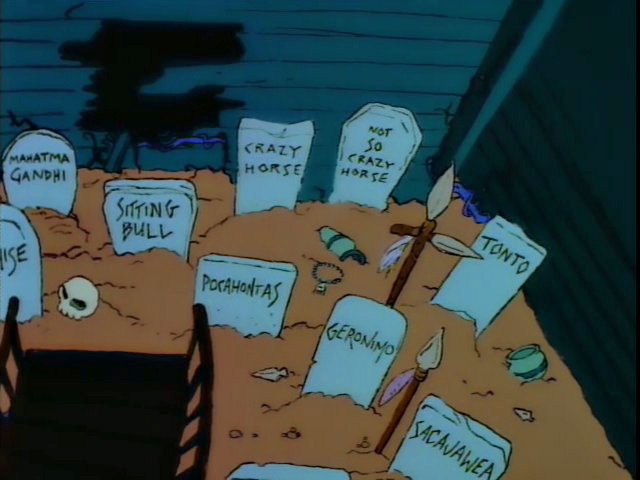
Since these pivotal works, the "Indigenous burial ground" trope has permeated countless other media. It has appeared in television series such as Buffy the Vampire Slayer and The Real Ghostbusters cartoon, numerous books, and video games. Its ubiquity eventually led to its transformation into a comedic cliché, frequently parodied in popular comedy series like The Simpsons, Friends, South Park, Family Guy, and Parks and Recreation. Seth Grahame-Smith’s How to Survive a Horror Movie humorously encapsulates its cultural saturation by suggesting one way to confirm a house is haunted is by asking: "Are Native Americans constantly showing up to ask, ‘What happened to our cemetery?’"
Beyond fiction and comedy, contemporary North American ghost hunting TV shows, like Ghost Adventures, frequently employ Indigenous burial grounds as an explanation for "demonic" entities, often following a predictable formula that blames Indigenous ghosts. This perpetuates Holzer’s strategy of shifting blame to non-white spectral figures, bringing a problematic narrative into the mainstream of "paranormal investigation."
Fictional Foundations vs. Factual Void: Unpacking the Data
Crucially, the widespread prevalence of the "Indigenous burial ground" trope stands in stark contrast to the dearth of credible evidence supporting its claims. The Shinnecock Nation, for instance, has repeatedly stated that their people never lived in the Amityville area, nor was it part of their traditional territory. There is no archaeological evidence or oral history to support the existence of a burial ground at the site. Holzer and Meyers effectively capitalized on an existing, though lesser-known, narrative to legitimize their own positions by adding to Anson’s already tainted Indigenous land story.
Closer to home for many, local urban legends of Indigenous burial grounds abound, often with similarly shaky foundations. In Victoria, British Columbia, the city’s reputation as "very haunted" and "one of the most haunted cities in Canada" is often attributed to its proximity to water and its purported construction on Indigenous burial grounds. While the "water theory" is often dismissed by experts as simplistic, the burial ground claims are particularly problematic. A recent news article, quoting a historian, cited well-known burial mounds in Beacon Hill Park, around Cadboro Bay, and on Saltspring Island. However, historical records suggest Beacon Hill Park claimed 23 mounds, none of which were built upon. Cadboro Bay, a neighboring city, was said to have around a hundred, while Saltspring Island is geographically irrelevant to Victoria’s core.
Furthermore, these claims often misrepresent historical Indigenous burial practices. Local First Nations in ancient times primarily used cairns. Bodies were placed in trees, on raised platforms, or within shoreline caves for 1,500 years, not typically in mounds that would form a "mega burial ground." While Indigenous remains are occasionally found, the assertion that Victoria was built entirely upon a vast burial ground is largely unsubstantiated, especially when compared to the tens of thousands of non-Indigenous bodies in established cemeteries. The power attributed to a single Indigenous grave in these narratives is disproportionate and telling.
The perpetuation of these damaging narratives is not confined to obscure local tales. Respected figures have also contributed to the misinformation. Robin Skelton, a university professor and admired public figure, co-authored Gathering of Ghosts (1989). Its chapter, "The Indian Inheritance," incorrectly identifies the land near Nanaimo as Kwakiutl territory and a "slave-body dump site." The authors then attribute a cult’s violent actions to the "tainted land," stating, "It seems not unlikely that the long history of Indian raids, feasts, and ritual killings accounted in part for the way in which Brother Twelve’s initially peaceful and gentle community became disturbed… The problem was the land and its history. It was crying out for blood. The evil was in the earth itself." Like Amityville, these "facts" were untrue, yet they painted Indigenous people, or their "evil soil made sentient," as the true culprits, perpetuating hateful stereotypes of "body dumps," "ritual killings," and "evil feasts."
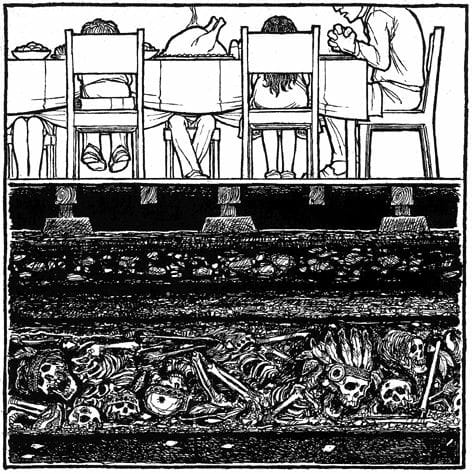
The memeification of the trope highlights its deep cultural penetration. In 2011, satirical news source The Onion released a video titled "Report: Economy Failing Because U.S. Built on Ancient Indian Burial Grounds." This brilliant piece of comedy featured panelists discussing a congressional report blaming the nation’s problems, including poverty, on Indigenous burial grounds, with one panelist even suggesting Republicans were trying to paint Obama as "soft on poltergeists." This satire underscored how absurdly this trope could be applied to explain any societal ill. Since then, thousands of posts on Twitter and Reddit threads have echoed this sentiment, using photo memes and videos to perpetuate the "ancient Indian burial grounds" narrative, even as awareness of the trope’s problematic nature grows.
Indigenous Perspectives and Expert Rebuttals
The pervasive nature of the "Indigenous burial ground" trope necessitates a critical examination through the lens of Indigenous perspectives, which consistently challenge its validity and reveal its harmful impact. Statements from Indigenous nations, such as the Shinnecock, directly refute the historical claims made in popular narratives, emphasizing that these stories are often fabricated and disrespectful. There is a consistent lack of support for these widespread settler stories from actual Indigenous oral histories or archaeological findings.
Indigenous communities often have designated storytellers and knowledge keepers who are authorized to share traditional narratives, with many stories intentionally kept private. The settler clichés of "ancient people dancing around in regalia" contrast sharply with the diversity and depth of authentic Indigenous spiritual beliefs. A widespread traditional belief in many Indigenous cultures, for example, is that even speaking about a deceased person can cause a haunting, underscoring a profound respect for the dead that is often absent from the sensationalized "burial ground" narratives.
The impact of residential schools also plays a role in understanding the disconnect. Children in these institutions were often taught abusive beliefs, such as the notion that Jesus was the only cure for evil, directly contradicting or suppressing traditional spiritual understandings.
It’s crucial to understand that "Traditional belief" in Indigenous contexts is not viewed as myth or legend in the same way settler cultures might categorize folklore. Entire cultures were systematically erased, and countless languages and stories were lost forever due to colonization. The language used to describe Indigenous peoples and their histories is also evolving; "Indigenous" is generally preferred over "Indian," though terminology varies between countries and generations. Beyond the disrespectful "burial ground" terminology, cultural appropriation is a significant factor in these narratives. Resources like the Alutiiq Museum’s cultural appropriation flowchart serve as vital references for understanding respectful protocol when engaging with Indigenous stories and heritage.
While there are genuine accounts of spirits associated with ancestral remains in museums and at archaeological digs, these nuanced accounts are rarely sensationalized for consumerism. Books like Phantom Past, Indigenous Presence: Native Ghosts in North American History and Culture offer deeper insights into authentic Indigenous beliefs, highlighting the stark difference between these respectful narratives and the exploitative burial ground trope.
Implications: Settler Guilt, Cultural Appropriation, and the Path Forward
The enduring popularity of the "Indigenous burial ground" trope is deeply unsettling, revealing troubling societal undercurrents. It acts as a projection of traditional Christian fears onto "uncivilized" people, intertwining settler ideas about consecrated ground and divine intervention with a demonized portrayal of Indigenous spirituality.
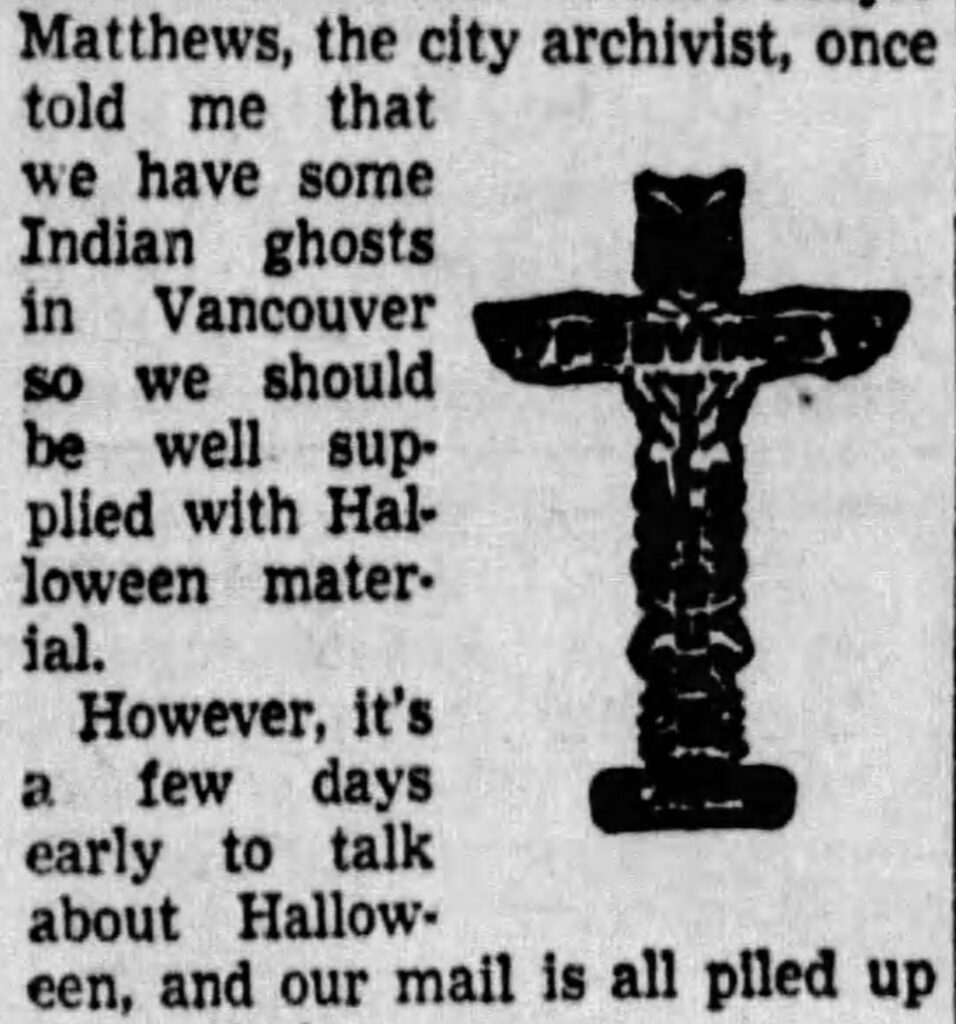
A compelling counterargument to the notion of "inferior earthbound ghosts" is the concept of "Settler Guilt." The theory posits that ghosts are often spirits of those wronged in life, sometimes even murdered. If colonial ancestors committed horrific acts against the First Peoples, then contemporary society, which continues to reap the benefits of stolen land, resources, and disrupted trade, may be experiencing a collective haunting on some level. Ron Cobb’s 1968 cartoon, depicting a Thanksgiving dinner atop skeletal remains, powerfully captures this sentiment, suggesting a haunting born from the "sins of our forefathers and foremothers."
While "Settler Guilt" might explain why even those sympathetic to Indigenous lives sometimes perpetuate these memes and stories, it is not an excuse. Claiming all places are Indigenous burial grounds dangerously delegitimizes actual sacred sites and minimizes real crimes and injustices. This ranges from individual criminal acts, like those committed by Ronald DeFeo Jr., to the profound, systemic genocidal violence embodied by residential school graveyards. The trope trivializes genuine suffering by turning it into a fictional plot device, thereby hindering true reconciliation and understanding.
The mainstream explanation for "evil" hauntings in North America often defaults to the ghosts of the very people whose lands were stolen and cultures suppressed. This narrative inherently demonizes Indigenous individuals, portraying them as inherently "evil or demonic." This stands in stark contrast to many Indigenous traditional versions of the afterlife, which are often depicted as beautiful, interconnected, and far less judgmental than many settler beliefs.
Moving forward requires a fundamental shift in how these narratives are understood and propagated. It demands critical engagement with popular culture, challenging tropes that misrepresent and demonize Indigenous peoples. It necessitates listening to and amplifying authentic Indigenous voices and histories, respecting their protocols for sharing knowledge, and recognizing that "traditional belief" is not merely folklore but a living, vital part of their cultural identity. "Settler Guilt," rather than perpetuating harmful stereotypes, should serve as a catalyst for acknowledging historical wrongs, pursuing justice, and fostering genuinely respectful relationships with Indigenous communities. Only then can we move beyond the simplistic and damaging "Indigenous burial ground" trope towards a more accurate and honorable understanding of North America’s complex history and its diverse spiritual landscapes.

Leave a Comment