
A Century of Wonder: The Intergenerational Legacy of Sir David Attenborough and His Youngest Superfan
On May 8, 2026, the world paused to celebrate a milestone that felt as much a victory for the planet as it did for the man himself: the 100th birthday of Sir David Attenborough. For over seven decades, Attenborough’s hushed, melodic cadence has served as the definitive soundtrack to the natural world, guiding billions of viewers through the deepest oceans, the densest jungles, and the most remote polar reaches. However, amidst the global tributes from world leaders, scientific institutions, and environmental organizations, one of the most poignant celebrations came from a six-year-old boy in a bedroom filled with animal encyclopedias.
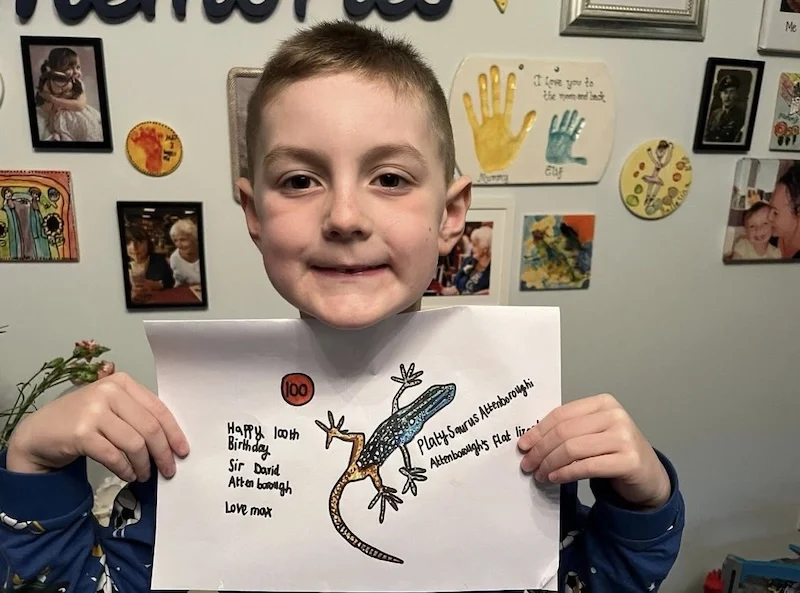
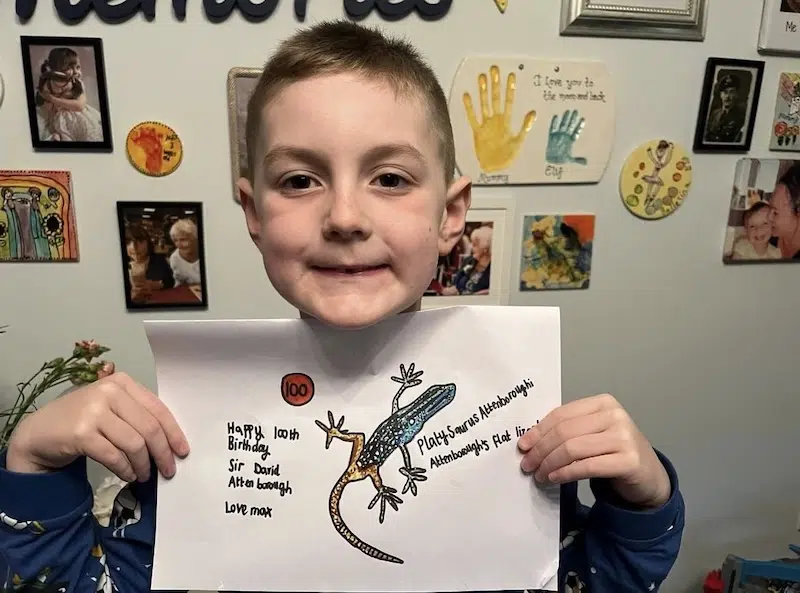
Max Evans-Browning, a self-described "superfan" from the United Kingdom, marked the naturalist’s centenary with a singular artistic endeavor: a meticulously crafted drawing of the Platysaurus attenboroughi, also known as Attenborough’s flat lizard. This gesture was not merely a child’s whim but the continuation of a tradition that has captivated the public and even garnered a personal response from the legendary broadcaster himself.
The Genesis of a Tribute: From 99 to 100
The story of Max’s tribute began a year earlier, in May 2025, as Sir David approached his 99th year. While most five-year-olds might be preoccupied with cartoons or playground games, Max was deep in the throes of a self-imposed marathon of creativity. To honor the naturalist’s 99th birthday, Max set out to draw 99 of Attenborough’s favorite animals.
The scope of the project was staggering for a child of his age. Over the course of just four days, Max utilized eight A3 sheets of paper to depict a vast menagerie of creatures. His selections were not limited to the "charismatic megafauna" typically favored by children, such as lions or elephants. Instead, Max’s list reflected the eclectic and deep-seated curiosity of his idol. His drawings included the peacock mantis shrimp, known for its vibrant colors and lethal strike; the gentle manatee; the iridescent hummingbird; and the formidable grizzly bear.
According to his mother, Samantha Evans-Browning, Max worked with a level of diligence and agility that bordered on the professional. The project was born from a lifelong obsession. "He has been enamored by Attenborough from the moment he could talk," Samantha noted in an interview. "He watches animals, reads about animals, his bedroom is animals. He knows the most rare animals. He will say, ‘I know that it’s a pangolin,’ and I’m like, what, I don’t even know what that is."
A Royal Response: The Letter from Sir David
The 2025 project did not go unnoticed. After Samantha shared her son’s work on social media, the post went viral, eventually reaching the desk of Sir David Attenborough. In an era of digital communication, the naturalist responded with his trademark grace, sending Max a handwritten thank-you note.
"Thank you very much for sending me these lovely drawings," Attenborough wrote. "I greatly enjoyed looking at them."
For Max, this was more than a letter; it was a validation of his passion from the person he admired most. It set the stage for an even more significant tribute as the world looked toward Attenborough’s 100th birthday in 2026. This year, Max decided to focus his energy on a single, highly symbolic creature: the Platysaurus attenboroughi.
Supporting Data: The Significance of Platysaurus attenboroughi
Max’s choice of the Platysaurus attenboroughi for the 100th birthday tribute was a sophisticated one. Named in honor of Sir David in 2015, this small, spiny lizard is native to the arid landscapes of Namibia and South Africa. It is a member of the flat lizard family, so named for their remarkably compressed bodies which allow them to retreat into the narrowest of rock crevices to escape predators.
The species is a fitting tribute to a man who has spent his life highlighting the beauty of the overlooked. The males of the species are known for their spectacular, multi-colored scales—vibrant blues, oranges, and yellows—which they use to signal to rivals and attract mates. Max spent an entire night perfecting the drawing, even enlisting his sister to help find the "finest pens" to capture the lizard’s intricate details.
In an accompanying letter, Max wrote: "Now you are 100, so I had to draw you your 100th animal. I wanted to do something special for you, so I chose an animal named after you. I wanted to make it perfect and it took a while, but I hope you like it." He concluded with a touch of six-year-old pragmatism: "I hope you have the best birthday, and be careful blowing out 100 candles on your cake!"
Official Responses and Global Commemorations
Max was far from alone in his celebrations. The 100th birthday of Sir David Attenborough was treated as a major international event, reflecting his status as a "national treasure" in the UK and a global icon of conservation.
The Natural History Museum’s Tribute
London’s Natural History Museum, an institution closely linked with Attenborough’s career, marked the occasion by naming a newly discovered species of parasitic wasp after him. This follows a long tradition of taxonomic honors; Attenborough currently has dozens of species named after him, ranging from a prehistoric "sea dragon" (an ichthyosaur) to a flightless weevil and a rare Indonesian butterfly.
The LEGO Milestone
In a more whimsical but equally telling tribute, the LEGO Group announced it was raising the age limit on its sets to "100+" specifically in honor of Sir David. The company cited his lifelong commitment to curiosity and "playful" exploration of the natural world as an inspiration for people of all ages.
Institutional Recognition
The BBC, Attenborough’s professional home for over 70 years, aired a series of retrospectives detailing his evolution from a young producer on Zoo Quest in the 1950s to the urgent voice of climate advocacy in documentaries like A Life on Our Planet. Scientists and environmentalists worldwide used the date to launch new conservation initiatives, framing them as a gift to a man who has done more than perhaps any other individual to bring the plight of the natural world into the public consciousness.
Implications: The Future of Conservation and Intergenerational Connection
The story of Max Evans-Browning and Sir David Attenborough is more than a "feel-good" news item; it serves as a powerful illustration of how environmental stewardship is passed down through generations.
The Realism of the Next Generation
One of the most striking aspects of Max’s fandom is his mature understanding of biological realities. Samantha Evans-Browning noted that Max is unfazed by the harsher scenes in Attenborough’s documentaries. "He would say, ‘Well, a predator goes after its prey, that’s life.’ It’s true, but it’s funny coming out of a little person," she said. This suggests that the "Attenborough Effect" is producing a generation of young people who view nature not through a sanitized lens, but with a grounded, scientific appreciation for ecological balance.
Longevity and the Plant-Based Shift
As Attenborough enters his second century, much has been made of his dietary recommendations for longevity. In recent years, Sir David has become increasingly vocal about the necessity of moving toward a plant-based diet, both for personal health and for the health of the planet. "The planet cannot support billions of large-scale meat-eaters," he has frequently warned. His own vitality at 100 serves as a living testament to the Mediterranean-style, low-meat diet he has championed.
Predictions for 2030 and Beyond
The centenary also brought renewed focus to Attenborough’s 2030 predictions. Throughout the early 2020s, he warned that the current decade is a "make or break" period for humanity. He predicted that without radical shifts in energy production and land use, we would see irreversible tipping points in biodiversity loss and climate instability. By 2026, as Max draws his lizards and Sir David celebrates his 100th, the world is at the halfway point of that critical window.
Conclusion
Sir David Attenborough’s 100th birthday is a milestone that bridges the past and the future. He represents a century of human discovery, from the era of black-and-white television to the age of high-definition satellite imagery and urgent climate science. Max Evans-Browning represents the future—a generation that has grown up with the knowledge that the natural world is both wondrous and fragile.
When Max sat in his room with his A3 paper and his sister’s best pens, he wasn’t just drawing a lizard; he was participating in a lineage of observation and appreciation that Sir David has spent a century fostering. As Attenborough looks back on a hundred years of life, he can see his legacy not just in the legislation passed or the documentaries filmed, but in the hands of a six-year-old boy who knows exactly what a pangolin is and why it matters.


Leave a Comment