
A Deep Dive into DAW Books’ "The Year’s Best Fantasy Stories": A Legacy Revisited
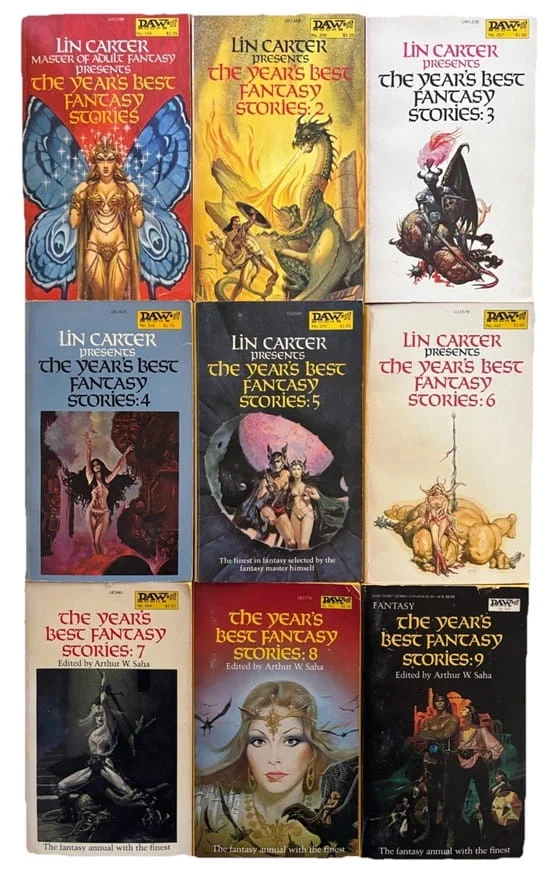
For decades, "Year’s Best" anthologies have served as crucial signposts in the ever-evolving landscape of speculative fiction, offering readers curated glimpses into the genre’s most compelling works. Among these, DAW Books’ The Year’s Best Fantasy Stories series holds a distinctive place, spanning from 1975 to 1988. Initially helmed by the indefatigable Lin Carter and later by Arthur W. Saha, this series not only introduced countless readers to new voices but also solidified the reputations of established masters. A recent retrospective by Charles Gramlich on Black Gate provides a timely opportunity to re-examine this influential collection, highlighting its triumphs, controversies, and enduring impact on the fantasy genre.
The Genesis of a Series: Main Facts and Vision
The Year’s Best Fantasy Stories emerged in an era when fantasy literature was truly beginning to carve out its own identity distinct from science fiction. DAW Books, under the visionary leadership of Donald A. Wollheim, was a pivotal publisher in this movement, known for championing new authors and subgenres. The series aimed to capture the essence of the year’s finest fantasy tales, making them accessible to a broad audience.
Lin Carter, a prominent author, critic, and editor, was the natural choice to inaugurate the series. Known for his encyclopedic knowledge of fantasy and his fervent dedication to promoting its various forms, Carter edited the first six volumes (1975-1980). His editorial vision was largely rooted in the classic sword-and-sorcery tradition, a style he himself contributed to significantly with his Thongor series and his work completing fragments by authors like Clark Ashton Smith. This focus appealed to a generation of readers captivated by heroic quests, ancient evils, and exotic worlds.
Following Carter’s departure, likely due to declining health – he passed away in 1988 – Arthur W. Saha took the reins, editing volumes 7 through 14 (1981-1988). Saha’s approach marked a noticeable shift, broadening the anthology’s scope to encompass a wider array of fantasy styles, moving beyond the traditional heroic narratives towards more contemporary, often character-driven or humorous tales.
The Chronology of Vision: Lin Carter’s Editorial Reign (1975-1980)
Lin Carter’s tenure as editor defined the early character of The Year’s Best Fantasy Stories. His selections consistently showcased a blend of foundational authors, burgeoning talents, and personal favorites, creating a distinct flavor that resonated with many readers of the period.
Volume 1: Laying the Foundation (October 1975)
The Year’s Best Fantasy Stories 1, with its striking George Barr cover, set the tone. It featured an impressive roster, including a Cormac Mac Art story by Robert E. Howard, "The Temple of Abomination," alongside works by Marion Zimmer Bradley, Lloyd Alexander, and Fritz Leiber (a Fafhrd/Gray Mouser tale). Carter’s dedication to preserving and presenting classic fantasy was evident in the inclusion of a Clark Ashton Smith fragment, completed by Carter himself. Notably, the volume also presented "Reflections in a Microcosm" by Charles R. Saunders, an early Imaro story that, as Gramlich observes, "shows a lot of power and promise but also feels like a very early effort." This highlights Carter’s willingness to give a platform to new, significant voices. L. Sprague de Camp also contributed, though his "tongue-in-cheek style" proved less appealing to Gramlich.
One recurring element, which would later draw scrutiny, was Carter’s inclusion of his own work – in this case, a Thongor story. While "generally considered a faux pas these days," as Gramlich notes, Carter’s stature and popularity as a writer at the time likely mitigated any immediate publisher concern, perhaps even acting as a sales draw.
Volume 2: Expanding Horizons (August 1976)
The second volume, also featuring a George Barr cover, continued Carter’s tradition of diverse selections. It opened with Carter’s "The Year in Fantasy" essay, a staple of his anthologies providing context for the genre’s developments. The stories ranged from the "beautifully written" "The Demoness" by Tanith Lee – a standout for Gramlich – to Thomas Burnett Swann’s "The Night of the Unicorn," described as a "magical realism story." Pat McIntosh contributed a werewolf tale, and Fritz Leiber delivered another strong Fafhrd/Gray Mouser entry. The volume also included a Lovecraftian tale by Gary Myers, "Xiurhn," and another of Carter’s own Thongor stories, "The City in the Jewel." A second collaboration with Clark Ashton Smith, "The Scroll of Morloc," was less successful in the reviewer’s estimation. The collection demonstrated Carter’s broad appreciation for different fantasy subgenres, even as his core preference for heroic fantasy shone through.
Volume 3: A Glimpse into Unread Treasures (November 1977)
Gramlich’s review notes he hasn’t read The Year’s Best Fantasy Stories 3, adorned with a Josh Kirby cover, but provides its table of contents. This volume is particularly significant for its inclusion of "The Lonely Songs of Laren Dorr" by George R. R. Martin, an early work from the future Game of Thrones author, showcasing his talent for intricate world-building and poignant narratives even then. Karl Edward Wagner’s grim Kane story, "Two Suns Setting," further cemented the anthology’s reputation for serious, dark fantasy. Other notable names included de Camp, Pat McIntosh, C. J. Cherryh, and another collaboration between Smith and Carter. This volume underscored Carter’s ability to identify and promote authors who would go on to become genre stalwarts.
Volume 4: Heroic Returns and Humorous Diversions (December 1978)
With a cover by Esteban Maroto, The Year’s Best Fantasy Stories 4 brought back Robert E. Howard, featuring "Nekht Semerkeht," a partial story completed expertly by Andrew Offutt. This inclusion reinforced Carter’s commitment to Howard’s legacy, a cornerstone of sword-and-sorcery. The volume also boasted contributions from Poul Anderson ("The Tale of Hauk"), Ramsey Campbell (from Swords Against Darkness), and Tanith Lee. Avram Davidson’s "Hark! Was that the Squeal of an Angry Thoat?" offered a humorous pastiche of Edgar Rice Burroughs, though Gramlich found it "pretty goofy." Clark Ashton Smith’s "Lok the Depressor" was present, alongside another story by Lin Carter himself. This mix illustrated Carter’s desire to present a comprehensive, if personally filtered, view of the year’s fantasy.
Volume 5: Crime, Conan, and Cosmic Wonder (January 1980)
Penalva’s artwork graced The Year’s Best Fantasy Stories 5, which included Robert E. Howard’s "Lord of the Dead," characterized as a crime story with fantastic elements, showcasing the breadth of Howard’s influence. A Conan pastiche, a collaborative effort between de Camp and Carter, further solidified the series’ connection to the Barbarian King. The volume also featured acclaimed authors like T. H. White, Tanith Lee, and Evangeline Walton, whose works often leaned into mythic and literary fantasy. Adrian Cole’s "Astral Stray" was singled out by Gramlich as a highlight outside of Howard’s contribution, affirming Cole’s burgeoning reputation. The consistent presence of Pat McIntosh and Grail Undwin (more on this later) further underlined Carter’s specific tastes.
Volume 6: A Strong Farewell (November 1980)
Lin Carter’s final edited volume, The Year’s Best Fantasy Stories 6, with a Josh Kirby cover, was deemed "a pretty good collection" by Gramlich, despite the absence of a Robert E. Howard tale. This volume presented a powerhouse lineup: Roger Zelazny’s "Garden of Blood" (a Dilvish story), John Brunner’s "The Things That Are Gods," and two more contributions from Tanith Lee ("Perfidious Amber" and "Red as Blood"). Fritz Leiber’s Fafhrd/Gray Mouser duo made another appearance with "The Mer She." Crucially, this volume contained Orson Scott Card’s "Sandmagic," which Gramlich declared "worth the price by itself," underscoring Carter’s ability to spot future luminaries. Carter also included his own Thongor story, "Demon of the Snows," and another piece under the "Grail Undwin" pseudonym. This volume served as a strong capstone to Carter’s significant contribution to the series.
The Editorial Transition: Carter’s Departure and Saha’s Ascent
The transition from Lin Carter to Arthur W. Saha as editor after volume 6 marked a pivotal moment for The Year’s Best Fantasy Stories. While the exact reasons for Carter’s departure are not explicitly stated, Gramlich’s observation that Carter "may have been suffering from ill health around that time" aligns with historical accounts, as Carter’s health indeed declined in the 1980s, leading to his untimely death in 1988. This change in leadership inevitably brought a fresh perspective to the series.
Arthur W. Saha, also an accomplished editor and co-editor of other notable anthologies, stepped into the role. His vision, as observed by Gramlich, diverged significantly from Carter’s, reflecting broader shifts within the fantasy genre itself.
The Saha Shift: A New Direction (1983-1988)
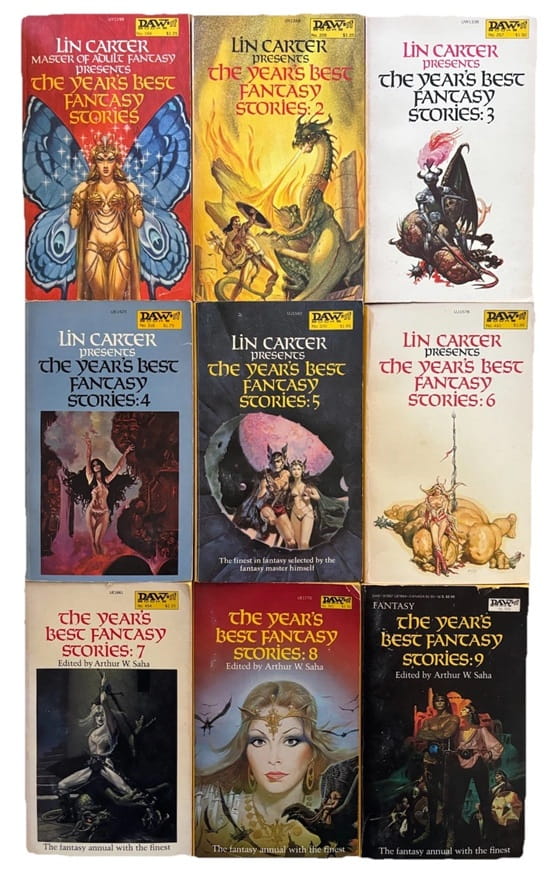
Arthur W. Saha’s editorial approach, as exemplified by The Year’s Best Fantasy Stories 9 (October 1983, cover by Sanjulian), represented a distinct departure from Carter’s sword-and-sorcery-centric selections.
Volume 9: Broadening the Definition
Saha’s Volume 9 showcased a roster of authors including John Kessel, R. A. Lafferty, Michael Shea, Harlan Ellison, Richard Christian Matheson, Parke Godwin, Jor Jennings, Jane Yolen, Suzette Haden Elgin, and Tanith Lee (a consistent presence across both editorial eras). Gramlich’s primary critique of this volume, and Saha’s approach in general, was its shift away from adventure-oriented fantasy. He states, "Saha took a much wider view of fantasy than Lin Carter and some people probably liked that. I didn’t. I wanted adventure and this presented very little of that, and most of the stories were set in much more modern milieus and tended toward the humorous."
This observation is crucial. It highlights the evolving nature of fantasy in the early to mid-1980s. While heroic fantasy remained popular, the genre was expanding to embrace urban fantasy, magical realism, literary fantasy, and more experimental forms. Saha’s selections reflected this diversification, appealing to readers who sought more nuanced narratives, character studies, or genre-bending tales rather than traditional quests and battles. For readers like Gramlich, who preferred the classic sword-and-sorcery mold, this shift felt like a loss of focus. The series continued under Saha’s editorship through Volume 14, concluding its run in 1988, marking the end of an important era in fantasy anthologies.
The "Grail Undwin" Revelation: A Question of Editorial Integrity
One of the most intriguing and ethically complex revelations surrounding Lin Carter’s editorship concerns the pseudonym "Grail Undwin." Gramlich notes that "Grail Undwin appeared in a bunch of these Carter edited collections," and, citing G. W. Thomas, reveals that "Grail Undwin was a secret pseudonym of Carter."
This information casts a different light on Carter’s editorial practices. While an editor including their own work in an anthology titled "Best Of" is already viewed critically – a "faux pas" as Gramlich terms it – the use of a secret pseudonym adds another layer of ethical concern. If true, Carter not only included his own stories under his acknowledged name but also covertly inserted additional pieces under a false identity, presumably receiving payment for both.
This practice raises significant questions about editorial integrity and conflicts of interest. The purpose of a "Best Of" anthology is to present the finest works by various authors, independently selected for their merit. An editor leveraging their position to disproportionately feature their own material, especially disguised, undermines the credibility of the "Best Of" designation. While the publishing world of the 1970s and 80s might have had different informal standards than today, such a revelation would likely spark considerable debate and criticism. It forces a re-evaluation of Carter’s legacy, not just as a tireless advocate for fantasy, but also as an editor whose methods, in this instance, appear questionable.
Legacy and Implications: A Snapshot of Fantasy’s Evolution
The Year’s Best Fantasy Stories series, across both Lin Carter’s and Arthur W. Saha’s tenures, offers an invaluable historical record of the fantasy genre during a crucial period of its development.
As a Gateway to Authors: For many readers, these anthologies served as primary entry points to authors who would become household names. The series consistently featured rising stars like Tanith Lee, Charles R. Saunders, George R. R. Martin, Karl Edward Wagner, Roger Zelazny, and Orson Scott Card, alongside genre titans like Robert E. Howard, Fritz Leiber, and Poul Anderson. This curated exposure was instrumental in building fandoms and shaping literary tastes.
Reflecting Genre Trends: The shift from Carter’s heroic fantasy focus to Saha’s broader, more contemporary selections directly reflects the genre’s internal evolution. Carter’s volumes championed the sword-and-sorcery tradition, solidifying its place. Saha’s later volumes, however, hinted at the diversification that would become characteristic of fantasy in the late 20th and early 21st centuries, embracing a wider spectrum of styles, tones, and settings. This evolution was not always met with universal approval, as Gramlich’s preference for adventure over modern/humorous tales illustrates, but it was an undeniable trend in the genre.
A Publisher’s Influence: DAW Books’ commitment to the series underscored its role as a key player in genre publishing. By consistently providing these annual collections, DAW not only offered a valuable service to readers but also fostered a sense of community around the fantasy genre.
The Editor’s Role: The series also highlights the immense power and responsibility of an anthology editor. Lin Carter’s passionate advocacy for certain styles and authors, even extending to the controversial "Grail Undwin" pseudonym, demonstrates how an editor can profoundly shape perceptions of a genre. Arthur Saha’s subsequent broadening of scope further illustrates how different editorial visions can guide the direction of "best of" selections.
Conclusion
Revisiting The Year’s Best Fantasy Stories through the lens of Charles Gramlich’s retrospective offers a fascinating journey back to a vibrant era of fantasy literature. It reminds us of Lin Carter’s undeniable passion and influence, even as it raises questions about the complexities of his editorial practices. It also underscores Arthur W. Saha’s role in guiding the series through a period of genre expansion.
More than just a collection of stories, these volumes represent a dynamic dialogue between editors, authors, and readers, reflecting the genre’s enduring power to captivate, challenge, and evolve. They remain essential resources for anyone seeking to understand the foundational currents that shaped modern fantasy, and a testament to the enduring appeal of a well-curated "Year’s Best." For enthusiasts and scholars alike, these anthologies continue to provide a rich tapestry of fantasy’s past, inviting new generations to discover the tales that once defined the "best."




Leave a Comment