A Journey Through Shared Worlds: "The Treasury of Folklore" Unveils a Unified Vision
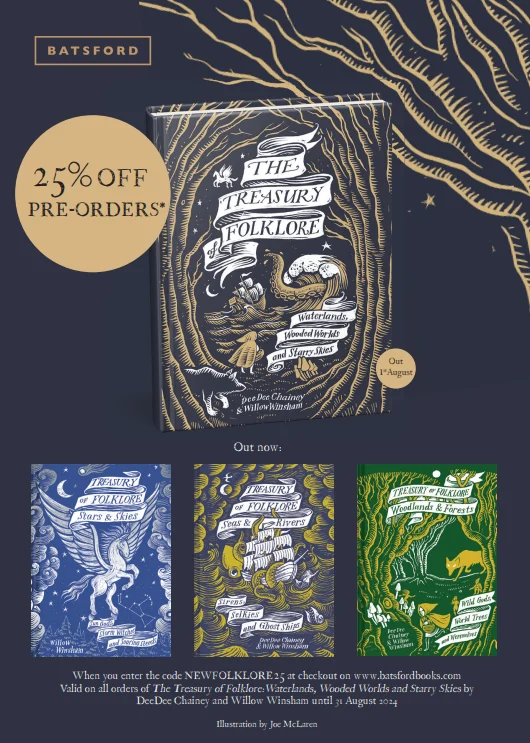
London, UK – July 22, 2024 – Nearly a decade after its inception, the acclaimed Treasury of Folklore series culminates its exploration of human narratives with the release of a magnificent new compendium. The Treasury of Folklore: Waterlands, Wooded Worlds and Starry Skies, set to launch on August 1st, 2024, brings together the most captivating tales and beliefs from the original three volumes into a single, beautifully bound edition. This anticipated release not only offers a comprehensive collection for enthusiasts but also reaffirms the series’ core message: that despite geographical and cultural divides, humanity shares a profound tapestry of primal fears, dreams, and a universal sense of wonder.
Published by Batsford Books and richly illustrated by Joe McLaren, this "hefty tome" promises to be more than just a book; it is presented as a conversation starter, a bridge connecting readers to the ancient stories that have shaped civilizations across the globe. Authors Dee Dee Chainey and Willow Winsham have curated this special volume, revisiting the extensive material with fresh eyes to craft a definitive collection that reflects their original, expansive vision.
Chronology: From a Single Dream to a Global Tapestry
The journey of The Treasury of Folklore began with an ambitious, singular vision: to create one comprehensive book cataloguing folklore across all physical landscapes inhabited by humans worldwide. This initial concept, however, quickly proved to be too vast for a single volume. The sheer volume and richness of material uncovered by the authors far surpassed expectations, necessitating an expansion into a series.
The genesis of the series was significantly inspired by the vibrant and overwhelming outpouring of stories shared through the #FolkloreThursday hashtag, a global online movement dedicated to the celebration of traditional tales. Witnessing this collective passion, the authors were moved to create something "meaningful, lasting, that reflected the unifying universality of folklore across the globe." This aspiration led to the creation of three distinct but interconnected books, each focusing on a specific natural realm: Seas and Rivers, Trees and Woodlands, and Stars and Skies.
The popularity of these three original books was, by the authors’ own admission, both "surprising and heartwarming." Their success underscored a deep public appetite for understanding the shared human experience through the lens of folklore. It was this enthusiastic reception that paved the way for the idea of a compendium – a return to the initial dream of consolidating the most cherished narratives into one volume.
The process of compiling The Treasury of Folklore: Waterlands, Wooded Worlds and Starry Skies was an intricate one. Behind the scenes, the authors meticulously reread material they already knew intimately, approaching it with "fresh eyes." The challenge lay in deciding what to include and what to leave out, ensuring that the final selection would best represent the series’ ethos and flow seamlessly within a single narrative arc. The goal was to create a cohesive volume that "spans our shared landscapes across time and place." The end result, a "beautifully bound volume" with "beautiful cream paper," has utterly thrilled the creators, realizing their long-held aspiration for a truly comprehensive work.
Supporting Data: The Universal Tapestry of Human Experience
At the heart of The Treasury of Folklore series lies a profound revelation: despite the myriad ways humans express themselves through culture, dress, and language, our underlying fears, dreams, and aspirations are fundamentally universal. The authors embarked on their initial quest in search of understanding how communities worldwide forge customs, beliefs, and tales around their immediate environments. What they unearthed was a testament to our shared humanity.
Primal Connections: Echoes Across Continents
Folklore, in its essence, serves as a mirror reflecting humanity’s deepest psychological and emotional landscapes. The series compellingly demonstrates that we all share "primal fears and dreams, no matter where we live, how we dress, or what we choose to name the monsters of our myths and legends." This universality manifests in our collective awe of nature, our dread of the unknown, and our yearning for meaning in the face of fleeting existence. Whether gazing at the vast horizon, gathering around a campfire in a dark forest, or contemplating the "eternity of time under the glimmer of ancient stars," humans are united by common existential questions and emotional responses.

Folklore thus acts as a vital tool for understanding the world, coping with anxieties, preserving cultural identity, and transmitting moral lessons across generations. The enduring presence of these tales, often adapting to modern contexts, speaks to their timeless resonance. The Kelpie sculptures in Scotland or the appearance of water horses in J.K. Rowling’s Fantastic Beasts, for instance, exemplify how ancient legends continue to inspire contemporary imagination.
Illustrative Extracts: A Glimpse into Shared Worlds
To illustrate these universal themes, The Treasury of Folklore offers a curated selection of tales, drawing readers into diverse cultural narratives that resonate with familiar human experiences. The compilation is thoughtfully divided into three sections, mirroring the original books, and featuring the distinctive original illustrations by Joe McLaren, whose evocative artwork beautifully complements the folkloric narratives.
Water Horses: Guardians of the Deep and Harbingers of Peril
From the depths of lochs to the swift currents of rivers, folklore across the world teems with tales of water horses – majestic yet often malevolent creatures that embody the alluring dangers of aquatic realms. These stories serve as powerful cautionary tales, reflecting humanity’s ancient respect and fear of the untamed natural world.
The Scottish Kelpie is perhaps the most famous, though it is crucial to distinguish it from the each-uisge (water horse), with kelpies typically inhabiting rivers and each-uisge preferring lakes and lochs. These shapeshifting entities, often appearing as beautiful horses, lure unwary travellers to their doom, dragging them beneath the water. While some tales hint at their temporary taming through a cross-marked bridle, such control is fleeting, and the creatures invariably return to their watery homes, sometimes taking their riders with them. The legend’s enduring power is vividly demonstrated by the colossal 30-meter-tall Kelpie sculptures near Falkirk, a modern testament to a timeless myth, and its inclusion in contemporary literature by authors like Lari Don and J.K. Rowling. Intriguingly, this specific variant of water horse is largely absent from English folklore, suggesting distinct regional developments in myth-making.
In contrast, Wales offers the Ceffyl Dŵr, a prominent belief well into the 19th century. In northern Wales, this spirit was a shapeshifter, capable of violence, while in the south, it consistently appeared as an enchanting small horse. Tales emphasize its incredible speed, covering vast distances before vanishing, leaving its hapless rider to drown. A curious exception highlights cultural values: clergymen of any creed were said to be immune to the Ceffyl Dŵr’s malicious intent, arriving at their destinations unscathed, while their companions were often abandoned or thrown into the water. This detail offers a fascinating insight into the perceived sanctity and protection afforded to religious figures within Welsh society.
Across the North Sea, Scandinavian folklore introduces the Bäckahäst or "brook horse." Often seen shrouded in fog, this creature is described as luminous and majestic, beguiling riders before plunging into the water, trapping its victims. Children frequently feature as its prey, perhaps to heighten the sense of peril and tragedy. One popular tale recounts a group of boys saved when the last child, attempting to exclaim "Jesus Christ" in awe, mispronounces it in a way that rhymes with a colloquial phrase. This act, whether intentional or accidental, causes the Bäckahäst to vanish, leaving the boys bruised but alive – a classic folkloric trope where sacred words or specific actions can break a magical spell. Like the Kelpie, the Bäckahäst could also be put to work, often through trickery, highlighting themes of human ingenuity against supernatural forces. These water horse narratives collectively underscore humanity’s enduring fascination with and apprehension of the unknown dangers lurking beneath the water’s surface, reflecting universal cautions against reckless trust and the hidden perils of nature.
Lords of the Wild: Echoes of Nature’s Power
Venturing into the verdant depths of forests and jungles, we encounter the Lords of the Wild – powerful spirits and creatures that embody the raw, untamed essence of nature. These figures often possess a dual nature, acting as both protectors and harbingers of destruction, reflecting humanity’s complex relationship with the wilderness.
Tapio, the Finnish king of the forest realm, is a striking example. Also known as Metsähine or Hiisi, he is depicted as tall and thin, cloaked in ermine fur or moss, with a hat and bushy eyebrows of lichen, much like the European Green Man. His back is said to resemble a gnarled tree, making him both the personification and protector of the forest. In ancient times, hunters sought Tapio’s blessing for a successful chase, pledging respect for the land and its creatures. He held dominion over all forest animals, capable of granting a plentiful haul or cursing a hunter to return empty-handed. His family, including his benevolent wife Mielikki (or malevolent Kuurikki), his son Nyrikki (who guides hunters), and daughter Tulikki (who directs prey), illustrates a rich pantheon reflecting the nuanced aspects of nature’s bounty and challenges.

The Slavic Leshy (also known as leshii or lyeshy) is another formidable tutelary spirit, a protector of trees and animals, particularly wolves or bears in some regions. Like bears, leshies hibernate in winter, further connecting them to the cycles of the wild. They are shapeshifting creatures, capable of growing taller than a tree or shrinking to the size of a blade of grass, and can mimic any forest dwelling, human, animal, or plant. When in human form, they possess peculiar identifying features: no eyelashes or brows, shoes worn on the wrong feet, or clothing wrapped in reverse of local fashion. Some even sport a single eye, cloven feet, or wings and a tail. Their bellowing can whip up great winds, causing creatures to flee in terror. To humans encroaching on their territory, leshies are tricksters, using shrieking laughter, clapping, or howling to warn intruders. If ignored, they confuse and lure people from paths, changing surroundings until victims are lost forever or even tickled to death. They are also known to abduct women and children, curse farms, and demand appeasement, such as annual cow sacrifices in the Olonetsky District of Russia. Farmers would also leave offerings of bread or tobacco to ensure their safety.
Leshies, though solitary or living with their wives (lesovikha) and children, are not above battling their own kind, wielding clubs and uprooting trees. One leshy from Vologda District was even said to frequent taverns, driving his wolf pack and consuming vast quantities of vodka before returning to the night. They are notorious gamblers, often bartering with squirrels and playing cards (though avoiding clubs, due to their resemblance to the Christian cross). Protecting oneself from a leshy involves turning clothes inside out or shoes on the wrong feet, an act believed to make them laugh, thus returning the victim to the correct path. Swearing at them or making the sign of the cross are other methods of banishment. For those daring enough to summon a leshy, a specific ritual involving cutting young birch trees and arranging them in a circle, while devoid of Christian symbols, is said to call forth the "grandfather of the forest." These tales of Tapio and the Leshy underscore the deep-seated human need to personify and negotiate with the powerful, unpredictable forces of nature, seeking both blessing and protection from the wilderness.
The Hare in the Moon: A Celestial Narrative of Sacrifice and Consequence
The enduring image of a rabbit or hare living on the moon is a universal motif, appearing in diverse cultures across the globe. From the Sea of Tranquillity forming its head to the seas of Fertility and Nectar delineating its ears, humankind has long gazed skyward, weaving intricate narratives around celestial phenomena. These stories often explore themes of sacrifice, compassion, and the explanation of life’s fundamental mysteries.
In the Buddhist Sasa-jātaka, the hare, alongside its friends the otter, jackal, and monkey, resolves to give alms on a fast day. When the deity Sakka, disguised as an old man, tests them, the other animals readily offer food. The hare, having only grass, offers the ultimate sacrifice: himself upon a fire. For this profound act of faithfulness, Sakka spares the hare, plucking him from the flames and setting him upon the moon for all eternity. In some versions, the deity even uses the essence of a mountain to draw the hare’s image onto the lunar surface. This story, with variations in other cultures, highlights the virtue of selfless giving and its divine reward.
Similar narratives emerge from Sri Lanka and Japan. In a Sri Lankan tale, when Buddha, lost and hungry, encounters the hare, the creature offers itself as food. Buddha, using his powers, saves the selfless hare and places it on the moon. In Japan, the hare, known as Tsuki no Usagi, encounters the Man in the Moon disguised as a beggar. Again, with only grass to offer, the rabbit sacrifices itself on a fire. The beggar then reveals his true form and takes the rabbit to live with him on the moon as a testament to its selflessness. This popular Japanese tale is often shared with children during the September Harvest Moon and the Mid-Autumn Festival, reinforcing cultural values of compassion and sacrifice.
However, not all lunar hare tales are imbued with such benevolence. A starkly contrasting narrative from South Africa attributes humanity’s mortality to the hare. The Moon, intending to convey that humans, like herself, would die and return, sent the flighty hare with this message. But the hare delivered only half the truth: that humans would die, omitting the promise of return. Enraged by this grievous error, the Moon attacked the hare with a hatchet, intending to split him in two, but only managed to split his lip. In retaliation, the hare lashed out, scarring the Moon’s face – scars that, according to the legend, are still visible in the dark shapes on the moon today. This South African tale provides a powerful etiological myth, explaining both the hare’s split lip and the moon’s markings, while simultaneously offering a poignant and tragic explanation for the irrevocability of human death. These diverse narratives demonstrate how a single celestial observation can inspire vastly different, yet equally profound, cultural explanations and moral lessons.
Official Responses & Critical Reception
The authors, Dee Dee Chainey and Willow Winsham, express immense pride and gratitude for the journey this series has taken them on. They are "utterly thrilled" to finally share this beautifully bound volume, which they see as the culmination of their original vision. Their appreciation extends to "each and every person who has bought and read these books," acknowledging the vital role of their readership in the series’ success.
Batsford Books, as the publisher, has clearly supported this ambitious undertaking, recognizing the cultural and literary value of consolidating these beloved works. The creation of such a meticulously produced compendium, with its emphasis on aesthetic quality – from its size and cover design to the "beautiful cream paper" – reflects a commitment to delivering a premium product for folklore enthusiasts and new readers alike.

The past popularity of the individual Treasury of Folklore books suggests that this new compilation will be met with enthusiastic reception. Experts and general readers alike will likely appreciate the convenience and comprehensive nature of a single volume that encapsulates such a broad spectrum of human storytelling. Such compilations are invaluable, not only for their accessibility but also for their ability to highlight the interconnectedness of global folklore, fostering a deeper understanding of shared cultural heritage.
Implications: The Enduring Power of Story
The Treasury of Folklore: Waterlands, Wooded Worlds and Starry Skies represents more than just a literary release; it is a significant contribution to the preservation and popularization of global folklore. Its compilation solidifies the series’ legacy, offering a definitive work that underscores the timeless relevance of these ancient narratives.
By bringing together tales from disparate landscapes, the book fosters a greater appreciation for cultural diversity while simultaneously revealing the threads of commonality that bind humanity. It encourages readers to look beyond superficial differences and recognize the shared psychological underpinnings of human storytelling. This deeper understanding has profound implications for promoting empathy and cross-cultural dialogue in an increasingly interconnected world.
Moreover, the physical presentation of the book as a "hefty tome" and a "beautiful addition to any book case or coffee table" elevates it to an artifact, an object that invites interaction and contemplation. It is designed to be a "conversation starter," actively encouraging the sharing of stories and ideas, thereby continuing the oral tradition of folklore in a modern context.
The ongoing relevance of folklore is undeniable, constantly adapting and finding new expressions in contemporary society, from blockbuster films to online communities like #FolkloreThursday. This compilation serves as a powerful reminder of the enduring human need for narrative – to make sense of our world, to transmit wisdom, to entertain, and to connect with something larger than ourselves. As The Treasury of Folklore: Waterlands, Wooded Worlds and Starry Skies embarks on its journey into readers’ hands, it carries with it not just tales of water horses, forest lords, and celestial hares, but the very essence of shared human experience, ensuring that the magic and wisdom of folklore continue to thrive for generations to come.
The Treasury of Folklore: Waterlands, Wooded Worlds and Starry Skies is now available for pre-order and will be released on August 1st, 2024. Readers can secure a 25% discount when ordering from Batsford Books using the code NEWFOLKLORE25.