A Timeless Siege: Revisiting the Enduring Legacy of "A2: Secret of the Slavers Stockade"
FOR IMMEDIATE RELEASE
[City, State] – [Date, Year] – In the annals of Dungeons & Dragons history, few adventure series command as much respect and nostalgic affection as the "A-series," known collectively as "Against the Slave Lords." Among its four distinct installments, "A2: Secret of the Slavers Stockade" stands out as a particular beacon of design excellence, frequently cited by critics and players alike as the strongest entry. A retrospective review, originally published on March 16th, 2002, and now revisited, solidifies its reputation as a classic D&D experience that, despite its vintage, continues to offer compelling gameplay and a masterclass in adventure design.
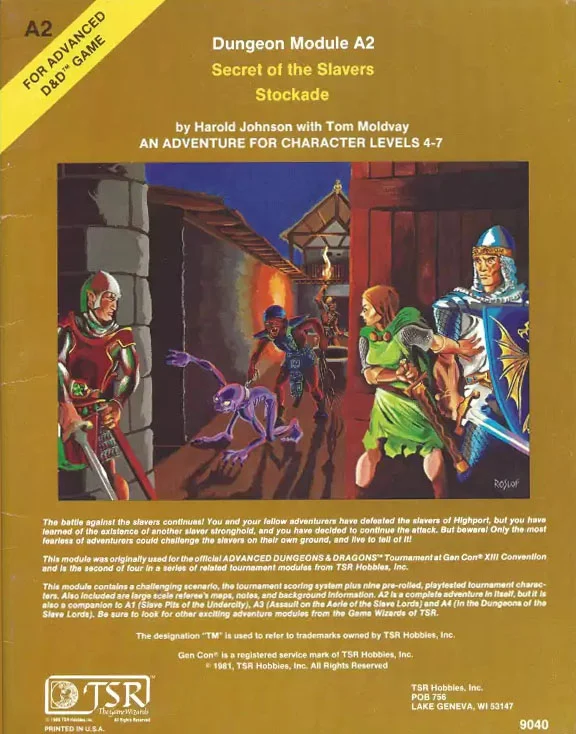
Penned by Harold Johnson with Tom Moldvay and originally released by TSR, Inc. in 1981, "A2: Secret of the Slavers Stockade" plunges player characters (PCs) into a high-stakes siege against a heavily fortified slaver compound. The adventure, a direct continuation of "A1: Slave Pits of the Undercity," challenges players with tactical combat, intricate villainous dynamics, and a gritty narrative that pushes the boundaries of early D&D module design. Its enduring appeal lies in its well-defined concept, memorable antagonists, and challenging encounters, cementing its status as "the best installment of the Slavers series of modules."
Main Facts
"A2: Secret of the Slavers Stockade" is a seminal adventure module for Advanced Dungeons & Dragons (1st Edition), published by TSR, Inc. in 1981. It serves as the second part of the iconic "Against the Slave Lords" quadrilogy (A1-A4), which originated as tournament modules for Gen Con. The module picks up directly from its predecessor, "A1: Slave Pits of the Undercity," with player characters (PCs) possessing a crucial map that leads them to a fortified slaver stronghold in the Drachensgrab Hills.
The central premise of A2 is a daring siege on this heavily guarded stockade, which functions as a central hub for humanoid slaver caravans. Unlike many dungeon crawls of its era, A2 emphasizes tactical engagement and strategic infiltration. The adventure introduces a robust cast of "Slave Lords," including the dangerous fighter and wizard Markessa, the fort’s commander Icar, and the enigmatic Blackthorn, alongside their lieutenants. These antagonists are not mere stat blocks but are presented with internal power struggles and distinct personalities, making them dynamic and compelling adversaries.
The 2002 retrospective review, which serves as the basis for this analysis, lauded A2 for its superior design compared to A1. It highlighted the module’s larger scope, better-conceived encounters, and more engaging characters as significant improvements. While acknowledging certain elements that have not aged gracefully—such as some dated artwork and a few narrative quirks—the review firmly concluded that A2’s strengths far outweigh its weaknesses, positioning it as a benchmark for classic D&D adventures. It was originally priced at $4.99, comprising 42 pages, and bore the ISBN 0-935696-26-1 and product code TSR9040.
Chronology
The journey of "A2: Secret of the Slavers Stockade" is intertwined with the nascent years of Advanced Dungeons & Dragons and the competitive spirit of early role-playing game conventions.
Origins of the A-series
The "Against the Slave Lords" series began not as retail products, but as tournament adventures for Gen Con, the premier tabletop gaming convention. In the late 1970s and early 1980s, TSR, Inc. frequently commissioned modules specifically for these competitive play environments. These tournaments often required adventures that could be completed within a strict time limit, featured clear objectives, and allowed for robust scoring mechanisms. This context significantly influenced the design philosophy of the A-series, including A2. The four modules—A1, A2, A3, and A4—were initially developed by different creative teams, each bringing their unique vision to a segment of the overarching narrative. The eventual decision to compile and release these successful tournament modules to the broader public allowed players worldwide to experience the challenges previously exclusive to convention attendees. This compilation later saw a unified release as "A0-A4 Against the Slave Lords," underscoring the series’ complete narrative arc.
A1: Slave Pits of the Undercity as a Precursor
"A1: Slave Pits of the Undercity," authored by David Cook, set the grim stage for the entire series. It introduced players to the pervasive threat of the Slave Lords and tasked them with infiltrating a hidden slaver compound to rescue captives and uncover intelligence. The adventure culminated in the acquisition of a critical map—the very artifact that propels the narrative directly into "A2: Secret of the Slavers Stockade." This sequential design ensured a seamless transition between modules, allowing campaigns to flow organically from one challenge to the next. A1 established the tone and the overarching goal: dismantle the Slave Lords’ insidious network.
A2’s Publication and Initial Reception
Released in 1981, "A2: Secret of the Slavers Stockade" marked a pivotal point in the series. Harold Johnson, alongside Tom Moldvay, took the reins from David Cook, tasked with expanding the lore and escalating the stakes. Upon its release, A2 was celebrated for its ambitious concept of a fortified stockade and the tactical challenge it presented. Players and Dungeon Masters (DMs) accustomed to more straightforward dungeon crawls found A2’s siege mechanics and dynamic enemy leadership refreshing. Its immediate impact was significant, offering a more complex and strategic experience that resonated deeply with the growing AD&D community. The module’s success contributed to the burgeoning reputation of the "Slave Lords" as truly formidable and iconic villains within the D&D canon.
The 2002 Retrospective Review
The review, originally published on March 16th, 2002, by "The Alexandrian" (initially on RPGNet), provided a valuable retrospective lens through which to evaluate A2. Published more than two decades after the module’s initial release, it offered a mature assessment, comparing the adventure not only to its direct predecessor but also to the evolving standards of adventure design. This review aimed to contextualize A2 within D&D history, highlighting its enduring strengths while candidly addressing elements that had become dated. Such retrospective analyses are crucial for understanding the evolution of role-playing games, allowing both veteran players to rekindle appreciation and new generations to discover the foundational works that shaped the hobby. The reviewer emphasized the importance of reading the A1 review beforehand, illustrating the interconnectedness of their critical series.
Supporting Data
The detailed analysis of "A2: Secret of the Slavers Stockade" reveals a carefully crafted adventure that pushed the boundaries of its time, despite some minor imperfections that are common with pioneering works.
Module Design and Narrative Core
The core concept of "A2: Secret of the Slavers Stockade" is the siege. Following the clues from A1, PCs arrive at "an old fort lost in the midst of the Drachensgrab Hills," now a bustling stockade for humanoid slaver caravans. This setup immediately distinguishes A2 from typical dungeon delves, framing the adventure as a tactical challenge. The module is explicitly designed with this siege mentality in mind, presenting a "gritty, dangerous, well-fortified fort." The challenge isn’t merely to find a hidden entrance but to overcome robust defenses, deal with patrols, and navigate a hostile environment where "Getting in won’t be easy, getting out will be even tougher." This emphasis on strategic planning and resource management provides a richer, more engaging experience than many of its contemporaries. While its tournament origins led to some "static" NPC responses, a minor flaw noted by the reviewer, the fundamental design successfully conveys the peril and reward of a well-executed siege.
The Antagonists: A Gallery of Villains
One of A2’s most significant strengths lies in its portrayal of the "Slave Lords." Unlike A1, which featured only one, A2 introduces a formidable array of antagonists, each with their own distinct roles and motivations, making them far more compelling and dynamic. At the helm is Markessa, the fort’s overseer—a highly dangerous fighter and wizard engaged in unsettling experiments with human subjects. Her intellectual prowess and martial skill make her a truly terrifying foe. She is locked in a subtle but palpable power struggle with Icar, the fort’s pragmatic commander, and Blackthorn, a direct representative of the enigmatic Slave Lords organization. Supporting them are Executioner, Icar’s brutal lieutenant, and Gulyet, Markessa’s assistant and apprentice. This ensemble cast, with their internal conflicts and varied skill sets, elevates the narrative beyond a simple good-versus-evil confrontation. The reviewer rightly pointed out that it is here that players begin to understand why the "Slave Lords" are talked about as "villains of special quality"—their depth and agency make the encounters far more memorable.
Enduring Strengths and Criticisms
Strengths:
The reviewer highlighted several critical strengths that solidify A2’s position as the strongest in its series:
- Sheer Material: A2 is a larger module than A1, offering more content and play value.
- Encounter Design: The encounters are "better designed and better conceived," moving beyond simple combat to incorporate tactical elements and narrative tension.
- Character Dynamics: The antagonists are "more compelling and dynamic," contributing significantly to the module’s overall quality and replayability.
- Execution Quality: The "average quality of material on A2’s page is higher than the average quality of material on A1’s page," indicating a superior level of polish and creative vision.
- Fundamental Excellence: A2 showcases "a strong, well-defined concept, an excellent setting, memorable villains, and challenging encounters," epitomizing "classic D&D at its best."
Weaknesses & Modernization:
Despite its strengths, A2 is not without its anachronisms and minor flaws:
- Artwork and Presentation: As an early 1980s publication, its artwork and general presentation are "sub-par by modern standards." Contemporary D&D modules boast full-color illustrations and sophisticated layouts, making the monochrome, sparse presentation of A2 feel dated.
- Narrative Quirks: The most "seriously debilitating element" identified was a series of rooms where a madman pretends to be a ghost through "parlor tricks." The reviewer found this difficult to reconcile with a fort controlled by a powerful sorceress like Markessa, suggesting a need for minor clean-up or DM adaptation. Other, less severe flaws also exist, but are "easily resolved (probably in less than a half hour of work)."
- Static NPC Responses: Born from its tournament origins, the module’s NPCs are sometimes "just a little too static in their response to the PCs." This can limit the dynamic nature of a siege, where defenders should ideally react more fluidly to player actions.
- Digital Map Quality (Historical): An "ESD Note" within the review pointed out a significant flaw in earlier digital copies (ESD standing for Electronic Standard Document, an early term for PDF downloads). Due to poor scanning, the map of the fort was "practically illegible," requiring DMs to reconstruct it. This issue, however, has since been resolved in current PDF versions.
The reviewer also offered a "hearty suggestion" for improvement: "Take the defenses of the stockade up to the next level." This involved making the fort’s defenders more dynamic and ensuring greater involvement from the leaders in organizing and coordinating the defense. This desire for more dynamic adversaries later informed the reviewer’s own design work on "adversary rosters," a system for managing enemy forces and their tactical responses, which would now make such an enhancement "trivially accomplished."
Technical Specifications and Publishing Details
The physical module details reflect its place in TSR’s publishing history:
- Author: Harold Johnson with Tom Moldvay
- Publisher: TSR, Inc.
- Price: $4.99 (original retail)
- ISBN: 0-935696-26-1
- Product Code: TSR9040
- Pages: 42
- Year Published: 1981
These details underscore the product’s vintage and its contribution to the rapidly expanding D&D market of the early 1980s.
Official Responses
Interpreting "official responses" for a historical review of an old D&D module requires looking at how the current custodians of Dungeons & Dragons, Wizards of the Coast (WotC), have treated and preserved this legacy content.
Modern Availability and Legacy Preservation
Wizards of the Coast, through its subsidiary D&D Beyond and its collaboration with DriveThruRPG/DMsGuild, has made significant efforts to digitize and make available much of TSR’s classic catalog, including the "Against the Slave Lords" series. "A2: Secret of the Slavers Stockade" is readily available for purchase in PDF format, often as part of the compiled "A0-A4 Against the Slave Lords" product. This continued availability serves as a testament to the module’s enduring popularity and WotC’s recognition of its historical and entertainment value. By preserving these modules, WotC provides new generations of players access to the foundational adventures that shaped D&D.
Addressing Past Technical Flaws
The original "ESD Note" in the 2002 review highlighted a specific technical issue: the "poor quality of the scan" for the fort’s map in early digital versions, which rendered it "practically illegible." The reviewer noted that "Efforts to have Wizards correct this problem have been met with stony silence." However, the review was updated to include a crucial note: "This is no longer true of the current PDF copies available for sale." This silent correction, while not a formal public statement, represents an "official response" through action. Wizards of the Coast (or its partners) rectified the technical flaw, ensuring that DMs purchasing the module today receive a fully legible and usable map, which is essential for tactical adventures like A2. This demonstrates a commitment to quality control for their digital archives, even if issues are resolved quietly.
The "Against the Slave Lords" Compilation
Perhaps the most significant "official response" to the series’ legacy is the 2013 publication of "A0-A4 Against the Slave Lords" for D&D 5th Edition. This compilation not only repackaged the original modules but also provided updated content, stat blocks, and guidance for running them with the then-newest edition of the game. While the 2002 review focuses on the original 1st Edition module, the subsequent 5th Edition compilation underscores WotC’s acknowledgment of the Slave Lords’ iconic status and the series’ enduring appeal, showcasing their willingness to adapt and reintroduce classic content to a modern audience.
Implications
The continued relevance and critical acclaim for "A2: Secret of the Slavers Stockade" carry several significant implications for the history of Dungeons & Dragons, adventure design, and the enduring appeal of classic tabletop role-playing.
Influence on D&D Module Design
"A2: Secret of the Slavers Stockade" stands as a foundational text in D&D adventure design, particularly for its innovative approach to antagonists and environment. Its shift from a purely linear dungeon crawl to a tactical siege scenario demonstrated the versatility of the D&D system and influenced subsequent modules to explore more dynamic environments. The introduction of multiple, complex Slave Lords with internal power struggles set a precedent for developing multi-faceted villains rather than monolithic evil overlords. This approach added layers of intrigue and moral ambiguity, encouraging DMs to think beyond simple combat encounters and to craft more compelling narratives driven by character interactions and political maneuvering. The module’s focus on a well-fortified location and the challenges of infiltration and extraction laid groundwork for countless future stronghold assaults and espionage adventures across various RPG systems.
The Enduring Appeal of Classic D&D
The sustained appreciation for A2, decades after its initial release, highlights the timeless appeal of well-designed classic D&D adventures. For many, modules like A2 represent "classic D&D at its best"—adventures that prioritize challenging gameplay, immersive settings, and memorable villainy over elaborate rules or sprawling lore. Its enduring popularity is fueled by nostalgia for veteran players and a desire for authentic historical experiences for newer enthusiasts. It serves as a benchmark, demonstrating that strong fundamental design, engaging concepts, and compelling antagonists can transcend generational shifts in gaming trends and system mechanics. These modules provide a raw, often gritty, experience that many contemporary D&D products strive to emulate, proving that the core tenets of adventure remain potent.
The Role of Retrospective Reviews
The 2002 retrospective review itself underscores the critical importance of revisiting and re-evaluating historical gaming content. Such reviews do more than just rate a product; they provide a historical context, tracing the evolution of game design, identifying foundational elements, and offering insights into how past challenges were met. By comparing A2 to its predecessor and to modern standards, the review illuminates both the innovations and the limitations of its era. This critical analysis helps DMs and designers understand what makes an adventure truly great and how those lessons can be applied or adapted to contemporary game design. It also acts as a guide for new players looking to explore the rich history of D&D, pointing them towards modules that have stood the test of time.
Legacy of the "Slave Lords"
The "Slave Lords" themselves, cemented by the complexity introduced in A2, became iconic villains within D&D lore. They are not merely interchangeable monsters but a distinct organization with a clear hierarchy, internal conflicts, and far-reaching influence. Their presence in the Greyhawk setting (and by extension, many generic fantasy campaigns) provided a long-term, tangible threat that player characters could actively work against across multiple adventures. The series’ exploration of their operations, from hidden pits to fortified stockades and aeries, created a sense of a living, breathing criminal enterprise. This legacy continues to inspire DMs to create their own complex villainous organizations, understanding that antagonists with depth and agency lead to more engaging and memorable campaigns.
In conclusion, "A2: Secret of the Slavers Stockade" remains a towering achievement in D&D adventure design. Its strengths in concept, villainy, and challenging gameplay continue to resonate, proving that true quality in tabletop role-playing transcends the passage of time. As the D&D community looks to its past and future, modules like A2 offer invaluable lessons and endless hours of thrilling adventure.