"Minions: The Fearsome Foes" – A Retrospective on a D20 Era Gem
Main Facts
First published in March 2002 by Bastion Press, Minions: The Fearsome Foes emerged as a notable third-party monster manual during the vibrant D20 System era. This 96-page, full-color softcover volume, priced at $24.95, quickly garnered attention for its ambitious attempt to introduce a fresh roster of adversaries for tabletop role-playing games. Despite a title that paradoxically suggested minor antagonists, the book presented a diverse collection of 92 monsters and templates, many of which were lauded for their originality and potential to inspire entire campaign arcs rather than mere single encounters.
While critically praised for its substantive content and innovative creature designs, Minions faced initial hurdles, primarily concerning its misleading title, understated cover art, and a price point that reviewers found slightly steep for its page count. The original review, published on March 13th, 2002, highlighted the book’s high quality and recommended it for its ability to deliver "truly fresh, original ideas." Over two decades later, Minions stands as a testament to the creative surge of the D20 System’s Open Game License (OGL), offering a valuable, albeit niche, resource for Dungeon Masters still running campaigns in Dungeons & Dragons 3rd Edition (D&D 3E) and 3.5E. Its enduring legacy is not just in its individual creatures, but in its pioneering inclusion of "Campaign" sections for each monster, providing invaluable adventure seeds and integration notes that elevate it beyond a simple compendium of stat blocks.
Chronology
The D20 Boom and Bastion Press’s Emergence (Late 1990s – Early 2000s)
The late 1990s and early 2000s marked a revolutionary period in tabletop role-playing games, largely driven by Wizards of the Coast’s decision to release the D20 System’s core mechanics under an Open Game License (OGL) in 2000. This unprecedented move democratized game design, allowing countless third-party publishers to create and market content compatible with Dungeons & Dragons 3rd Edition. The market was flooded with supplements, adventures, and monster manuals, each vying for attention in a rapidly expanding ecosystem.
It was within this fertile ground that Bastion Press, Inc., a relatively new player, sought to carve out its niche. Specializing in D20-compatible material, Bastion Press aimed to distinguish itself through innovative design and high-quality production, contributing to the rich tapestry of the D20 OGL landscape. Their strategy was to offer content that expanded upon the core D&D experience, providing DMs with unique tools and inspiration that went beyond the standard fare.
Minions‘ Initial Release and Market Entry (March 2002)
Minions: The Fearsome Foes was published in March 2002, entering a competitive market already saturated with monster supplements. The book was presented as a 96-page softcover, printed in full color on glossy pages—a premium offering for its time. Its release was an attempt by Bastion Press to showcase its creative prowess, delivering a compendium of original creatures designed to challenge and surprise players.
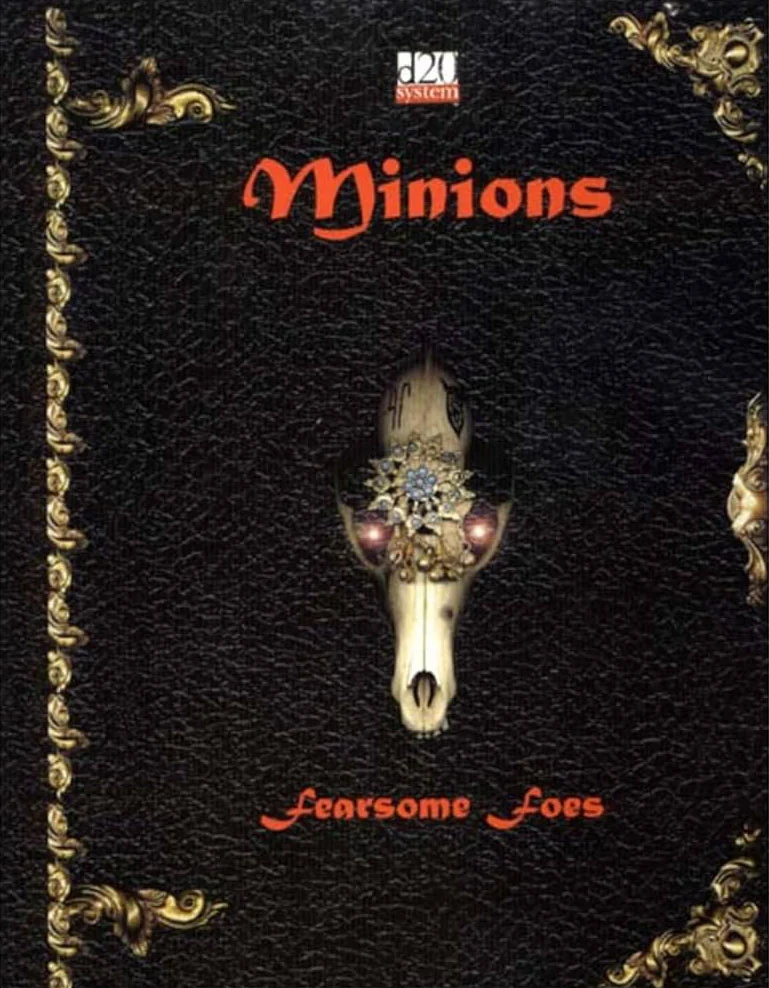
The initial perception of Minions was, ironically, hampered by its own branding. The title itself, coupled with an unassuming cover design, led many to assume it was a collection of generic, low-level NPCs or minor antagonists, a common type of supplement during the D20 boom. This misdirection meant that the book, despite its internal quality, risked being overlooked on store shelves, a critical challenge for a new publisher attempting to stand out.
Critical Reception and Player Adoption (2002 onwards)
Upon its release, Minions quickly garnered critical attention from reviewers who looked beyond its superficial presentation. The review from March 13th, 2002, praised the book’s "high quality" and "truly fresh, original ideas," awarding it strong scores for both style and substance. Reviewers noted the significant number of monsters (92, including templates) packed into its pages and, more importantly, the imaginative concepts behind many of them. The "Campaign" sections, offering adventure hooks and integration advice for each creature, were highlighted as a particularly innovative and useful feature that elevated the book above many contemporaries.
Despite the initial positive reception, the book’s $24.95 price tag for a 96-page softcover was a recurring point of contention. While acknowledged as a premium product with full-color printing, many felt the cost was slightly prohibitive, especially given the artwork was deemed functional but not exceptional. Nevertheless, the book found its audience among DMs seeking to inject novelty and challenge into their campaigns. Its unique creatures provided fresh narrative opportunities, allowing DMs to surprise seasoned players with foes they hadn’t encountered a "thousand times before."
Post-D20 Era and Legacy (Mid-2000s to Present)
As the D20 System evolved from 3rd Edition to 3.5th Edition and eventually gave way to D&D 4th Edition (2008) and 5th Edition (2014), many third-party D20 products faded into obscurity. However, Minions: The Fearsome Foes maintained a dedicated following. The original reviewer’s retrospective note underscores this longevity, stating that the book was used extensively for "a couple of years" and that it "veers closer to greatness" by inspiring entire adventures. This speaks to the profound impact of its creative content, which transcended mere stat blocks to become genuine storytelling catalysts.
Today, Minions remains a cherished resource for those who continue to play D&D 3E and 3.5E. Its availability on digital platforms like DriveThruRPG ensures its continued accessibility, allowing new generations of DMs to discover its unique charm. While it has not received an official update for D&D 5th Edition—a common fate for many excellent D20-era products—its core concepts and narrative potential are timeless, offering inspiration that can be adapted to various systems with a little effort. Its journey from a potentially overlooked release to a recognized "great" monster manual highlights its inherent quality and the enduring appeal of well-crafted, original fantasy content.
Supporting Data
A Deep Dive into the "Fearsome Foes"
The true strength of Minions: The Fearsome Foes lies in its diverse and imaginative roster of creatures. Far from being mere fodder, many of these monsters presented unique challenges, narrative hooks, and psychological twists designed to engage players on multiple levels. Let’s delve deeper into some of the standout examples:
- Amberjuron: More than just a wise owl, the Amberjuron is a millennium-old enigma. Its indistinguishable appearance from a snowy owl, save for its intelligent gaze, makes it a master of camouflage and observation. These creatures are repositories of ancient lore and rare magic, driven by an insatiable curiosity. Encountering an Amberjuron isn’t a combat scenario but a diplomatic puzzle. PCs seeking obscure knowledge or artifacts must navigate complex social interactions, perhaps undertaking quests for the Amberjuron in exchange for its wisdom. This creature forces players to think beyond brute force, emphasizing role-playing and negotiation.
- Am-Ren: This demon embodies a profound psychological horror. By stealing names, the Am-Ren doesn’t just inflict a physical wound but erodes the very identity of its victims. Those afflicted literally lose who they are, becoming shells devoid of personal history or recognition. This monster provides rich opportunities for high-stakes quests involving identity recovery, exploring themes of memory, self, and the power of a name. Its presence can create a pervasive sense of dread, as the threat extends beyond physical harm.
- Blessed Ring: Drawing inspiration from folklore’s fairy rings, the Blessed Ring twists a familiar concept into a moral gauntlet. These rings of common toadstools become impenetrable domes, testing the purity of heart of those who enter. For the virtuous, it offers a sanctuary, protecting them from external threats while they rest. For the wicked, however, the ring becomes a digestive trap, slowly consuming them with powerful acidic attacks. This environmental hazard serves as both a potential haven and a deadly moral judgment, forcing players to confront their characters’ alignments and past actions.
- Cacogen: These undead assassins, crafted from the remains of the deformed and outcast, introduce a chilling element of stealth and urban horror. Made from lepers, hunchbacks, or other disfigured individuals, Cacogens are not mindless zombies but cunning killers. Their tragic origins can be woven into narratives of social injustice or dark necromancy, making them more than just combat encounters. They challenge players with their stealth and precision, demanding tactical thinking in combat.
- Ebant: A "dark treant" might seem straightforward, but the Ebant distinguishes itself through its malevolent nature and potential ties to corrupted nature magic. Unlike benevolent treants, Ebants could be guardians of blighted forests or agents of vengeful fey, representing the destructive side of the natural world. This creature allows for exploration of environmental corruption and moral ambiguity within natural settings.
- Hearth Horror: This powerful undead entity is ingeniously tied to the cycle of ruin and rebuilding. The Hearth Horror compels mortal servants to restore its original form, explaining why ancient, evil temples in the wilderness are perpetually being rebuilt. This concept provides excellent long-term campaign potential, as PCs might repeatedly encounter the same structure under different stages of reconstruction, always leading back to the same malevolent force. It transforms ruins from static encounter zones into dynamic, evolving threats.
- Mirror Fiend: A golem that resides within and emerges from mirrors, the Mirror Fiend offers unique tactical challenges. Its ability to regenerate wounds by retreating into its mirror forces players to think creatively about how to engage it. The critical vulnerability—destroying its mirror—provides a clear objective beyond simply reducing hit points, turning combat into an environmental puzzle. This creature can be a guardian, an assassin, or even a twisted reflection of a PC.
- Quickener: A formidable CR 20 creature, the Quickener is a master of arcane absorption and mimicry. It absorbs every spell cast at it, then retaliates by casting those same spells back at its targets. This makes it incredibly unpredictable and deadly, demanding that high-level characters employ strategy, resource management, and potentially non-magical solutions. It’s a test of both brawn and brains, forcing magic-users to reconsider their offensive tactics.
- Slather: This huge magical beast, disguised as the entrance to buildings or dungeons, preys on unsuspecting adventurers. The Slather transforms mundane doorways into deadly traps, swallowing anyone who passes through its "doors." It’s a clever take on the mimic concept, extending the environmental threat to an entire entrance. This creature provides unexpected danger and encourages players to be wary of their surroundings.
- Sync: Perhaps one of the most original creations, the Sync is a humanoid race with featureless faces that adapt to their chosen target in combat. As they fight, they slowly assume the features of their opponent, simultaneously growing faster, stronger, and quicker by mimicking their target’s tactics. This escalating threat creates intense, time-sensitive encounters, as PCs must destroy a Sync quickly before it becomes overwhelmingly powerful. The psychological impact of fighting a mirror image of oneself, steadily improving, can "totally panic your PCs," as noted by the reviewer.
The "Campaign" Section: A Design Innovation
One of the most praised and forward-thinking aspects of Minions was the inclusion of a "Campaign" section for each monster entry. This wasn’t just a collection of stat blocks; it was a DM’s toolkit. Each entry offered adventure seeds, plot hooks, and practical advice for effectively integrating the monster into ongoing campaigns. This feature elevated Minions beyond a mere bestiary, transforming it into a source of inspiration for entire storylines. It demonstrated a deep understanding of how DMs actually use monster manuals—not just for combat, but for narrative development. This design choice anticipated later trends in monster manual design, emphasizing storytelling potential alongside mechanical statistics.
Navigating the Critiques
While Minions largely excelled in content, it was not without its flaws, some of which inadvertently contributed to its initial underestimation.
- The Naming Conundrum: The reviewer pointed out some "cheesy" monster names that detracted from the gravitas of the creatures. The "Cavernivore," for instance, despite being a "solid creature," suffered from a name that evoked a literal cave-eater rather than its true nature. More infamously, the "Chortler" was described as a hyena-like creature that attacked with a "deadly cloud of dandruff." While perhaps intended to be grotesque or humorous, the concept of a "dandruff attack" struggled to maintain a fearsome reputation, occasionally breaking player immersion and inviting comedic relief in what should have been a terrifying encounter. These naming choices highlighted the delicate balance between originality and maintaining a sense of fantasy gravitas.
- Humanoid Redundancy: The critique regarding "too many humanoids" was acknowledged as a personal preference, but it touches upon a common challenge in monster design. Creating distinct humanoid races that aren’t merely "goblins, but with dog heads" requires significant ingenuity. While Minions did succeed with innovative humanoids like the Sync, the sheer volume meant some might have felt less unique, leading to a sense of repetition for DMs seeking truly alien or non-anthropomorphic threats.
- Artwork’s Role and Impact: The artwork in Minions, while present for nearly every monster, was consistently cited as merely functional rather than evocative. In a medium where visual representation can dramatically enhance a creature’s impact, the art in Minions failed to fully capitalize on the imaginative designs within. Reviewers wished for stronger, more inspiring illustrations that DMs could confidently show to players to convey the terror or wonder of an encounter. This aspect, combined with the premium price point, meant that the full-color printing didn’t always justify its cost in terms of visual dynamism, contrasting with other D20 products that invested heavily in striking monster art.
Official Responses
In the context of a third-party D20 product from the early 2000s, "official responses" in the journalistic sense are rare. Publishers like Bastion Press operated with leaner teams and direct public engagement was less formalized than today. Therefore, we must interpret the "official response" through the product itself, its subsequent trajectory, and the enduring reflections of those who engaged with it.
Bastion Press’s Vision and Execution
Minions: The Fearsome Foes can be seen as Bastion Press’s implicit statement of intent within the D20 OGL landscape. The publisher prioritized creative content and mechanical depth over lavish marketing or flawless aesthetic execution. By packing 92 original monsters, many with highly imaginative concepts and detailed "Campaign" sections, Bastion Press signaled its commitment to providing substantive, game-enhancing material. The decision to print in full color on glossy pages, despite the average artwork, suggests an aspiration for quality production, even if budget constraints or artistic direction didn’t always align with critical expectations for the visual component. In essence, Bastion Press’s "response" was to deliver on the promise of original, inspiring content, trusting that the utility and creativity of the monsters would speak for themselves despite minor presentation shortcomings.
The Post-Publication Perspective: Enduring Value
The most significant "official response" to the initial critiques comes from the long-term assessment of the product by its users and, notably, the original reviewer’s retrospective. The reviewer’s admission that they "got quite a bit of use out of Minions for a couple of years" and that it "veers closer to greatness" by inspiring "whole adventures" directly addresses the initial reservations. This long-term perspective validates Bastion Press’s core strategy: that compelling ideas and practical utility outweigh superficial flaws. The price, initially a "hard pill to swallow," was ultimately justified by the sheer amount of inspiration and playable content derived from the book. This retrospective view serves as a powerful testament to the book’s substance, demonstrating that its intrinsic value transcended its initial presentation and pricing concerns.
The Question of Updates
The lack of an official D&D 5E update for Minions is a common narrative for many D20-era products. This isn’t necessarily a "response" from Bastion Press but rather a reflection of market realities and resource allocation. As D&D editions evolve, updating older content requires significant investment in design, art, and marketing for a new ruleset and audience. For smaller publishers, or those no longer actively producing new material, such updates are often economically unfeasible. The enduring appeal of Minions for D&D 3E players, however, highlights that its content doesn’t require an update to remain valuable. The core concepts are robust enough for DMs to adapt them to other systems, making the lack of an official 5E version a matter of convenience rather than obsolescence. It implicitly underscores the fact that the book’s genius lies in its ideas, which are largely system-agnostic.
Implications
A Blueprint for Third-Party Innovation
Minions: The Fearsome Foes stands as a prime example of the innovative potential unleashed by the D20 Open Game License. It demonstrated how third-party publishers, free from the constraints of established IP, could push creative boundaries, introducing truly novel mechanics and monster concepts that enriched the D&D ecosystem. The book’s commitment to originality, rather than merely rehashing classic tropes, set a high standard for supplementary material. It showed that quality content could emerge from independent studios, offering unique perspectives and challenges that even official publications might overlook.
The Enduring Value of Inspiration
The most profound implication of Minions‘ legacy is its emphasis on inspiration. The inclusion of detailed "Campaign" sections for each monster was a design choice that proved revolutionary. It transformed the monster manual from a simple list of adversaries into a dynamic sourcebook for storytelling. This approach underscored that a great monster manual doesn’t just provide stat blocks for combat; it ignites the DM’s imagination, offering hooks and narrative threads that can spawn entire adventures or even full campaigns. This focus on utility and creative enablement has become a benchmark for subsequent monster compendiums, influencing how designers approach the presentation of new creatures.
Lessons in Presentation and Marketing
Conversely, Minions also serves as a cautionary tale regarding product presentation and marketing. Its misleading title and understated cover design likely caused many potential buyers to overlook a truly excellent product. In a competitive market, first impressions are crucial. The book’s initial struggle to gain widespread recognition despite its internal quality highlights the importance of effective branding, compelling cover art, and clear messaging to accurately convey a product’s value and content. It’s a reminder that even brilliant content can suffer if it’s not effectively communicated to the target audience.
The Niche of Classic Editions
The continued appreciation for Minions among players of D&D 3E and 3.5E underscores the enduring vitality of classic editions within the TTRPG community. Despite the advent of newer, more streamlined editions, a dedicated player base continues to engage with older rulesets, valuing their specific mechanics, campaign styles, and the vast library of content created for them. Minions exemplifies how these older supplements remain relevant and cherished, proving that quality game content is often timeless, irrespective of the current edition’s popularity. It highlights a thriving niche market that values depth and originality over constant updates.
Legacy in the Digital Age
The digital availability of Minions: The Fearsome Foes on platforms like DriveThruRPG is crucial for its ongoing legacy. In an era where physical copies of older, out-of-print books can be difficult and expensive to acquire, digital distribution ensures that this D20 gem remains accessible. This allows new generations of DMs, particularly those delving into older editions or seeking inspiration for system-agnostic adventures, to discover its unique charm and creative potential. Its digital presence solidifies its place as a significant, albeit niche, artifact from a golden age of third-party TTRPG publishing.