A Whimper, Not a Bang: The Disappointing End to D&D’s Classic "Slavers" Saga
Originally Published: March 16th, 2002
FOR IMMEDIATE RELEASE
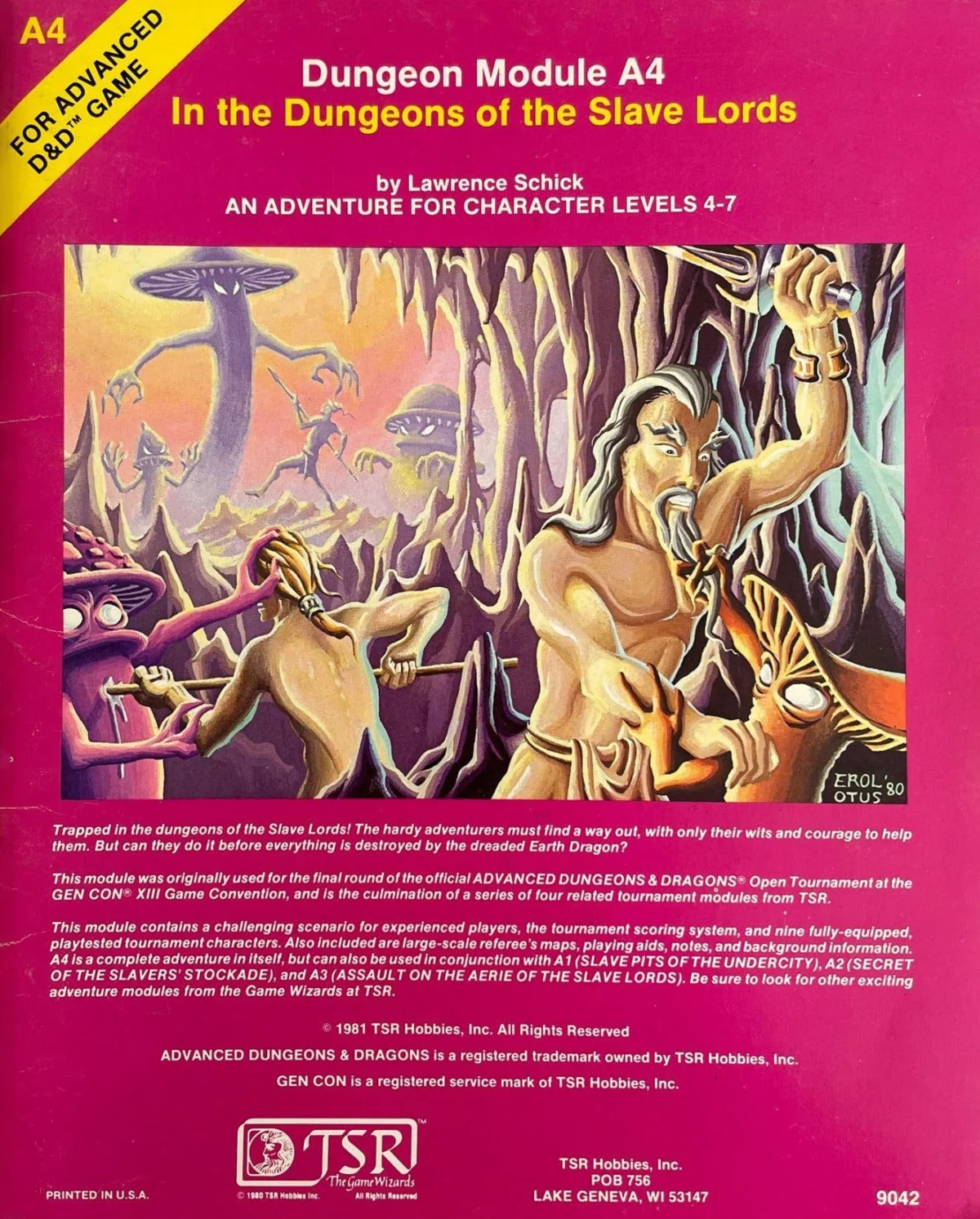
Waterdeep, Faerûn – The climactic conclusion to one of Dungeons & Dragons’ most iconic adventure series, A4: In the Dungeons of the Slave Lords, has long been a point of contention among veteran players and critics. While the Slave Lords saga is celebrated for its compelling initial chapters, the final module, released by TSR, Inc. in 1981 and later reviewed in 2002, is widely regarded as a significant misstep, failing to deliver the epic confrontation its predecessors promised. According to a trenchant review originally published over two decades ago, the module concludes the saga with "a whimper instead of a bang," leaving players and Dungeon Masters alike questioning the narrative coherence and overall execution of what should have been a memorable finale.
Authored by Lawrence Schick, A4: In the Dungeons of the Slave Lords (ISBN: 0-935696-28-8, Product Code: TSR9042, 32 pages, $4.99) was intended to provide a definitive resolution to the player characters’ long struggle against the insidious Slave Lords. However, as the 2002 review articulated, the module’s conceptual promise of a stripped-down survival challenge quickly unravels under the weight of perplexing plot devices and a distinct lack of an epic payoff, ultimately diminishing the legacy of the entire series.
The Saga’s Trajectory: From Grand Quest to Confined Captivity
The Against the Slave Lords series (A1-A4) is a cornerstone of early Dungeons & Dragons lore, renowned for its challenging encounters and compelling narrative that saw heroes dismantle a vast slaving operation. To fully grasp the disappointment surrounding A4, it’s essential to trace the journey that led to its ill-fated conclusion.
The adventure began with A1: Slave Pits of the Undercity, where player characters (PCs) first encountered the brutal reality of the Slave Lords’ operations, investigating disappearances and rescuing captives. This initial module effectively established the morally reprehensible nature of the villains and the stakes involved. It set a tone of heroic intervention against a widespread evil, challenging players to navigate dangerous urban environments and subterranean lairs.
Following this, A2: Secret of the Slavers Stockade plunged the PCs deeper into the conspiracy, tasking them with infiltrating a heavily guarded stockade to uncover more about the Slave Lords’ network. This module expanded the scope, introducing more complex tactical challenges and further solidifying the image of the Slave Lords as formidable and elusive adversaries. Players were pushed to think strategically, utilizing stealth and cunning alongside combat prowess.
The penultimate module, A3: Assault on the Aerie of the Slave Lords, escalated the conflict to a direct confrontation with a major Slave Lord stronghold. This chapter built considerable tension, leading players to believe they were on the cusp of dismantling the entire organization. However, in a dramatic twist designed to raise the stakes for the final act, the PCs were ultimately captured by the Slave Lords themselves. This capture, intended as a powerful narrative hook for A4, saw the heroes stripped of their dignity and power, paving the way for a desperate struggle for survival.
This setup for A4 was, in theory, brilliant. The player characters, having spent months imprisoned and subjected to systematic torture – spellcasters denied sleep to prevent spell memorization, thieves deprived of their tools, and fighters separated from their weapons – are at their most vulnerable. The module begins with them being dosed with more sleeping potions and unceremoniously dumped into a complex cave system beneath a volcano. The core premise is a classic survival narrative: the PCs must rely solely on their wits, recover their strength, and find a way to escape their dire predicament. Their ultimate goal is to survive the volcanic eruption that looms, which threatens to engulf the nearby city of Suderham in lava and a terrifying invasion of magmen, and perhaps, by sheer chance, intercept the Slave Lords’ escape vessel, the Water Dragon, for a final, decisive confrontation.
A Web of Incoherence: The Module’s Fatal Flaws
Despite the promising initial concept, A4: In the Dungeons of the Slave Lords quickly devolves into a series of inexplicable narrative choices, forming a "web of incoherence" that fundamentally undermines the entire experience. The primary critique, as highlighted by the 2002 review, is a pervasive lack of logical consistency, starting from the very first page.
The Illogical Narrative: A Villain’s Stupidity?
The most glaring flaw lies in the baffling motivations and actions of the Slave Lords themselves. After going to such lengths to capture, imprison, and systematically weaken the player characters over "months," the decision to simply drug them again and dump them into a volcanic tunnel system defies all logic. The review pointedly asks, "Why?" – a question that echoes throughout the module. What strategic advantage could possibly be gained by releasing their most persistent enemies, albeit disarmed and disoriented, into a potentially escapable environment? This act of "incomprehensible stupidity on the part of the villains" transforms what should be a desperate escape engineered by cunning heroes into a scenario created by antagonist incompetence.
Furthermore, the ecology of the volcanic caverns themselves presents another perplexing issue. The review queries, "Why are there kobolds, myconids, giant ants, and magmen all living in close proximity to each other down here?" This lack of a coherent ecological or environmental explanation for such a diverse and often conflicting array of creatures residing in the same cramped ecosystem further pulls players out of immersion. It suggests a module designed more as a series of disconnected encounters than a believable, living environment. The creatures appear to exist merely as obstacles, rather than integral parts of a functioning, albeit dangerous, underground world.
The Anti-Climax: An Epic Denied
Perhaps the most egregious failing of A4 is its inability to deliver a satisfying, epic confrontation with the titular Slave Lords. After three preceding modules painstakingly built these villains into formidable, memorable adversaries, the finale largely denies players the opportunity for a definitive showdown. The review laments the decision to allow "the saga of Slavelords… to die with a whimper at best – a complete anti-climax at worst."
The potential for a final encounter with the Slave Lords on their escaping ship, the Water Dragon, is presented as a "slight chance" rather than an inevitable or earned climax. If this encounter doesn’t happen, the module offers no alternative resolution, vaguely suggesting the PCs "might bump into them in the next pub they stop at." This casual dismissal of the series’ central antagonists is a profound disservice to the narrative and the players’ investment. The battle that "should live in the memories of the players forever" is reduced to "a whimpering formality, if it happens at all," transforming what should be a cathartic and earned victory into a contingent footnote. The volcanic eruption, a potentially "brilliant and epic complication for the final act," is similarly squandered, serving as a backdrop for an anti-climax rather than enhancing the drama of a decisive battle.
A Promising Premise Undermined: The Unfulfilled Potential
Despite its significant weaknesses, A4 did possess a genuinely compelling core concept: "Stripped of their equipment and their most potent magical abilities, the PCs are asked to escape their imprisonment, re-establish a power base, and strike a final, definitive blow against their would-be captors." This premise alone is rich with dramatic potential, forcing players to think creatively, scavenge for resources, and overcome overwhelming odds through sheer resourcefulness. It’s a survival horror scenario within a high-fantasy context, demanding ingenuity over brute force.
However, as the review meticulously details, this brilliant concept is tragically undermined by the module’s execution. The "dramatic escape" is not a testament to the PCs’ cunning but rather a consequence of the Slave Lords’ inexplicable blunders. The opportunity to "re-establish a power base" is overshadowed by the arbitrary nature of the environment and encounters. The "final, definitive blow against their would-be captors" is rendered optional and easily missed, robbing players of the satisfaction of a hard-won victory against a long-standing foe. The contrast between the potential of the core idea and the reality of its implementation is perhaps the most frustrating aspect of A4. It’s a testament to how even the strongest concepts can fail without consistent narrative logic, proper pacing, and a satisfying climactic resolution.
The Historical Lens and Community Reaction: An Unofficial Fix
Given its publication in 1981, direct "official responses" from TSR (or later, Wizards of the Coast) to specific criticisms of A4 were not commonplace in the same way modern game companies might engage with community feedback. The module itself, in its published form, represented the official vision for the saga’s conclusion. However, the lasting legacy of the Slave Lords series, and particularly the reception of A4, has led to an unspoken understanding within the D&D community.
Many Dungeon Masters, faced with the module’s shortcomings, have historically taken matters into their own hands. It became common practice for DMs to heavily modify, or even entirely rewrite, the latter half of A4, crafting their own endings that felt more earned and epic. The 2002 review explicitly suggests this approach: "You’ll be much better off ignoring everything except the high-level concept of A4 (which you can safely glean from this review) and crafting your own ending to this epic." This community-driven adaptation highlights a core strength of tabletop role-playing games – the collaborative nature that allows for correction and enhancement by those at the table.
The enduring popularity of the Slave Lords series eventually led to its re-release in various compilations, most notably Against the Slave Lords (A0-A4) for 5th Edition D&D. While these modern versions often aim to preserve the spirit of the original, designers frequently undertake revisions to smooth out rough edges, improve pacing, and address long-standing criticisms. Whether the inherent narrative illogicalities and anti-climactic nature of A4 were fully rectified in these later iterations remains a point of discussion, but their existence acknowledges the series’ significance despite its problematic conclusion.
Enduring Lessons and Legacy: Beyond the Whimper
The critical reception of A4: In the Dungeons of the Slave Lords offers several enduring lessons for game design and the art of storytelling in tabletop role-playing games.
Firstly, it underscores the profound impact of a satisfying conclusion on a long-running campaign. Players invest significant time, effort, and emotional energy into their characters and the narrative. To deny them a cathartic, earned climax can lead to widespread dissatisfaction, a sense of wasted effort, and ultimately, undermine the entire epic journey. A strong beginning and middle can be severely diminished by a weak ending.
Secondly, A4 serves as a cautionary tale regarding narrative logic and consistency. Even in a fantasy setting, internal coherence is crucial for player immersion. Villains, no matter how evil, must act with some degree of understandable motivation and intelligence. Arbitrary plot twists or illogical actions by antagonists can shatter the illusion of a believable world and turn dramatic tension into comedic absurdity. The comment from the original review, that it was "Arguably a great concept for a tournament scenario, but a terrible railroad in any other context," perfectly encapsulates this. A tournament might prioritize quick, contained challenges over deep narrative consistency, but a campaign module demands more.
Thirdly, the module highlights the vital role of the Dungeon Master as a facilitator and, at times, a reviser of published material. When official content falls short, the DM often steps in to bridge the gaps, correct flaws, and tailor the experience to their specific group. This adaptive quality is a unique strength of TTRPGs, allowing campaigns to survive even poorly executed modules.
Despite its flaws, the Against the Slave Lords series remains a significant part of D&D history. Its early entries are celebrated, and even A4, through its very shortcomings, has become a point of discussion, a case study in what not to do, and a testament to the enduring creativity of the D&D community in making even flawed adventures playable and memorable. While A4 may have ended with a whimper for many, the broader legacy of the Slave Lords saga continues to resonate, reminding us that even in imperfection, there are valuable lessons to be learned and cherished.