The Mighty Trireme: Unveiling the Engineering Marvels of Ancient Greek Naval Warfare
Introduction: The Echoes of Homer and the Dawn of Naval Supremacy
The epic verses of Homer’s Iliad, particularly the famously detailed "Catalogue of Ships," have long captivated readers with their vivid descriptions of the assembled Achaean forces preparing to sail for Troy. Yet, for many modern audiences, conjuring a tangible image of these ancient vessels can prove challenging. While Homer’s poetry evokes a sense of grandeur, the practicalities of ancient naval warfare often remain shrouded in the mists of time. Fortunately, recent advancements in digital reconstruction, specifically a compelling 3D animation produced by the YouTube channel "Deconstructed," have shed new light on the engineering genius behind one of antiquity’s most formidable warships: the trireme. This article delves into the multifaceted world of the trireme, exploring its design, operational prowess, tactical significance, and the broader technological context of ancient Greece.
The Trireme: A Symphony of Manpower and Ingenuity
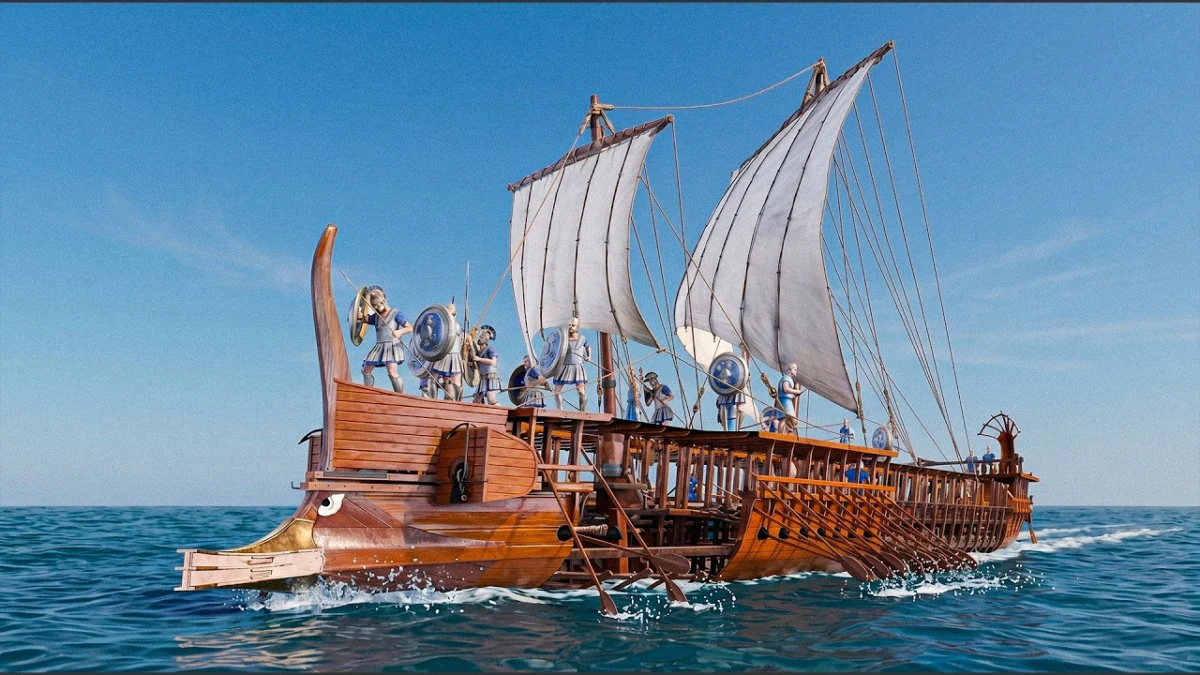
At its zenith, roughly two and a half millennia ago, the trireme stood as the undisputed master of the Mediterranean Sea. Its dominance was not derived from sophisticated machinery, advanced weaponry, or heavy armor, but from a potent combination of raw, synchronized human power and remarkably efficient naval architecture. As the "Deconstructed" animation illustrates, the trireme was a lean, wooden hull propelled by a formidable force of 170 men rowing in perfect unison. This reliance on human propulsion, rather than the vagaries of wind, granted the trireme unparalleled speed and maneuverability, making it a decisive weapon in ancient naval engagements.
The very name "trireme" offers a clue to its innovative design. It refers to the three superimposed tiers of single-person oars on each side of the vessel. This arrangement was a stroke of engineering brilliance, maximizing the propulsive power generated by the crew while minimizing the ship’s overall width. This optimization for speed and agility was paramount, pushing the technological boundaries of the ancient world. The hull itself was designed to be narrow and lightweight, further enhancing its responsiveness. A sharp bronze ram, affixed to the prow, served as the trireme’s primary offensive weapon. A well-timed, powerful strike from this ram could shatter an enemy hull, incapacitating or sinking the opposing vessel in a single, decisive blow.
Chronology: From Humble Beginnings to Mediterranean Hegemony
While Homer’s Iliad paints a picture of naval conflict during the legendary Trojan War, the trireme, as we understand it, was a later development. The epic’s depictions of ships like the trieres (triremes) and penteconters (ships with fifty oarsmen) suggest a lineage of naval technology that predates the trireme’s widespread adoption. These earlier vessels, propelled by fewer oarsmen, highlight a gradual evolution in shipbuilding and naval strategy.
The trireme is believed to have emerged and gained prominence around the 7th century BC. This period marked a significant shift in naval warfare, moving beyond the simpler designs of earlier eras. The development of the trireme coincided with the burgeoning power of city-states like Athens, which increasingly relied on naval strength for trade, defense, and imperial expansion. The Athenian navy, in particular, became synonymous with the trireme, forming the backbone of its formidable fleet and playing a crucial role in pivotal conflicts such as the Persian Wars. The subsequent centuries saw the trireme as the dominant warship across the Hellenistic world, a testament to its enduring design and effectiveness.
Supporting Data: The Anatomy of a War Machine
The effectiveness of the trireme was rooted in its sophisticated design and the synchronized efforts of its crew. Beyond the three tiers of oars, several key components contributed to its prowess:
- The Hull: The trireme’s hull was constructed from lightweight wood, designed for speed and agility. Its narrow profile allowed for rapid turns and nimble maneuvering. The keel was often reinforced to withstand the stresses of ramming.
- The Oarsmen: The heart of the trireme’s propulsion system was its crew of 170 oarsmen. Arranged in three banks, they provided the immense power needed to drive the vessel forward at considerable speeds. The rhythmic rowing was crucial for maintaining momentum and executing complex maneuvers.
- The Ram (Embolon): This bronze-sheathed ram, projecting from the prow, was the trireme’s primary offensive weapon. Its sharp, heavy design was capable of piercing the hulls of enemy ships, causing catastrophic damage.
- The Sails and Masts: While primarily powered by oars, triremes also utilized sails for long-distance travel and to conserve the energy of the oarsmen when conditions allowed. Typically, they had a single mast with a square sail.
- The Marines: In addition to the oarsmen, triremes carried a contingent of marines, usually numbering around 10-20. These soldiers were responsible for boarding enemy vessels, defending the trireme from attack, and engaging in close-quarters combat.
- The Helmsman and Captain: A skilled helmsman was essential for navigating and maneuvering the trireme, especially during complex naval tactics. The captain, or trierarch, commanded the vessel and its crew, making strategic decisions during battle.
The trireme’s design was a marvel of ancient engineering, balancing speed, maneuverability, and offensive capability. Its success lay not just in its physical components but in the seamless integration of human power and meticulous craftsmanship.
Tactical Maneuvers: The Art of Naval Combat
The trireme’s speed and agility enabled sophisticated naval tactics that dominated the ancient Mediterranean. Two key maneuvers, as highlighted by the "Deconstructed" animation, exemplify this strategic prowess:
- Diekplous (Sailing Through): This daring tactic involved a trireme fleet sailing through the gaps in an enemy formation. Once past the enemy line, the triremes would turn and attack the exposed sterns of the opposing ships, which were far more vulnerable than their prows. This maneuver required exceptional coordination and precise maneuvering.
- Periplous (Sailing Around): In this tactic, triremes would sail around the enemy line, attacking from the flanks or the rear. This allowed them to exploit weaknesses in the enemy’s formation and target less defended areas of their ships.
These tactics, reliant on the trireme’s superior maneuverability, demonstrate a level of naval sophistication that was far ahead of its time. The ability to outmaneuver and outflank an opponent, rather than relying solely on brute force, was a hallmark of effective ancient naval strategy.
Official Responses and Historical Significance
The historical significance of the trireme is undeniable. Its widespread adoption and dominance played a crucial role in the rise and fall of ancient powers. For Athens, the trireme was the foundation of its naval empire, enabling its victory in the Persian Wars and its subsequent Golden Age. The Battle of Salamis, a decisive naval engagement where Athenian triremes outmaneuvered and defeated the larger Persian fleet, is a testament to the trireme’s strategic importance.
Later, during the Hellenistic period, the trireme remained a vital component of naval arsenals across the Mediterranean, used by powers such as Macedon, Rhodes, and the Seleucid Empire. Its influence extended beyond its military application, shaping naval architecture and maritime trade routes for centuries. The very concept of a powerful, oar-driven warship capable of independent operation, unreliant on favorable winds, was a revolutionary development in military history.
Implications: Lessons from the Ancient Seas
The study of the trireme offers profound implications, extending far beyond historical curiosity:
- The Power of Optimization: The trireme stands as a prime example of how intelligent design and optimization can overcome technological limitations. By focusing on speed, maneuverability, and efficient use of resources (human power), the ancient Greeks created a war machine that dominated its era.
- The Synergy of Technology and Human Endeavor: The trireme was not just a product of engineering; it was a testament to the power of human coordination and discipline. The synchronized rowing of 170 men was a feat of organization and training, highlighting the crucial role of human factors in technological success.
- The Evolution of Warfare: The trireme’s development illustrates the continuous evolution of warfare. The shift from earlier, less sophisticated vessels to the trireme represents a significant leap in naval technology and strategy, influencing subsequent military developments.
- Inspiration for Modern Innovation: Even today, the principles of efficiency, optimization, and the seamless integration of human and technological elements embodied by the trireme can inspire modern engineering and design. The pursuit of speed, agility, and decisive impact remains a constant in many fields.
In conclusion, the trireme was more than just a ship; it was a symbol of ancient Greek ingenuity, naval prowess, and strategic brilliance. The "Deconstructed" animation, by bringing this ancient war machine to life in 3D, allows us to appreciate the sophisticated engineering and tactical mastery that made the trireme the undisputed queen of the Mediterranean for centuries, leaving an indelible mark on the history of warfare and human achievement.