Apex Magazine Takes Decisive Stance Against AI-Assisted Submissions, Removes Story and Anthology Contender
FOR IMMEDIATE RELEASE
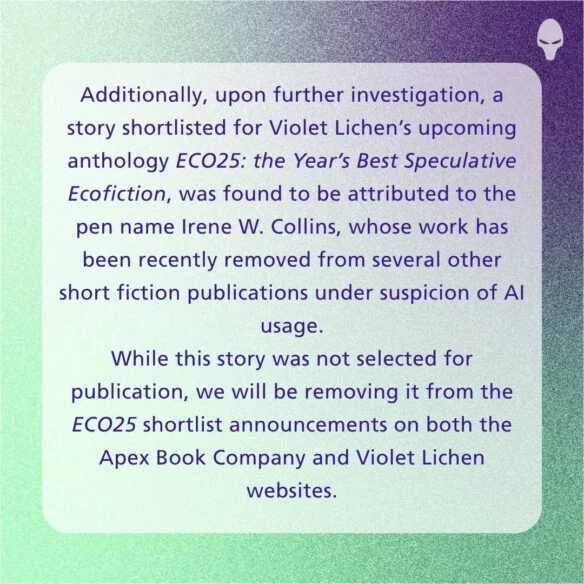
July 10, 2026 – In a significant move reverberating across the literary community, particularly within the speculative fiction genre, Apex Magazine today announced the removal of a short story from its latest issue, citing strong suspicions of AI assistance in its creation. Concurrently, the esteemed publication confirmed that a second author’s work has been withdrawn from consideration for an upcoming anthology, also due to similar concerns regarding artificial intelligence involvement. This swift action by Apex Magazine, a stalwart in science fiction, fantasy, and horror publishing for over two decades, underscores the escalating challenges publishers face in maintaining editorial integrity amidst the rapid proliferation of AI writing tools.
The announcement, disseminated via the Apex Book Company blog and a comprehensive Facebook post, represents a firm and public declaration of the magazine’s commitment to human authorship and originality. Lesley Conner, Editor-in-Chief of Apex Magazine, and Jason Sizemore, the magazine’s publisher, have spearheaded this decisive policy, setting a precedent that is likely to influence other literary journals grappling with the ethical and practical implications of AI-generated or AI-assisted content. The incident serves as a stark reminder of the evolving landscape of creative writing and the imperative for clear guidelines in an age where the line between human ingenuity and algorithmic generation is increasingly blurred.
Main Facts
Apex Magazine, a renowned publisher of dark science fiction and fantasy, has publicly disclosed the removal of a short story from its most recent issue. The decision stems from strong suspicions that the submitted work benefited from significant AI assistance during its composition. This move is not an isolated incident, as the magazine also revealed that another piece of writing, authored by a different individual, has been disqualified from a forthcoming anthology’s shortlist due to similar AI-related concerns.
The announcements were made on July 10, 2026, through official channels, including the Apex Book Company blog and detailed posts on their Facebook page. These communications included multi-page statements outlining the magazine’s position and the rationale behind its actions. The editorial team, led by Editor-in-Chief Lesley Conner and Publisher Jason Sizemore, emphasized the importance of authentic human creativity and the integrity of their editorial process.
Founded in 2005, Apex Magazine has built a formidable reputation over 153 issues for publishing high-quality, thought-provoking speculative fiction. Its current actions highlight a growing concern within the publishing industry about the ethical boundaries of using artificial intelligence in creative endeavors. The magazine’s stance is expected to spark further discussion and potentially lead to more stringent guidelines across the literary world as publishers navigate the complex intersection of technology and art. This incident marks a critical juncture, as a prominent genre publication takes definitive action to uphold its standards against what it perceives as an encroachment on human artistic expression.

Chronology of the Incident
The sequence of events leading to Apex Magazine‘s unprecedented announcement likely unfolded over several weeks, involving meticulous review and internal deliberation. While the specific details of the detection process remain proprietary, a plausible chronology can be constructed based on common editorial practices and the nature of AI content detection.
Pre-Submission Phase (Prior to Publication):
Like all literary journals, Apex Magazine operates on a rolling submission basis or specific reading periods. The story in question would have been submitted through their standard portal, likely alongside hundreds, if not thousands, of other submissions. At this stage, authors typically affirm their adherence to submission guidelines, which increasingly include clauses against plagiarism and, more recently, against AI-generated content. The author of the removed story presumably submitted their work, and it underwent the initial editorial filtering process, progressing through slush piles to higher-level editors.
Editorial Acceptance and Publication (Leading up to July 2026):
After a rigorous selection process, the story was deemed suitable for publication and included in an issue of Apex Magazine. The second author’s work was also selected for the shortlist of an upcoming anthology, indicating that both pieces had passed initial editorial scrutiny. This suggests that the AI assistance, if present, was not immediately obvious through conventional human reading and editorial judgment alone.
Suspicion Arises (Early July 2026):
The exact trigger for suspicion is not publicly detailed, but several scenarios are possible. It could have been:
- Reader Feedback: A discerning reader, perhaps familiar with the characteristics of AI-generated text or even the original author’s previous human-written work, might have flagged the story after publication.
- Internal Review: The editorial team, perhaps prompted by increasing awareness of AI content or by a specific stylistic anomaly, might have revisited the story.
- AI Detection Software: Apex Magazine might employ or have recently adopted AI detection tools, which could have flagged the story upon a routine scan or a targeted investigation. These tools analyze text for patterns, predictability, and statistical anomalies often present in AI output.
- Author Disclosure (Unlikely given the outcome): Less likely, but possible, is an author admitting to AI use, though the magazine’s definitive removal suggests a lack of satisfactory explanation or an admission of unacceptable levels of assistance.
Internal Investigation and Verification (Early to Mid-July 2026):
Upon suspicion, the Apex editorial team, led by Lesley Conner, would have initiated a thorough internal investigation. This likely involved:
- Deep Reading and Analysis: Closer examination of the prose for hallmarks of AI, such as generic phrasing, lack of genuine emotional depth, inconsistent character voice, or uncanny valley effects in narrative.
- Stylometric Analysis: Comparing the suspected story’s style to known human-written works by the author (if available) or to general human writing patterns versus AI patterns.
- AI Detection Tools: Running the text through various commercially available or internally developed AI detection software. While not foolproof, these tools provide probabilistic assessments.
- Communication with Authors: It is highly probable that Apex Magazine reached out to both authors to seek clarification or explanations regarding the suspected AI involvement. The specific nature of these conversations would be confidential, but the outcome indicates that the explanations were either unsatisfactory or confirmed the problematic use of AI.
Decision to Remove (Mid-July 2026):
Following the investigation and likely consultation between Lesley Conner and Jason Sizemore, the definitive decision was made to remove the short story from the current issue and the second author’s work from the anthology shortlist. This decision reflects a serious commitment to their editorial policy and the belief that the integrity of their publication was at stake. Removing a published story is a significant and costly undertaking, both in terms of reputation and logistical effort, underscoring the gravity of their findings.

Public Announcement (July 10, 2026):
The magazine chose to be transparent about its actions, publishing a detailed statement on its blog and Facebook page. This public declaration served multiple purposes: informing readers, clarifying their policy, deterring future problematic submissions, and signaling their stance to the wider literary community. The public nature of the announcement suggests a desire to foster an open dialogue about AI in creative writing and to encourage other publishers to take similar principled stands.
Immediate Aftermath:
The announcement immediately generated significant discussion and debate within online literary forums, social media, and among writers and readers. While the specific stories and authors were not named, the incident quickly became a focal point for conversations about the future of authorship and the ethics of technology in art. The ripple effect of this decision is expected to be long-lasting, influencing submission guidelines and editorial practices across the industry.
Supporting Data and Broader Context
The incident at Apex Magazine is not an isolated event but rather a high-profile manifestation of a rapidly evolving and complex challenge facing the entire publishing industry. The advent of sophisticated large language models (LLMs) like OpenAI’s ChatGPT, Google’s Bard (now Gemini), and others has fundamentally altered the landscape of content creation, making AI-generated or AI-assisted text virtually indistinguishable from human-written prose in many instances.
The Proliferation of AI Writing Tools:
Over the past few years, AI writing tools have moved from nascent experiments to powerful, accessible platforms. These tools can generate coherent narratives, poems, articles, and even entire short stories based on simple prompts. While initially praised for their potential to assist writers with brainstorming, outlining, or overcoming writer’s block, their capabilities have expanded to allow for full-text generation, raising serious questions about authorship and originality. The ease of access and increasing sophistication of these tools mean that publishers are now inundated with submissions that may originate, in whole or in part, from non-human intelligence.
Challenges for Publishers and Editors:
For publications like Apex Magazine, the rise of AI presents multifaceted challenges:
- Authenticity and Artistic Integrity: The core mission of literary magazines is to showcase human creativity and unique voices. AI-generated content, by its nature, draws from existing datasets and patterns, potentially lacking the genuine human experience, emotional depth, and originality that define true art.
- Plagiarism and Copyright Concerns: While AI doesn’t "plagiarize" in the human sense, its output can inadvertently mimic or draw too heavily from copyrighted material in its training data. The legal framework around AI-generated content and copyright remains largely unsettled, creating a grey area for publishers.
- Flooding the Submission Queues: The ability of AI to generate vast amounts of text quickly risks overwhelming editorial teams with submissions. A human writer might produce a few polished stories a year; an AI could generate dozens in a day. This volume can significantly increase the workload for editors, making it harder to find genuinely human-authored gems.
- Ethical Dilemmas: What constitutes "AI assistance"? Is using AI for grammar checks acceptable? What about generating plot ideas? Or entire paragraphs? The spectrum of AI involvement is wide, necessitating clear ethical guidelines from publishers.
- Financial Impact on Human Writers: If AI-generated stories become commonplace, they could devalue the work of human writers, potentially leading to reduced payment rates or fewer opportunities for emerging talents.
Industry-Wide Responses and Precedents:
Apex Magazine is not the first, nor will it be the last, publication to grapple with this issue. In late 2022 and early 2023, several prominent speculative fiction magazines, including Clarkesworld Magazine, reported a dramatic surge in AI-generated submissions, leading to temporary closures of their submission windows and public statements on the matter. Neil Clarke, editor of Clarkesworld, shared data indicating a significant increase in submissions flagged for "bot-generated content." Other magazines like Lightspeed, Fantasy Magazine, and numerous smaller presses have also updated their submission guidelines to explicitly prohibit or severely restrict the use of AI in submitted fiction.

These responses highlight a growing consensus among genre publishers: the unique spark of human creativity is paramount. Policies vary, with some publications issuing outright bans on any AI involvement, while others might allow for minimal assistance (e.g., for grammar, but not content generation) provided it is fully disclosed. The challenge lies in defining and enforcing these boundaries consistently.
Detection Methods and Their Limitations:
Publishers are employing a combination of strategies to detect AI-generated content:
- Human Editorial Judgment: Experienced editors often develop an intuition for the subtle differences between human and AI writing, noticing stylistic blandness, repetitive phrasing, or a lack of genuine voice.
- AI Detection Software: Tools like GPTZero, Originality.ai, and others are designed to identify patterns characteristic of LLMs. However, these tools are not foolproof; they can produce false positives (flagging human text as AI) and false negatives (missing AI-generated text), especially as AI models become more sophisticated at mimicking human writing.
- Author Declarations: Many publishers now require authors to explicitly declare whether their work was created with AI assistance and, if so, to what extent.
- Verification Processes: In cases of suspicion, editors might ask authors about their writing process, drafts, or specific creative choices, looking for signs of genuine human engagement with the text.
The incident at Apex Magazine underscores the imperfect nature of current detection methods and the proactive stance required from editorial teams. It highlights the need for continuous adaptation and refinement of policies as AI technology continues to advance.
Official Responses and Policy
The official communication from Apex Magazine regarding the removal of the AI-suspected story and anthology entry provides crucial insight into their immediate policy and future intentions. While the full text of their statement was referenced in the original article via a Facebook link, its essence reveals a principled stand from the magazine’s leadership.
Lesley Conner, Editor-in-Chief:
As the primary gatekeeper of Apex Magazine‘s content, Lesley Conner’s role in this decision is central. Her leadership signifies a commitment to preserving the artistic integrity and quality for which Apex is known. While specific quotes from her aren’t provided in the brief, the action itself speaks volumes. It reflects a difficult but necessary editorial judgment, prioritizing the human element of storytelling above all else. Her responsibility includes not only identifying problematic submissions but also communicating the magazine’s evolving stance to its community of writers and readers. This incident positions her at the forefront of a critical industry discussion, requiring clear articulation of what Apex defines as acceptable and unacceptable use of AI in creative writing. The nuanced term "AI assistance" in the original report suggests that Apex is likely navigating a complex spectrum, distinguishing between minor tool use (e.g., grammar checks) and substantive content generation.
Jason Sizemore, Publisher:
Jason Sizemore, as the publisher, carries the weight of the magazine’s business and long-term vision. His involvement in the announcement indicates that this decision is not just an editorial one, but also a strategic business move to protect the Apex brand and its value proposition to readers and authors. Publishing a story that is later found to be AI-generated can damage a magazine’s reputation, erode reader trust, and potentially lead to financial repercussions. Sizemore’s backing of this policy demonstrates a proactive approach to safeguarding the magazine’s future in a rapidly changing technological landscape. His perspective likely balances the need for artistic purity with the practicalities of managing submissions and maintaining a viable publication.

Clarity on "Assistance" and Future Policy:
The use of the term "suspected AI assistance" rather than outright "AI generation" is significant. It implies a recognition of a spectrum of AI involvement. Apex Magazine‘s detailed statement likely elaborates on where they draw the line. Common distinctions emerging in the industry include:
- Unacceptable: Using AI to generate plot, characters, dialogue, significant portions of the narrative, or the entire story.
- Potentially Acceptable (with disclosure): Using AI for minor tasks like grammar checking, spell checking, or rephrasing a single sentence for clarity, as long as the core creative work remains human.
- Ambiguous/Under Discussion: Using AI for brainstorming, outlining, or generating initial prompts.
Apex Magazine‘s official policy, as communicated, is expected to provide greater clarity on these distinctions. Moving forward, it is highly probable that Apex will implement stricter measures, possibly including:
- Updated Submission Guidelines: Explicitly outlining their policy on AI usage, perhaps requiring authors to attest to human authorship or disclose any AI tools used.
- Increased Scrutiny: Dedicating more resources or developing more sophisticated internal processes for identifying AI-generated content.
- Educational Initiatives: Potentially publishing articles or guides to help authors understand ethical AI use and avoid pitfalls.
By taking this public stance, Apex Magazine is not only protecting its own integrity but also contributing to the development of industry standards in an area that currently lacks universal guidelines. Their response is a crucial step in defining the future of authorship in an AI-powered world.
Implications for the Literary Landscape
The decisive action taken by Apex Magazine sends a powerful message that will undoubtedly have far-reaching implications for the literary landscape, particularly within the speculative fiction community and the broader publishing industry. This incident is not merely about one removed story; it is a microcosm of a larger, ongoing debate about the nature of creativity, authorship, and the role of technology in art.
The Ethical Debate on Authorship and Creativity:
At its core, the Apex Magazine incident reignites the fundamental ethical debate: what does it mean to be an author? If a machine can generate coherent, seemingly creative narratives, does it diminish the value of human imagination and effort? Publishers and readers alike are grappling with the philosophical implications of AI. The general consensus within the creative community leans towards valuing human originality and the unique perspective that only a human author, with their lived experiences, emotions, and consciousness, can bring to a story. The fear is that a proliferation of AI-generated content could dilute the very essence of what makes literature meaningful.
Financial Impact on Human Writers:
One of the most immediate and tangible implications is the potential financial impact on human writers. If AI-generated stories, which require minimal time and effort from a "creator," begin to flood submission queues and potentially even get published, it could lead to:

- Devaluation of Work: Publishers might be tempted to offer lower rates for stories, arguing that content is easily replicable.
- Reduced Opportunities: Fewer slots for human-authored stories if AI content fills publications.
- Increased Competition: Human writers already face intense competition; AI adds an unprecedented, scalable competitor.
The livelihoods of countless authors, especially those in genre fiction where short story markets are vital, could be severely threatened.
Erosion of Trust and Authenticity:
The trust between a reader and a publication, and between a reader and an author, is paramount. Readers expect that the stories they consume are products of human imagination and skill. If doubts arise about the authenticity of published works—whether they are truly human-authored or significantly AI-assisted—it could lead to a widespread erosion of trust. This could manifest as:
- Reader Skepticism: Readers might become wary, questioning the origin of every story.
- Damage to Reputation: Publications that fail to adequately vet for AI content could suffer reputational damage.
- Loss of Engagement: If the "human spark" is perceived to be absent, readers might lose interest in literary magazines altogether.
The Future of Speculative Fiction:
Apex Magazine is a significant voice in speculative fiction. This genre, by its very nature, explores the implications of technology and future societies. It is ironic, then, that it finds itself at the forefront of this particular technological ethical dilemma. The genre has always been a space for pushing boundaries, but the boundary between human and machine creativity is one that many in the SFF community are keen to protect. The incident forces a reckoning within the genre about what "speculative" truly means when the lines of creation are so blurred. It could lead to a renewed emphasis on unique human perspectives and experiences that AI, despite its sophistication, cannot authentically replicate.
Legal and Copyright Ramifications:
The legal landscape surrounding AI-generated content is still nascent. Key questions remain unanswered:
- Who owns the copyright of an AI-generated story? The user who prompted it? The AI developer? No one?
- Can AI-generated content infringe on existing copyrights if its training data included copyrighted works?
- How will international copyright laws adapt to these new forms of creation?
The Apex decision highlights the urgent need for legal frameworks and industry-wide agreements to address these complex intellectual property issues, protecting both creators and publishers.
Call for Industry Standards and Collaboration:
This incident, following similar challenges faced by other magazines, underscores the critical need for unified industry standards. Individual publications setting their own policies is a start, but a more cohesive approach would benefit everyone. This could involve:
- Collaborative Guidelines: Literary organizations, genre associations, and publishing houses working together to establish clear, widely adopted guidelines for AI use.
- Improved Detection Tools: Investing in and collaborating on the development of more robust and reliable AI detection technologies.
- Transparency and Disclosure: Encouraging authors to be transparent about any AI tools used, creating a culture of honesty.
- Dialogue with AI Developers: Engaging with AI companies to discuss ethical safeguards and potential watermarking or identification features for AI-generated content.
Long-Term Outlook:
The long-term implications are profound. The Apex Magazine incident is a significant marker in the ongoing evolution of publishing. It suggests that, for the foreseeable future, publishers will increasingly act as gatekeepers not just for quality, but also for the very origin of creative work. While AI tools will undoubtedly continue to advance, the emphasis on human creativity, originality, and the unique voice of the author is likely to become an even more cherished and protected commodity in the literary world. The industry is in a period of intense transformation, and Apex Magazine‘s firm stance is a clear signal of the values it intends to carry forward into this new era.