Calypso: The Nymph of Ogygia and Odysseus’s Enigmatic Captor
ATHENS, GREECE – In the vast tapestry of Greek mythology, few figures are as captivating and complex as Calypso, the nymph whose name, fittingly, means "to hide" or "to conceal." Immortalized in Homer’s epic The Odyssey (c. 750 BCE), Calypso is best known for her profound love for the hero Odysseus, a love that led her to detain him on her secluded island of Ogygia for a period spanning seven years, or five years depending on ancient accounts, during his arduous journey home from the Trojan War. Her story is one of divine beauty, irresistible temptation, and the poignant struggle between immortal desires and mortal longing.
Main Facts: The Enigmatic Nymph and Her Island Prison
Calypso’s narrative is inextricably linked with that of Odysseus, the resourceful king of Ithaca. Washed ashore on Ogygia after a catastrophic shipwreck, Odysseus found himself in the clutches of a goddess who, captivated by his strength and wisdom, fell deeply in love. Calypso harbored a singular ambition: to make Odysseus immortal, thereby securing his presence by her side for eternity. This desire, however, clashed with the hero’s unwavering yearning for his mortal home and family, transforming her idyllic island into a gilded cage.
Her formidable will eventually yielded to the supreme authority of the Olympian gods. Under the direct command of Zeus, delivered by the swift messenger Hermes, Calypso was compelled to release her captive, setting in motion the final stages of Odysseus’s epic homecoming.
Calypso’s lineage varies across ancient texts, though she is most frequently cited as the daughter of the mighty Titan Atlas, condemned to bear the heavens on his shoulders after the Titanomachy. Other traditions suggest her parentage might lie with the Titan Oceanus and the sea nymph Thetis, or even the primordial sea god Nereus, often referred to as "the old man of the sea." Regardless of her exact origins, her divine status is undisputed, and Homer himself describes her with the evocative epithet, "the nymph with lovely braids" (The Odyssey, 5.33), hinting at her alluring beauty.
Her domain, the island of Ogygia, is depicted as a place of breathtaking, untamed beauty. Dense forests of cypress, alder, and poplar shrouded her grotto-palace, its entrance adorned with luxuriant vines heavy with clusters of gold and purple grapes. The air was perpetually alive with the melodious songs of birds and the soothing sounds of splashing springs, while the ground was a soft carpet of violets, moss, and parsley. It was within this paradisiacal yet isolated setting that Calypso held Odysseus prisoner, a stark contrast between external splendor and internal despair.
Chronology: The Divine Intervention and Odysseus’s Release
The unfolding drama of Calypso and Odysseus is meticulously detailed in Homer’s Odyssey, beginning with a divine assembly and culminating in the hero’s bittersweet departure.
Athena’s Urgent Plea to Zeus
The initial revelation of Odysseus’s plight comes early in The Odyssey, in Book 1, during a pivotal Assembly of the Gods. Here, the ever-vigilant goddess Athena, Odysseus’s divine patron, passionately pleads with Zeus to intervene on behalf of the beleaguered hero. While acknowledging that some men who fought in the Trojan War justly met grim fates, Athena vehemently argues that Odysseus was undeserving of such prolonged suffering.
"My heart breaks for Odysseus," Athena laments to Zeus, describing his lonely captivity on Ogygia, "a wave-washed island in the center of the seas." She portrays Odysseus as a man wrestling with despair, desperately trying to forget his beloved Ithaca, yet inwardly consumed by a longing for death. Zeus, who holds Odysseus in high regard for his wisdom and bravery, reassures Athena that he has not forgotten the hero. He concedes that Odysseus must indeed find his way home. Athena, seizing the moment, proposes that Hermes, the messenger of the gods, be dispatched to Ogygia to inform Calypso that the time for Odysseus’s release has come.
Hermes’s Divine Summons to Ogygia
By Book 5 of The Odyssey, Odysseus’s ordeal continues to trouble Athena. He remains stranded, utterly alone, without ship or crew, on Calypso’s remote island. Zeus, responding to Athena’s persistent advocacy, issues his decree. He commands his son Hermes to convey an unequivocal message to Calypso: Odysseus must return to Ithaca. Crucially, Zeus stipulates that Odysseus is to receive no divine or mortal assistance in his journey, but must construct a crude raft and endure a perilous twenty-day voyage across the open sea to reach his next destination.
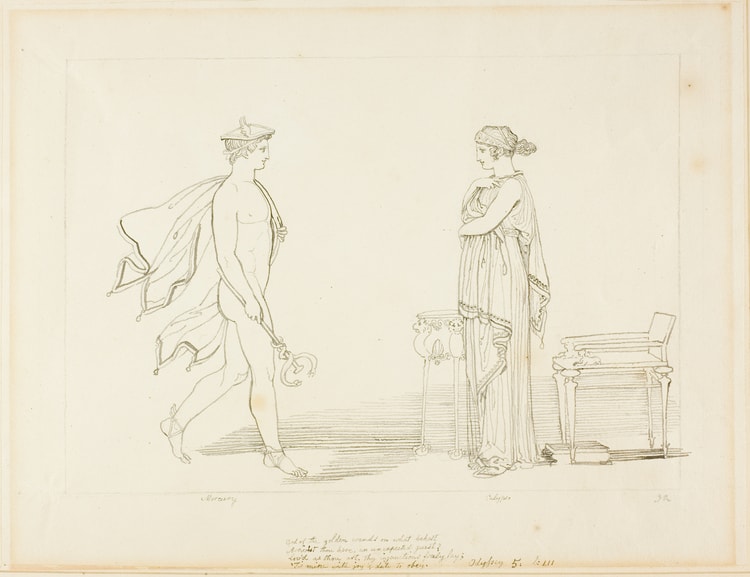
Hermes, obedient to his father’s will, swiftly departs for Ogygia. Upon his arrival, he discovers Calypso within her enchanting grotto, her breathtaking voice echoing as she works at her loom. The divine messenger is momentarily spellbound by Calypso’s ethereal beauty and the wondrous tranquility of her island home. Calypso, recognizing Hermes as a fellow immortal, extends a warm welcome, offering him a polished chair, ambrosia, and deep-red nectar – the sustenance of the gods.
Addressing Hermes, she inquires with a blend of reverence and curiosity:
"God of the golden wand, why have you come?
A beloved, honored friend,
but it’s been so long, your visits much too rare.
Tell me what’s on your mind. I’m eager to do it,
whatever I can do… whatever can be done." (Homer, The Odyssey, 5.99-102)
Once fortified, Hermes delivers Zeus’s stern message. He clarifies that his presence on such an isolated island is solely due to divine command, not personal inclination. He recounts Odysseus’s harrowing journey, emphasizing that the hero’s arrival on Ogygia was a consequence of Athena’s wrath, which unleashed a storm after Odysseus’s men angered her, leaving him as the sole survivor. Hermes concludes by stating unequivocally that Odysseus’s destiny is not to perish on Ogygia, but to return to his loved ones.
Calypso’s Reluctant Compliance and Odysseus’s Departure
Calypso, faced with the unyielding decree, responds with a poignant and impassioned protest. She rails against the perceived double standards of the Olympian gods, who, she argues, are quick to condemn goddesses for consorting with mortal men, even when such unions are born of genuine love and result in offers of immortality.
"So, now at last, you gods, you train your spite on me
for keeping a mortal man beside me. The man I saved,
riding astride his keel-board, all alone, when Zeus
with one hurl of a white-hot bolt had crushed
his racing warship down the wine-dark sea.
There all the rest of his loyal shipmates died
but the wind drove him on, the current bore him here.
And I welcomed him warmly, cherished him, even vowed
to make the man immortal, ageless, all his days…" (Homer, The Odyssey, 5.143-151)
Despite her bitter resentment, Calypso understands the futility of defying Zeus. She accepts her fate but declares that she will send Odysseus forth alone, without a fully equipped ship or crew. Instead, she promises to provide him with guidance on how to safely navigate his journey to Ithaca. Hermes, having delivered his message, reaffirms the wisdom of obeying Zeus, warning of the thunderer’s formidable wrath.
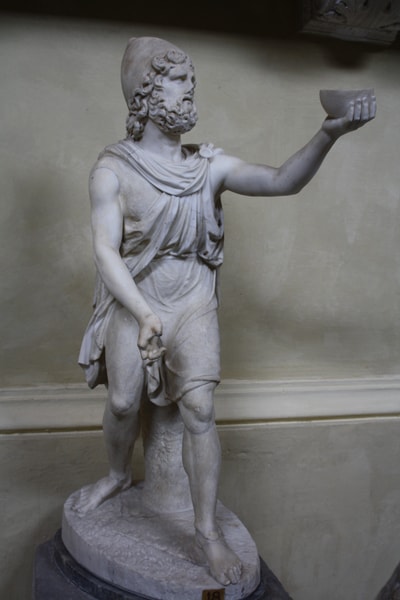
After Hermes departs, Calypso seeks out Odysseus, finding him in his usual spot on the headland, weeping inconsolably for his distant home and family. The text poignantly describes his nights spent begrudgingly with Calypso in her grotto-palace, only to return to the solitary beach each day, consumed by sorrow. Calypso approaches him, announcing that his tears are no longer necessary, for she is finally willing to let him go.
She instructs Odysseus to cut timber and construct a sturdy raft, capable of withstanding the tumultuous seas. In return, she pledges to provide him with provisions: food, water, his beloved ruddy wine, and suitable clothing. A weary and distrustful Odysseus, having endured years of captivity, hesitates. He refuses to embark until Calypso swears a binding oath that her intentions are genuine and that she will not conspire to trick or harm him. Calypso complies, swearing by the vaulting sky and the sacred, dark waters of the Styx – an unbreakable oath for any immortal – that she would never plot his demise. She even assures him that if their positions were reversed, she would seek the same escape.
They retreat to her grotto, sharing a final feast of nectar and ambrosia. In a last, desperate attempt, Calypso makes one more plea for Odysseus to stay:
"So then, royal son of Laertes, Odysseus, man of exploits,
still eager to leave at once and hurry back
to your own home, your beloved native land?
good luck to you, even so. Farewell!
But if you only knew, deep down, what pains
are fated to fill your cup before you reach that shore.
you’d stay right here, preside in our house with me
and be immortal. Much as you long to see your wife,
the one you pine for all your days… and yet
I just might claim to be nothing less than she,
neither in face nor figure. Hardly right, is it,
for mortal woman to rival immortal goddess?
How, in build? in beauty?" (Homer, The Odyssey, 5.224-237)
Odysseus, ever diplomatic yet resolute, assures Calypso he harbors no anger. He acknowledges her superior beauty and immortality compared to his mortal wife, Penelope, who cannot age gracefully like a goddess. Despite this, he declares that his longing for Penelope and his home transcends all other desires. As night falls, they share a final intimate moment in the cavern.
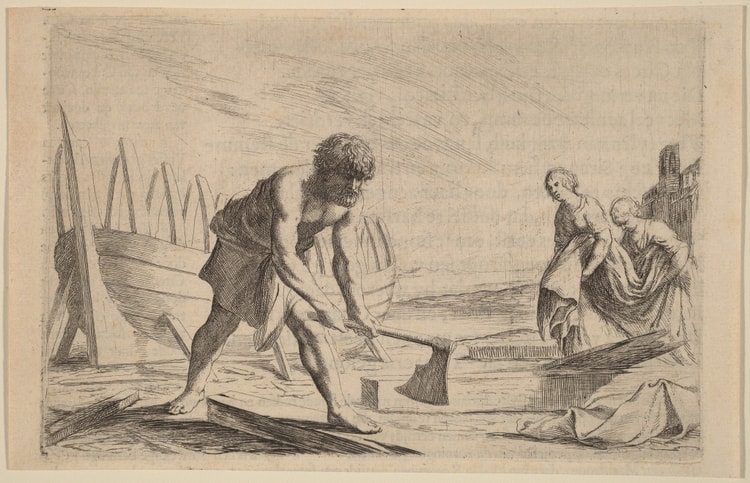
The following morning, the work begins. Calypso provides Odysseus with a bronze axe and guides him to a grove of towering trees. As Odysseus diligently fells timber and constructs his raft, Calypso reappears with drills and bolts of cloth for the sail. After four days of strenuous labor, the raft is complete. On the fifth day, Calypso bathes Odysseus, clothes him in fine, fragrant garments, and generously supplies his raft with wine, water, and meat. Finally, she summons a gentle, favorable wind to propel him on his way, marking the end of his seven-year captivity.
Odysseus Recounts His Ordeal
Later in The Odyssey, in Book 7, Odysseus himself recounts his time with Calypso to Queen Arete of Phaeacia after yet another shipwreck. He describes Ogygia as an island "lying far at sea" and Calypso as a "seductive nymph with lovely braids," acknowledging her beauty but also her inherent danger, which keeps both gods and mortals away. He details his miraculous survival for nine days clinging to his ship’s keel before the gods delivered him to Calypso on the tenth. He admits that she received him with kindness, cherished him, and offered him immortality. Yet, despite her generosity and promises, he confesses, "he could never love her." His days on Ogygia were largely spent in tears. He confirms that in the eighth year, by Zeus’s command and a change of heart, she finally released him, aiding him with supplies, raft construction, and a fair wind for his departure.
Supporting Data: Unpacking Calypso’s Identity and Mythology
Beyond Homer’s seminal account, other ancient sources offer alternative perspectives and expand upon Calypso’s narrative, enriching her mythological profile.
Lineage and Divine Status
The ambiguity surrounding Calypso’s parentage is noteworthy. While her common identification as the daughter of Atlas places her among the Titans’ offspring, aligning her with powerful, albeit defeated, primordial forces, the alternative suggestions are equally significant. Being a daughter of Oceanus and Thetis would link her more directly to the vast, ancient powers of the sea, while Nereus, "the old man of the sea," would make her a Nereid, a category of sea nymph. These variations suggest that while her divine status was universally acknowledged, her precise place within the intricate divine hierarchy might have been less rigidly defined or subject to regional mythological traditions. Her status as a nymph, a minor nature deity, yet capable of offering immortality, underscores the immense power wielded by even lesser figures in the Greek pantheon. The name "Calypso" itself, derived from the Greek kalyptō (καλύπτω), meaning "to cover," "to hide," or "to conceal," profoundly reflects her character and her island. She conceals Odysseus, both physically on her hidden island and metaphorically from his destiny and home. Ogygia, too, is a place of concealment, shrouded in dense vegetation and isolated by vast seas.
Ogygia: A Paradoxical Prison
The detailed description of Ogygia is not merely atmospheric; it’s central to understanding Calypso’s character and Odysseus’s plight. It’s a land of intoxicating beauty – fragrant flowers, melodious birdsong, crystal springs, and abundant grapes – designed to lull one into forgetting the outside world. Yet, it is also "wild and isolated," emphasizing its detachment from civilization and the hero’s world. This paradox defines Calypso’s captivity: she offers a paradise, but it’s a paradise without freedom, a beautiful cage. The natural splendor reflects her own allure, while the isolation mirrors her lonely existence as a goddess in a remote corner of the world.
Children and Alternative Fates
Homer’s Odyssey is notably silent on the matter of Calypso having children with Odysseus. However, other esteemed ancient scholars and poets offer different accounts, suggesting that their union was more fruitful. The Greek scholar and historian Apollodorus (c. 180 BCE) credits Calypso and Odysseus with a son named Latinus. Interestingly, Latinus is also attributed to Circe in some traditions, highlighting the fluidity of mythological genealogies. Even earlier, Hesiod (c. 776 BCE), in his seminal work Theogony, names two sons born to Calypso and Odysseus: Nausithous and Nausinous. These accounts, though not part of the Homeric canon, reveal a desire in ancient storytelling to explore the full ramifications of such a significant divine-mortal coupling.
Perhaps the most dramatic departure from Homer is found in the Fabulae by the ancient Roman writer Hyginus. In a poignant twist, Hyginus records that Calypso, utterly heartbroken by Odysseus’s departure and unable to bear his absence, ultimately takes her own life out of love for him. This tragic ending offers a deeply sympathetic portrayal of the nymph, shifting her from a mere obstacle to a figure of profound suffering, whose love, though possessive, was also consuming and ultimately self-destructive.
Official Responses: Divine Decrees and Mortal Resolve
The narrative arc of Calypso and Odysseus is driven by a series of "official responses" – the pronouncements of the gods and the unwavering reactions of the mortals caught in their divine machinations.
Zeus’s Unquestionable Decree
The ultimate "official response" comes from Zeus, the king of the gods. His decision to free Odysseus is not merely an act of compassion but a reaffirmation of cosmic order and destiny. Zeus’s reasoning, conveyed through Hermes, emphasizes that Odysseus’s fate is to return home, not to remain an immortal consort. This decree underscores the limits of even a powerful nymph’s will when it conflicts with the overarching plan of the supreme deity. It also reflects the Olympian pantheon’s perceived right to intervene in mortal affairs, even if it means disrupting a passionate, albeit forced, relationship.
Athena’s Persistent Advocacy
Athena’s role is that of a divine advocate, her pleas to Zeus serving as the catalyst for intervention. Her "response" is one of righteous indignation and unwavering loyalty to her chosen hero. She leverages her influence within the divine council to highlight the injustice of Odysseus’s prolonged suffering, effectively putting pressure on Zeus to act. Her persistent concern is a powerful "official response" to the perceived inaction of the gods regarding a deserving mortal.
Hermes’s Diplomatic Delivery
Hermes, as the messenger of the gods, acts as the conduit for the official decree. His "response" is one of direct communication, delivering Zeus’s orders without embellishment or personal opinion. However, his initial spellbound reaction to Ogygia’s beauty and Calypso’s allure adds a subtle layer to the divine message, acknowledging the potent enchantment that held Odysseus captive. His clear articulation of Zeus’s wrath as the consequence of disobedience serves as the ultimate "official response" to Calypso’s potential defiance.
Calypso’s Protest Against Divine Hypocrisy
Calypso’s "official response" to Hermes’s message is a powerful indictment of divine double standards. She challenges the gods’ perceived hypocrisy, lamenting their readiness to condemn goddesses for romantic relationships with mortals, even as male gods frequently engage in such liaisons without similar censure. Her words reveal a deep sense of injustice and resentment, framing her captivity of Odysseus not merely as an act of selfish love, but also as a reaction to the perceived unfairness of the divine realm. Her eventual compliance, though bitter, demonstrates the undeniable authority of Zeus.
Odysseus’s Unwavering Resolve
Perhaps the most crucial "official response" in this entire saga is Odysseus’s. Despite Calypso’s overwhelming beauty, her divine status, her offer of immortality, and her final, desperate plea comparing herself favorably to Penelope, Odysseus’s resolve remains unshaken. His polite yet firm refusal, acknowledging Calypso’s superior beauty but reaffirming his profound longing for his mortal wife and home, serves as the ultimate "official response" to temptation. It highlights his defining characteristic: nostos, the powerful desire for homecoming, which triumphs over even the most alluring immortal offerings. His skepticism about Calypso’s intentions, demanding a binding oath, further showcases his cunning and his learned distrust after years of hardship.
Implications: Legacy and Enduring Archetypes
Calypso’s story resonates far beyond the confines of ancient Greek epic, leaving a lasting legacy in literature, art, and the collective human imagination. Her narrative explores profound implications regarding love, freedom, divine power, and the nature of temptation.
The Archetype of the Enchanting Temptress
Calypso, much like Circe, is frequently cast as an enchanting yet formidable woman who initially obstructs Odysseus’s journey home. She embodies the archetype of the alluring temptress, a figure whose beauty and power are intertwined with a capacity to detain or derail heroes from their destined paths. Her name, "to hide" or "to conceal," aptly describes her ability to make Odysseus forget his true purpose, drawing him into her hidden world. This portrayal positions her as a significant test of the hero’s will and fidelity, a powerful symbol of the seductive forces that can divert one from duty and destiny.
However, her character is more nuanced than a simple villain. Her love for Odysseus, though possessive, is genuine. It is a "double-edged sword," as the original text suggests: a love so intense that it prevents her from letting him go, despite the pain it causes him. This complexity allows for a more sympathetic reading of Calypso, not merely as a captor, but as a heartbroken lover bound by the constraints of her own immortal existence and desires.
A Study in Longing and Perseverance
Odysseus’s time with Calypso is a crucial segment in his extended journey, a testament to his unwavering perseverance and his profound nostos. Despite the comforts, the beauty, and the promise of eternal youth, his daily tears on the shore underscore the intrinsic human need for home, family, and mortality. The seven years spent on Ogygia are not a period of blissful escape but one of profound internal struggle, highlighting the idea that even paradise can be a prison if freedom and genuine love are absent. This aspect of the story carries significant implications for understanding the human spirit’s resilience against temptation and the power of longing.
Shifting Interpretations: From Captor to Heartbroken Lover
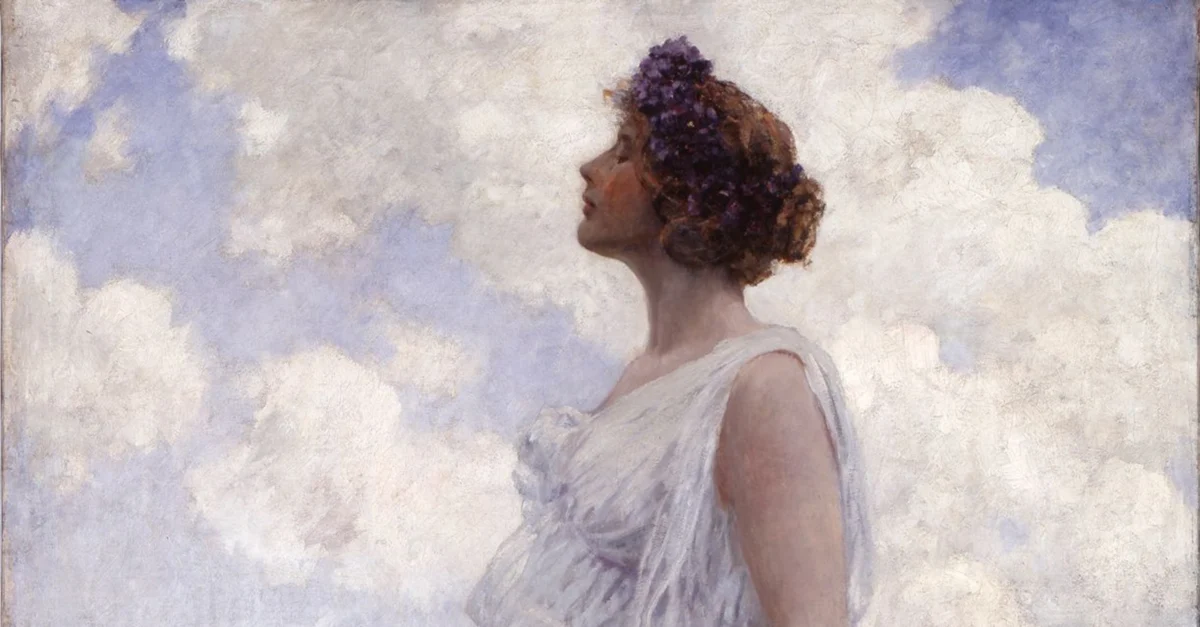
Over centuries, interpretations of Calypso have evolved. While Homer’s primary focus is on Odysseus’s ordeal and eventual escape, later artists and writers have explored Calypso’s inner world with greater empathy. The English poet Letitia Landon (1802-1838), in her poem Calypso Watching the Ocean (1830s), offers a poignant example. Landon beautifully describes a heartbroken Calypso, sitting alone, gazing at the ocean, consumed by a wish to weep and escape her lonely island. This portrayal reframes Calypso not as a malevolent force, but as a tragic figure, trapped by her own immortality and unrequited love, mirroring Odysseus’s own feelings of captivity. This shift in perspective allows for a deeper exploration of themes of loneliness, unfulfilled desire, and the burden of eternal life.
Modern Adaptations and Enduring Appeal
The enduring power of the Calypso myth continues to inspire contemporary culture. The mention of Christopher Nolan’s hypothetical epic production of The Odyssey (2026), with Charlize Theron cast as Calypso, however speculative it might be, underscores the myth’s timeless appeal and its relevance to modern storytelling. Such adaptations reflect a continued fascination with these ancient characters and the universal themes they embody: love, loss, temptation, and the journey of self-discovery. Calypso remains a compelling figure, a symbol of the alluring obstacles and profound emotional landscapes encountered on life’s epic voyages. Her story serves as a perennial reminder of the complexities of desire, the sacrifices of heroism, and the eternal human yearning for home.