
Cultural Catastrophe in Kyiv: Russian Missile Barrage Decimates Historical Landmarks and Claims Civilian Lives
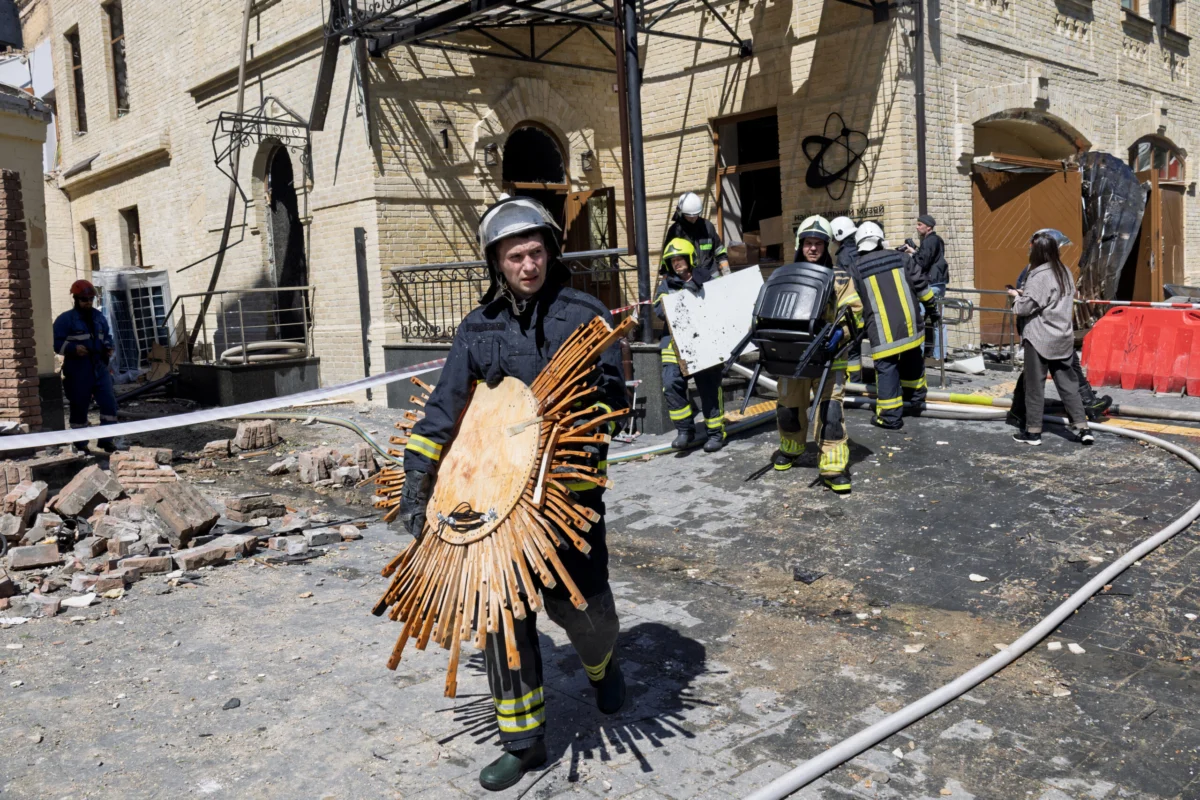
KYIV — In what has been described as one of the most devastating aerial assaults since the full-scale invasion began, a massive Russian drone and missile strike targeted the Ukrainian capital and its surrounding suburbs on the night of May 23 and the early morning of May 24, 2026. The bombardment, characterized by its intensity and the breadth of its targets, resulted in the deaths of at least four civilians and left nearly one hundred others wounded. Beyond the human toll, the strike has inflicted irreparable damage on Ukraine’s cultural infrastructure, striking a blow to the nation’s historical memory by damaging some of its most venerable museums and academic institutions.
Main Facts: A Night of Fire and Loss
The assault, which utilized a combination of high-precision missiles and Iranian-designed loitering munitions, pierced the night sky over Kyiv, overwhelming local air defenses in several sectors. According to reports from Reuters and local emergency services, the debris from intercepted missiles and direct hits from those that breached the perimeter caused widespread fires across residential districts. Four individuals were confirmed dead in the immediate aftermath, with the casualty count expected to fluctuate as search and rescue teams continue to navigate the ruins of several apartment complexes and educational facilities.
While the human cost remains the most tragic aspect of the night, the systematic damage to Kyiv’s cultural heart has sparked international outrage. Among the most severely affected sites is the National Chernobyl Museum, an institution dedicated to documenting the 1986 nuclear disaster. Preliminary assessments suggest that approximately 40 percent of the museum’s irreplaceable artifacts have been destroyed or damaged beyond recovery.
Simultaneously, the National Art Museum of Ukraine (NAMU), a cornerstone of European neoclassical architecture and the primary repository of Ukrainian fine art, suffered significant structural damage. While the museum’s internal collection remained miraculously intact due to prior fortification and evacuation efforts, the building’s historic facade—a symbol of Kyiv’s 19th-century intellectual awakening—was heavily scarred.
Chronology of the Assault: May 23–24, 2026
The sequence of events began late on the evening of May 23, when air raid sirens echoed across the Dnipro River.
- 22:45 PM (May 23): Initial reports of "Shahed" drone swarms entering Ukrainian airspace from the north and south. Residents were urged to seek immediate shelter.
- 01:15 AM (May 24): The first wave of cruise missiles was detected. Explosions were heard in the Podil and Pechersk districts, where many of the city’s cultural landmarks are concentrated.
- 02:30 AM: A second, more intensive wave of ballistic missiles targeted the city center. It was during this window that the Taras Shevchenko Institute of Literature and the National Art Museum of Ukraine sustained their primary hits.
- 04:00 AM: Emergency services began responding to a massive blaze at a residential high-rise where three of the four fatalities occurred.
- 06:00 AM: The "all-clear" signal was given, revealing a city skyline marred by smoke and the skeletal remains of shattered windows across the historic district.
In the hours following the attack, the scale of the "cultural liquidation" became clear. The Zhytnii Market, the Kyiv Small Opera, and the "Ukrainian House" convention center all reported varying degrees of damage, ranging from blown-out windows to structural collapses.

Supporting Data: A Detailed Inventory of Destruction
The impact on Kyiv’s cultural heritage is not merely aesthetic; it represents a significant loss of academic and historical data.
The National Chernobyl Museum
The loss of 40 percent of this museum’s artifacts is a global tragedy. The institution serves as the primary archive for the liquidators’ stories, original technical maps of the exclusion zone, and personal effects of those who died preventing a global nuclear catastrophe. The destruction of these items means that a vital link to understanding the 20th century’s worst industrial disaster has been severed.
The Taras Shevchenko Institute of Literature
The Institute, the nation’s oldest center for literary studies, reported "serious damage" to its library and book repositories. In a poignant statement released via Facebook, the Institute confirmed that the catalogues of its Manuscript Centre are now temporarily unavailable. These archives contain original drafts from the foundational figures of Ukrainian literature, making the damage a direct hit on the country’s intellectual lineage.
Wider Cultural Impact
According to Ukrainska Pravda, the damage extends to:
- The Hinaus Gallery: A hub for contemporary art, which saw its exhibition spaces shattered.
- The Kyiv Small Opera: An architectural gem that has survived multiple wars, now facing significant restoration needs.
- Residential and Educational Infrastructure: Aside from the museums, several schools were hit, further disrupting the lives of Kyiv’s youth and reinforcing the atmosphere of "urbicide"—the deliberate destruction of a city’s ability to function and sustain its culture.
As of May 13, 2026, UNESCO had already verified damage to 527 cultural sites across Ukraine since the 2022 invasion. This latest attack is expected to push that number significantly higher once formal inspections are completed.
Official Responses: "A War Against Memory"
The reaction from Ukrainian leadership has been one of defiance and grief. Kyrylo Budanov, a top aide to President Volodymyr Zelenskyy, framed the attack not as a military necessity, but as an act of cultural genocide.
“This is a war against our culture, memory, and identity,” Budanov told CBC. “For centuries, Moscow has tried to destroy everything that makes us Ukrainian. They target our museums because they fear our history.”

The Taras Shevchenko Institute of Literature echoed this sentiment, noting that the attack has exacerbated an already dire financial situation. “The premises were seriously damaged… the catalogues of the Manuscript Centre are temporarily unavailable to readers,” the institution stated, highlighting the practical paralysis of Ukrainian scholarship caused by the strikes.
Internationally, the targeting of museums and libraries is being scrutinized as a potential violation of the 1954 Hague Convention for the Protection of Cultural Property in the Event of Armed Conflict. UNESCO officials have reiterated that cultural property is not a military target and that the systematic destruction of such sites constitutes a war crime under international law.
Implications: The Long Road to Restoration
The implications of the May 24 strikes are three-fold: psychological, academic, and economic.
1. Psychological Warfare
By targeting the National Chernobyl Museum and the National Art Museum, the Russian military is striking at symbols of Ukrainian resilience and antiquity. The goal is to instill a sense of hopelessness—to suggest that even the nation’s past is not safe from the reach of modern missiles. The closure of NAMU "until further notice" deprives the citizens of Kyiv of a sanctuary of beauty and history during a time of immense trauma.
2. The Erasure of Academic Records
The damage to the Taras Shevchenko Institute’s Manuscript Centre is perhaps the most insidious aspect of the strike. While buildings can be rebuilt, original manuscripts and unique historical catalogues are often irreplaceable. This hinders the ability of future generations to study their own language and literature, effectively creating a "dark age" in Ukrainian historiography.
3. The Economic Burden of Recovery
Ukraine’s economy is already stretched to its limits by the demands of the defense sector. The cost of restoring neo-classical facades, replacing specialized climate-control systems for art preservation, and rebuilding shattered markets like Zhytnii will run into the hundreds of millions of dollars. Without significant international aid specifically earmarked for cultural heritage, many of these institutions may remain shuttered for years.
Conclusion
The bombardment of Kyiv on May 24, 2026, serves as a grim reminder that the front lines of the conflict are not limited to the trenches of the Donbas. They exist in the galleries of the National Art Museum, the archives of the Institute of Literature, and the memory-halls of the Chernobyl Museum. As the smoke clears over the capital, the resilience of the Ukrainian people remains evident, but the scars on their cultural landscape run deep. The international community now faces the challenge of not only providing the weapons to defend Ukraine’s territory but also the resources to preserve the soul of a nation that Russia is so determined to erase.




Leave a Comment