"Secret of the Slavers Stockade": A Timeless D&D Classic Re-Examined
FOR IMMEDIATE RELEASE
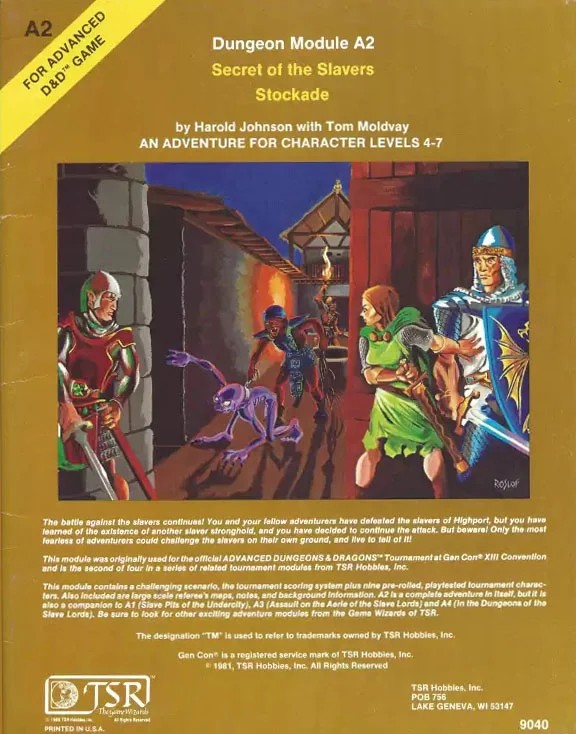
[City, State] – [Date] – In the vast pantheon of Dungeons & Dragons adventure modules, certain titles stand out not just for their historical significance, but for their enduring quality. Among these, A2: Secret of the Slavers Stockade, originally published by TSR, Inc. in 1981, holds a particularly esteemed position. A recent retrospective review from The Alexandrian, initially published on March 16th, 2002, and now revisited, unequivocally hails A2 as "the best installment of the Slavers series of modules" and a prime example of "classic D&D at its best." This re-examination delves into why this module continues to captivate players and Dungeon Masters (DMs) decades after its release.
Main Facts: A Benchmark of Adventure Design
A2: Secret of the Slavers Stockade is the second module in the seminal A-series, designed for Advanced Dungeons & Dragons (1st Edition). Authored by Harold Johnson with Tom Moldvay, it follows directly from A1: Slave Pits of the Undercity, picking up the narrative thread with player characters (PCs) embarking on a direct assault against a fortified slaver stronghold. The module’s central premise revolves around a dynamic siege, challenging players with tactical choices and formidable opposition.
The Alexandrian’s review, a detailed critical analysis, commends A2 for its robust concept, intricate setting, and particularly for its introduction of a compelling cast of antagonists. Unlike its predecessor, A2 features multiple, layered villains, collectively known as the Slave Lords, whose internal power struggles add depth and complexity to the adventure. Despite some acknowledged weaknesses related to its age and original tournament design, the review concludes that A2 stands as a superior product, offering a rich, challenging, and memorable D&D experience. Its original publication details include a price of $4.99, 42 pages, and an ISBN of 0-935696-26-1, with product code TSR9040.
Chronology: From Tournament Origins to Enduring Legacy
The Genesis of the A-Series
The A-series modules – A1: Slave Pits of the Undercity, A2: Secret of the Slavers Stockade, A3: Assault on the Aerie of the Slave Lords, and A4: In the Dungeons of the Slave Lords – were initially conceived as tournament adventures for the prestigious Gen Con gaming convention. This origin profoundly influenced their design, often emphasizing challenging combat encounters, clear objectives, and a somewhat linear progression to accommodate competitive play within strict time limits. Each module in the series was penned by different creative teams, a common practice at TSR during a period of prolific content creation. David Cook handled A1, setting the initial stage for the PCs’ confrontation with the enigmatic Slave Lords. The baton then passed to Harold Johnson and Tom Moldvay for A2, who were tasked with escalating the conflict and deepening the narrative. This collaborative, yet segmented, approach allowed for diverse design perspectives within a cohesive overarching campaign.
Building on A1: Slave Pits of the Undercity
A2 is explicitly designed as a direct sequel, building upon the narrative momentum established in A1. At the conclusion of Slave Pits of the Undercity, PCs are expected to have acquired a crucial map, which serves as their guide to the next stage of their anti-slavery crusade. This map points them towards "an old fort lost in the midst of the Drachensgrab Hills," which turns out to be the heavily guarded stockade at the heart of A2. This direct narrative handover was innovative for its time, fostering a sense of continuous campaign play that was less common in earlier standalone modules. The transition from the subterranean pits of A1 to the exterior siege of A2 also represented a significant shift in environmental and tactical challenges, demonstrating a thoughtful progression in adventure design.
The Original Publication and Era
Published in 1981, A2: Secret of the Slavers Stockade emerged during a golden age for tabletop role-playing games, particularly for Dungeons & Dragons. The game, still relatively young, was rapidly expanding its audience, and TSR was at the forefront of defining what an adventure module could be. The early 1980s saw a surge in module releases, establishing iconic settings, monsters, and campaign arcs that would become foundational to D&D lore. Players of this era expected challenging dungeons, intricate puzzles, and memorable adversaries. A2 delivered on these expectations, offering a gritty, dangerous environment that pushed players to their tactical limits. Its publication contributed significantly to the growing reputation of the Against the Slave Lords series as a definitive high-level campaign, solidifying TSR’s reputation for producing high-quality, impactful adventures.
The Review’s Original Publication
The Alexandrian’s review of A2 was originally published on March 16th, 2002, as part of a larger retrospective series on the entire A-series. At this time, D&D had undergone several significant evolutionary phases, including the release of 3rd Edition D&D (2000), which modernized many aspects of the game. Reviewing a 1st Edition module in the early 2000s required a specific critical lens: acknowledging its historical context and inherent design philosophies while also assessing its enduring playability and relevance for a potentially new generation of DMs and players accustomed to more contemporary game mechanics and presentation standards. The Alexandrian’s approach was to provide constructive criticism through a modern perspective, highlighting areas that might require adaptation while celebrating the module’s timeless strengths. This dual perspective offered valuable insights for both nostalgic veterans and curious newcomers looking to explore the roots of D&D.
Supporting Data: Anatomy of a Classic
Core Concept: The Siege and the Stockade
The core concept of A2 is a masterclass in tactical adventuring: a full-scale siege on a heavily fortified enemy compound. The module’s design, as noted by The Alexandrian, successfully conveys the grit and danger inherent in such an undertaking. PCs are not merely exploring a dungeon; they are engaging with a living, guarded fortress. Harold Johnson, along with Tom Moldvay, excels in presenting a "gritty, dangerous, well-fortified fort" where "getting in won’t be easy, getting out will be even tougher." This emphasis on strategic planning, resource management, and overcoming entrenched defenses differentiates A2 from many contemporary modules that focused more on exploration or linear combat. While its tournament origins might lead to some static NPC responses, the overall intent to create a formidable, dynamic challenge is clear and largely successful. This aspect alone makes A2 a valuable study for DMs looking to run fortress assaults.
The Antagonists: A Pantheon of Villains
One of A2‘s most significant strengths lies in its robust cast of antagonists, a stark contrast to the singular major villain of A1. A2 introduces several key figures within the Slave Lords’ hierarchy, adding layers of intrigue and potential for complex social interaction alongside combat.
- Markessa: The overseer of the fort, a supremely dangerous fighter and wizard. Her current engagement in "various experiments involving human subjects" immediately establishes her as a chilling and formidable foe. Her power and ruthlessness make her a primary target and a memorable villain.
- Icar: The fort’s commander, caught in a power struggle with Markessa. This internal conflict between the module’s primary antagonists provides fertile ground for player manipulation, strategic diversions, and unexpected alliances, adding a political dimension to the siege.
- Blackthorn: A direct representative of the enigmatic Slave Lords, whose presence signifies the broader reach and importance of the organization.
- Executioner: Icar’s lieutenant, likely a brutal enforcer contributing to the fort’s oppressive atmosphere.
- Gulyet: Markessa’s assistant and apprentice, potentially a conduit for information or a weaker link in her command structure.
The presence of multiple, interconnected villains, each with their own agendas and positions within the stockade, elevates A2 beyond a simple hack-and-slash adventure. It offers opportunities for reconnaissance, subterfuge, and exploitation of internal rivalries, allowing for a more nuanced and role-play intensive approach to the siege. This depth in characterization is precisely why, as the review states, "you begin to understand why people talk about the Slave Lords as being villains of special quality."
Design Strengths and Enduring Appeal
Beyond its core concept and compelling villains, A2 boasts several design strengths that contribute to its enduring appeal. The review highlights that A2 is a "larger module, giving you more in the way of sheer material" compared to A1. More importantly, its "encounters are better designed and better conceived," leading to a higher overall quality of material. The module strikes a commendable balance between challenging combat scenarios, exploration of the fortified compound, and opportunities for strategic thinking. It embodies the essence of "classic D&D" by presenting a clear objective – infiltrate, dismantle the slaver operation, and confront its leaders – while providing a rich environment ripe with danger and discovery. This combination of well-crafted encounters, strategic depth, and memorable characters firmly places A2 as a prime example of high-quality adventure design from the early days of D&D.
Identified Weaknesses and Modern Reinterpretations
While largely positive, the review candidly addresses A2‘s weaknesses, many of which stem from its age. The "artwork and presentation is sub-par by modern standards," a common critique of older modules which often featured sparse, black-and-white illustrations and utilitarian layouts. More significantly, certain elements "don’t stand the test of time well," with the prime example being a series of rooms inhabited by a "madman pretending to be a ghost through a variety of parlor tricks." The reviewer rightly questions the credibility of such a feature within a fort controlled by a powerful sorceress like Markessa.
However, these flaws are deemed "far less severe" than those in A1 and are "easily resolved (probably in less than a half hour of work)." This underscores the module’s fundamental soundness. The Alexandrian also made a specific suggestion for improvement: "Take the defenses of the stockade up to the next level," advocating for "more involvement from the fort’s leaders in organizing, coordinating, and contributing to that defense." This desire for dynamic, responsive antagonists directly influenced the reviewer’s later work on "adversary rosters," a modern DM tool designed to make enemy forces more reactive and intelligent.
A notable technical flaw mentioned in the 2002 review concerned the poor quality of the scanned map in early digital versions (ESD) of the module, rendering it "practically illegible." This issue, which was met with "stony silence" from Wizards of the Coast at the time, has since been rectified in current PDF copies available for sale, a positive development for those wishing to experience the module today.
Official Responses: Preserving and Recontextualizing a Legacy
TSR’s Vision for the A-Series
From TSR’s perspective, the A-series was a significant undertaking. Initially designed for competitive play, its success quickly led to its repackaging and release for general consumption. The modules were instrumental in showcasing the potential for multi-part campaigns, where player actions in one adventure directly influenced the next. The "Slave Lords" themselves were designed to be iconic antagonists, a shadowy organization whose defeat would require not just martial prowess but also cunning and investigation. The eventual release of Against the Slave Lords (A0-A4), an omnibus edition compiling all four modules, serves as an official acknowledgment of the series’ importance and its cohesive narrative arc, allowing players to experience the entire saga seamlessly. This repackaging demonstrates TSR’s commitment to preserving and presenting these classic adventures as a unified campaign experience.
Wizards of the Coast’s Legacy Management
As the current custodians of the Dungeons & Dragons brand, Wizards of the Coast (WotC) has actively managed the legacy of classic modules like A2. The availability of these modules on platforms like the DMsGuild (often in updated PDF formats) represents a crucial "official response" to their enduring demand. By providing digital access, WotC ensures that new generations of DMs and players can experience these foundational adventures. The rectification of the previously illegible map in A2‘s digital release is a testament to WotC’s commitment to quality control for its legacy products, addressing past shortcomings and ensuring a better user experience. This ongoing support helps bridge the gap between D&D’s storied past and its vibrant present.
Community Reception and Critical Acclaim
While not an "official response" in the corporate sense, the widespread and consistently positive reception of A2 within the D&D community acts as a powerful collective endorsement. Decades after its release, Secret of the Slavers Stockade is frequently cited in online forums, gaming blogs, and critical retrospectives as a fan favorite. It is often recommended as a benchmark for well-designed fortress assaults and a prime example of challenging, tactical D&D. This sustained community acclaim, spanning multiple editions of the game, underscores the module’s fundamental quality and its ability to transcend generational shifts in gaming preferences. The ongoing discussions, adaptations, and praise for A2 serve as a testament to its impact on the D&D landscape.
Implications: A Blueprint for Adventure
The Legacy of A2 and the A-Series
A2: Secret of the Slavers Stockade left an indelible mark on D&D adventure design. Its focus on a direct siege, multi-faceted villains, and the importance of tactical planning became a blueprint for subsequent modules. The Slave Lords, as an organization with internal conflicts and a broader reach, influenced the development of complex antagonist factions in later campaigns. The A-series as a whole demonstrated the power of a linked campaign, teaching DMs and players the satisfaction of long-term narrative engagement and the cumulative impact of their choices across multiple adventures. The challenges presented in A2 specifically honed player skills in reconnaissance, resource management, and strategic combat, elements that remain core to the D&D experience.
Relevance in Contemporary D&D
Even in the era of 5th Edition D&D, A2 remains highly relevant. Modern DMs frequently adapt classic modules, drawing inspiration from their strong concepts and converting mechanics to suit current rulesets. The module’s robust design for a fortified compound and its dynamic cast of villains offer valuable lessons for contemporary adventure writers and DMs seeking to craft compelling siege scenarios or introduce multi-layered antagonists. The enduring appeal of "classic D&D" lies precisely in modules like A2, which provide a direct link to the game’s roots while offering timeless challenges that resonate with players today. Its focus on strategic combat and overcoming formidable odds ensures its continued utility as a resource for engaging gameplay.
The Art of the Retro Review
The Alexandrian’s review of A2 exemplifies the enduring value of retrospective critiques. By revisiting classic material, such reviews not only preserve gaming history but also offer crucial insights into evolving design philosophies. The reviewer’s personal anecdote about his desire for "a more dynamic defense of the stockade" leading to his later work on "adversary rosters" highlights how studying older modules can inspire modern design solutions. This symbiotic relationship between past and present ensures that the lessons learned from modules like A2 continue to inform and enrich the current landscape of tabletop RPGs, making the act of reviewing old content a vital component of game design discourse.
Future of Classic Modules
The continued availability, discussion, and critical re-evaluation of modules like A2: Secret of the Slavers Stockade underscore the vibrant future for D&D’s vast back catalog. As D&D continues to evolve, classic adventures provide a rich repository of ideas, challenges, and narrative frameworks that can be reinterpreted and enjoyed by new generations. Their enduring quality ensures that they will not merely be historical artifacts, but living documents that continue to inspire, challenge, and entertain, proving that true excellence in adventure design is indeed timeless.
### ABOUT THE ALEXANDRIAN
The Alexandrian is a prominent online resource dedicated to role-playing games, game design, and creative content, known for its in-depth analyses, design theory, and extensive reviews.
### ABOUT TSR, INC.
TSR, Inc. was an American game publishing company, best known for publishing Dungeons & Dragons. It was instrumental in establishing the tabletop role-playing game industry and creating many iconic fantasy settings and adventure modules.
### CONTACT:
[Insert Contact Information – e.g., Media Relations Department, or similar placeholder]