Uncanny Magazine Navigates Financial Headwinds and Celebrates Acclaim Ahead of Pivotal Annual Kickstarter
[City, State] – [Date, e.g., June 20, 2026] – Uncanny Magazine, a leading voice in the speculative fiction landscape, is preparing for its annual Kickstarter campaign, a crucial event that its Publisher and Editor-in-Chief, Michael Damian Thomas, describes as a "yearly referendum" on the magazine’s existence. The campaign, titled "Uncanny Magazine Year 13: The Space Unicorn Believes in YOU!", is set to launch on July 13, 2026, aiming to secure funding for another year of groundbreaking stories, essays, and poetry, culminating in the milestone DIAMOND Issue #75.
This pivotal crowdfunding drive comes at a challenging time for the independent publication, which has recently experienced a significant loss of subscription revenue from a major online retailer. This financial setback underscores the increasing reliance of Uncanny Magazine on the direct support and "goodwill and generosity of the Space Unicorn Ranger Corps" – its dedicated readership. Despite these operational pressures and personal challenges faced by its leadership, the magazine continues to garner widespread critical acclaim, celebrating numerous prestigious award nominations and a significant editorial promotion in recent weeks.
The Annual Referendum: A Decade of Crowdfunded Excellence
Main Facts
Since its inception in 2014, Uncanny Magazine has distinguished itself as a beacon for innovative and inclusive speculative fiction, consistently delivering award-winning content. The magazine’s operational model has, for over a decade, leaned heavily on the success of its annual Kickstarter campaigns. For Michael Damian Thomas, each campaign represents a high-stakes moment, a make-or-break endeavor that dictates the magazine’s future.
"Nobody would call a yearly referendum about whether or not your business should exist a stress-free process," Thomas stated in a recent update. "Every year since 2014, I’ve prepped and coordinated and hoped for the best as I pressed the launch button on another Kickstarter." This sentiment highlights the inherent vulnerability of independent publishing, especially within the arts, where passion projects often grapple with commercial realities.
The upcoming "Year 13" campaign is particularly significant. Beyond ensuring the continued publication of Uncanny Magazine, it will fund the production of the special DIAMOND Issue #75. This landmark issue promises to be a celebratory compilation, featuring original fiction from authors who have previously received awards for their contributions to Uncanny, a testament to the magazine’s enduring legacy of fostering literary excellence. Backer rewards for the campaign are reportedly being compiled from "some of the greatest creators in the universe," aiming to incentivize community participation and celebrate the vibrant ecosystem of speculative fiction.
Navigating a Precarious Publishing Landscape
Chronology and Supporting Data
The current financial climate presents a formidable challenge for independent literary magazines. Thomas openly acknowledges this, noting that "Many magazines have closed recently, and many others have been in precarious shape." This trend reflects broader shifts in publishing, including the consolidation of media, changing consumption habits, and the increasing difficulty for smaller entities to compete with larger platforms.
A specific blow to Uncanny Magazine this year was the complete cessation of subscription revenue previously received from a "Big Online Retailer." While the specific retailer was not named, the impact of such a loss can be catastrophic for publications operating on tight margins. These subscription streams provided a predictable base income, allowing the magazine to plan and compensate its creators and staff fairly. The loss necessitates an even greater reliance on direct community funding, making the upcoming Kickstarter campaign more critical than ever.
Thomas’s personal reflections further underscore the dedication required to sustain such a venture. He spoke candidly about living through a "very strange time" in his life, grappling with the grief of losing his daughter, Caitlin, and the geographical distance from his wife, Kirsty, and their children. He also noted the minimal personal income derived from Uncanny, highlighting that the endeavor is driven by a profound belief in its mission rather than financial gain. "I still believe in Uncanny Magazine," he affirmed. "I feel these stories, essays, poems, interviews, covers, and podcasts are important to people. As the world darkens, having these pieces there for the folks who need them is vital." This conviction forms the bedrock of his tireless efforts to keep the "Space Unicorn" flying.
Editorial Leadership Strengthens Amidst Challenges
Official Responses and Supporting Data
In a move signaling robust internal growth and strategic foresight, Uncanny Magazine recently announced the promotion of Monte Lin. Lin, who has served as Managing Editor since May 2022 and previously as Assistant Editor since September 2021, will now also assume the role of Nonfiction Editor. This expanded responsibility comes with significant accolades, as Lin has already secured two Hugo Awards in his capacity as Managing Editor, demonstrating his exceptional editorial prowess.
"Monte will bring amazing amounts of thoughtfulness, organization, experience, and vision to the nonfiction editing," the magazine announced. "We are certain Monte will continue Uncanny‘s tradition of publishing provocative, thoughtful, and passionate essays. We can’t wait to see what he’s going to do!" This appointment is expected to further elevate the magazine’s already strong nonfiction section, which is known for its incisive commentary and diverse perspectives on speculative fiction and broader cultural topics. His continued role as Managing Editor ensures continuity and stability in the magazine’s day-to-day operations, a crucial asset during periods of financial uncertainty.
A Triumphant Season of Awards and Recognition
Supporting Data
Despite the operational challenges, Uncanny Magazine continues to be a powerhouse in the awards circuit, securing an impressive array of nominations for its exceptional content. These nominations not only validate the magazine’s editorial vision but also highlight the outstanding talent of its contributors.
Shirley Jackson Awards 2025
"The Millay Illusion" by Sarah Pinsker has been named a finalist for the Best Novelette Shirley Jackson Award. These awards, established in 2007, recognize "outstanding achievement in the literature of psychological suspense, horror, and the dark fantastic," honoring the legacy of the iconic author. Voted upon by a jury of professional writers, editors, critics, and academics, the Shirley Jackson Awards are presented annually at Readercon, with the 2025 awards ceremony scheduled for Saturday, July 11, 2026, at Readercon 35 in Burlington, Massachusetts. Pinsker’s nomination underscores Uncanny‘s commitment to publishing work that explores the darker, more unsettling corners of human experience and imagination.
Theodore A. Sturgeon Memorial Award
Two Uncanny Magazine stories, "Six People to Revise You" by J. R. Dawson and "The Shadow on the Nest" by Alaya Dawn Johnson, have been selected as Theodore A. Sturgeon Memorial Award Finalists. Notably, Uncanny‘s Managing Editor, Monte Lin, also earned a finalist spot for his story "his love’s ashes on his tongue," published in The Deadlands. Established in 1987 by James Gunn and the heirs of Theodore Sturgeon, this prestigious award celebrates the best short science fiction story of the year, focusing on innovation and literary merit. The winner will be announced later this summer and honored at the annual Sturgeon Symposium in October. These nominations reaffirm Uncanny‘s consistent contribution to the science fiction genre’s cutting edge.
Eugie Foster Memorial Award 2026
"When He Calls Your Name" by Catherynne M. Valente is a finalist for the 2026 Eugie Foster Memorial Award for Short Fiction. The Eugie Award, presented annually at Dragon Con, champions "the best in innovative fiction," honoring stories that are "irreplaceable, that inspire, enlighten, and entertain." The award seeks works that are "beautiful, thoughtful, and passionate, and change us and the field," becoming "essential to speculative fiction readers." Valente’s nomination exemplifies Uncanny‘s dedication to publishing unique and impactful narratives that resonate deeply with readers.
Hugo Awards 2026
Perhaps the most globally recognized accolades in science fiction and fantasy, the Hugo Awards, are also poised to honor Uncanny Magazine with a staggering number of nominations. Voting for the Hugo Awards closes on August 8, 2026, at noon PDT, and Uncanny has a strong presence across multiple categories:
- Best Novelette: Three stories from Uncanny are finalists: "Kaiju Agonistes" by Scott Lynch, "When He Calls Your Name" by Catherynne M. Valente, and "The Millay Illusion" by Sarah Pinsker.
- Best Short Story: "Six People to Revise You" by J. R. Dawson and "10 Visions of the Future; or, Self-Care for the End of Days" by Samantha Mills are finalists.
- Best Poem: "Care for Lightning" by Mari Ness and "The Mourning Robot" by Angela Liu have secured nominations.
- Best Semiprozine: Uncanny Magazine itself is a finalist, recognizing the collective efforts of its team, including Publisher/Editor-in-Chief Michael Damian Thomas, Managing Editor Monte Lin, Poetry Editor Betsy Aoki, and Podcast Producers Erika Ensign and Steven Schapansky.
- Best Editor-Short Form: Michael Damian Thomas is also a finalist in this highly competitive category, acknowledging his discerning eye and leadership in curating the magazine’s exceptional content.
These multiple Hugo nominations underscore the magazine’s consistent high quality and its significant influence within the speculative fiction community, further solidifying its reputation as a leading literary platform.
A Glimpse into Issue 71: The Current Heart of Uncanny
Supporting Data
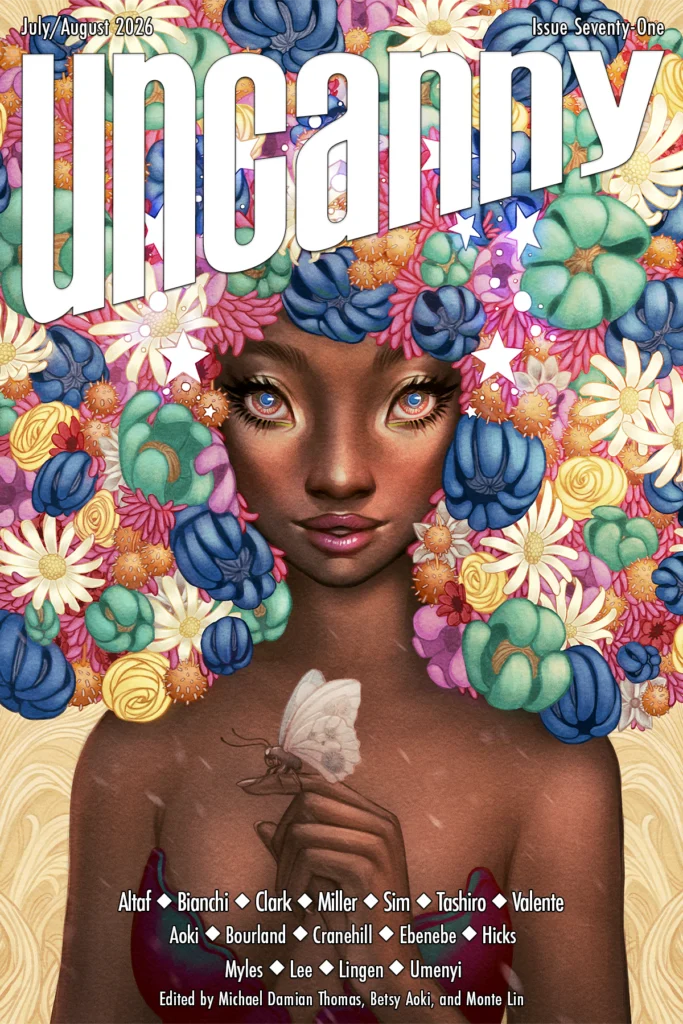
The magazine’s current offering, Uncanny Magazine Issue 71, exemplifies the diverse and thought-provoking content that has earned it critical acclaim. The issue features the stunning cover art, "Flower Crown" by Ejiwa "Edge" Ebenebe, setting a vibrant tone for the narratives within.
The new fiction lineup is robust, including "Leavetaking" by Tia Tashiro, "Learning the Loom" by P. Djèlí Clark, "This Is Just Another Carnaval Love Story" by Jana Bianchi, "The Cinema of Babel" by Sam J. Miller, "Judar of the Island: A Story Told in Four Feasts" by Rida Altaf, and "A Hundred Ways the Story Ends" by Tara Sim. These stories span a wide range of speculative subgenres, from fantasy to science fiction, showcasing diverse voices and imaginative world-building. The issue also includes a reprint of "White Lines on a Green Field" by Catherynne M. Valente, originally published in Subterranean Online in 2011, offering readers a chance to revisit a classic.
The nonfiction section, soon to be overseen by Monte Lin, features compelling essays such as "The Strange Worlds Among Us—of Turing, Trans People, and the Road to Laniakea" by Ryka Aoki, "Doctor Who in an Exciting Adventure with AI Slop 1969 AD" by Lizbeth Myles, "This Is Not About AI" by Hana Lee, and "Middle-Aged Love: Rereading in Your Forties and Beyond" by Marissa Lingen. These pieces engage with contemporary issues, explore genre history, and offer personal reflections, reflecting the magazine’s commitment to intellectual depth.
Poetry in Issue 71 includes "Instructions for Becoming Fire" by Chisomaga Umenyi, "Six Views of a Speedster" by Gwendolyn Hicks, "I called the swan down" by Laura Cranehill, and "enough johnnie blue" by E. A. Bourland, demonstrating the magazine’s dedication to the lyrical and imaginative power of verse. Additionally, Caroline M. Yoachim conducts insightful interviews with authors P. Djèlí Clark and Rida Altaf, providing deeper context to their featured stories.
The Uncanny Magazine Podcast extends this content to audio, with Episode 71A featuring Tia Tashiro’s "Leavetaking" read by Erika Ensign, and Chisomaga Umenyi’s "Instructions for Becoming Fire" read by Matt Peters, alongside an interview with Tia Tashiro. Episode 71B offers Sam J. Miller’s "The Cinema of Babel" read by Matt Peters, Laura Cranehill’s "I called the swan down" read by Erika Ensign, and an interview with Sam J. Miller, ensuring accessibility and an alternative way to experience the magazine’s offerings.
Implications: The Future of Independent Speculative Fiction
The upcoming Kickstarter is not merely a fundraising effort for Uncanny Magazine; it is a critical bellwether for the health of independent speculative fiction publishing. The loss of stable subscription income from a large retailer highlights a systemic vulnerability within the industry, where smaller, quality-focused publications often find themselves at the mercy of shifting corporate policies.
The success of Uncanny‘s annual campaign will have far-reaching implications. It will directly enable the magazine to continue paying its diverse array of creators and staff fairly, a core tenet of ethical publishing. Moreover, it will ensure that a vital platform for new voices and challenging narratives remains active, contributing to the richness and diversity of the genre. In a world that Michael Damian Thomas describes as "darkening," the presence of thoughtful, imaginative, and hopeful stories becomes even more "vital" for readers seeking solace, inspiration, and escape.
The "Space Unicorn Ranger Corps" – Uncanny‘s ardent supporters – are positioned as the ultimate arbiters of the magazine’s future. Their collective generosity directly translates into the ability of Uncanny to not only sustain itself but to also offer its content freely to those who may not have the financial means to subscribe. This model of community-supported art embodies a powerful counter-narrative to the prevailing commercial pressures.
As the launch of the "Year 13" Kickstarter approaches, and with Hugo Award voting deadlines looming, the call to action for the speculative fiction community is clear: engage, support, and participate. The continued existence and flourishing of publications like Uncanny Magazine depend on the active involvement of its readership, ensuring that the "Space Unicorn" can continue to shine brightly for years to come.