Read an Excerpt From Back for Blood: Never Whistle at Night Part II, edited by Shane Hawk and Theodore C. Van Alst Jr.
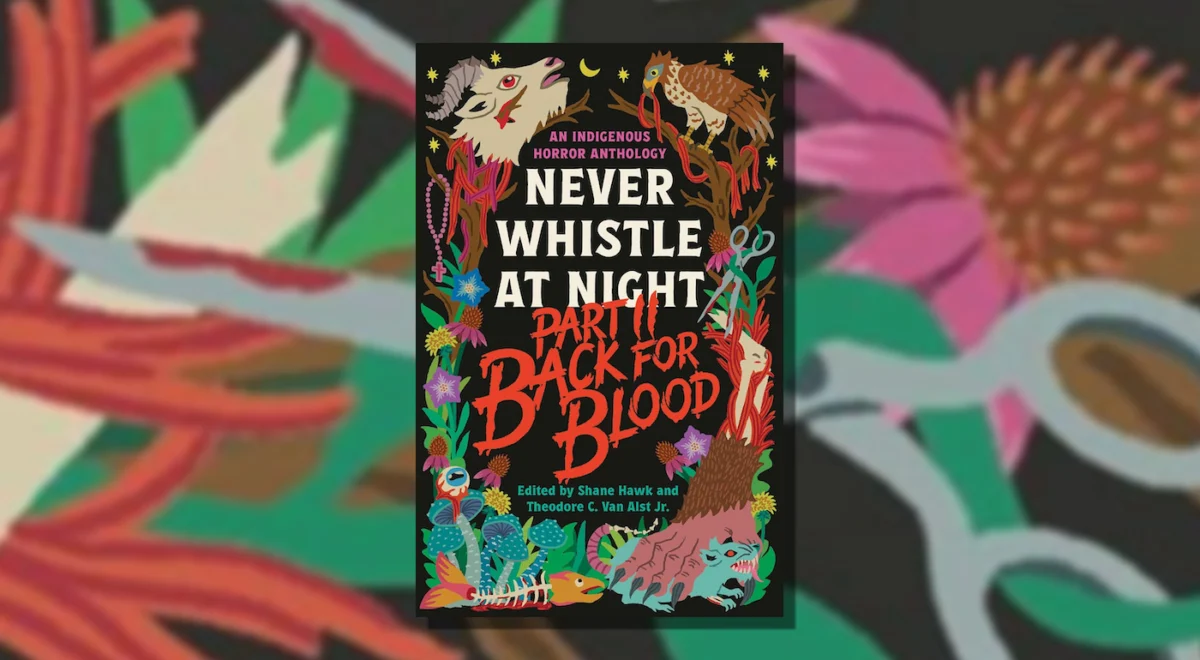
NEW YORK, NY – August 18th marks a pivotal moment in contemporary horror literature with the highly anticipated release of Back for Blood: Never Whistle at Night Part II. This groundbreaking anthology, co-edited by Shane Hawk and Theodore C. Van Alst Jr., promises to plunge readers into the chilling depths of Indigenous dark fiction, offering a potent blend of supernatural terror and the stark realities of colonial existence. Published by Vintage, the collection features twenty-one brand-new stories from a diverse array of established and emerging Indigenous literary talents, brought to life with illustrations by renowned Cheyenne and Arapaho painter Brent Learned.
Building on the critical and commercial success of its predecessor, Never Whistle at Night, this sequel arrives "hungry from the grave" to deliver "more dark delicacies for your delectation." The anthology unapologetically embraces horror in all its forms, from twisted psychological narratives to gore-filled monster hunts. Crucially, it positions these tales not merely as entertainment, but as profound explorations of "Indigenous survival and the enduring tradition of transforming adversity into art."
One of the collection’s most compelling entries, an excerpt of which has been shared, is "Neon Moon" by co-editor Theodore C. Van Alst Jr. This chilling short story offers a visceral, urban nightmare that deftly intertwines street-level gang life in Chicago with a terrifying, government-engineered monster, revealing the insidious and enduring legacy of colonial violence.
The Resurgence of Indigenous Dark Fiction
The original Never Whistle at Night made a significant impact by showcasing the rich, diverse, and often terrifying storytelling traditions of Indigenous peoples. Its success underscored a growing demand for authentic voices and perspectives within the horror genre, moving beyond stereotypical representations to explore complex cultural narratives and historical truths. Back for Blood amplifies this mission, presenting a new wave of stories that continue to challenge, provoke, and entertain.
The anthology’s description highlights a dual focus: confronting both "supernatural horrors and the everyday horror of living under colonialist rule." This thematic depth is a hallmark of Indigenous dark fiction, where monsters often serve as potent metaphors for historical trauma, systemic oppression, and the ongoing struggle for survival and cultural preservation. By explicitly connecting the monstrous to the colonial experience, the editors and contributors reclaim and redefine horror, transforming it into a powerful tool for social commentary and artistic expression. The inclusion of Brent Learned’s illustrations further enriches this cultural tapestry, providing visual interpretations that ground the terrifying narratives in Indigenous artistic traditions.
"Neon Moon": A Glimpse into Urban Indigenous Horror
Theodore C. Van Alst Jr.’s "Neon Moon" is a prime example of the anthology’s bold approach. Set in the gritty, neon-lit alleys of Chicago, the story immediately establishes a sense of urban realism, immersing the reader in the world of Joey, a young Native gangbanger. This grounded setting makes the eruption of the supernatural all the more disorienting and terrifying. Van Alst crafts a narrative that is both a relentless chase sequence and a profound commentary on the invisible struggles faced by Indigenous youth in modern cities.
Chronology of Terror: Joey’s Last Night in Chicago
The story opens with Joey in a frantic flight, his ragged breaths mirrored by an unseen pursuer. We learn he’s been running for a mile, navigating the familiar yet treacherous alleyways of Chicago’s Uptown district. The narrative flashes back to the evening’s genesis: Joey and his friends, Jimmy and Tommy, are on a fire escape behind the derelict Granada Theater, drinking beers and exchanging cynical banter about city life, including a recent newspaper report about a "Mothman." Joey’s world is one where real monsters are human—criminals, corrupt politicians, and brutal cops like "fat patrolman Squiggy" who once abused him by the lake. This established reality grounds the subsequent supernatural encounter in a chillingly familiar context of threat and vulnerability.
The turning point occurs when Joey witnesses a shadow briefly extinguish the moon. His friends dismiss it as clouds, but Joey, "on the Nation," insists on its reality. This minor disagreement foreshadows the horrifying truth they are about to face. Despite Joey’s unease, Jimmy and Tommy, fueled by alcohol, brazenly challenge the unseen entity, inviting consequences that Joey presciently warns them about.
The creature’s arrival is swift and brutal. It "hurtled straight at them from the deep dark," slamming into the fire escape. The description of its attack on Tommy is unflinching: claws biting deep into his chest, his face torn off, throat slashed open, blood arcing onto the building. The horror is visceral, immediate, and overwhelming. Joey’s assessment of the monster paints a vivid picture of a terrifying, bat-like entity: "crouched upright, gripping the rail with taloned feet on thin bowed legs," with a "massive" upper body, "broad-chested and heavily muscled," featuring "veiny boulders where its wings sprouted." Its "humanlike arms" end in "three-fingered hands tipped by thick black obsidian claws," and its "bloodred eyes glowed in what passed for a face, no emotion but hatred there." This is no mere cryptid; it is a force of pure, destructive malevolence.
The chase that ensues is a relentless, heart-pounding sequence. Joey shoves Jimmy down the stairs, gambling on the creature’s initial clumsiness on the metal slats. They briefly escape into the alley, but the monster’s "inhuman scream" and "roar of wings" pursue them. Jimmy, though fast, cannot match Joey’s desperate pace and becomes the next victim, his "muffled shriek and the loud snapping of bones announcing his exit from this mortal coil." Joey, swallowing his grief, focuses solely on survival, a testament to the primal instinct to live.
His desperate flight takes him through the labyrinthine streets and alleys of Chicago. He attempts a diversion, sacrificing "Wino Joe," an old man living in a cardboard box, by throwing a beer at him and cutting sharply into a gangway. The creature, drawn to the easier prey, pauses its pursuit of Joey, confirming its predatory intelligence and adding another layer of tragic realism to the horror. Inside an old apartment building, Joey briefly thinks he’s gained an advantage, but the monster’s "glistening bald head" and "longlong black wings" soon reappear, signaling its unrelenting pursuit.
The chase culminates on Lawrence Avenue. Joey, though the fastest among his friends, is no match for the Mothman’s "endurance beyond his world and genetically manipulated rage." The creature, tiring of the game, finally ends the pursuit with a powerful gust of its wings, knocking Joey down. The scene is set for his demise, but it is here that the story takes a profound and unexpected turn.

The Mothman Unveiled: A Weapon of Colonialism
What truly elevates "Neon Moon" beyond a simple monster story is the revelation of the Mothman’s origin. It is not a natural phenomenon or a creature of ancient myth in the traditional sense, but a product of "government experiments." The creature’s internal monologue reveals its chilling purpose: "brought to life to hunt down the last of the Indians and anyone associated with them." This monster is a literal embodiment of colonialist aggression, a "final solution" conceived after previous programs, such as the "Relocation in the ’50s and ’60s," failed to eradicate Indigenous communities.
The government’s twisted ingenuity extended to basing the creature on an "Indian legend," specifically the Animikii, the Thunderbird. This detail is crucial, as it highlights the colonial practice of appropriating and perverting Indigenous cultural elements for oppressive ends. By transforming a powerful, revered figure from Indigenous cosmology into a tool of terror, the colonizers sought to instill a deeper, more psychological fear—to make Indigenous people "obey in advance or give in prematurely." The addition of "scalpings, murder, and mayhem" was merely to "make their point," underlining the brutal, dehumanizing nature of this engineered horror.
This revelation transforms the story from a personal chase into a stark allegory for the historical and ongoing violence against Indigenous peoples. The "everyday horror of living under colonialist rule" is no longer a metaphor; it is literally manifested in a monstrous entity designed to perpetuate genocide. The Mothman represents the systemic, institutionalized nature of oppression, a constant, lurking threat that targets Indigenous lives.
A Glimmer of Humanity: The Monster’s Internal Conflict
Perhaps the most poignant and complex aspect of "Neon Moon" is the Mothman’s unexpected internal conflict. Despite being "engineered out of" the ability to feel "remorse and sadness," the creature experiences a "strange feeling, this empathy." This is attributed to the "military scientists’ own lack of humanity and sense of community," which inadvertently "fucked it up." Their inability to comprehend the depth of human connection and feeling meant they could not entirely erase it from their creation.
The Mothman remembers a time "before they’d forced him into the lab" when he was "human, a good person. A dad, a brother, a friend." This fleeting memory of his past self, juxtaposed with his current monstrous form and genocidal mission, creates a profound sense of tragedy. He questions if he can "let this one go, run free," a moment of moral struggle that humanizes the very instrument of terror.
In the final, agonizing moments, as the Mothman’s drool "slow-burned through his T-shirt," Joey looks up, sensing the "empathy" in the creature’s "fluttering eyes." He understands his fate and, with his "last breath," requests a swift end: "Do it already. Now." The Mothman, comprehending, leans in, tries to smile, and delivers a mercifully quick killing blow, a "shadow of memory forcing some empathy into his mind." This exchange, a silent communication between predator and prey, victim and perpetrator, is a powerful moment of shared, albeit tragic, humanity. It suggests that even in the most engineered forms of evil, a fragment of human essence, however distorted, can persist.
Themes and Broader Implications
"Neon Moon", and by extension Back for Blood, delves into several critical themes relevant to Indigenous experiences and contemporary society:
- Horror as Historical Allegory: The story brilliantly uses the horror genre to represent the historical violence and ongoing systemic oppression faced by Indigenous communities. The Mothman is not just a monster; it is a manifestation of colonial policies and the trauma they inflict.
- Urban Indigenous Identity: Joey’s character grounds the narrative in the specific realities of urban Indigenous youth. His street smarts, his gang affiliations, and his connection to the American Indian Center all paint a picture of a community navigating a complex, often hostile, urban landscape. The story subtly highlights the invisibility of these struggles in mainstream society, as "no one would come to that window to watch him die."
- Reclaiming Narrative: By reinterpreting the Mothman legend through an Indigenous lens and exposing its colonial origins, the story reclaims a narrative often co-opted or simplified. It challenges dominant historical accounts and asserts Indigenous agency in storytelling.
- The Persistence of Humanity: The Mothman’s internal struggle with empathy, despite its engineered purpose, speaks to the enduring nature of human connection and morality, even in the face of profound dehumanization. It suggests that the spirit of community and compassion, deeply valued in many Indigenous cultures, cannot be entirely extinguished.
- The Unseen and Unacknowledged: The concluding lines are particularly poignant: "But like most vignettes in the city, there was no one to see anything, no one to capture a moment that was a blip in the life of a metropolis that writhed and churned through the years, its minutes recorded for all to see somewhere, to be sure, but ones that few if any bothered to review." This underscores the broader societal tendency to ignore or trivialize the suffering of marginalized communities, reducing profound tragedies to mere footnotes in the urban churn or sensationalized newspaper headlines.
Official Responses and Societal Relevance
While "Neon Moon" is a work of fiction, its themes resonate deeply with ongoing discussions about truth, reconciliation, and the recognition of historical injustices against Indigenous peoples. The concept of a government-engineered monster designed to eliminate a population group echoes the dark chapters of history, including forced assimilation, genocidal policies, and the systemic dismantling of Indigenous cultures.
In recent years, there has been increasing public and governmental acknowledgment of past wrongs, such as the residential school systems in Canada and the United States, and the enduring impacts of colonialism. Works like "Neon Moon" contribute to this broader dialogue by using the compelling medium of horror to expose these painful truths. They serve as a powerful artistic response, transforming the "adversity into art" that the anthology champions.
The demand for Indigenous dark fiction signifies a growing societal hunger for stories that are authentic, challenging, and reflective of diverse experiences. It pushes back against monolithic narratives and demands space for perspectives that have historically been marginalized or silenced. Publishers like Vintage, by supporting anthologies such as Back for Blood, play a crucial role in amplifying these voices and fostering a more inclusive literary landscape.
Conclusion
Back for Blood: Never Whistle at Night Part II stands as a vital continuation of a movement within literature to center Indigenous voices in the horror genre. Theodore C. Van Alst Jr.’s "Neon Moon" is a masterful, unsettling narrative that exemplifies the anthology’s core strengths: a compelling blend of urban realism and supernatural dread, a fearless engagement with the trauma of colonialism, and a nuanced exploration of humanity, even within the monstrous.
As readers delve into these twenty-one new stories, they will find themselves not only entertained by tales of "unspeakable yet satisfying terror" but also challenged to confront uncomfortable truths about history, power, and the enduring resilience of Indigenous peoples. This anthology is more than just a collection of scary stories; it is a testament to survival, a reclamation of narrative, and a powerful artistic response to generations of adversity. It promises to "sate your darkest appetites and leave you slavering for more," while simultaneously enriching the cultural discourse around Indigenous identity and experience.