
Uncanny Magazine Defies Publishing Headwinds with Record-Breaking Award Nominations, Championing Community Resilience
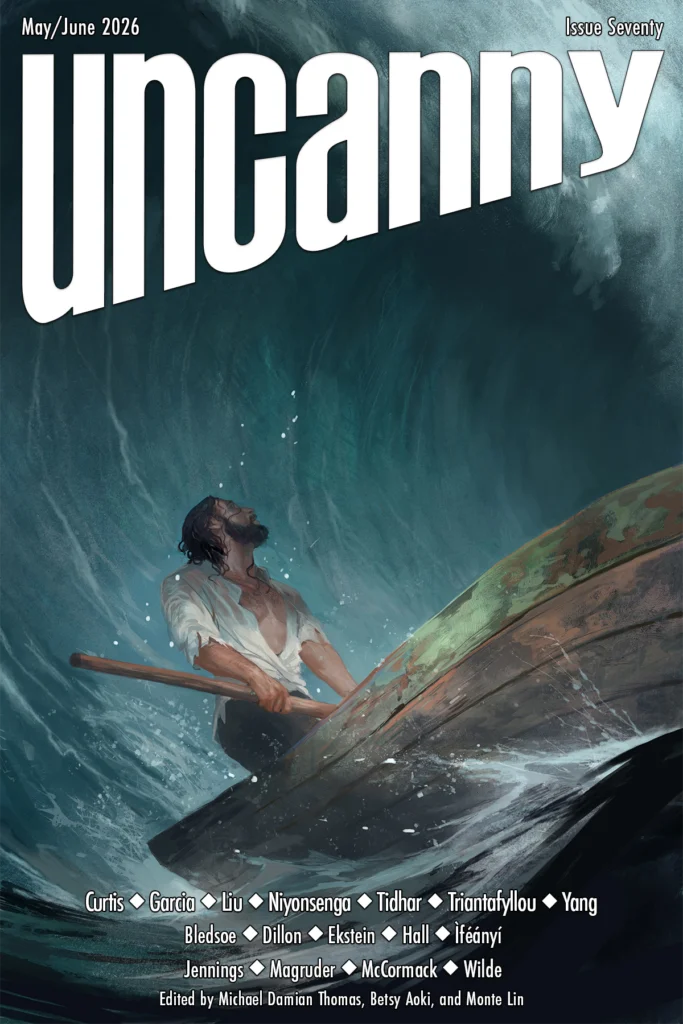
SEATTLE, WA – In an era where the publishing industry grapples with ever-increasing precarity, Uncanny Magazine, a celebrated online publication for Science Fiction and Fantasy, stands as a beacon of resilience and community spirit. The magazine and its dedicated team have recently garnered an unprecedented array of prestigious award nominations, including multiple nods for the Hugo, Nebula, Aurora, and British Science Fiction Association (BSFA) Awards, all while preparing for the release of its 70th issue. This wave of recognition arrives amid a candid reflection from Editor-in-Chief Michael Damian Thomas, who underscores the vital role of community in safeguarding the future of genre publishing.
Thomas, acknowledging a personal journey through significant life changes and the pervasive pessimism of current global events, revealed an initial editorial draft steeped in frustration over the precarious nature of the publishing landscape. However, drawing inspiration from the enduring positivity of his late daughter, Caitlin, he pivoted to focus on a powerful source of hope: the uniquely community-driven infrastructure of Science Fiction and Fantasy awards. This ethos, he argues, is not only a testament to the genre’s collaborative spirit but also a critical lifeline for its independent publications.
A Chronology of Accolades and Creative Output
The period leading up to the release of Uncanny Magazine Issue 70 has been marked by a cascade of significant nominations, highlighting the exceptional quality and impact of its published works and the tireless efforts of its editorial team. These accolades affirm Uncanny Magazine‘s position as a leading voice in contemporary speculative fiction.
March 2026: Nebula Award Finalists Announced
The Science Fiction and Fantasy Writers Association (SFWA) announced the finalists for the prestigious 2026 Nebula Awards, with Uncanny Magazine securing four nominations for works published in 2025. Eugenia Triantafyllou’s novelette, “The Life and Times of Alavira the Great as Written by Titos Pavlou and Reviewed by Two Lifelong Friends,” was nominated for Best Novelette. J. R. Dawson’s “Six People to Revise You” earned a nomination for Best Short Story. Additionally, two poems from Uncanny Magazine were recognized: Mari Ness’s “Care for Lightning” and Angela Liu’s “The Mourning Robot,” both finalists for Best Poem. The winners of the Nebula Awards are scheduled to be announced at the 2026 Nebula Conference and Awards, held from June 3-7, 2026, at the Crowne Plaza Chicago O’Hare Hotel & Conference Center in Chicago, IL, with virtual attendance options available.
April 2026: British Science Fiction Association Award Recognition
Shortly after the Nebula announcements, “The Life and Times of Alavira the Great as Written by Titos Pavlou and Reviewed by Two Lifelong Friends” by Eugenia Triantafyllou received another significant nod, becoming a finalist for the British Science Fiction Association Award for Best Short Fiction. This nomination further underscores the international appeal and critical acclaim for Uncanny Magazine‘s content. The BSFA Awards, presented annually since 1970, are voted on by members of the British Science Fiction Association and attendees of Eastercon, the national Science Fiction convention.
May 2026: Aurora Awards Celebrate Canadian Talent
The Canadian Science Fiction and Fantasy Association (CSFFA) unveiled the finalists for the 2026 Aurora Awards, recognizing works by Canadian creators published in 2025. Uncanny Magazine saw two of its pieces nominated: Silvia Moreno-Garcia’s novelette, “The Lure of Stone,” as a finalist for the Best Novelette/Novella Aurora Award, and Ejiwa “Edge” Ebenebe’s evocative cover art for Listen To Me And I’ll Tell You A Story (featured in Uncanny Magazine Issue Sixty-Six) as a finalist for Best Cover Art/Interior Illustration. The Aurora Awards ceremony is slated for an online broadcast on Sunday, August 9th, 2026, at 5 PM EDT, hosted by Mark Leslie Lefebvre and Elizabeth May Anderson.
May 2026: Hugo Award Finalists – A Banner Year
The crowning achievement of this awards season came with the announcement of the 2026 Hugo Award finalists, where Uncanny Magazine secured an impressive nine nominations. Five individual stories were recognized: Scott Lynch’s “Kaiju Agonistes,” Catherynne M. Valente’s “When He Calls Your Name,” and Sarah Pinsker’s “The Millay Illusion,” all nominated for Best Novelette. J. R. Dawson’s “Six People to Revise You” and Samantha Mills’s “10 Visions of the Future; or, Self-Care for the End of Days” were finalists for Best Short Story. Adding to this remarkable tally, Mari Ness’s “Care for Lightning” and Angela Liu’s “The Mourning Robot” both received nominations for Best Poem. Beyond individual works, Uncanny Magazine itself (Publisher/Editor-in-Chief Michael Damian Thomas, Managing Editor Monte Lin, Poetry Editor Betsy Aoki, and Podcast Producers Erika Ensign and Steven Schapansky) was once again named a finalist for Best Semiprozine. Furthermore, Michael Damian Thomas personally received a nomination for the Best Editor Short Form Hugo Award, recognizing his editorial prowess. The winners of the Hugo Awards will be announced at a live ceremony during LAcon V, the World Science Fiction Convention, on August 30, 2026. Voting on the final ballot is set to commence in early May for all members of the World Science Fiction Convention.
May 2026: Uncanny Magazine Issue 70 Released
Amidst this flurry of nominations, Uncanny Magazine proudly unveiled its 70th issue, a fresh collection of speculative fiction, essays, poetry, and interviews. The issue features the stunning cover art, Ocean Swell, by Julie Dillon. New fiction includes “The Snatchers” by Eugenia Triantafyllou, “The Glass City” by AnaMaria Curtis, “Extracted from an unravelled braid” by Aline-Mwezi Niyonsenga, “Immigrant Girl from the End of the World” by Hannah Yang, “Magical Girl Eater” by Angela Liu, “#HumansOfMars” by Lavie Tidhar, and “Lincoln and the Harvester C-100” by R. S. A. Garcia.
Thought-provoking essays delve into diverse topics: Una McCormack’s “The End of This Day’s Business—Or, My Life as Repetitive Epic,” Alex Bledsoe’s “The Mopey Ghost Nightmare Girl: The Character of Hari in Three Filmed Versions of Stanislaw Lem’s Solaris,” Alex Jennings’ “An Absolute Crisis: DC’s Big 7 Have Been Stripped Down and Relaunched for the Present Age,” and Nilah Magruder’s “Nature, Monsters, and the Responsibility of Larger Things.”
The issue’s poetry selection features “A Mermaid Looks at 40” by Fran Wilde, “Empty Music” by Prosper Åféeányí, “Quorum” by Ceridwen Hall, and “electric in the silver stormchain that burst behind my wings” by S. R. Ekstein. Accompanying these works are interviews with AnaMaria Curtis and Angela Liu by Caroline M. Yoachim. The Uncanny Magazine Podcast offers audio renditions of select stories and poems, alongside interviews with their creators, ensuring multi-platform engagement.
Supporting Data: The Power of Community in a Precarious Industry
Michael Damian Thomas’s reflections on the publishing industry resonate deeply with current challenges facing independent literary magazines and genre publications. The digital age, while offering new avenues for dissemination, has simultaneously fragmented readership, intensified competition for attention, and put immense pressure on traditional revenue models. Advertising revenues have dwindled, subscription models face stiff competition from free content, and the sheer volume of material available can overwhelm even dedicated readers. For niche genres like Science Fiction and Fantasy, maintaining a financially viable publication often feels like a constant uphill battle against economic realities.
In this context, Thomas identifies the Science Fiction and Fantasy awards as a unique antidote to industry anxieties. Unlike many other sectors where industry elites or corporate entities solely dictate recognition, the SF/F awards are predominantly grassroots, community-driven endeavors.
- Volunteer Administration: Most awards, from the Hugos to the Rhyslings, are administered by dedicated volunteers who pour their time and passion into organizing the nomination and voting processes. This intrinsic motivation ensures the awards remain tethered to the community’s values rather than commercial imperatives.
- Reader and Creator-Driven Selection: The core principle is that the community itself—readers, writers, and fans—chooses the finalists and winners. The Hugo Awards are decided by Worldcon members, the Nebula Awards by members of the SFWA, and the Rhyslings by the Science Fiction Poetry Association (SFPA) members. Even awards like the Locus Awards and Ignyte Awards leverage free online voting, democratizing the process.
- Engagement and Discussion: This participatory model fosters vibrant discussion and active engagement. Readers are encouraged to read, discuss, and champion works they believe in, creating a dynamic ecosystem of literary discovery and appreciation. Thomas emphasizes this as "fucking phenomenal," a stark contrast to industries where consumer influence is often limited to purchasing decisions.
This communal spirit extends beyond awards to the very survival of magazines like Uncanny. Thomas’s heartfelt appeal to the "Space Unicorns" – Uncanny Magazine‘s dedicated readership – highlights the critical role of financial support mechanisms such as Patreon, Weightless Books Subscriptions, and yearly Kickstarter campaigns. He argues that as long as there exists a community of readers who "love and need these stories, poems, essays, interviews, art, and podcasts," Uncanny Magazine and SF/F magazines as a whole will endure. This sentiment echoes the historical resilience of SF/F magazines, which have faced and overcome predictions of their demise since at least the 1950s.
Official Responses and Editorial Gratitude
The official press releases from the various award bodies underscore the democratic and community-centric nature of these accolades.
- Los Angeles Worldcon (LAcon V): "All members of the World Science Fiction Convention are able to vote on the Hugo Awards, including those who have memberships in the virtual portion of the convention." This ensures broad participation in selecting the genre’s most prestigious literary awards.
- Canadian Science Fiction and Fantasy Association (CSFFA): "The Aurora Awards are nominated by members of the Canadian Science Fiction and Fantasy Association. The top five nominated works were selected." This outlines a clear, community-driven nomination and selection process for Canadian speculative fiction.
- Science Fiction and Fantasy Writers Association (SFWA) via Locus Magazine: Details regarding the Nebula Conference and Awards confirm the event’s dual physical and virtual presence, ensuring accessibility for its members to celebrate and vote.
- British Science Fiction Association (BSFA): "The awards are voted on by members of the British Science Fiction Association and by the members of the year’s Eastercon, the national Science Fiction convention." This dual voting mechanism reinforces the broad community consensus behind the BSFA Awards.
Michael Damian Thomas, reflecting on the numerous nominations, expressed profound gratitude: "We are honored, ecstatic, and overwhelmed. Thank you to everyone who nominated these works, and to the hard-working Los Angeles Worldcon staff." He extended congratulations to all finalists, particularly highlighting the many Uncanny authors and friends who received recognition, reinforcing the collaborative and supportive nature of the SF/F community. His concluding remarks, "I will do my best to keep editing and publishing a magazine that values having this spectacular community. Shine on, Space Unicorns!" serve as both a personal pledge and a rallying cry to the readership.
Implications for Uncanny Magazine and the SF/F Landscape
The unprecedented number of award nominations for Uncanny Magazine and its contributors carries significant implications, not only for the publication itself but for the broader Science Fiction and Fantasy landscape and independent publishing as a whole.
For Uncanny Magazine, these nominations represent a powerful validation of its editorial vision, its commitment to publishing diverse and high-quality speculative fiction, poetry, and non-fiction, and the tireless efforts of its entire team. Such widespread recognition elevates its profile within the genre, attracting new readers and submissions, and reinforcing its reputation as a leading light in the field. The inclusion of the magazine itself for Best Semiprozine and Michael Damian Thomas for Best Editor Short Form speaks volumes about the consistency and excellence of their work. This critical acclaim also strengthens the argument for continued financial support from its "Space Unicorns," demonstrating that their contributions directly translate into award-winning content.
More broadly, Uncanny Magazine‘s success underscores the enduring vitality and dynamism of the Science Fiction and Fantasy genre. In an age often characterized by doom-and-gloom predictions for print media and niche publications, the robust, community-driven support systems within SF/F stand out. The democratic nature of the awards, where the readership and creative community actively participate in recognizing excellence, ensures that the genre remains responsive to its audience and its evolving artistic standards. This model offers a potential blueprint for other niche cultural industries struggling with similar challenges, demonstrating that collective passion and engagement can indeed create sustainable ecosystems for creative endeavors.
The narrative woven by Michael Damian Thomas, moving from personal frustration to collective hope, serves as an inspiring reminder that even in the face of daunting industry pressures, the power of community, shared values, and a commitment to quality can not only sustain but allow publications to thrive. As Uncanny Magazine continues to push boundaries and earn accolades, it reinforces the optimistic vision that as long as there are stories to be told and a community eager to consume and champion them, the future of speculative fiction magazines remains bright.



Leave a Comment