Redefining the Virtual Court: Just Hoops 2.0 and the Future of Controller-Free Sports
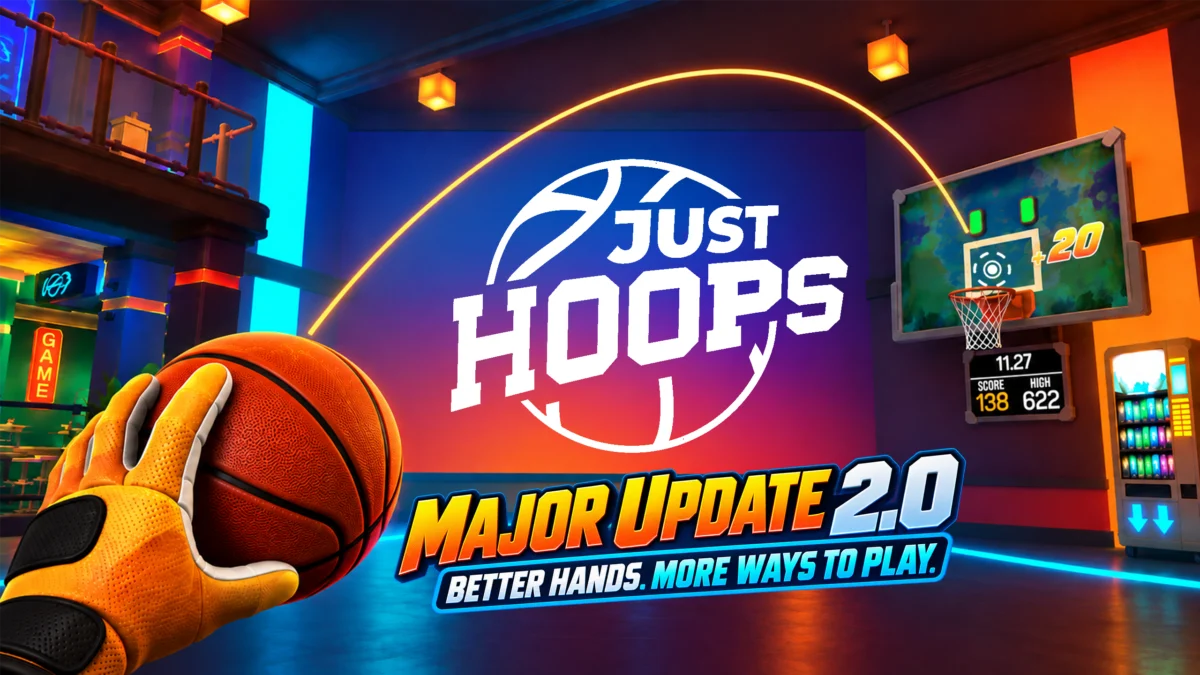
The landscape of virtual reality (VR) sports is undergoing a transformative shift, moving away from the tactile reliance on plastic controllers and toward the intuitive fluidity of human movement. This week, in a strategic alignment with the Meta Connect 2024 event, developer Realcast launched the highly anticipated Just Hoops 2.0 update. This overhaul represents more than a simple content patch; it is a fundamental reimagining of the basketball experience, optimized for Meta’s latest hand-tracking technology and designed to bridge the gap between casual arcade fun and realistic sports simulation.
As Meta unveils its vision for the future—headlined by the controller-free "Orion" AR glasses and the budget-friendly Quest 3S—Just Hoops 2.0 serves as a flagship example of how developers are adapting to a "hands-first" ecosystem.
I. Main Facts: The 2.0 Overhaul
The Just Hoops 2.0 update is a comprehensive reconstruction of the game’s core mechanics, social features, and visual fidelity. At its heart, the update prioritizes accessibility and immersion through advanced hand-tracking integration.
Core Enhancements at a Glance:
- Dual Shooting Systems: Introduction of "Natural Shot" (physics-based) and "Pointer Shot" (gesture-based) to cater to different skill levels and physical abilities.
- Mixed Reality (MR) Integration: A new "Trickshots" mode that utilizes the Quest’s passthrough capabilities to turn the user’s physical environment into a customized basketball playground.
- Social and Competitive Play: Enhanced online matchmaking and private room support for up to four players.
- Progression and Content: A redesigned user interface (UI), a new 1970s-inspired retro environment, and a refined "Zen Mode" for low-pressure practice.
- Platform Availability: Currently live on the Meta Quest Store, with the status of the SteamVR version remaining unconfirmed.
The update arrives at a critical juncture for Meta. By incentivizing developers like Realcast to embrace controller-free input, Meta is preparing its user base for a future where hardware becomes increasingly invisible, and the user’s body becomes the primary interface.
II. Chronology: From Player Feedback to Meta Partnership
The journey to Just Hoops 2.0 began shortly after the game’s initial success on the Quest platform. While the original version was praised for its nostalgic arcade feel, player feedback consistently highlighted a desire for more realistic shooting mechanics and better hand-tracking support.
The Development Timeline:
- Late 2023: Realcast begins a year-long development cycle dedicated to rebuilding the game’s physics engine. The goal was to solve the "release problem"—the notorious difficulty of accurately timing the release of a virtual object using only hand tracking.
- Early 2024: Meta identifies Just Hoops as a key candidate for its hand-tracking showcase. Meta provides technical support and resources to ensure the game leverages the latest Presence Platform features, including high-frequency hand tracking and improved occlusion handling.
- Mid-2024: Beta testing of the "Natural Shot" mechanic reveals that while realism is desired, pure physics can be frustrating. Realcast introduces a tiered "assist" system to balance authenticity with playability.
- September 2024: The 2.0 update is synchronized with Meta Connect. This timing was intentional, serving as a software demonstration of the hardware capabilities Meta discussed during its keynote, specifically the transition toward hands-only interaction.
III. Supporting Data: The Mechanics of Virtual Shooting
To understand the significance of the 2.0 update, one must look at the technical granularity of the new shooting modes. Realcast has implemented a sophisticated scoring and assist system that rewards skill while maintaining a "low floor, high ceiling" entry point.
The "Natural Shot" Tiered System
The "Natural Shot" mode is the centerpiece of the 2.0 update. It requires the player to mimic the actual biomechanics of a jump shot or a free throw. To mitigate the inherent latency of current VR hardware, the game offers optional assists. However, these assists come with a mathematical trade-off in the scoring system:
- Unassisted (Pro): Rewards up to 8 points per basket. This mode relies entirely on the player’s release angle, velocity, and arc.
- Moderate Assist: Rewards 4–6 points. Provides a slight magnetic pull toward the rim if the shot is within a reasonable margin of error.
- High Assist: Rewards 3 points. Focuses on the "fun factor," ensuring most well-aimed shots find the net.
The "Pointer Shot" and Accessibility
For players with limited mobility, those playing in a seated position, or casual users looking for a relaxed experience, the Pointer Shot offers a gesture-based alternative. By pointing at the hoop and performing a simple flicking motion, players can trigger a shot. This mode is capped at 2 points per basket to maintain competitive integrity in global leaderboards.
Mixed Reality and Environmental Data
The "Trickshots" mode represents a significant leap in MR utility. By utilizing the Quest’s spatial anchors and scene mesh, players can:
- Place virtual hoops on real-world walls.
- Bounce virtual balls off real-world furniture (couches, tables, etc.).
- Create complex "Rube Goldberg" style trick shots that integrate the physical and digital worlds.
IV. Official Responses: The Developer’s Vision
Realcast has been vocal about the collaborative nature of this update. In statements accompanying the release, the developer emphasized that Just Hoops 2.0 is a direct response to the community’s evolution.
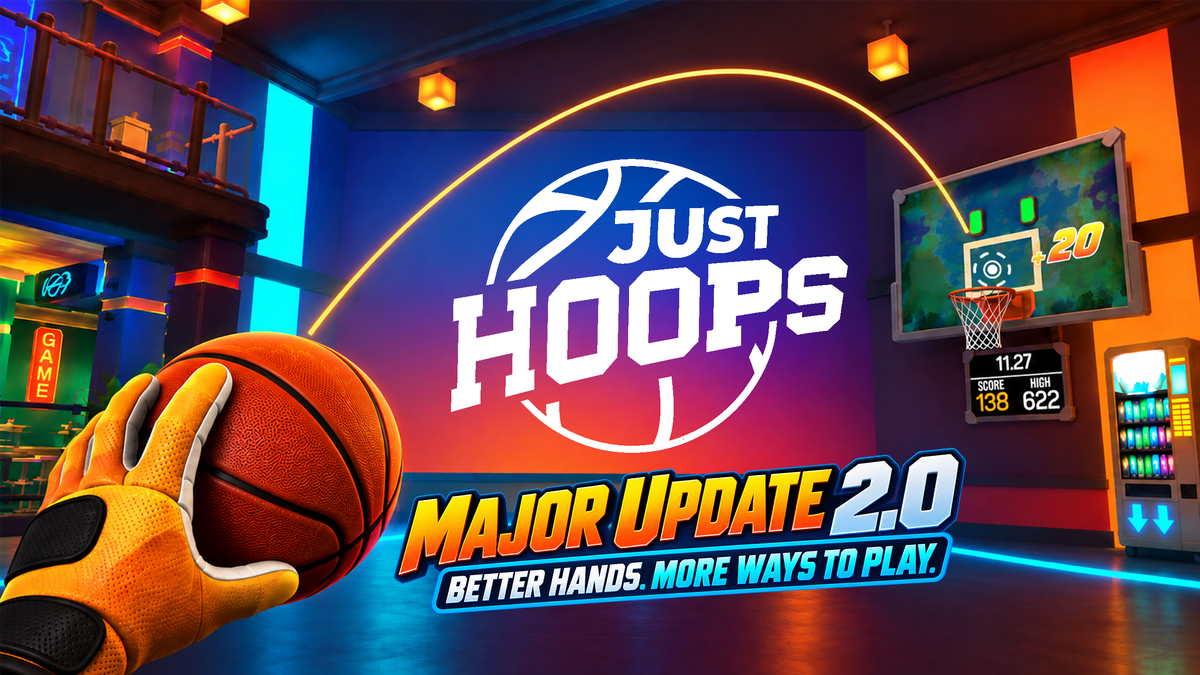
"We spent the last year listening," a spokesperson for Realcast noted. "The challenge of VR basketball has always been the ‘feel’ of the ball leaving your hand. With the support of Meta and the advancements in their hand-tracking SDK, we’ve been able to create a system that feels closer to the real thing than ever before."
Meta’s involvement is equally telling. Industry analysts suggest that Meta’s "vested interest" in this update stems from their broader hardware roadmap. By funding and supporting high-quality hand-tracking updates, Meta is building a software library that will be compatible with future "controller-less" devices. The 2.0 update serves as a proof of concept: if a high-speed, precision-heavy sport like basketball can be played successfully with hands alone, then the necessity of controllers for general spatial computing is significantly diminished.
V. Implications: The Future of VR Sports and Spatial Computing
The release of Just Hoops 2.0 carries weight far beyond the confines of a single game. It signals several major shifts in the XR (Extended Reality) industry.
1. The Death of the Controller?
While controllers remain essential for haptic feedback and complex button mapping in "hardcore" gaming, Just Hoops 2.0 proves that sports and fitness apps are moving toward a controller-free standard. This reduces the barrier to entry for non-gamers who may find traditional VR controllers intimidating or unintuitive.
2. The Gamification of Reality
The "Trickshots" MR mode is a harbinger of how we will soon interact with our living spaces. As AR/VR headsets become lighter and more transparent, the ability to overlay "playable" layers onto the physical world will become a standard feature of home entertainment. Just Hoops is an early adopter of the "Nothing But Net" nostalgia—referencing the iconic 90s commercials—but applying it to a modern, interactive medium.
3. Platform Divergence
The uncertainty regarding the SteamVR version of Just Hoops 2.0 highlights a growing rift in the VR market. As Meta pushes toward specialized features like hand tracking and MR (which are hardware-dependent), cross-platform development becomes increasingly difficult. SteamVR, which largely relies on tracked controllers (Valve Index, Vive), may struggle to keep pace with the "hand-first" software innovations happening within the Meta ecosystem.
4. Quality of Life as a Retention Strategy
The inclusion of a Zen Mode and a 1970s-inspired retro environment shows a maturing understanding of player psychology. By removing the "pressure to perform," Realcast is positioning Just Hoops not just as a game, but as a "hangout" space. This aligns with the broader trend of "cozy gaming" and social VR, where the environment is just as important as the mechanics.
Conclusion
Just Hoops 2.0 is a landmark update that successfully navigates the difficult transition from traditional input to the future of spatial interaction. By balancing the demands of hardcore simulation with the accessibility of gesture-based play, Realcast has created a blueprint for the next generation of VR sports titles.
As Meta continues to iterate on its hardware, the success of titles like Just Hoops will be the barometer by which we measure the viability of a controller-free future. For now, players on the Quest can step onto the virtual court, leave their controllers on the desk, and experience the simple, tactile joy of "nothing but net"—all with the wave of a hand.