
Satire in the Age of Polarization: The Evolution of Political Commentary at ‘Comic Strip of the Day’
The landscape of American political satire is undergoing a significant transformation as the divide between traditional editorial neutrality and pointed advocacy continues to blur. In a move that highlights the growing tension within the media industry, Mike Peterson, the long-time author of the "Comic Strip of the Day" (CSotD) column, has officially announced the implementation of a formal disclaimer for his work. The decision marks a pivotal moment for the platform, which has served as a cornerstone of cartooning analysis since 2010.
Peterson’s decision to draw a clear line between his personal political trajectory and the non-partisan mission of the host website reflects a broader trend in journalism: the abandonment of "both-sides-ism" in favor of what many commentators describe as a "truth-oriented" or "crisis-responsive" approach. As the nation grapples with deep-seated ideological fractures, the role of the editorial cartoonist—and the critics who analyze them—has shifted from mere entertainment to a frontline battle for narrative dominance.
The Core Mandate: Defining the New Disclaimer
At the heart of this development is a new editorial policy intended to preserve the integrity of the CSotD platform. For over a decade, the site has operated under a pro-cartoon, non-partisan banner. However, Peterson acknowledged that his recent output has adopted an "increasingly progressive stance," a shift noted by both the author and his readership.
The new disclaimer serves as a structural "firewall." It clarifies that while the site remains a neutral ground for the appreciation of the art form, the analysis provided in the daily columns represents the specific, subjective viewpoint of the author. Peterson’s rationale is rooted in a rejection of the "pure statement of fact" claim often made by political columnists. By admitting to a personal bias, Peterson argues he is providing more transparency than those who mask their opinions behind a veneer of objective reporting.
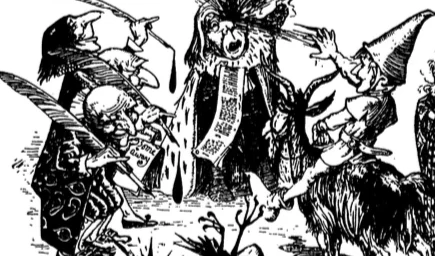
This move is particularly significant given the historical context of the column. Peterson has long utilized H.J. Ford’s illustration from Blockhead Hans as a logo—a nod to the traditional role of the satirist as a "giggling reporter" who points out the absurdities of power. However, Peterson notes that the current political climate has rendered "giggles" insufficient, suggesting that the United States is in a "very serious crisis" that demands a more assertive form of commentary.
Chronology of a Shift: From Neutrality to Advocacy
The evolution of Peterson’s editorial philosophy can be traced through the selection and rejection of specific cartoons over recent months. His methodology reveals a rigorous, if admittedly biased, vetting process that distinguishes between "personal insults" and "anchored political opinion."
The Trump-Narcissism Dilemma
In analyzing recent works by cartoonists like Jack Ohman, Peterson highlighted the difficulty of critiquing a figure like Donald Trump. While he considered using cartoons that focused on Trump’s narcissism, he ultimately passed on several, citing them as "personal insults" rather than political critiques. This distinction is a key component of Peterson’s editorial evolution: the belief that for a cartoon to be valuable, it must link a personality trait to a specific policy or public statement.
The Fauci and RFK Jr. Contrast
The timeline of Peterson’s recent commentary also shows a hardening stance against what he perceives as "anti-science" rhetoric. He recently rejected a cartoon targeting Dr. Anthony Fauci regarding the hantavirus, labeling it an "irrelevant" personal attack on a retired official.
Conversely, he has leaned into critiques of Robert F. Kennedy Jr. (RFK Jr.). Peterson’s background—which includes several semesters of the History of Science—informs his view that RFK Jr. represents a "hazard" to public health. By comparing current political appointments to the Saturday Night Live character Theodoric of York, Medieval Barber, Peterson illustrates his shift from objective observer to a commentator concerned with the "scary" reality of modern governance.
The Global Stage: Xi, Trump, and Taiwan
The shift in Peterson’s tone is perhaps most evident in his analysis of international relations. He recently critiqued the work of cartoonist Steve Kelley regarding the summit between Donald Trump and Chinese President Xi Jinping. While some cartoonists portrayed the meeting as a rapprochement, Peterson sided with those, like Bennett, who characterized the interaction as an imbalance between a calculated world leader (Xi) and a leader driven by "personal considerations" (Trump). This indicates a move toward "realpolitik" analysis, where the columnist prioritizes the strategic implications of Taiwan and global power dynamics over the "feel-good" narratives of diplomatic summits.
Supporting Data: The Logistics of Selection
Peterson’s editorial process is not merely a matter of taste; it involves a data-driven look at the relevance and accuracy of the cartoons in question. This is exemplified in his treatment of a recent cartoon by Stiglich regarding a California mayor accused of being a Chinese operative.
Peterson conducted a "deep dive" into the facts, discovering that the mayor of Arcadia, California, had indeed resigned over such allegations. However, he used demographic data to justify his decision to "pass" on the cartoon:
- Arcadia Population: 54,000
- Los Angeles County Population: 9.7 million
- California Population: 39.3 million
His conclusion was that the story, while factually true, lacked the national "weight" to justify a broader political commentary. This suggests that even within his progressive shift, Peterson maintains a journalistic filter based on scale and impact.
Official Responses and Site Integrity
The official stance of "Comic Strip of the Day" remains one of open dialogue. While Peterson’s opinions are now explicitly labeled as his own, the platform continues to welcome comments that either agree or disagree with his assessments. This "open-door" policy is a strategic attempt to maintain a community of readers across the political spectrum, even as the primary content provider takes a side.
The site’s management (and Peterson himself) appears to be betting on the idea that readers value "authentic bias" over "feigned neutrality." In the modern digital age, where algorithms often silo users into echo chambers, CSotD is attempting a difficult balancing act: providing a specific viewpoint while maintaining a space for the "opposition" to engage.
Implications for the Future of Satire
The implementation of the disclaimer at CSotD has several long-term implications for the field of editorial cartooning and political commentary.
1. The Death of the "Neutral Observer"
Peterson’s admission that it is "no time for ‘on the one hand, on the other’ neutrality" reflects a growing sentiment among journalists. In a period defined by what many see as existential threats to democratic institutions, the traditional "view from nowhere" is increasingly viewed as an abdication of responsibility. The implication is that satire must now be a tool for defense rather than just a mirror of absurdity.
2. The Rise of "Scientific" Commentary
By citing his education in the History of Science to justify his critiques of RFK Jr., Peterson is signaling a move toward "expert-led" satire. This suggests that future political commentary may rely more heavily on academic and historical context to debunk what columnists perceive as "nonsensical" or "dangerous" populist rhetoric.
3. The Challenge of "Partisan Nonsense"
Peterson’s harsh critique of cartoonists like Branco—whose work he dismissed as "nonsensical" rather than just partisan—highlights a growing intolerance for "loyalist" satire. He argues that when a cartoonist suggests a political figure is "doing Jesus’s work," they move out of the realm of political opinion and into the realm of the irrational. The implication for the industry is a widening gap between "analytical satire" and "tribal iconography."
4. The "My House, My Rules" Doctrine
The new disclaimer reinforces the authority of the curator. By stating "My house, my rules," Peterson asserts that the selection of cartoons is an editorial act in itself. This places a higher premium on the curator of content, who acts as a gatekeeper in an era of information overload.
Conclusion
Mike Peterson’s decision to add a disclaimer to his "Comic Strip of the Day" columns is more than a simple administrative change; it is a manifesto for a new era of political commentary. By acknowledging his progressive lens, Peterson is challenging his peers to be equally transparent about their own biases.
As the 2024 election cycle approaches and global tensions rise, the role of the editorial cartoonist and the critic will likely become even more polarized. Whether this transparency will foster better dialogue or further entrench readers in their respective camps remains to be seen. However, for Peterson and the readers of CSotD, the "Blockhead Hans" era of simple giggles has officially come to an end, replaced by a more somber, pointed, and admittedly partisan pursuit of the truth.

Leave a Comment