The Fragile Majesty of the Avian World: How ‘The Paper Ark’ Redefines Conservation Through Art
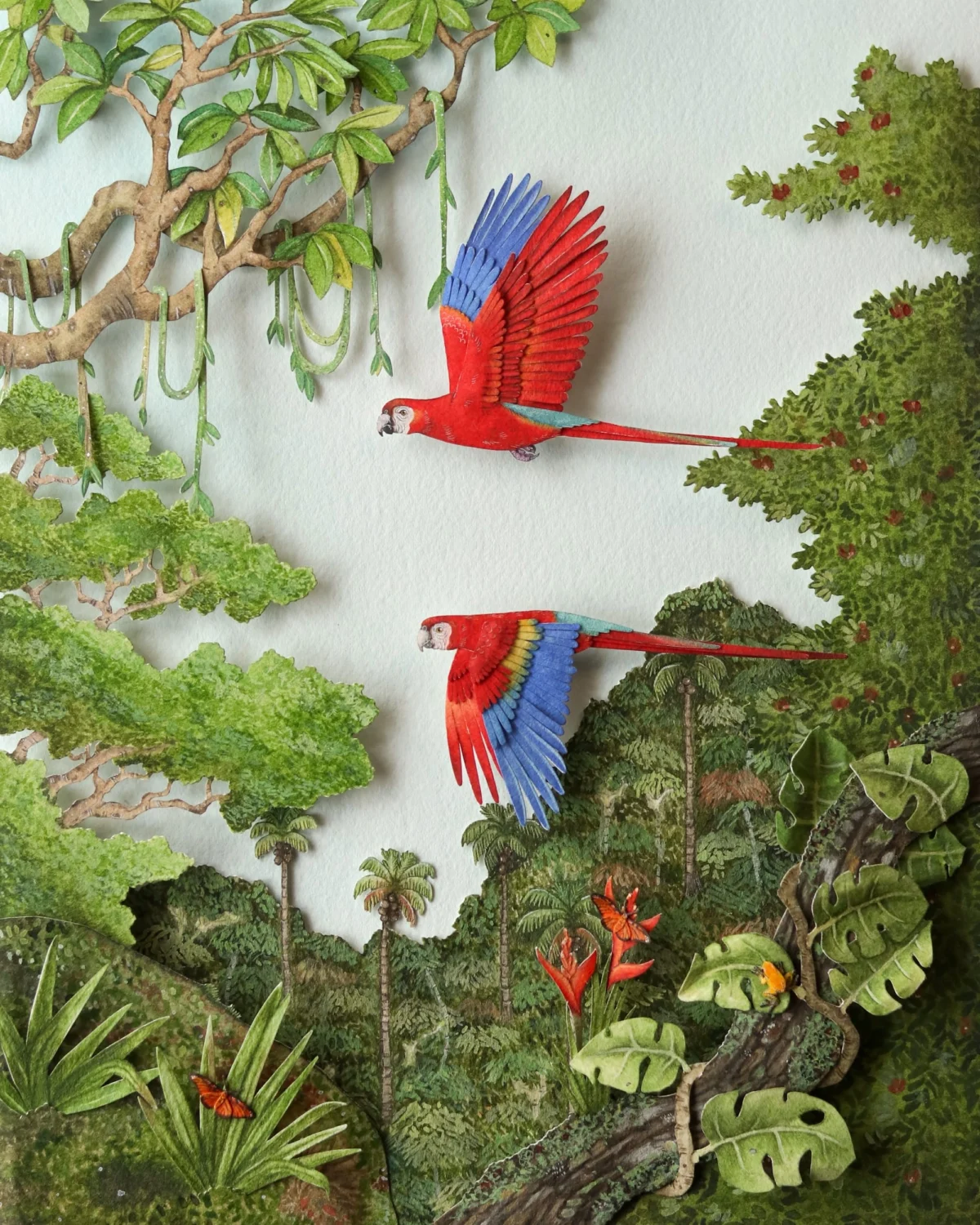
In an era where the digital often overshadows the tactile, the collaborative duo known as The Paper Ark is reclaiming the narrative of the natural world through one of humanity’s oldest mediums: paper. Comprising artists Nayan Shrimali and Venus Bird, the practice has garnered international acclaim for its ability to transform flat, fibrous sheets into vibrant, three-dimensional ecosystems. Their work, which centers on the meticulous recreation of bird species and their native habitats, serves as both a masterclass in technical precision and a poignant plea for environmental preservation.
As of mid-2026, the duo has reached a new zenith in their professional journey, with high-profile exhibitions and features in premier scientific publications. Their latest series of paper reliefs does more than just mimic life; it captures the "sense of wonder" that defines the human experience within nature, utilizing art as a bridge to ecological literacy.

The Intersection of Craft and Conservation
The Paper Ark is not merely a creative studio; it is a mission-driven enterprise. By focusing on "paper reliefs"—a technique that involves layering cut paper to create depth and shadow—Shrimali and Bird illustrate real-world species with startling accuracy. From the cerulean gradients of a Blue Jay’s wing to the intricate, moss-laden bark of a rainforest tree, every element is hand-cut and hand-painted.
The core of their practice lies in the relationship between the subject and its environment. Unlike traditional ornithological illustrations that often isolate the bird on a white background, The Paper Ark embeds its subjects within "compositions of foliage and forests." This choice is intentional. It highlights the interdependence of species and their habitats, reminding the viewer that a bird cannot exist—and certainly cannot thrive—without the complex botanical architecture that supports it.

A Chronology of Creative Evolution: The 2026 Milestones
The trajectory of The Paper Ark has been marked by a steady ascent from niche craft circles to the forefront of the contemporary art world. The year 2026 has proven to be a watershed moment for the duo.
- Spring 2026: The Audubon Feature. One of the most significant endorsements of their work came in the Spring 2026 issue of Audubon Magazine. The publication, a titan in the world of bird conservation and natural history, featured their "Great Green Macaws" composition. This placement signaled a bridge between the fine arts and the scientific community, validating the duo’s commitment to biological accuracy.
- July 2026: The Seattle Art Fair. Working with the renowned Antler Gallery, The Paper Ark debuted a collection of new works at the Seattle Art Fair. The exhibition allowed the public to witness the scale and texture of the pieces firsthand—elements that are often lost in digital reproduction.
- Ongoing Digital Engagement: Throughout 2026, the duo has maintained a robust presence on social media platforms like Instagram, where they share "behind-the-scenes" glimpses of their process. These videos, often showing a pair of tweezers placing a microscopic paper feather, have demystified the labor-intensive nature of their work and built a global community of "artivists" (artist-activists).
The Technical Precision of Paper Reliefs
To understand the impact of The Paper Ark, one must look at the physical labor involved. The process begins with extensive research into the anatomy and plumage of a specific bird. Shrimali and Bird do not rely on generic templates; they study high-resolution photography and scientific sketches to ensure that the proportions of a Great Horned Owl or the beak shape of a Baltimore Oriole are correct.

Once the research is complete, the "deconstruction" begins. The artists must visualize the bird as a series of layers. A single wing might consist of dozens of individual paper "feathers," each cut to a specific shape and then painted with watercolor or acrylic to mimic the iridescent or matte textures of real plumage.
The assembly requires a level of patience that borders on the meditative. Using fine-tipped tweezers and surgical-grade adhesives, the artists build the relief from the background forward. This creates a physical shadow play within the frame, giving the birds a "lifelike" quality that shifts as the viewer moves around the piece. In works like "Long-tailed Parakeet in Clementi Rainforest," the depth of the foliage creates a sense of voyeurism, as if the viewer has just stumbled upon the bird in a hidden corner of the Singaporean wild.

Ecological Context: Mapping the Global Aviary
The species selected by The Paper Ark reflect the duo’s global perspective on biodiversity. Their portfolio acts as a curated tour of the world’s most iconic and threatened biomes.
The Neotropics: Macaws and the Amazon
Works such as "Hyacinth Macaw" and "Diurnal Wings of Amazonia" focus on the vibrant parrots of South America. The Hyacinth Macaw, the largest of all parrots, is currently classified as "Vulnerable" due to habitat loss and the illegal pet trade. By rendering these birds in such exquisite detail, Shrimali and Bird force the viewer to confront the beauty of what stands to be lost.

North American Woodlands: The Familiar and the Formidable
The "Blue Jay," "Baltimore Oriole," and "Red Cardinal" represent the "backyard" biodiversity of North America. These pieces serve to remind viewers that nature is not just something found in distant rainforests; it is present in suburban gardens and city parks. Conversely, the "Great Horned Owl" and "Pileated Woodpecker" highlight the more elusive and specialized inhabitants of the northern forests.
The Urban Wild: Clementi Rainforest
The inclusion of the "Long-tailed Parakeet in Clementi Rainforest" is a nod to the struggle for green spaces in rapidly urbanizing environments. The Clementi Rainforest in Singapore is a site of significant conservation debate, and by naming the location in their title, the artists ground their work in specific, contemporary ecological struggles.

The Philosophy of Wonder: Official Artistic Intent
In statements shared with the public and through their gallery representations, Shrimali and Bird emphasize that their work is designed to evoke a "sense of wonder." This is not merely an aesthetic goal but a psychological strategy for conservation.
The artists argue that the modern world suffers from "nature deficit disorder," where the average person is increasingly disconnected from the biological realities of the planet. By creating art that is undeniably beautiful and technically impressive, they "hook" the viewer’s attention. Once the viewer is engaged by the craft, they are more likely to absorb the ecological message behind the piece.

"We aim to raise awareness of biodiversity and conservation by evoking a sense of wonder akin to how we also often feel in nature," the duo explains. This philosophy suggests that if you can make someone fall in love with a paper bird, you might make them care about the survival of the living one.
Supporting Data: The Crisis Behind the Art
The urgency of The Paper Ark’s work is supported by sobering data regarding global bird populations. According to recent reports by BirdLife International and the State of the World’s Birds, nearly 48% of bird species worldwide are known or suspected to be undergoing population declines.

- Habitat Loss: The primary driver for the decline of species like the Great Green Macaw (featured in the Audubon 2026 issue) is the clearing of primary forests for agriculture.
- Climate Change: For species like the Eastern Meadowlark, shifting weather patterns and the loss of grasslands have led to a staggering 70% population loss since 1970.
- The "Window" Effect: By framing their paper birds in glass-fronted boxes, The Paper Ark creates a "window" into a world that is shrinking. The physical boundary of the frame serves as a metaphor for the limited space left for these creatures in the wild.
Implications for the Future of Conservation Art
The success of The Paper Ark in 2026 points toward a growing trend in the art world: the rise of "Tactile Environmentalism." As AI-generated imagery and digital art become more prevalent, there is a counter-movement toward labor-intensive, physical crafts that mirror the complexity of the biological world.
The implications of their work extend into several fields:

- Educational Integration: Their reliefs are increasingly being viewed as tools for museums and educational centers, providing a 3D alternative to traditional taxidermy, which is often viewed as ethically problematic by modern audiences.
- Market for Sustainable Art: The use of paper—a renewable, if fragile, resource—aligns with the growing demand for art that has a lower carbon footprint than massive metal sculptures or plastic-based installations.
- The "Artivist" Model: Shrimali and Bird provide a blueprint for how artists can collaborate with scientific organizations (like the Audubon Society) to amplify environmental messaging without sacrificing artistic integrity.
Conclusion: An Ark for the 21st Century
The name "The Paper Ark" evokes the biblical story of Noah, a vessel built to save the world’s species from a rising tide. In the 21st century, the "tide" is a combination of climate change, habitat destruction, and human apathy. While Nayan Shrimali and Venus Bird cannot physically save these birds from extinction, they are building a different kind of ark—a repository of beauty and a record of existence.
Through their meticulously cut and painted compositions, they remind us that the natural world is a masterpiece of complexity. Their work at the 2026 Seattle Art Fair and in the pages of Audubon serves as a testament to the power of the human hand to recreate what the human heart must learn to protect. As long as they continue to layer paper and pigment, The Paper Ark will remain a vital voice in the chorus for a greener, more biodiverse future.