The Architecture of Dreams: How Fran Rodriguez is Redefining Digital Surrealism

In an era where the boundaries between the physical and virtual worlds are increasingly porous, few artists have managed to navigate the transition as seamlessly as Fran Rodriguez. Operating under the evocative pseudonym "lacabezaenlasnubes"—Spanish for "head in the clouds"—Rodriguez has emerged as a vanguard of the neo-surrealist movement. His work does not merely present a fantasy; it constructs a meticulously detailed alternative reality where the laws of physics are secondary to the logic of the subconscious. From the verdant landscapes of Northern Spain to the global stage of digital art galleries, Rodriguez’s journey reflects a broader cultural shift toward "visionary art," a genre that seeks to unveil the hidden dimensions of human perception.

Main Facts: The Visionary Behind the Clouds
Fran Rodriguez is more than a digital illustrator; he is a world-builder. Born in Torrelavega, Cantabria, his aesthetic foundation was laid amidst the dramatic, lush scenery of Northern Spain. This geographic origin is vital to understanding his work, as his "surreal landscapes" often feature a tension between the grounding elements of nature—mountains, oceans, and forests—and the ethereal intrusions of the cosmos.

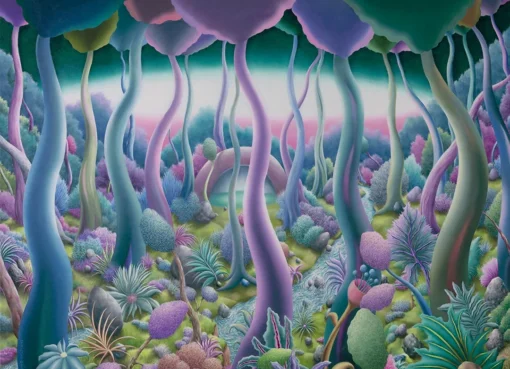
Rodriguez’s portfolio is defined by three pillars: surrealist landscapes, psychedelic influences, and digital mastery. His work often serves as a bridge between the classic surrealism of Salvador Dalí and René Magritte and the high-definition capabilities of modern digital tools. By leveraging cutting-edge software, he achieves a level of detail that makes the impossible feel tactile. Whether it is an astronaut floating through the Roman Pantheon or a girl swinging over the curvature of the Earth, the "lacabezaenlasnubes" style is instantly recognizable for its vibrant palette and its ability to evoke a profound sense of "sublime wonder."

Chronology: From Cantabria to the Global Digital Stage
The evolution of Fran Rodriguez’s career follows the trajectory of a modern artist finding his voice through geographic and technological transitions.

The Formative Years in Cantabria
Growing up in Torrelavega, Rodriguez was surrounded by the natural beauty of the Cantabrian coast. This early exposure to "verdant landscapes" provided him with a library of organic textures and forms that would later appear in his digital collages. During this period, he developed a fascination with 20th-century surrealism and the psychedelic art movement of the 1960s, drawing inspiration from the way these movements challenged the "status quo" of visual reality.

The Urban Transition: Madrid and Barcelona
Rodriguez’s artistic journey eventually led him away from the quietude of Northern Spain toward the bustling cultural hubs of Madrid and Barcelona. A significant stint in Madrid allowed him to refine his technical skills and engage with the broader Spanish art community. However, it was the vibrant, cosmopolitan energy of Barcelona that seemed to crystallize his "visionary" approach. In these urban environments, the contrast between the rigid structures of the city and the infinite possibilities of the digital canvas fueled his creative output.

The Rise of "lacabezaenlasnubes"
With the advent of social media and digital art marketplaces, Rodriguez found a global audience. Adopting the moniker "lacabezaenlasnubes," he began sharing works that resonated with a generation seeking escapism and introspection. His pseudonym became more than a handle; it became a philosophy. By placing his "head in the clouds," Rodriguez signaled his intention to prioritize imagination over mundane observation.

Supporting Data: The Anatomy of a Surreal Masterpiece
To understand the impact of Rodriguez’s work, one must analyze the recurring themes and technical hallmarks that define his oeuvre. His creations are not random; they are carefully orchestrated compositions that rely on specific psychological triggers.

The Cosmic and the Commonplace
One of Rodriguez’s most effective techniques is the juxtaposition of monumental cosmic elements with everyday human activities.

- "Space Swing": A girl sits on a simple wooden swing, but instead of a backyard, she hangs suspended over the glowing atmosphere of Earth.
- "Saturn in a Cornfield": A person stands in a traditional agricultural setting, looking up to see the ringed planet Saturn looming impossibly large in the sky.
This "supporting data" suggests that Rodriguez is interested in the "democratization of the sublime." He takes the vast, terrifying scale of the universe and makes it intimate, suggesting that the cosmic and the domestic are part of the same continuum.

Chromatic Intensity and Psychedelia
Rodriguez’s use of color is a deliberate nod to psychedelic art. Unlike the muted tones often found in traditional surrealism, Rodriguez employs high-saturation blues, oranges, and purples. His piece "Bloom Boom"—an explosion of vibrant flowers against a stark sky—serves as a case study in his color theory. The colors are designed to bypass the analytical mind and speak directly to the emotional centers of the brain, inducing a state of "digital awe."

Technical Precision
The "Digital Mastery" mentioned in Rodriguez’s profile refers to his ability to blend disparate elements—often sourced from vintage photography, botanical illustrations, and 3D renders—into a cohesive whole. His technical prowess is evident in pieces like the "Astronaut in the Pantheon," where the lighting from the oculus must interact realistically with the suit of a 20th-century space traveler. This attention to light and shadow is what prevents his work from feeling like a simple "copy-paste" collage, elevating it to the level of digital painting.

Critical Perspectives: The Role of Surrealism Today
While Rodriguez’s work is highly accessible, it also invites deeper critical analysis. Modern art historians often categorize this style as "Neo-Surrealism" or "Pop-Surrealism."

Experts suggest that the resurgence of surrealism in the 21st century is a response to the "over-saturation of information." In a world where every fact is a click away, the human psyche craves the "unsolvable mystery." Rodriguez’s art provides this by offering "tantalizing glimpses of an iceberg’s tip breaking the surface of our consciousness."

Furthermore, the "official response" from the commercial art world has been overwhelmingly positive. Platforms like Big Wall Decor and Society6 have seen a surge in demand for "visionary art" that can transform living spaces into "portals for contemplation." Rodriguez has successfully bridged the gap between "high art" found in galleries and "lifestyle art" that people want in their homes, a feat that requires both aesthetic talent and a keen understanding of modern interior design.

Implications: The Future of the Subconscious Canvas
The success of Fran Rodriguez has significant implications for the future of digital art and how we perceive the role of the artist in society.

The Democratization of Art Consumption
Rodriguez’s availability on multiple platforms—ranging from Inprnt to Big Wall Decor—highlights a shift away from the "gatekeeper" model of the art world. By making his work available as everything from high-end prints to everyday accessories, he ensures that his "visionary" message reaches a diverse demographic. The use of promotional incentives, such as the "SurrealismToday20" discount code, further emphasizes the commercial viability of digital surrealism.

Art as a Tool for Mental Exploration
As we move deeper into the digital age, the "philosophy" behind Rodriguez’s work becomes increasingly relevant. His belief that the visible world represents only a fraction of reality encourages viewers to engage in "subconscious exploration." In an era of rising anxiety and digital fatigue, art that prompts us to "contemplate the nature of existence" serves a therapeutic function, providing a mental space for rest and wonder.

The Influence on Future Creators
Rodriguez’s journey from a small town in Spain to international digital fame provides a blueprint for future artists. It demonstrates that geographic isolation is no longer a barrier to artistic impact, provided one has a "restless spirit and boundless imagination." His upcoming "adventures," ranging from the wilderness of Alaska to the conceptual exploration of distant planets, suggest that his work will continue to evolve, likely incorporating more complex themes of environmentalism and "cosmic solitude."

Conclusion: Keeping Our Heads in the Clouds
Fran Rodriguez, the man behind "lacabezaenlasnubes," has proven that surrealism is not a relic of the past but a vital, evolving language for the present. Through his meticulous digital craftsmanship, he has created a portal into a world where "imagination reigns supreme."

His work challenges us to look beyond the "tip of the iceberg" and acknowledge the vast, mysterious universe that lies beneath our daily perceptions. As he continues to redefine the boundaries of reality, Rodriguez remains a reminder that even in a world governed by data and logic, there is always room for the extraordinary—if only we are willing to keep our heads in the clouds.

How to Experience the Vision:
For those looking to bring a piece of the subconscious into their own reality, Fran Rodriguez’s collections are available through major digital art retailers. His work continues to be a staple for collectors who value the intersection of psychedelic wonder and technical perfection. Through his ongoing presence on social media and digital galleries, he invites the world to join him on a journey that is only just beginning.