
The Architecture of Lightness: Navigating Existential Weight Through the ‘Ice Cream Principle’

Main Facts: The Quest for Existential Courage
In an era increasingly defined by "burnout culture" and a global mental health crisis, the pursuit of light-heartedness is often dismissed as a luxury of the naive. However, for Dutch writer, artist, and filmmaker Samuel van Keeken, the reclamation of joy is not a passive state but a rigorous, intentional practice. Following the loss of his father to cancer and a subsequent decade-long search for meaning, van Keeken has emerged with a philosophical framework that prioritizes "loving life" over "understanding its meaning"—a concept famously championed by Fyodor Dostoevsky.
Van Keeken’s journey, which culminated in the founding of Same Worldwide and the development of the "Same Method," suggests that the "monochrome" of adulthood—a state of cynicism and emotional exhaustion—can be countered through radical presence and the embrace of the unknown. By analyzing van Keeken’s transition from existential dread to a state of "lightness," we can uncover broader implications for how modern individuals cope with grief, career pressure, and the inherent "meaninglessness" of suffering.
Chronology: From Sodium Lamps to the Panamanian Campo
The Childhood Genesis of Melancholy
The roots of van Keeken’s existential inquiry began in childhood, triggered by a specific sensory experience: the switching on of sodium street lanterns at dusk. This transition from the saturated colors of day to a "yellow monochrome" served as a precocious metaphor for the loss of vibrancy that often accompanies aging.
A pivotal moment occurred during one such evening when van Keeken’s father, sensing his son’s quiet sadness, took him on a bicycle ride to a village ice cream shop. Amidst the freezing air and the artificial yellow glow of the lanterns, his father simply enjoyed an ice cream with sprinkles, uttering the Dutch word "Lekker, hè?" (Delicious, right?). This act of simple indulgence in the face of a "colorless" world would later become the cornerstone of van Keeken’s philosophy.
The Decade of Seeking (The 20s)
Following his father’s death a decade ago, van Keeken entered a period of frantic activity. He immersed himself in art school, philosophy, powerlifting, filmmaking, and global travel. This "neurotic" pursuit was an attempt to outrun embitterment. As he notes, he subscribed to the idea that enough effort could justify the suffering of life. However, by age 30, the "sodium-lamp feeling" had become a permanent fixture. The intellectual pursuit of answers had led to a "bleaker world," eventually bringing him to the edge of an existential abyss where he contemplated "stepping out" through the door of finality.
The Radical Shift: Spain and Panama
The turning point came through two radical experiments in living:
- The Camino de Santiago: Van Keeken and his partner walked the famous pilgrimage route in Northern Spain—backwards. This physical manifestation of "embracing the unknown" forced a slowing down that transformed fear into presence.
- Solitude in Panama: Moving from the bustling streets of Amsterdam to the rural campo of Panama, van Keeken faced the "solitude of the heights." Here, stripped of distractions, he confronted his desire to "be something" and his need to rationalize existence.
Supporting Data: The Psychology of Existential Dread and Resilience
Van Keeken’s personal narrative aligns with several psychological phenomena regarding how humans process grief and find "Post-Traumatic Growth" (PTG).
The Burden of ‘Meaning-Making’
Psychologists often distinguish between hedonic well-being (pleasure) and eudaimonic well-being (meaning). Research suggests that while eudaimonia is essential for long-term satisfaction, an obsessive focus on "finding one’s purpose" can lead to "existential frustration." According to data from the Journal of Happiness Studies, individuals who focus too intensely on the meaning of their lives during periods of depression often experience higher levels of rumination and lower levels of immediate life satisfaction.
The Power of Novelty and ‘The Unknown’
Van Keeken’s decision to walk backwards and move to a foreign wilderness is supported by studies on neural plasticity. Breaking habitual patterns—even simple ones—activates the brain’s prefrontal cortex and can interrupt the "Default Mode Network" (DMN), which is often overactive in individuals with depression and anxiety. By intentionally placing himself in "the unknown," van Keeken effectively "rebooted" his sensory perception, allowing "color" to return to his world.
Grief and the ‘Father Figure’ Metric
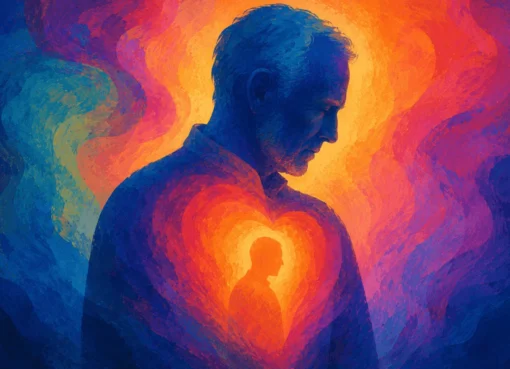
The loss of a parent is a primary driver of existential crisis. Statistics from the American Psychological Association indicate that "complicated grief" can persist for years if the individual cannot integrate the loss into their narrative. Van Keeken’s realization—that his father also struggled with existence but chose the "ice cream" regardless—represents a successful "re-authoring" of his grief, moving from a position of loss to one of shared human experience.
Official Responses: The ‘Same Method’ and Contemporary Wellness
While van Keeken’s approach is deeply personal, it has been formalized through his co-founding of Same Worldwide. This organization serves as a hub for essays, art, and retreats designed to help others cultivate "existential courage."

The Same Method Framework
The "Same Method" posits that meaningful action is not found in the avoidance of bleakness, but in the decision to act inside of it. In a statement regarding the philosophy of the organization, the framework is described as:
"A tool for those who have exhausted the traditional answers provided by careerism and self-help. It is about the transition from being an observer of life’s meaninglessness to being a participant in its beauty."
Perspectives from the Artistic Community
Mentors from van Keeken’s past, such as his art school instructor who noted that "being a romantic is the hardest thing you can do," echo a sentiment common in contemporary philosophy: that in a post-religious, hyper-rational world, maintaining a "light heart" is an act of rebellion. This "New Romanticism" focuses on the subjective experience of the moment over the objective achievement of goals.
Implications: The ‘Ice Cream Principle’ in Modern Life
The story of Samuel van Keeken offers a blueprint for navigating the complexities of the 21st century. The implications of his journey can be categorized into three actionable pillars:
1. The Rejection of the ‘Solution’
Modern culture is obsessed with "fixing" mental states. Van Keeken’s narrative suggests that some states of being—like the sadness of the "sodium lamps"—cannot be fixed; they can only be accompanied. The father’s "ice cream" was not a cure for the son’s melancholy; it was a refusal to let that melancholy be the only thing that existed in that moment.
2. The Value of ‘Voluntary Displacement’
For those stuck in the "monochrome" of routine, radical change (like moving to Panama or walking backwards) acts as a shock to the system. While not everyone can move across the world, the principle of voluntary displacement—intentionally putting oneself in situations where the outcome is unknown—is a potent antidote to the bitterness of "knowing too much."
3. Choosing Joy Over Meaning
Perhaps the most profound implication is the Dostoevskian realization: "Love life more than the meaning of it." When the search for meaning becomes a weight that prevents one from living, the search must be abandoned in favor of direct experience.
Conclusion: Living Inside the World
Today, sitting in the sun in Panama and looking out at the heights of Volcán Barú, van Keeken finds himself repeating his father’s words: "Lekker, hè?"
This simple phrase represents a full-circle return to lightness. It signifies that he is no longer fighting the "sodium lanterns" of the world or trying to outrun the "monochrome" stretch of time. Instead, he has learned to sit inside the world, enjoying the metaphorical "vanilla with sprinkles" next to those he loves.
The "Ice Cream Principle" reminds us that while the world may lose its color through tragedy and time, the act of choosing a small, sweet moment is not an act of denial—it is the ultimate form of courage. In the end, staying light-hearted is not about the absence of weight, but about the strength to carry it while still being able to smile.
About the Subject:
Samuel van Keeken is a Dutch writer, artist, and filmmaker. He is the co-founder of Same Worldwide, a platform dedicated to cultivating existential courage through the Same Method. He currently resides in Panama.

Leave a Comment