The Architecture of Memory: The Surrealist Vision and Romantic Legacy of Christian Quintin
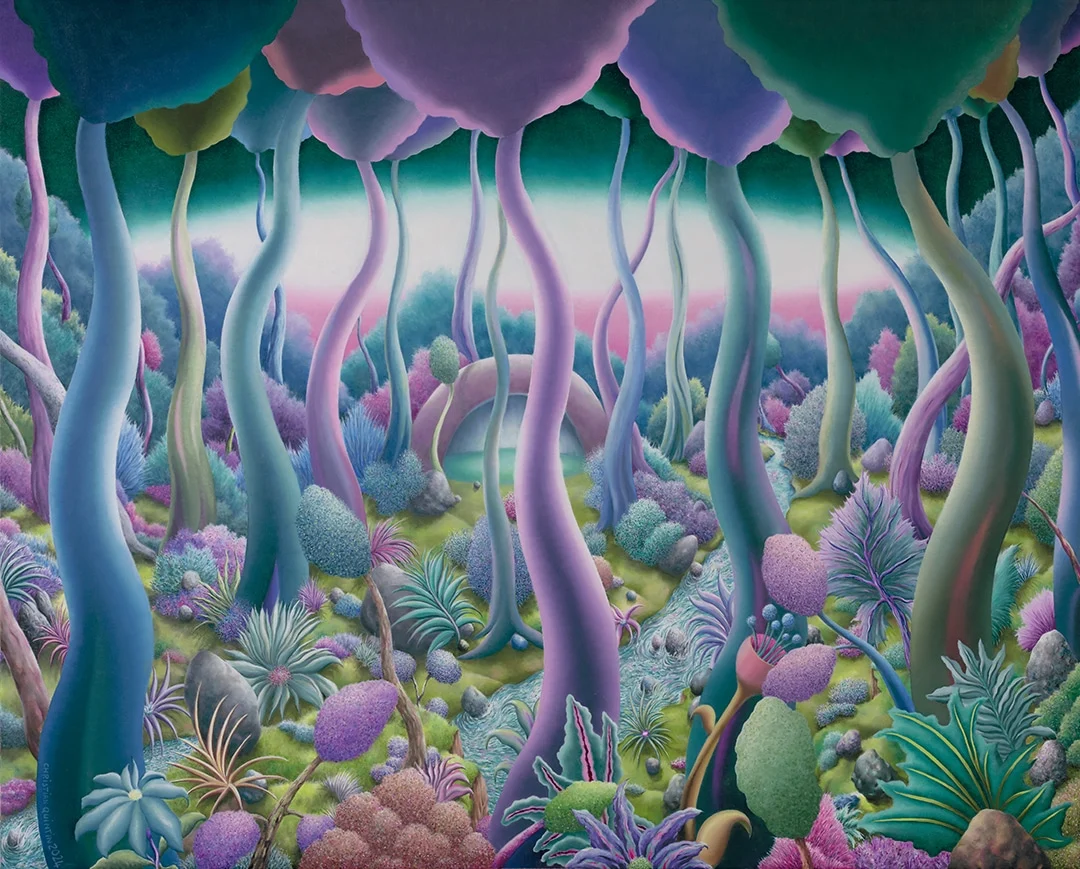
For more than four decades, the Franco-American artist Christian Quintin has operated as a cartographer of the subconscious. He does not paint what he sees in the literal, ocular sense; rather, he paints what the viewer remembers feeling—long before those feelings were codified into language. His images arrive with the jarring yet familiar impact of déjà vu: a tree that sways with the deliberate grace of a dancer, a human face composed of architectural chambers, a landscape that appears to draw breath.
Born in the rugged coastal regions of Brittany and now a fixture of the Northern California art scene, Quintin has cultivated a body of work that defies the reductive labels of modern art history. His practice is a rare synthesis of Romanticism, Surrealism, and meticulous classical craftsmanship. Eschewing the slogans and manifestos that often dominate contemporary art, Quintin offers a singular, quiet invitation: “See the art as one would read poetry, hopeful that one would wander into its imagery.”

I. Main Facts: A Unified Vision of Inner and Outer Terrains
Christian Quintin’s artistic output is characterized by a dual focus: intricate surrealist compositions and luminous, emotive landscapes. While these might appear as distinct genres, for Quintin, they represent a unified visual philosophy. He utilizes a diverse toolkit—ink, oil, graphite, and pastel—to bridge the gap between inner consciousness and the external world.
The hallmark of a Quintin piece is its technical density. His works are not the result of rapid-fire "automatic" drawing associated with early Surrealism; they are built through months of painstaking labor. A single pen-and-ink drawing may take upwards of half a year to complete, involving thousands of crosshatched lines that create a sense of depth and vibration. This commitment to craft serves a philosophical purpose: it forces a slowness upon the viewer, acting as a direct counter-narrative to the "speed and spectacle" of modern digital culture.

Key Philosophical Pillars:
- Intuition Over Logic: Quintin advocates for the "first thought," allowing the subconscious to dictate the initial form before technical discipline takes over.
- Beauty as Defiance: In an art world often preoccupied with irony, cynicism, or social critique, Quintin views the creation of beauty as a radical act of resistance.
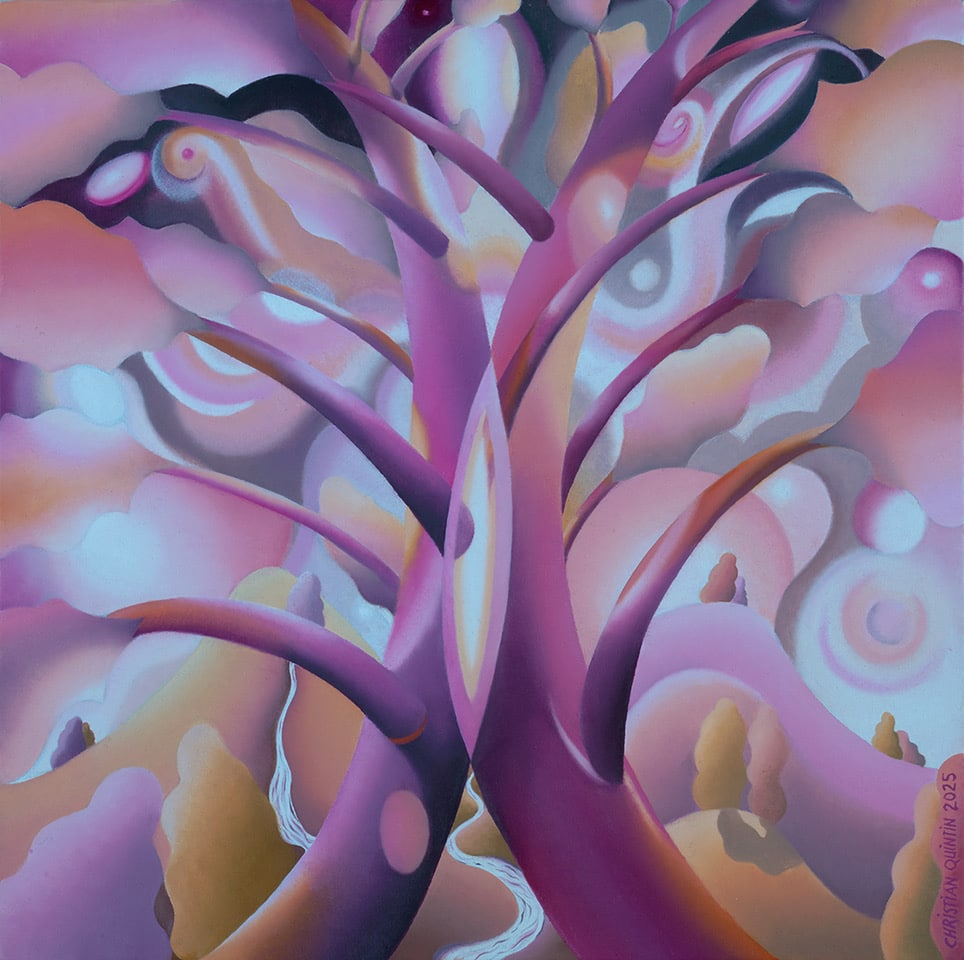
- Nature as Mirror: His work posits that there is no separation between the human spirit and the natural ecology. As he often notes, "When you draw a tree, you also draw yourself."
II. Chronology: From the Cliffs of Brittany to the Valleys of Sonoma
The Formative Years (1957–1975)
Quintin’s aesthetic foundation was laid on the moody, storm-lashed northern coast of Brittany. Born in 1957 in the port town of Saint Brieuc, his childhood was framed by ruined castles and the dramatic topography of the Armorican Massif. One specific location, L’Île de la Comtesse, became a recurring motif in his psyche. This island, with its solitary architecture and storybook aura, provided the "mythic vocabulary" that continues to surface in his work today.
The Parisian Discipline (1975–1981)
In 1975, Quintin moved to Paris to study at the prestigious Beaux Arts Academy. It was here that his romantic instincts were tempered by classical rigor. He spent these years mastering the legacies of the French Surrealists, the Symbolists, and the Romantic painters. This period was crucial for his development of "precise draftsmanship"—the ability to render the impossible with such clarity that it becomes believable.

The California Synthesis (1981–Present)
The most significant turning point in Quintin’s life occurred in 1981 when he relocated to Northern California. Settling in the vineyards and rolling hills of Sonoma County, he found a landscape that resonated with the "spirit" of his native Brittany but offered a new, expansive light. The sacred ecology of the American West—redwoods, fog-drenched valleys, and golden hills—became his second vocabulary. Over the next forty years, he would fuse the old-world myths of Europe with the vibrant, living landscapes of California.
III. Supporting Data: Technical Mastery and Key Works
Quintin’s work is often categorized into two modes, though they frequently overlap.

The Surrealist "Interior Constellations"
These works are maps of memory and emotion. A prime example is The Aviary, a piece that took six months to complete. In it, Quintin’s face emerges from a crystalline structure, his neck transforms into a tree trunk, and his hair becomes a leafy canopy. It is less a self-portrait and more an "ecosystem of self."
Another landmark work, La Porte Ouverte, was inspired by the 13th-century Persian poet Rumi. Reflecting the line, "Why stay in prison when the door is wide open?", Quintin spent seven months creating a dense network of symbols and figures that blur the line between logic and dream.

The Luminous Landscapes
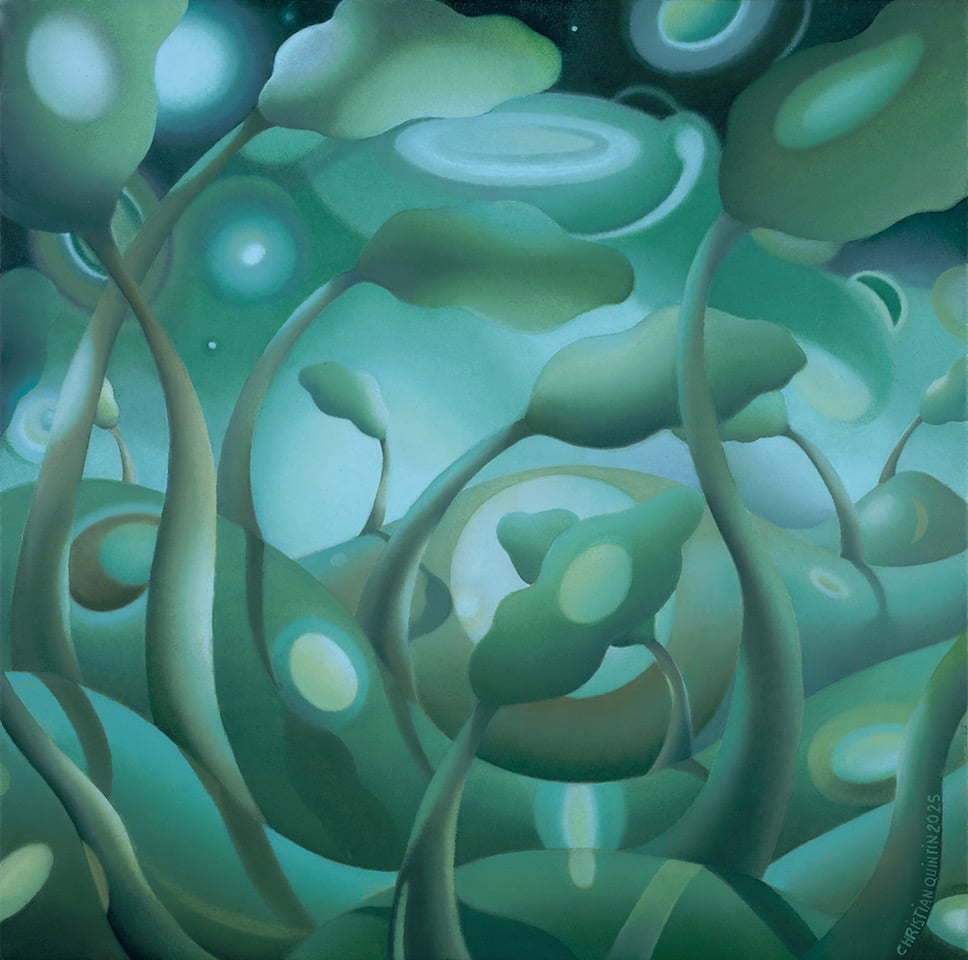
In his landscapes, such as Leaves of Absence or A Lake Color of Emeralds, Quintin uses oil and pastel to create "emotional terrains." His use of color is non-literal; skies may be brown-orange or violet, and lakes a brilliant emerald. These works demonstrate his belief that shape is story and color is feeling. Even in his more "realistic" depictions of West Sonoma County, surreal elements—such as a floating face hidden in the clouds—remind the viewer that they are looking at a mental landscape, not a photographic one.
Technical Specifications:
- Mediums: Pen and ink (for high-contrast surrealism), Oil on canvas (for depth and atmosphere), Pastel and Graphite (for soft, emotive textures).
- Labor Intensity: Major works typically require 4 to 7 months of daily execution.
- Scale: Ranges from intimate drawings to large-scale public murals.
IV. Official Responses: The Art World Catches Up
For several decades, Quintin worked as a "slow-burning" artist, respected within Northern California but largely operating outside the frenetic centers of the global art market. He completed numerous public commissions, including hospital lobbies and city murals, and received early accolades such as the Grumbacher Award (1987) and the California State Fair Award of Excellence (1990).

The Vorpal Gallery Connection
A significant institutional validation occurred in 1999 when he began exhibiting with the Vorpal Gallery. This was a prestigious association; the Vorpal Gallery was famous for introducing the mathematical surrealism of M.C. Escher to the American public. This placement firmly situated Quintin in a lineage of "Visionary Artists" who prioritize meticulous technique alongside mind-bending conceptualism.
Global Expansion in the 2020s
In recent years, Quintin’s career has seen a dramatic international surge. Now represented by Lorin Gallery (Los Angeles and Paris), his work has been showcased at:
- KIAF Seoul: Introducing his vision to the burgeoning South Korean market.
- Art Central Hong Kong: Expanding his reach into the Asian contemporary scene.
- Morrison Gallery (Connecticut): Establishing a stronger foothold on the American East Coast.
Curators and gallery directors have noted that the art world’s renewed interest in Quintin stems from a cultural exhaustion with "disposable" art. As a review from the Calabi Gallery noted in 2022: "In an era largely devoid of it, his work is beautiful. We could all use more beauty in our lives."
V. Implications: Art as Sanctuary in the 21st Century
Christian Quintin’s legacy is best understood as part of the "Visionary Continuum." While he shares DNA with the 1960s psychedelic spiritualists of Northern California, his work is quieter, more classical, and more structured. He acts as a bridge between several worlds:
- Europe and America: Merging the ruined-castle melancholy of Brittany with the expansive naturalism of the West Coast.
- Precision and Emotion: Proving that technical rigor does not have to come at the expense of soul.
- The Symbolic and the Natural: Showing that the "tree" and the "dream" are, in fact, the same thing.
The Rejection of Irony
Perhaps the most significant implication of Quintin’s work is its rejection of didacticism. He does not seek to "teach" the viewer or provide a political message. Instead, he creates a "sanctuary for the soul." In a culture defined by rapid-fire information and digital anxiety, Quintin’s art functions as a form of meditation.
Conclusion: The Resistance of Beauty
Christian Quintin’s art is not an escape from reality; it is a reentry into its hidden dimensions. By focusing on the "feelings that flow through him," he reminds his audience that beauty is not a luxury, but a necessity. His career trajectory suggests that while trends in the art world may fluctuate between the conceptual and the abstract, there remains a deep, perennial hunger for work that is made with "attention and soul."
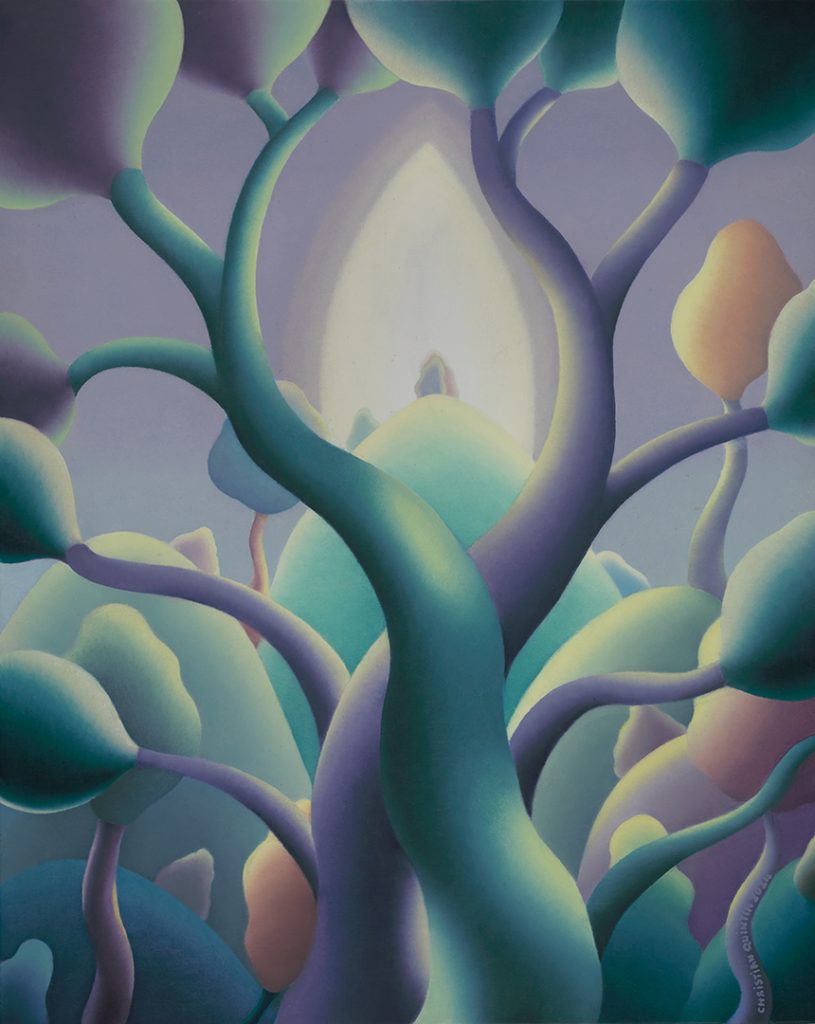
As he continues to exhibit in major global capitals, Quintin remains rooted in his Sonoma studio, following his own advice to young artists: "Intuition first. Technique follows." His body of work stands as a testament to the power of the slow, the intricate, and the beautiful—a rare and wondrous sanctuary in a loud world.
Where to See His Work:
- Lorin Gallery (Los Angeles / Paris)
- Morrison Gallery (Kent, Connecticut)
- Online Archive: christianquintin.com