
The Gilded Disconnect: Commodity Politics and the Erosion of Global Alliances

WASHINGTON D.C. — In a week defined by the convergence of luxury marketing and high-stakes diplomacy, the Trump administration finds itself navigating a widening chasm between its "America First" rhetoric and the lived reality of both its domestic constituents and international allies. From the long-delayed shipment of "gold" branded telecommunications hardware to a controversial summit in Beijing that has left the status of Taiwan in a state of precarious ambiguity, the administration’s current trajectory suggests a pivot away from traditional statecraft toward a model of "transactional governance" that critics argue prioritizes optics over national interest.
Main Facts: A Convergence of Commodity and Crisis
The primary developments of the week center on three distinct but interconnected pillars: the commercial release of the Trump T1 smartphone, the underwhelming results of a major diplomatic summit with Chinese President Xi Jinping, and a series of candid admissions regarding the administration’s lack of focus on domestic economic suffering.
First, the "gold" Trump T1 phones, priced at $499, have finally begun shipping to consumers after months of speculation and criticism regarding their manufacturing origins. Despite early promises that the devices would be a hallmark of American manufacturing, reports indicate they are largely produced abroad, featuring a "gold-colored" finish rather than the precious metal suggested by early marketing campaigns.
Second, on the global stage, the President’s recent summit with President Xi has sparked alarm among defense analysts. While the administration touted the meeting as a success, the lack of concrete trade concessions—coupled with hints that the U.S. may be reconsidering its long-standing support for Taiwan—has led to accusations that the "Deal Maker" returned home empty-handed, save for a packet of symbolic rose seeds.
Finally, the domestic economic climate continues to sour. With gas prices surging to a national average of $4.51 per gallon and inflation remaining stubbornly high, the President’s recent comments to Fox News—admitting that he does not "think about Americans’ financial situation"—have provided significant ammunition to political rivals ahead of the critical midterm elections.
Chronology: From the Summit to the Sales Floor
The timeline of the past fortnight illustrates a rapid sequence of events that have strained the administration’s narrative of economic and diplomatic dominance.
The Beijing Summit (May 10–14, 2026)
The week began with high expectations as the President, accompanied by a delegation of billionaire business associates, traveled to Beijing. The stated goal was to secure a "grand bargain" on trade and regional security. However, the four-day visit was characterized more by ceremonial opulence than by substantive policy negotiations. By May 14, the delegation departed, having secured no new tariffs reductions or market access agreements. The most publicized takeaway was President Xi’s gift of Chinese rose seeds, a gesture noted for its irony given the administration’s previous decision to pave over the White House Rose Garden.
The Fox News Interview (May 15, 2026)
Following his return, the President sat for an interview with Howard Kurtz of Fox News. It was during this exchange that the President made the comments that have since dominated the news cycle. When asked about the impact of his foreign policy on the domestic economy, the President shifted focus entirely to Iran’s nuclear program, explicitly stating, "I don’t think about anybody… I think about one thing—we cannot let Iran have a nuclear weapon."
The T1 Launch (May 17, 2026)
As the economic fallout from the interview began to settle, the administration’s commercial arm announced that the Trump T1 phones were officially in transit to customers. The launch was intended to be a victory for "patriotic consumerism," but it was immediately met with technical critiques regarding the phone’s mid-range specifications and its failure to meet "Made in USA" benchmarks.
Supporting Data: The Cost of Disconnection
To understand the gravity of the current political moment, one must look at the quantitative shift in the American economic landscape compared to previous treaty-bound eras.
Macroeconomic Indicators
During the period of the internationally monitored Iran Nuclear Deal (JCPOA), which the current administration abandoned, the U.S. enjoyed a relatively stable energy market.
- Gas Prices: $3.11/gallon (Pre-withdrawal average) vs. $4.51/gallon (Current).
- Inflation: 3.0% (Previous baseline) vs. current elevated levels impacting logistics, shipping, and consumer goods.
The Hardware Gap
The Trump T1 phone, marketed as a premium "gold" device, occupies a curious space in the market. At $499, it sits at the lower end of the mid-range smartphone tier.
- Materiality: The casing is a metallic-painted polycarbonate, not gold-plated.
- Production: Supply chain tracking indicates assembly in Southeast Asia, contradicting early "America First" manufacturing pledges.
The Geopolitical Shift
The administration’s recent movements suggest a systemic withdrawal from traditional alliances:
- NATO: Significant reduction in funding and joint exercises.
- Eastern Europe: Withdrawal of troops from Poland and a marked ambivalence toward Ukrainian sovereignty.
- The Taiwan Pivot: Analysts suggest that abandoning Taiwan would not only jeopardize the global semiconductor supply chain but would signal a definitive end to American reliability as a security partner.
Official Responses and Editorial Reactions
The reaction to the week’s events has been polarized, though notably, some of the harshest criticism has come from traditionally friendly quarters.
Fox News Analysis: Howard Kurtz noted that while the President’s focus on Iranian nuclear proliferation is a valid security concern, the dismissal of the American voter’s financial plight was a significant "gift to the Democrats." The network’s editorial tone suggested that the administration is failing to connect its foreign policy "adventurism" with the rising costs of living for its base.
International Skepticism: In Beijing, state-run media portrayed the summit as a demonstration of Chinese "soft power," highlighting the rose seed exchange as a symbol of China’s "cultivated" diplomacy compared to the "transactional" nature of the American delegation.

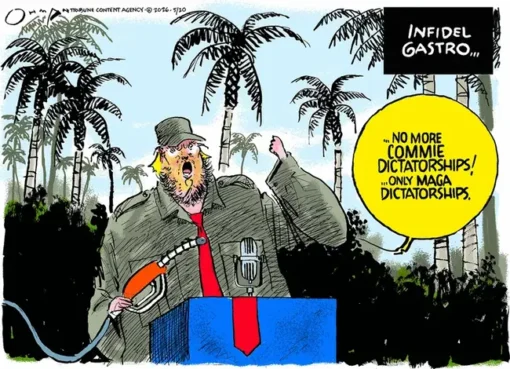
The "Gapitalism" Critique: Political cartoonists and commentators, such as Steve Breen and Mike Peterson, have coined the term "Gapitalism" to describe the current economic state. They argue that the administration judges the health of the U.S. economy based solely on the performance of the "inner circle" of billionaires who accompanied the President to China, rather than the "fortunate 1%" vs. the "rest of us."
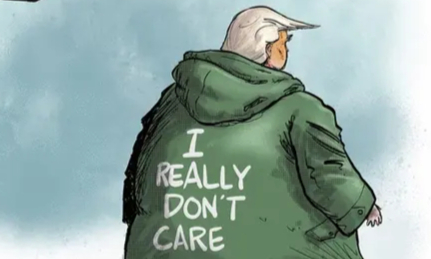
The Melania Factor: The reappearance of Melania Trump’s "I Really Don’t Care, Do U?" jacket in political commentary has served as a visual shorthand for the administration’s perceived insensitivity. Critics argue that what was once dismissed as a wardrobe gaffe has now been codified into a governing philosophy.
Implications: The High Price of "America First"
The long-term implications of this week’s developments suggest a period of significant volatility for the United States, both at home and abroad.
The Midterm Calculus
The upcoming midterm elections will serve as a referendum on whether the "America First" base prioritizes ideological loyalty over economic stability. While the President has historically maintained a "bulletproof" connection with his supporters—famously claiming he could "shoot someone on Fifth Avenue" without losing votes—the rising cost of essentials like eggs and gasoline presents a different kind of threat. If the Republican base perceives that the administration’s policies are directly responsible for their dwindling purchasing power, voter turnout may collapse, regardless of the President’s personal popularity.
The Erosion of Trust
Geopolitically, the potential abandonment of Taiwan represents a "point of no return" for American diplomacy. If the U.S. signals that its alliances are negotiable for the right price—or even for minor personal gestures like a packet of seeds—the global order will likely shift toward a bipolar system dominated by China and Russia. The "hemorrhaging of friends," as described by contemporary analysts, leaves the U.S. isolated, making it harder to form the coalitions necessary to manage global crises, including the very nuclear proliferation in Iran that the President claims is his sole focus.
The Theology of Prosperity
Finally, the ideological divide in Washington has never been more stark. The contrast between the "Noblesse Oblige" of previous generations—typified by Robert Kennedy’s visits to the poverty-stricken Mississippi Delta—and the "Gospel of Prosperity" that informs the current administration is profound. Under the Prosperity Theology model, wealth is seen as a sign of divine favor, and poverty as a lack thereof. This framework explains the President’s inability to empathize with financial suffering; in his worldview, the "winners" deserve his attention, while the "losers" are a distraction from the "grand deals" of history.
As the "gold" phones arrive in the mailboxes of supporters, they serve as a fitting metaphor for the current era: a shiny, branded exterior that, upon closer inspection, reveals a standard product manufactured elsewhere, sold at a premium to those who can least afford the rising costs of the world it inhabits.

Leave a Comment