
The Liminality of Light and Sand: River Reishi Claims Top Honors at Surreal Salon 18
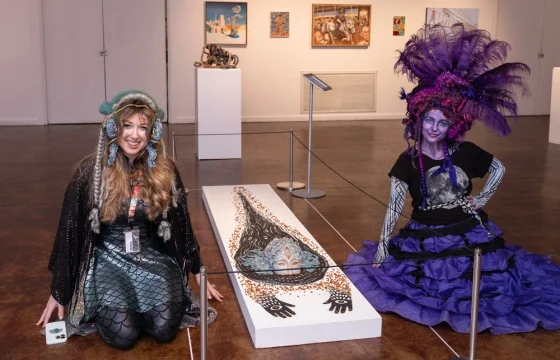
The intersection of the ethereal and the tangible took center stage at the Baton Rouge Gallery recently as the eighteenth iteration of the Surreal Salon reached its crescendo. In a year marked by an unprecedented caliber of submissions and the presence of a world-renowned juror, multidisciplinary artist River Reishi emerged as the winner of the "Best in Show" title. Her winning installation, Surface Tension, captivated both the judging panel and the public, offering a haunting meditation on the thresholds between worlds, the fragility of existence, and the power of myth.
Selected by guest juror Caledonia Curry—better known to the global art community as Swoon—Reishi’s work stood out in a crowded field of pop-surrealist and lowbrow visionaries. The victory marks a significant milestone for Reishi, whose practice explores the delicate balance between permanent form and ephemeral presence.
Main Facts: A Landmark Victory at Surreal Salon 18
Surreal Salon 18, hosted by the Baton Rouge Gallery (BRG) in partnership with the LSU School of Art, has long been a cornerstone for the pop-surrealist movement in the American South. This year’s exhibition was particularly notable for its guest juror, Swoon, an artist whose career has spanned from street art interventions to massive installations at the MoMA and the Tate Modern.
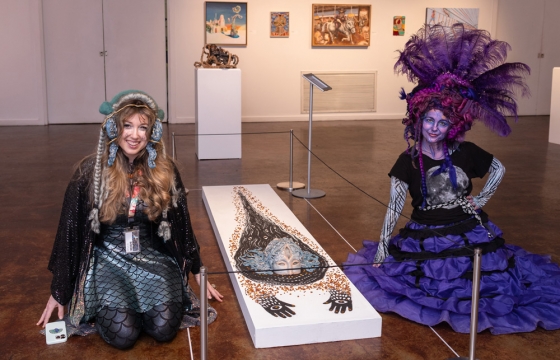
River Reishi’s winning piece, Surface Tension, is a complex installation featuring a central figurative sculpture emerging from a field of hand-drawn black sand and Baltic amber. The work utilizes internal illumination to create a faint, pulsing glow, inviting viewers to approach the "threshold" it represents. Reishi’s victory is not merely a recognition of technical skill but an endorsement of her conceptual depth, which bridges the gap between traditional sculpture and performance-based installation art.
The award comes with a financial prize and, perhaps more significantly, a featured profile in Juxtapoz Magazine, a publication that has historically championed the very genres the Surreal Salon celebrates. For Reishi, the win serves as a validation of a career spent working with materials that many traditional galleries find challenging: loose sand, temporary structures, and light.
Chronology: From Concept to the "Surreal" Night of the Win
The journey of Surface Tension began long before it was installed on the gallery floor in Baton Rouge. River Reishi’s process is one of deep contemplation, often inspired by her surroundings and personal history.
The Evolution of "Surface Tension"
Reishi’s fascination with water as a metaphorical boundary stems from her time living near the coast in Washington State and her observations of the Gulf region’s relationship with the sea. The sculpture was conceived as a "figure in flux," neither fully submerged nor fully emerged. The process involved meticulous sculpting of the central figure, followed by the integration of LED lighting designed to mimic the bioluminescence found in deep-water environments.
The Submission and Selection
When the call for entries for Surreal Salon 18 was announced, Reishi was particularly drawn by the involvement of Swoon. Having followed Swoon’s career since the Swimming Cities of Serenissima project in 2009, Reishi viewed the submission as an opportunity to have her work seen by an artist who shares her interest in narrative-driven, site-specific installations. Out of hundreds of international entries, Surface Tension was selected as one of the few dozen works to be exhibited in the physical gallery.
The Night of the Exhibition
The Surreal Salon is famously known as the "unofficial kickoff to Mardi Gras season" in Baton Rouge. On the night of the opening, the gallery was transformed into a costume-heavy, celebratory space. Reishi arrived to find that her work had already begun to take on a life of its own; one attendee had even designed a costume specifically inspired by the textures and themes of Surface Tension.
The evening took a dramatic turn when a guest accidentally collided with the platform holding Reishi’s installation. Because the black sand surrounding the sculpture was loose and hand-drawn—not glued—the vibrations caused the intricate patterns to collapse. Rather than viewing this as a disaster, Reishi spent a portion of the evening sitting on the gallery floor, painstakingly restoring the patterns while guests watched. This act of "live repair" highlighted the very fragility she intended the work to convey. Later that night, Swoon announced Reishi as the "Best in Show" winner, a moment Reishi described as "surreal in the truest sense."
Supporting Data: The Materials and Philosophy of River Reishi
To understand why Surface Tension resonated so deeply with the jury, one must look at the specific materiality and philosophical underpinnings of Reishi’s practice.
The Power of Ephemerality
Reishi’s work is rooted in the concept of the "ephemeral." This preference for temporary materials began as a practical response to limited studio space but evolved into a core tenet of her artistic voice. By using loose sand—specifically black volcanic sand inspired by the beaches of Reynisfjara, Iceland—she ensures that her work can never be truly "owned" or "fixed." It exists only for the duration of the exhibition, after which it is dismantled.
Material Symbolism: Amber and Sand
- Black Sand: Represents the "dark water" or the unknown. It is a material that holds the weight of geological time but is easily shifted by a single breath or footfall.
- Baltic Amber: Reishi incorporates amber not just for its aesthetic quality but for its mythological history. Known as "the tears of the gods" in various Baltic myths, amber represents preserved light and memory.
- Internal Light: The faint glow within the sculpture serves as a "quiet surprise," a reward for viewers who take the time to look closely. It suggests life and agency within a figure that might otherwise appear static.
The Influence of the Feminine Voice
Reishi speaks openly about the challenges women face in claiming "audacity" within the art world. Her work is heavily influenced by feminine water deities and the concept of the oracle. By creating her own symbolic languages, she follows in the footsteps of artists like Swoon, who "carve out space for themselves" without waiting for institutional permission.
Official Responses: Swoon and the Baton Rouge Gallery Context
The selection of River Reishi as the winner reflects a specific curatorial direction taken by the Baton Rouge Gallery and Swoon.

Swoon’s Jurorial Perspective
As a juror, Swoon (Caledonia Curry) has a history of favoring works that possess a "living" quality—art that feels as though it could breathe or move. In her comments regarding the exhibition, Swoon emphasized the haunting and memorable nature of the selected works. Reishi’s Surface Tension aligned perfectly with Swoon’s own interest in "public intervention" and the creation of immersive environments. The piece didn’t just sit on a pedestal; it commanded the space around it, creating its own atmosphere.
The Gallery’s Role
The Baton Rouge Gallery has spent nearly two decades cultivating the Surreal Salon as a premier venue for works that defy easy categorization. By inviting high-profile jurors like Swoon, the gallery elevates the local art scene, connecting regional artists with global icons. The success of Surreal Salon 18 demonstrates the enduring appeal of the "pop-surrealist" movement, which continues to evolve from its underground roots into a sophisticated, conceptually rigorous genre.
Implications: Future Projects and the Legacy of the "Fixed" Object
The victory at Surreal Salon 18 serves as a springboard for Reishi’s most ambitious project to date: a residency in Reykjavik, Iceland.
The Iceland Residency (August 2026)
In August, Reishi will move her practice to the Raf Gallery in Iceland. This residency is timed to coincide with a total solar eclipse on August 12 and the city’s Menningarnótt (Culture Night) festival. Reishi plans to create a large-scale installation using local Icelandic black sand and Baltic amber, exploring the intersection of eclipse mythology and the "birth" of amber.
Community Dismantling: A New Model for Art
Perhaps the most radical implication of Reishi’s work is her approach to the end of an exhibition. In Iceland, she will invite the community to help her dismantle the installation. The sand will be carried back to the ocean and returned to the shore with "a wish, prayer, or intention." This ritualistic approach challenges the commercial art market’s obsession with permanent, sellable objects, proposing instead that the value of art lies in the shared experience and the moment of creation.
Conclusion: The Voice of the Threshold
River Reishi’s win at Surreal Salon 18 is a testament to the power of "the threshold." Her work reminds us that the most profound moments often occur in the space between—between land and water, between light and dark, and between the permanent and the passing. As she moves from the celebratory atmosphere of Baton Rouge to the volcanic shores of Iceland, Reishi continues to prove that an artist’s voice is most powerful when it is used to speak of things that cannot stay.
For the Baton Rouge Gallery and the legacy of the Surreal Salon, Reishi represents a new generation of makers: those who are unafraid of fragility and who find their greatest strength in the very materials that are destined to wash away.


