The Rhythm of Intelligence: Flow Chaser Brings Procedural Spatial Gaming to visionOS 27

The landscape of spatial computing has reached a significant milestone with the release of visionOS 27, and at the forefront of this software evolution is a title that bridges the gap between nostalgic gaming history and futuristic artificial intelligence. Flow Chaser, a newly launched spatial rhythm game for the Apple Vision Pro, is garnering attention not just for its immersive gameplay, but for its sophisticated integration of Apple’s latest on-device music intelligence.
By transforming any audio file into a playable, three-dimensional landscape, Flow Chaser represents a realization of a decades-old dream in the gaming industry: a truly infinite rhythm experience powered by the player’s own library.
Main Facts: A New Era of Procedural Rhythm
Flow Chaser arrived on the App Store this week, priced at $14.99, coinciding with the global rollout of visionOS 27. While the rhythm game genre is well-populated on VR and AR platforms—headlined by giants like Beat Saber and Synth Riders—Flow Chaser distinguishes itself through its foundational reliance on Apple’s high-level machine learning frameworks.
The Core Mechanics
The gameplay loop follows a familiar, intuitive formula that has become the gold standard for spatial rhythm titles. Players are tasked with slicing through blocks or striking orbs that propel toward them in synchronization with the music. However, unlike its predecessors, which often rely on manual "beat-mapping" (where developers or fans manually place every note), Flow Chaser utilizes real-time structural analysis.
Music Intelligence and On-Device Processing
The game’s standout feature is its use of Apple’s on-device music intelligence. This technology allows the Vision Pro to "listen" to a track, identifying not just the beats per minute (BPM), but also melodic shifts, percussive intensity, and emotional cadence. The result is a procedurally generated level that feels hand-crafted.
Key features include:
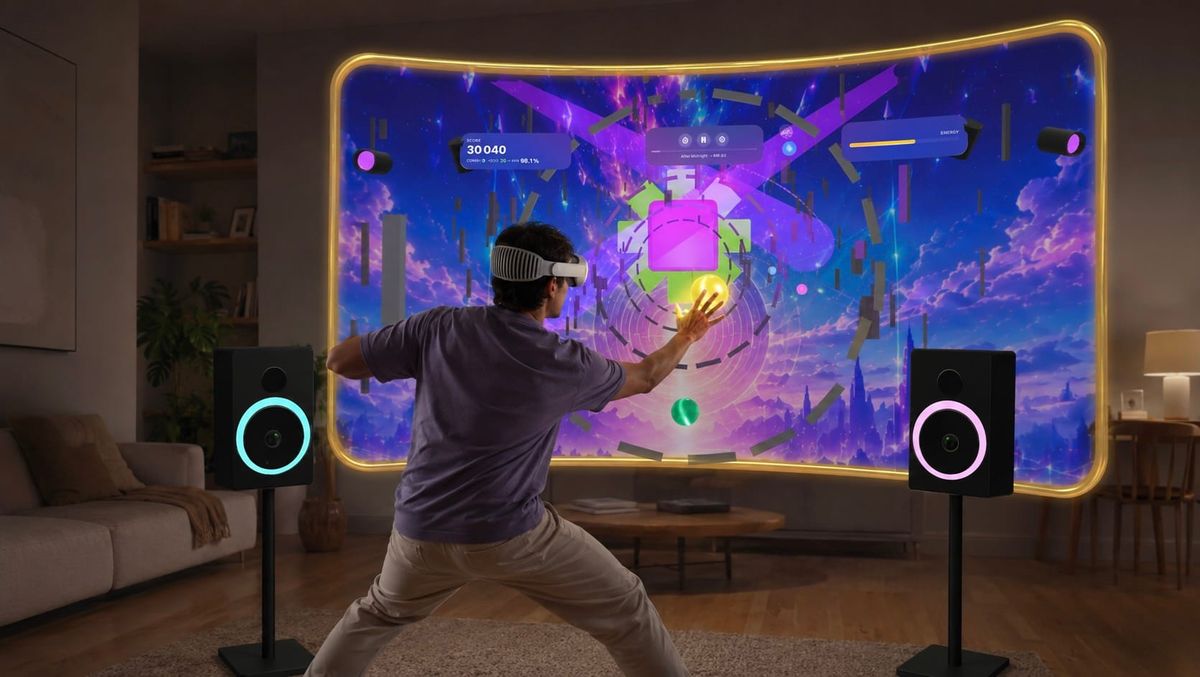
- A Massive Day-One Library: The game ships with 140 original tracks, offering over 7.5 hours of curated content across genres like Synthwave, Glitch Hop, Classical, and Lo-fi.
- The "Your Music" Factor: Players can import their own DRM-free files (MP3, WAV, FLAC). The engine analyzes these tracks locally, ensuring privacy and low latency, to create unique stages.
- Hybrid Environments: Users can choose to play in "Mixed Reality" mode, where the game elements are overlaid on their actual living room, or "Fully Immersive" mode, which transports them to otherworldly digital vistas.
Chronology: From 1999’s CDs to 2026’s Spatial Intelligence
To understand the significance of Flow Chaser, one must look back nearly thirty years to the origins of procedural music gaming. The concept of a game that "builds itself" around a user’s music was pioneered by Masaya Matsuura, the legendary designer behind PaRappa the Rapper.
1999: The Vib Ribbon Revolution
In 1999, Matsuura’s studio, NanaOn-sha, released Vib Ribbon for the original PlayStation. It was a minimalist game where a vector-art rabbit named Vibri walked along a line that vibrated and twisted according to the music. The revolutionary aspect was that players could swap the game disc for any music CD in their collection. The PlayStation’s RAM would hold the game data while the hardware analyzed the CD’s audio data to generate obstacles. Sony was so impressed by this innovation that they secured patents for the underlying technology.
2010s: The Rise of Manual Beat-Mapping
As the industry moved into the VR era, games like Audiosurf and Beat Saber took center stage. While Audiosurf attempted procedural generation, it often lacked the "flow" required for high-level play. Consequently, the industry pivoted toward manual mapping, which ensured high-quality levels but limited the library to what developers could license or what the modding community could build.
2024–2026: The Vision Pro Era
With the launch of the Apple Vision Pro and the subsequent iterations of visionOS, the hardware finally caught up to the software ambitions of the late 90s. The introduction of visionOS 27 brought enhanced Siri AI and deeper neural engine access for developers. This paved the way for Flow Chaser to move beyond the limitations of the past, utilizing the M-series and R-series chips to perform complex audio-to-visual transformations in milliseconds.
Supporting Data: Technical Specifications and Performance
Flow Chaser is not merely a visualizer; it is a high-performance application that demands the full breadth of the Vision Pro’s capabilities.
Audio Analysis Metrics
According to technical documentation, the "Flow Engine" analyzes music across four primary vectors:

- Transient Detection: Identifying the sharp "attacks" in drums and percussion to place primary targets.
- Harmonic Complexity: Determining the "mood" of the level. Higher complexity often translates to more intricate patterns and spatial movements.
- Frequency Distribution: Low-end frequencies (bass) often trigger environmental vibrations, while high-end frequencies (cymbals/synths) dictate the height and speed of incoming objects.
- Spectral Flux: This measures the change in the power spectrum of an audio signal, helping the game decide when to transition between different "biomes" or visual themes within a single song.
The visionOS 27 Advantage
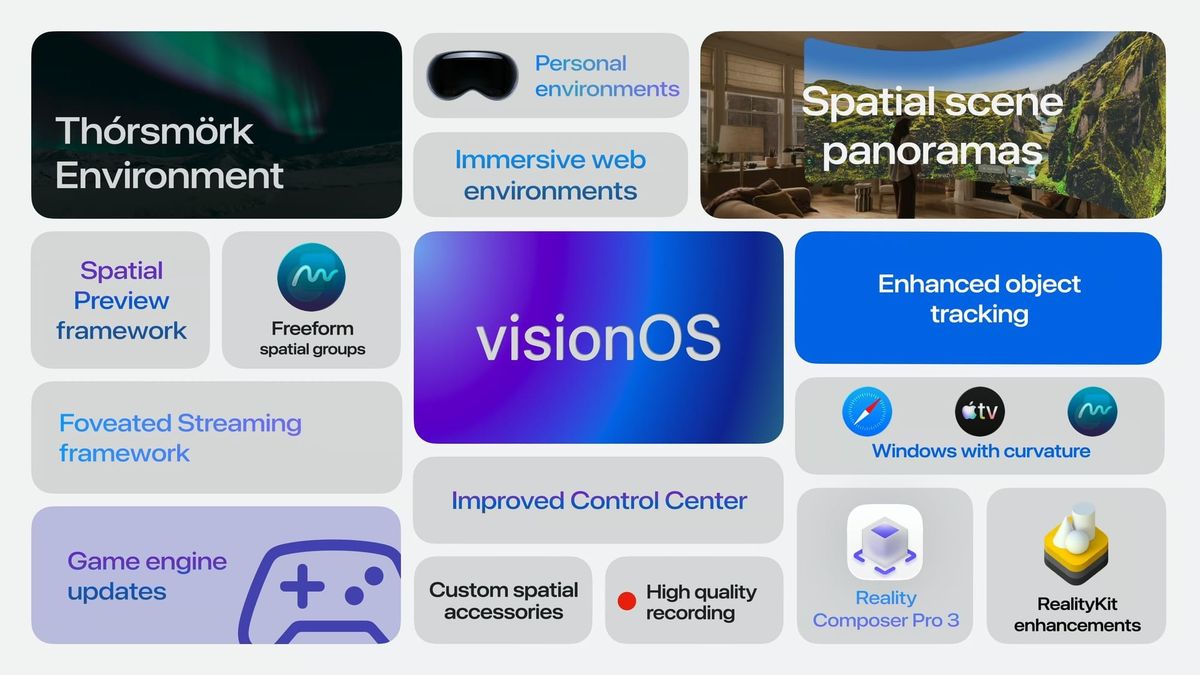
The timing of the launch is critical. visionOS 27 introduced a revamped "Spatial Audio API" that allows Flow Chaser to pin sound sources to specific game objects with unprecedented precision. This means that as an orb approaches from the top-left, the sound of that specific instrument is perceived as coming from that exact coordinate in 3D space, creating a "synesthetic" experience where sight and sound are perfectly aligned.
Official Responses: Developer and Industry Perspectives
While the developers of Flow Chaser have remained focused on the software’s technical "flow," their public statements highlight a commitment to the "democratization of rhythm gaming."
In a press release accompanying the launch, the development team noted:
"Our goal was to remove the gatekeepers of the rhythm genre. For too long, players have been restricted to the tracks that developers could afford to license. With the power of Apple’s on-device intelligence, the player’s own taste becomes the architect of the experience. Whether it’s a 1970s jazz fusion track or a modern heavy metal anthem, the game adapts to the artist’s intent."
Industry analysts have also weighed in on the significance of the $14.99 price point. "At fifteen dollars, Flow Chaser is positioned as an ‘essential’ app for the Vision Pro," says tech analyst Sarah Jenkins. "By leveraging Apple’s own AI frameworks, the developers have kept overhead low while providing infinite replayability. It’s a showcase for why on-device processing matters—no cloud lag, no subscription fees, just pure local computation."
Apple has also featured Flow Chaser in its "Best of visionOS 27" showcase, highlighting the game’s use of hand-tracking. The game eschews controllers entirely, relying on the Vision Pro’s advanced sensors to track finger and palm movements with sub-millimeter accuracy, allowing for the "slicing" and "bonking" motions described in the gameplay overview.
Implications: The Future of Algorithmic Creativity
The success of Flow Chaser carries implications that extend far beyond the niche of rhythm gaming. It serves as a proof-of-concept for the future of "Generative Spatial Content."
1. The End of Static Content
If a game can build a compelling level from a song, can a movie-watching app build a 3D environment based on the cinematography of a film? Flow Chaser suggests that the future of spatial computing is not static assets, but dynamic environments that react to the media we consume.
2. Privacy and Local AI
By performing all music analysis on-device, Flow Chaser adheres to the strict privacy standards that have become a hallmark of the Apple ecosystem. This sets a precedent for future AI-driven games: you don’t need to upload your personal data or your music library to the cloud to get a personalized experience.
3. Reviving the DRM-Free Market
In an age of streaming, Flow Chaser provides a compelling reason for users to own their music again. Because the game requires DRM-free files for the import feature, it may spark a minor resurgence in digital music purchases from platforms like Bandcamp or 7digital, as players seek to "play" their favorite underground artists.
4. Evolution of the "Flow" State
The title of the game is no accident. In psychology, "flow" is the state of being fully immersed and energized by an activity. By utilizing AI to match the game’s difficulty and rhythm to the user’s specific music, Flow Chaser is a direct experiment in engineering the flow state. As these algorithms become more refined, we may see "smart" games that adjust their difficulty in real-time based on the player’s biometric data—a feature already rumored for future Vision Pro updates.
Conclusion
Flow Chaser is more than a tribute to Vib Ribbon; it is a sophisticated evolution of its spirit. By combining the nostalgia of 90s procedural generation with the cutting-edge power of visionOS 27, it offers a glimpse into a future where gaming is as personal as a playlist. For Apple Vision Pro owners, the $14.99 entry fee provides a portal to an infinite library of spatial challenges, proving that when it comes to the next generation of entertainment, the rhythm is indeed in the machine.