The Surreal Evolution of Matt Lesniewski: A Deep Dive into ‘Faceless and the Family’
The landscape of independent comic books is often defined by the tension between narrative clarity and raw, unfiltered artistic expression. Few contemporary creators embody this tension as vividly as Matt Lesniewski. Five years after bursting onto the scene with the critically acclaimed and Eisner-nominated The Freak, Lesniewski has returned with a sprawling, ambitious new graphic novel, Faceless and the Family, published by Oni Press. This latest offering marks a significant milestone in the artist’s career, showcasing an aesthetic evolution that pushes the boundaries of the medium while grappling with the complexities of identity, trauma, and the search for belonging.
Main Facts: The Intersection of High Art and High Fantasy
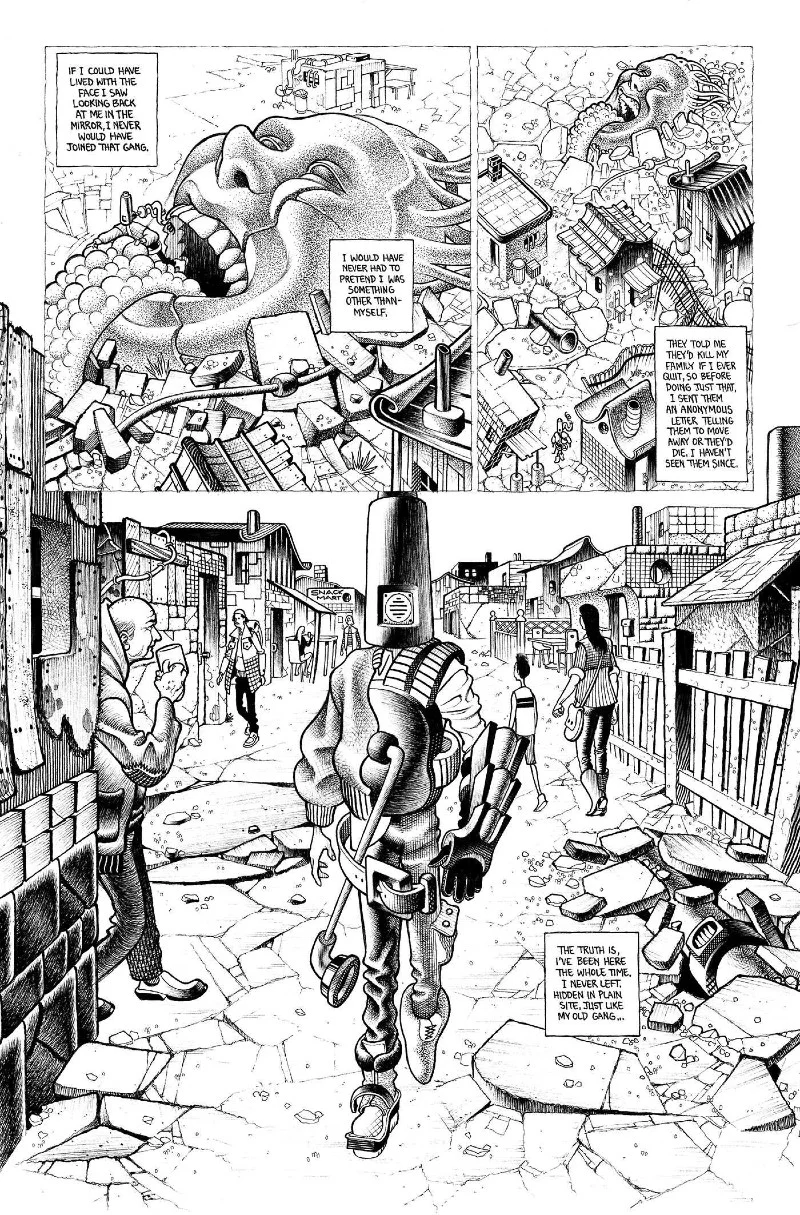
Faceless and the Family is a $29.99 graphic novel written and illustrated by Matt Lesniewski and published by Oni Press. At its core, the book is a surrealist odyssey set on a planet physically shaped like a human hand floating in the vacuum of space. The narrative follows a protagonist known only as "Faceless," a man who has spent a decade hiding his identity within a suit of industrial piping after deserting a violent criminal organization.
The book has garnered significant attention for its singular visual style, which critics have described as a fever-dream fusion of diverse influences. Lesniewski’s work on this project represents a departure from the more direct homages to artists like Moebius and Geoff Darrow seen in his earlier work. Instead, Faceless and the Family introduces a "black-and-white Yellow Submarine" aesthetic, blending the psychedelic geometries of 1960s animation with the gritty textures of underground manga, classic Westerns, and 1980s Saturday morning cartoons.
Despite the overwhelming praise for its visual ingenuity, the book has also sparked a dialogue regarding the balance between world-building and narrative execution. While the art is undeniably a "high point" for the medium, the internal mechanics of the story—specifically its dialogue and plotting—have become points of critical contention.
Chronology: From ‘The Freak’ to the Finger Cities
To understand the weight of Faceless and the Family, one must look at the trajectory of Matt Lesniewski’s career.

2019: The Arrival of ‘The Freak’
Lesniewski first made waves in the industry with The Freak (published by AdHouse Books). The story, which focused on a physically grotesque man seeking validation in a world that rejected him, established Lesniewski’s penchant for "ugly-beautiful" art. It was a masterclass in texture and grotesque anatomy, earning him an Eisner Award nomination for Best Penciller/Inker.
The Developmental Gap
Following the success of his debut, Lesniewski spent the intervening years refining his craft. His style began to shift from the purely hyper-detailed, Darrow-esque linework toward a more experimental use of negative space and geometric abstraction. During this period, the concept for Faceless and the Family began to take shape—a story that would move away from the singular focus of The Freak and toward an ensemble cast within a highly structured, metaphorical world.
2024: Release of ‘Faceless and the Family’
Released through Oni Press, Faceless and the Family represents Lesniewski’s transition to a major independent publisher. The release marks a shift in scale, moving from the niche underground appeal of his earlier work to a more widely distributed, prestige format graphic novel. The story introduces the "Palm" and the "Finger Cities," establishing a socio-economic hierarchy that serves as the backdrop for the protagonist’s ten-year post-gang life.
Supporting Data: Artistic Techniques and Narrative Themes
The primary draw of Faceless and the Family is its dense, almost claustrophobic visual language. Lesniewski employs a variety of traditional ink techniques to create a sense of tactile reality within a surrealist framework.
Textural Complexity
The book is characterized by a "smorgasbord of different textures." Lesniewski utilizes:

- Swarms of Crosshatching: Used to create depth and shadow, giving objects a physical weight that feels almost burdensome.
- Stippling and Squiggles: These techniques are used to differentiate materials, from the cold, hard surface of Faceless’s industrial mask to the organic, erupting warts of the planet’s surface.
- Anatomical Distortion: Characters often elongate at impossible angles or seem to dissolve into the background patterns, a visual metaphor for the instability of their identities.
World-Building via Geography
The setting of the "Hand Planet" provides a literal map for the story’s themes of class and aspiration:
- The Palm: A wasteland inhabited by the "poor folk," characterized by stagnation and hiding.
- The Finger Cities: The destination for the wealthy and those seeking "reconstruction." It represents the promise of a new life, albeit one that requires a permanent erasure of the past.
Character Design as Narrative
Lesniewski’s knack for character design serves as a grounding force. Each of the four outcasts Faceless meets along his journey possesses a "unique and believable" visage, despite the surreal environment. This consistency allows the reader to connect with the characters’ "sadness and loss," even when the environment—such as monsters popping out of earth-warts—becomes intentionally overwhelming.
Official Responses and Critical Reception
While Oni Press has marketed the book as a "visionary epic," critical responses have highlighted a divide between the book’s visual achievements and its literary components.
The "Visual Masterpiece" Consensus
The consensus among comic book critics is that Lesniewski is currently operating at the peak of his visual powers. Reviewers have noted that "as an artist, Lesniewski finds new ways to spark the imagination on almost every page." The book is being hailed as an "idiosyncratic and immersive world" that could only have originated from a single, uncompromised creative mind.
The Narrative Critique
However, the "clunkiness" of the dialogue has been a recurring theme in critical circles. Several reviews point out that:

- Expository Dialogue: Characters have a tendency to state their internal feelings and the plot’s themes explicitly, rather than allowing them to emerge naturally through action.
- Plot Congestion: The sheer volume of subplots and character arcs is said to occasionally "distract from the art’s function," leading to a mechanical feeling in the story’s progression.
- Themes vs. Execution: While the themes of family and self-acceptance are profound, the "blunt" delivery of these ideas can sometimes diminish the visual "punch" of the illustrations.
In a recent assessment, the book received a 7/10, a score that reflects a "high-distinction" for art but suggests room for growth in scriptwriting and editorial pacing.
Implications: The Future of the Auteur in Comics
The publication and reception of Faceless and the Family have several implications for Matt Lesniewski and the broader comic book industry.
The Rise of the "Total Cartoonist"
Lesniewski belongs to a rare breed of "total cartoonists" who write, draw, and letter their own work. Faceless and the Family proves that there is a significant market for "unfiltered" visions. Oni Press’s willingness to back such a stylistically challenging book suggests that major indie publishers are still invested in "art-first" projects, even if they lack the streamlined narrative of more commercial fare.
Refining the Craft
The critique of Lesniewski’s writing suggests a common growing pain for visual-heavy auteurs. As he continues to evolve, the challenge will be to "hone his concepts to the essentials." The consensus suggests that if Lesniewski can learn to "let his art do the talking," his future as a "formidable cartoonist" is virtually guaranteed.
Socio-Political Commentary in Surrealism
By using a hand-shaped planet to illustrate the divide between the "Palm" and the "Finger Cities," Lesniewski has tapped into a tradition of using high-concept sci-fi to explore class struggle. The "industrial piping" worn by the protagonist serves as a powerful metaphor for the masks people wear to survive trauma. The success of these metaphors, despite the clunky dialogue, indicates that the visual language of comics can often communicate complex social truths more effectively than text.

Conclusion
Faceless and the Family is a flawed masterpiece. It is a testament to the power of the human imagination and the "messy" nature of the creative process. While the narrative mechanics may strain under the weight of the book’s ambition, the "tangible sense of heart" and "passion" humming through its pages make it a mandatory read for fans of the medium. Matt Lesniewski has constructed an expansive, heartbreaking world that stands as a bold, if occasionally overwhelming, achievement in modern graphic storytelling.
Faceless and the Family
- Author/Artist: Matt Lesniewski
- Publisher: Oni Press
- Format: Graphic Novel / 180+ Pages
- Price: $29.99
- Availability: In stores and online via Simon & Schuster and major comic retailers.