The Surreal Pitch: Reimagining Football Icons Through the Lens of Ghanaian Hand-Painted Art
Main Facts: A Bold Intersection of Sport and Folk Art
In the heart of East London, a singular cultural collision is currently taking place, blending the high-octane world of professional football with the vibrant, surrealist traditions of West African folk art. Running until July 8 at The Art House, the exhibition titled Fantasy Football offers a radical departure from the polished, corporate imagery usually associated with the global sport. Presented by the creative collective A Store Like 94 and football-art specialists Oof, the show features legendary players such as Lionel Messi, Zinedine Zidane, and Thierry Henry, but reimagined through the hyper-expressive, often bizarre aesthetic of Ghanaian hand-painted movie posters.
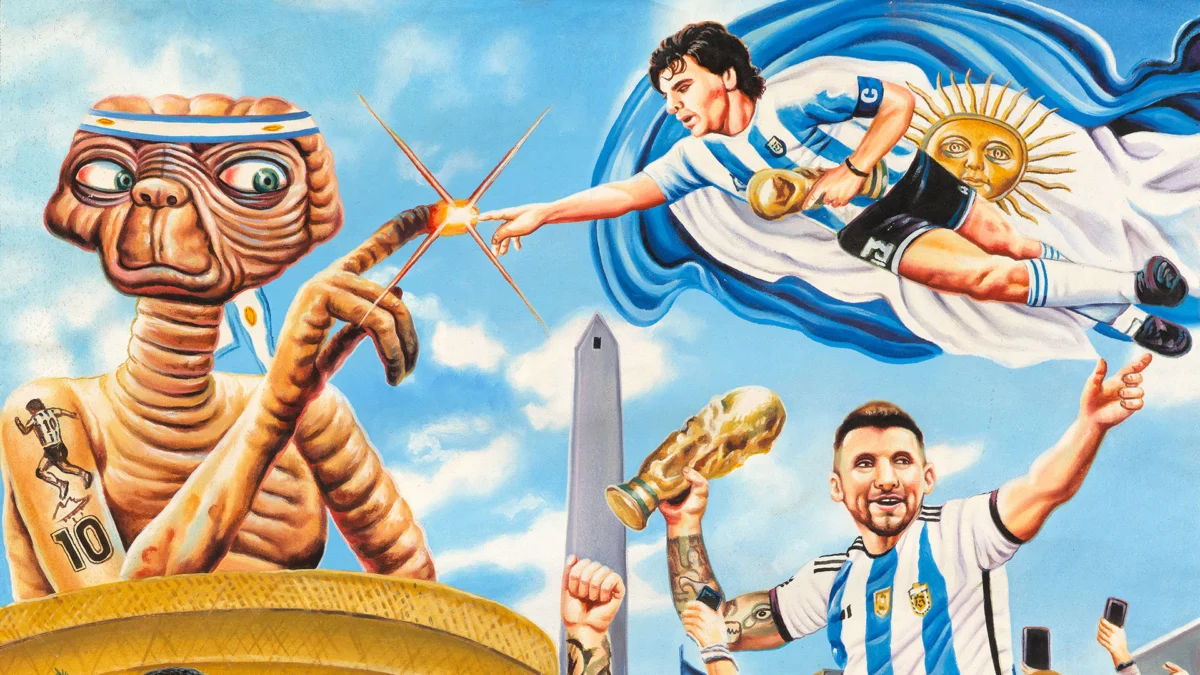
The exhibition showcases newly commissioned works by eight preeminent practitioners of this craft: Bright Obeng, C A Wisely, Daniel, Heavy J, Magasco, Nii Bi Ashitey, Salvation, and Stoger. These artists are masters of a genre that prioritizes visual impact and narrative "shock and awe" over anatomical accuracy or corporate branding. In this alternate reality, Zinedine Zidane is a cybernetic biker reminiscent of The Terminator, Lionel Messi shares a divine moment with a tattooed E.T., and Thierry Henry stands triumphant over the decapitated head of former manager Harry Redknapp.
Beyond the visual spectacle, the exhibition serves a dual purpose: it acts as a retrospective of a dying cinematic tradition and a contemporary platform for African artists to engage with the world’s most popular sport. Crucially, the exhibition maintains an ethical backbone, with 100% of the proceeds from print sales going directly to the artists in Ghana, a move aimed at correcting historical imbalances in the international art trade.

Chronology: From Mobile Cinemas to Global Galleries
To understand the visual language of Fantasy Football, one must look back to the late 1980s and early 1990s in Ghana. This era marked the "mobile cinema" boom, a grassroots movement where entrepreneurs traveled across the country with television sets, VCRs, and diesel generators to screen Hollywood blockbusters, Bollywood musicals, and local "juju" horror films in remote villages.
The Era of the Flour Sack Canvas
During this period, access to official promotional materials from Hollywood studios was non-existent. To lure audiences into these makeshift theaters, local cinema owners commissioned artists to create posters. Working with whatever materials were available—often recycled flour sacks stitched together and primed with basic house paint—these artists had frequently never seen the films they were advertising. They relied on brief descriptions or single-frame snippets, leading to the creation of posters that were wildly imaginative, emphasizing action, gore, and supernatural elements that may not have even appeared in the actual movie.
The Rise of Deadly Prey
As digital printing technology reached Ghana in the mid-2000s, the demand for hand-painted posters plummeted, nearly rendering the craft extinct. However, the genre found a second life in the Western art world. Much of this resurgence is credited to the Deadly Prey Gallery, a Chicago and Accra-based outfit that has worked since 2012 to archive these works and connect the artists with international collectors.

Fantasy Football represents the latest evolution in this timeline. By shifting the focus from cinema to sport, the exhibition demonstrates the versatility of the Ghanaian style. It proves that the same techniques used to sell Rambo or The Matrix in 1992 can be used to mythologize the "Galácticos" of 2024.
Supporting Data: The Artists and Their Surrealist Vision
The eight artists featured in the exhibition are not mere illustrators; they are world-builders. Their work is characterized by a "more is more" philosophy, where the goal is to capture the essence of a player’s power rather than their likeness.
Key Works and Artistic Interpretation
- Zidane: A 21st Century Portrait (by Salvation): Drawing from the 2006 documentary of the same name, Salvation reimagines the French maestro not as a midfielder, but as a brooding, mechanical force of nature. Clad in leather and riding a motorcycle, Zidane’s stoic intensity is translated into the language of an 80s action hero.
- Lionel Messi: Destiny (by Heavy J): This piece is perhaps the most surreal in the collection. It references Michelangelo’s The Creation of Adam, but replaces God with a heavily tattooed E.T. The juxtaposition suggests Messi’s "alien" talent—a common trope in football commentary—elevated to a religious, pop-culture icon.
- The Phenomenon (by Bright Obeng): Ronaldo (R9) is depicted alongside Mickey Mouse. In the visual grammar of Ghanaian posters, the inclusion of Western cartoon characters is a frequent "attraction" tactic, used to signify a world of global entertainment and joy.
- Super Buffon (by Magasco): The legendary Italian goalkeeper is portrayed as a literal giant, emphasizing his longevity and the "superhuman" nature of his career.
The Technical Process
The works are painted with oil or acrylic on high-durability surfaces, designed originally to withstand the rigors of being rolled up and transported through the Ghanaian bush. The color palettes are intentionally garish—neon yellows, blood reds, and deep cobalts—ensuring that the artwork "pops" against any background. This aesthetic, once a necessity for outdoor advertising, is now celebrated as a form of "African Pop Art."

Official Responses: Curatorial Insights and Ethical Stakes
The organizers of Fantasy Football emphasize that the exhibition is more than just a playful look at the sport; it is a serious exploration of how icons are made and maintained.
A Store Like 94, a collective known for celebrating football nostalgia through design, stated that the goal was to "strip away the sanitized, PR-managed image of modern footballers." By placing Messi or Beckham in these visceral, hand-painted worlds, they return the players to a state of myth and folklore.
Oof, a magazine and gallery dedicated to the intersection of art and football, highlighted the importance of the partnership with Deadly Prey Gallery. "These artists are legends in their own right," a spokesperson for Oof noted. "For decades, they operated in a vacuum, creating some of the most exciting art on the planet without international recognition. This show is about giving them the platform and the financial rewards they deserve."

The decision to give 100% of print proceeds to the artists has been hailed by critics as a benchmark for ethical curation. In an industry often criticized for "cultural raiding"—where Western galleries profit off the work of Global South artists without fair compensation—Fantasy Football seeks to establish a sustainable and respectful model of collaboration.
Implications: The Globalization of Folk Traditions
The success of Fantasy Football at The Art House signals a broader shift in the contemporary art market. The "low-brow" or "outsider" art of the Ghanaian mobile cinema has successfully transitioned into the "high-brow" gallery space of London.
The Blurring of "High" and "Low" Culture
This exhibition challenges the traditional hierarchy of the art world. It suggests that a hand-painted poster on a flour sack is as culturally significant as a photograph in a glossy sports magazine. By using football—a universal language—as the subject matter, the exhibition makes Ghanaian art accessible to a demographic that might not typically frequent art galleries. It bridges the gap between the "ultra-casual" football fan and the "avant-garde" art collector.

The Future of the Genre
As the original mobile cinema artists age, there is a growing concern about the preservation of their skills. However, exhibitions like Fantasy Football are inspiring a younger generation of Ghanaian painters to take up the brush. By proving that there is a global market for this specific, surrealist style, the exhibition helps ensure that this unique artistic lineage continues to evolve rather than fading into history.
Football as a Mythological Canvas
Finally, the exhibition raises questions about how we consume sports in the digital age. In a world of 4K slow-motion replays and endless statistical analysis, the hand-painted posters of Fantasy Football remind us of the "magic" and "mystery" that originally drew many to the game. They remind us that players like Maradona or Zidane are not just athletes; they are characters in a global drama that is constantly being rewritten and reimagined.
As the exhibition draws to a close on July 8, its legacy will likely be measured by the prints hanging in homes across London and beyond—each one a vibrant, chaotic testament to the power of the human imagination and the enduring, global allure of the beautiful game.

Exhibition Details:
- Fantasy Football
- Location: The Art House, East London
- Closing Date: July 8
- Featured Artists: Bright Obeng, C A Wisely, Daniel, Heavy J, Magasco, Nii Bi Ashitey, Salvation, Stoger.
- Curated by: A Store Like 94, Oof, and Deadly Prey Gallery.