"The Treasury of Folklore" Unveils a Unified Vision of Humanity’s Shared Myths in Landmark Compilation
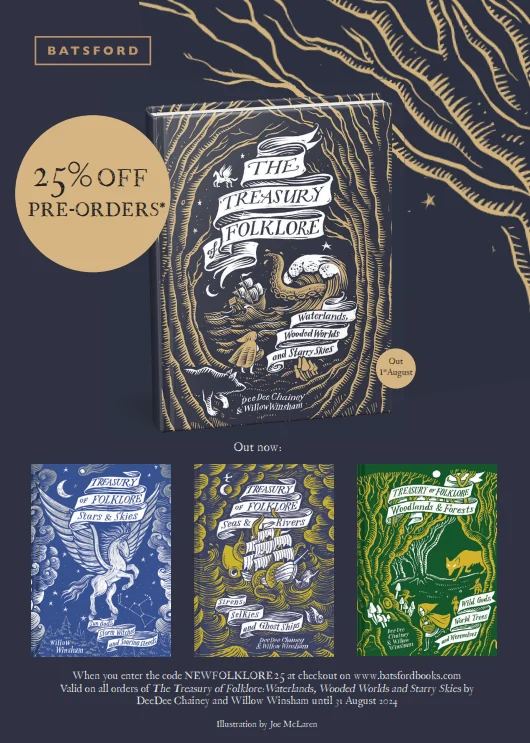
London, UK – July 25, 2024 – A decade-long journey into the heart of human storytelling culminates this August with the release of The Treasury of Folklore: Waterlands, Wooded Worlds and Starry Skies. This highly anticipated volume, compiled by acclaimed authors Dee Dee Chainey and Willow Winsham, brings together the most cherished tales from their popular three-book series into a single, beautifully bound collection. Scheduled for release on August 1st, 2024, the book promises to be an essential addition for enthusiasts of myth, legend, and the shared human experience.
The compilation represents the original vision of the authors, who initially conceived their extensive research as one comprehensive tome. The sheer volume and richness of the material, however, necessitated an initial expansion into three distinct, award-winning books: Seas and Rivers, Trees and Woodlands, and Stars and Skies. Now, these narratives are harmoniously reunited, offering readers a seamless exploration of how humanity has woven beliefs, customs, and tales around the physical landscapes of our world.
Chronology: From Digital Spark to Global Narrative
The genesis of The Treasury of Folklore series traces back nearly a decade, born from a profound desire to explore the universal threads connecting diverse cultures through their myths. Authors Dee Dee Chainey and Willow Winsham embarked on this ambitious project, fueled by a simple yet powerful question: how do humans, regardless of geography, interpret and interact with the natural world through story?
A significant catalyst for their work was the vibrant online community fostered by the #FolkloreThursday hashtag. This digital phenomenon, which continues to thrive, demonstrated an overwhelming global outpouring of interest in folklore, showcasing its enduring relevance and unifying power. It underscored the authors’ belief that folklore was not merely archaic tales, but living narratives reflecting deep-seated human truths. This online inspiration solidified their resolve to create something "meaningful, lasting, that reflected the unifying universality of folklore across the globe."
The initial success of the individual volumes — Seas and Rivers, Trees and Woodlands, and Stars and Skies — exceeded the authors’ expectations. Each book meticulously explored the myths and legends associated with specific environments: the treacherous depths and life-giving flows of water, the ancient wisdom and shadowed mysteries of forests, and the awe-inspiring expanse of the celestial heavens. The popularity of these initial publications was "both surprising and heartwarming," a testament to the universal resonance of their chosen subject matter and the accessible, engaging way in which Chainey and Winsham presented it.
The idea for a definitive compendium naturally emerged, a suggestion the authors embraced with enthusiasm. It offered the perfect opportunity to realise their initial, grander vision: to house this vast collection of human imagination within a single volume. The process of curating this compilation involved "much work behind the scenes," as the authors revisited their extensively researched material with "fresh eyes." The challenge lay in sifting through a decade’s worth of beloved stories, carefully selecting and arranging them to create a cohesive narrative that would flow seamlessly across "shared landscapes across time and place." The meticulous attention to detail extended to the physical attributes of the book itself, with the authors expressing their utter delight at the final product, describing it as a "hefty tome" with a beautiful binding, cover, and cream paper, designed to be both a treasure and a conversation starter.
Supporting Data: Unearthing Universal Truths Through Mythical Narratives
The Treasury of Folklore: Waterlands, Wooded Worlds and Starry Skies is more than just a collection of stories; it is a meticulously crafted artifact. The "beautifully bound volume" is designed to be a significant presence on any bookshelf or coffee table, an object that invites engagement and contemplation. Its "hefty tome" status is a physical reflection of the rich content within, printed on "beautiful cream paper" that enhances the reading experience. A key highlight of the compilation is the inclusion of the "wonderful original illustrations of Joe McLaren," whose evocative artwork masterfully brings these ancient tales to life.

The compilation is thoughtfully structured into three distinct sections, mirroring the original series and allowing readers to journey through the realms of water, earth, and sky. While the authors stress that the book contains no new material, featuring text taken directly from the existing three books, its value lies in its consolidated presentation, making these interconnected narratives more accessible and impactful than ever before. To whet the appetite of expectant readers, the authors have provided a glimpse into the rich tapestry of folklore contained within.
Water Horses: Majestic and Malevolent Creatures from the Depths
From the swirling currents of rivers to the glassy surfaces of ancient lakes, water horses emerge as one of folklore’s most captivating and perilous archetypes. These shapeshifting equines embody humanity’s primal fear of the unknown lurking beneath the water, often serving as potent cautionary tales against recklessness and solitude.
The Scottish Kelpie stands as perhaps the most famous of these creatures, though the compilation clarifies a crucial distinction within Scottish lore: while kelpies inhabit rivers, the more dangerous each-uisge prefers the deeper, more expansive lochs and lakes. Both share a malevolent streak, luring unwary travellers onto their backs before plunging them into watery graves. Yet, tales also reveal cunning methods of evasion: a bridle marked with a cross could temporarily tame a kelpie, though its control was always "illusory and fleeting." The ultimate weapon against such a beast, as in many folkloric narratives, was "red-hot iron." The enduring power of the kelpie is manifest in modern Scotland, most strikingly in the colossal 30-meter (98ft) sculptures near Falkirk, visible from the M9 motorway since 2013. Its presence in contemporary literature, from Lari Don to J.K. Rowling’s Fantastic Beasts and Where to Find Them, further cements its place in the global imagination. Interestingly, the article notes a distinct absence of similar water horse figures in English folklore, highlighting regional variations in mythic landscapes.
Crossing the border into Wales, the Ceffyl Dwr redresses this deficit. A staple of Welsh belief well into the 19th century, this water horse exhibited regional differences in its appearance and behaviour. In the north, it was a violent, shapeshifting spirit, while in the south, it consistently appeared as an enchanting, small horse. Its legendary speed allowed it to cover "huge distances in an impossibly short space of time" before vanishing, leaving its hapless rider to drown. A curious exception to this grim fate involved clergymen of any creed, who were said to be able to ride the Ceffyl Dwr unharmed, suggesting a fascinating intersection of ancient pagan fears and later Christian beliefs.
In Scandinavia, the Bäckahäst or "brook horse" presents a similarly alluring yet deadly figure. Most often sighted in the misty shroud of fog, this creature is described as "majestic and luminous," enticing riders before dragging them to their doom. Children are often its victims in these tales, perhaps to heighten the sense of vulnerability and tragedy. One popular story recounts a group of boys saved from a Bäckahäst when the last child accidentally mispronounces a rhyming phrase, uttering "Jesus Christ," a name the creature despises. This narrative vividly illustrates the syncretic nature of folklore, where older nature spirits are influenced by newer religious beliefs. Like the kelpie, the Bäckahäst could, in some tales, be tricked and put to work, hinting at humanity’s perennial desire to exert control over the wild forces of nature.
These diverse water horse narratives, despite their geographical separation, share a common thread: they are potent expressions of humanity’s respect and fear for the untamed power of water, embodying the dangers of venturing into the unknown.
Lords of the Wild: Embodiments of Nature’s Power
Venturing from the watery depths into the "verdant greenery of the forest," the compilation introduces readers to the "Lords of the Wild"—powerful spirits and creatures that personify the dual nature of the woodlands: both nurturing and perilous. These figures range from benevolent protectors to malevolent tricksters, their forms often echoing the ancient trees and shadowed glades they inhabit.
Tapio, the Finnish Forest God, also known as Metsähine or Hiisi, reigns as the king of the Finnish forest realm. His appearance is deeply intertwined with his domain: tall and thin, cloaked in ermine fur or moss, his head crowned with a hat, and a beard of "straggling black hair" or moss and lichen. Like the Green Man figures of European folklore, he gazes out from beneath bushy eyebrows, embodying the spirit of the forest itself. Intriguingly, he is described as having "the back of a gnarled tree" when viewed from behind, emphasizing his non-human, elemental nature. Tapio is both the personification and protector of the forest, holding dominion over all its creatures. Historically, hunters would seek his blessing for a successful hunt, pledging reverence for the land and its inhabitants, a clear reflection of the deep ecological awareness embedded in ancient Finnish culture. His ability to grant or curse a hunt highlights the precarious balance between human needs and natural forces. His family — benevolent wife Mielikki (or stern Kuurikki), son Nyrikki (who guides hunters), and daughter Tulikki (who directs prey) — further illustrates the intricate personification of the forest’s various aspects.
In Slavic folklore, the Leshy (also leshii or lyeshy) stands as a formidable tutelary spirit of the woods, a protector of trees and animals, particularly wolves or bears in different regions. Like the bears it sometimes serves, the leshy hibernates in winter. Known by many names, often linking it to the woods or even the Devil, the leshy is frequently likened to Greek satyrs, sporting horns, claws, and a bushy, sometimes "forest green," beard, or being entirely covered in moss. A master shapeshifter, the leshy can alter its size and form at will, appearing "taller than a tree, or as short as a blade of grass," or even changing its perceived size based on distance. When it takes human form, subtle clues betray its true nature: a lack of eyelashes or brows, shoes worn on the wrong feet, or clothing wrapped contrary to local fashion. Some even possess a single eye, cloven feet, or wings and a tail.

The leshy’s presence is often heralded by its "bellowing," which whips up great winds and sends forest creatures fleeing in terror. For human intruders, its shrieking laughter, clapping, or howling serve as warnings. Those who ignore these omens risk being hopelessly lost in the wilds, confused and disoriented by the leshy’s power to "change their surroundings about them." The leshy is a quintessential trickster figure, mimicking voices to lure victims, and famously capable of "tickling their victims to death." Beyond confusion and trickery, leshies are also known to inflict illness, abduct women for marriage, and snatch children "cursed by their parents" or found wandering alone. Their wrath could extend to entire farms, "sucking the milk from the herd," leading farmers in some Russian districts to offer annual cow sacrifices for protection. However, appeasement through offerings of bread and tobacco, or uttering a prayer before entering the forest, could ensure safe passage.
Leshies, according to belief, live alone or with their wives, the lesovikha, and children, sometimes in forest huts. They are not above internal conflict, waging war with clubs and ripping up trees. One anecdote describes a Vologda District leshy frequenting taverns with his wolf pack, guzzling vodka before returning to the night. They are also avid gamblers, often bartering with squirrels or playing cards (though notably avoiding clubs, which too closely resemble the Christian cross). Protection against a leshy often involves turning clothes inside out or putting shoes on the wrong feet, actions said to provoke laughter and restore the lost to their path. Swearing "remorselessly" is another unconventional method of banishment, while the sign of the cross serves as a more traditional defence. For those daring enough to summon a leshy, the method involves arranging young birch trees in a circle, standing within it devoid of Christian symbols, and calling out to the "grandfather of the forest." These intricate details paint a vivid picture of a spirit deeply embedded in the daily lives and fears of Slavic communities.
The Hare in the Moon: A Celestial Tapestry of Sacrifice and Folly
Finally, the compilation directs our gaze skyward, to the enduring mystery of the moon. Across countless cultures, humanity has seen faces and figures etched upon its surface, none more prevalent than the image of a rabbit or hare. This motif is so widespread that specific lunar features, like the Sea of Tranquillity, are often identified as parts of the celestial lagomorph, such as its head, with the Seas of Fertility and Nectar forming its ears.
One of the most profound narratives explaining the hare’s presence on the moon originates from the Buddhist Sasa-Jātaka. In this tale, a virtuous hare, along with his friends (an otter, jackal, and monkey), resolves to offer alms on a fast day. To test their sincerity, the deity Sakka, ruler of Trāyastriṃśa heaven and protector of Buddhism, descends to Earth disguised as an old man, begging for food. While his friends readily offer what they have, the hare, possessing only grass, understands its inadequacy and, in an ultimate act of self-sacrifice, offers his own body upon a fire for Sakka to eat. Moved by such profound faithfulness, Sakka spares the hare, plucking him from the flames and immortalising him on the moon for all eternity. Some versions elaborate that Sakka used the "essence extracted from squeezing the mountain" to draw the hare’s image. Similar self-sacrificing hare stories, with variations in animal companions, are found in numerous other cultures, highlighting a shared veneration for altruism.
A Sri Lankan tale echoes this theme, recounting how Buddha, lost and hungry in a wood, encounters a helpful hare. When Buddha laments his poverty and inability to pay for assistance, the hare immediately offers himself as food. Buddha, witnessing this selfless act, saves the creature from the fire he lit and sends him to reside on the moon. Similarly, in Japan, the rabbit, known as Tsuki no Usagi, features in a popular tale often told to children during the Harvest Moon and Mid-Autumn Festival. Here, the Man in the Moon descends disguised as a beggar. While other animals offer food, the rabbit, with only grass, sacrifices itself. The beggar reveals his true form and takes the selfless rabbit to live with him on the moon. These narratives, spanning diverse regions and spiritual traditions, consistently elevate the hare as a symbol of profound generosity and ultimate selflessness.
In stark contrast to these tales of sacrifice, a compelling narrative from South Africa presents the hare in a less benevolent light. Here, the hare is held responsible for humanity’s mortality. The Moon dispatches Hare to deliver a crucial message to humankind: just as she, the Moon, "dies" and is reborn each month, so too would humans experience a cyclical return from death. However, the "flighty creature" misdelivers the message, informing humanity that they would simply die, without the promise of return. Enraged by this catastrophic error, the Moon attacks Hare with a hatchet, intending to cleave him in two, but only succeeds in splitting his lip. In retaliation, Hare lashes out, scarring the Moon’s face with his claws—scars that, the tale asserts, can still be seen in the dark shapes on the moon today. This narrative offers a starkly different perspective, transforming the hare from a symbol of virtue into a trickster figure whose folly condemns humanity, while simultaneously providing an origin myth for the moon’s familiar markings.
These lunar legends collectively demonstrate humanity’s innate drive to imbue celestial phenomena with meaning, reflecting our deepest hopes, fears, and understandings of life and death.
Official Responses: Authors’ Voice and Publisher’s Commitment
Dee Dee Chainey and Willow Winsham have expressed profound gratitude for the reception of their initial series and immense excitement for this compilation. "To say we have been blown away by the end result is an understatement," they shared, reflecting on the journey from an initial concept to a celebrated series and now, its definitive compilation. Their passion for folklore and their commitment to its preservation is palpable, evident in the meticulous research and heartfelt presentation of each story. They extend their thanks to "each and every person who has bought and read these books," acknowledging the vital role readers play in keeping these ancient narratives alive.

Batsford Books, the esteemed publisher of The Treasury of Folklore, has shown unwavering support for the authors’ vision. Their commitment to producing high-quality, culturally significant works is evident in the exquisite craftsmanship of this new volume. The collaboration between authors and publisher has clearly resulted in a publication that is not only rich in content but also a joy to behold and hold.
The Treasury of Folklore: Waterlands, Wooded Worlds and Starry Skies is now available for pre-order, with its official release scheduled for August 1st, 2024. Readers can avail of a special 25% discount when ordering directly from Batsford Books using the code NEWFOLKLORE25.
Implications: Folklore as a Mirror to the Human Condition
The release of The Treasury of Folklore: Waterlands, Wooded Worlds and Starry Skies carries significant implications for both the study of folklore and the broader cultural landscape. At its core, the book reinforces the authors’ profound discovery: "in so many ways, we are all inherently the same." By presenting diverse myths from across the globe, it powerfully illustrates how humans share "primal fears and dreams," regardless of geographical location, cultural attire, or the names given to the "monsters of our myths and legends." The longing for "treasures and pleasures," the dread of the unknown "around our campfires in the darkness of the nighttime forest," and the "awe of the eternity of time under the glimmer of ancient stars" are universal sentiments that transcend time and place.
This compilation serves as a vital tool for the preservation and accessibility of cultural heritage. In an increasingly globalized yet fragmented world, the act of collecting and presenting these stories in a unified, accessible format ensures their continued life and relevance. It makes profound narratives, often confined to academic texts or specific cultural enclaves, available to a wider audience, fostering a deeper appreciation for the world’s rich tapestry of human imagination.
Beyond mere entertainment, the Treasury of Folklore offers a unique lens through which to understand human psychology, cultural values, and historical contexts. Each tale, whether of a treacherous water horse or a self-sacrificing hare, encapsulates a society’s relationship with its environment, its moral codes, and its attempts to comprehend the inexplicable. It highlights how these ancient stories provide frameworks for understanding the world, navigating ethical dilemmas, and coping with the fundamental mysteries of existence.
Ultimately, The Treasury of Folklore stands as a legacy project, a significant contribution to the ongoing study and appreciation of global folklore. It underscores the enduring power of storytelling, reminding us that these ancient narratives are not relics of the past but living reflections of our shared humanity. In a world often marked by division, this compendium offers a compelling testament to the unifying threads that bind us all, inviting readers to discover the universal truths embedded within the diverse and vibrant myths of our planet. The continued relevance of folklore, as evidenced by the #FolkloreThursday movement and the success of this series, ensures that these tales will continue to resonate and inform future generations, bridging the gap between our ancestors’ world and our own.