Unlocking the Secret: Laura Sampson’s "Enchanted Tales" Revitalizes the Mystery of the Twelve Dancing Princesses
LONDON, UK – December 12, 2023 – In an age increasingly defined by digital narratives, the timeless allure of traditional folklore continues to captivate, offering solace, wisdom, and thrilling escapes. Acclaimed author Laura Sampson masterfully breathes new life into one such enduring classic with her latest publication, "Enchanted Tales." At its heart lies a captivating retelling of "The Twelve Dancing Princesses," a beloved narrative with roots stretching across European oral traditions. Sampson’s rendition, published by Templar Books, meticulously draws inspiration from the 19th-century French version by Charles Deulin, offering readers a rich tapestry woven with regional specifics and universal themes of mystery, love, and transformation.
The publication of "Enchanted Tales" is more than just another fairy tale collection; it represents a significant effort to preserve and present cultural heritage through a contemporary lens. Sampson’s meticulous research into Deulin’s narrative, originating from the French-Belgian border region, imbues the well-known story with a fresh authenticity, grounding its fantastical elements in tangible historical and geographical details. This journalistic exploration delves into the core facts of this literary event, traces the enchanting chronology of the tale itself, examines the supporting data of its creation, imagines the critical and official responses it garners, and considers its profound implications for modern audiences.
Unveiling a Timeless Mystery: Laura Sampson’s "Enchanted Tales"
Laura Sampson’s "Enchanted Tales" arrives as a beacon for enthusiasts of classic folklore, promising to transport readers into worlds both familiar and refreshingly new. Central to its appeal is the retelling of "The Twelve Dancing Princesses," a narrative renowned for its beguiling mystery and romantic undertones. Sampson’s choice to revisit this particular tale, and specifically to highlight Charles Deulin’s version, speaks volumes about her dedication to the nuances of folkloric tradition.
The Enduring Allure of "The Twelve Dancing Princesses"
"The Twelve Dancing Princesses" is a story that has danced its way through generations, enchanting audiences with its central riddle: how do twelve princesses, locked securely in their chambers each night, manage to wear out their satin slippers as if they’d been dancing until dawn? This enigmatic premise has fueled countless adaptations across Europe, each reflecting the cultural particularities of its origin. Sampson’s retelling acknowledges this rich lineage while carving out its own distinct identity. By focusing on Deulin’s version, she champions a less ubiquitous, yet incredibly detailed, interpretation, distinguishing her work from more common retellings that might strip away some of the regional flavor. The universal themes of youthful escapism, the yearning for freedom, and the eventual triumph of true love against societal barriers are what ensure the story’s perennial popularity, making it ripe for reinterpretation.
Charles Deulin’s Regional Tapestry
Charles Deulin, a 19th-century French writer from the small town of Montignies-sur-Roc, nestled on the French-Belgian border, provides the unique foundation for Sampson’s narrative. Deulin was a folklorist and author known for his meticulous incorporation of local customs, dialect, and geographical specificities into his tales. Sampson’s commitment to this original source material means her version is rich with details – from the food the characters consume to the clothing they wear and the distinct place names that anchor the fantasy in a verifiable reality. This approach elevates the story beyond a generic fairy tale, transforming it into a vibrant cultural artifact.
The inclusion of the "Château of Beloeil" is a prime example of this historical anchoring. Beloeil Castle, a magnificent stately home in Belgium, is a real landmark with a storied past, lending an air of authenticity and grandeur to the princesses’ mysterious abode. Similarly, the protagonist, Michel, hailing from the village of Montignies-sur-Roc, directly links the narrative to Deulin’s home region, painting a vivid picture of a humble, dreaming cowherd rooted in a specific European landscape. This regional specificity is not merely decorative; it provides context for the characters’ motivations and worldviews, deepening the reader’s engagement with the narrative.
A Journey Through Enchantment: The Chronology of Discovery
Sampson’s retelling of Deulin’s "The Twelve Dancing Princesses" unfolds with a deliberate, enchanting rhythm, inviting readers to follow the young protagonist, Michel, on his extraordinary quest. The narrative is a masterclass in building suspense and wonder, chronicling Michel’s transformation from a dreaming cowherd to a prince by virtue of his courage, wit, and steadfast heart.
The Call to Adventure: Michel’s Humble Beginnings
The story commences in the idyllic village of Montignies-sur-Roc, introducing Michel, a young cowherd whose curly hair and striking blue eyes earned him the affectionate moniker "Stargazer." His predisposition for gazing upwards, dreaming of adventures beyond his pastoral existence, immediately establishes him as a hero destined for more. It is this innate longing that makes him receptive to the magical intervention that soon follows. One summer’s day, a radiant fairy, adorned in a golden dress, appears to him, delivering a cryptic yet exhilarating prophecy: "Go to the Château of Beloeil, and you will marry a princess!" This divine instruction serves as the catalyst for Michel’s journey, propelling him from his quiet life into a world of royal intrigue and arcane mysteries.
The Duke’s Enigma and the Suitors’ Fates
Michel, spurred by the fairy’s words, arrives at the formidable Château of Beloeil, only to find it abuzz with an unsettling mystery. The Duke, father to twelve exceptionally beautiful princesses, is tormented by an inexplicable phenomenon: each morning, despite their suite being locked with three robust bolts, the princesses’ satin shoes are found utterly worn through, as if they had engaged in a night of tireless dancing. Desperate for a resolution, the Duke issues a public decree: "ANYONE WHO CAN SOLVE THE MYSTERY OF THE WORN-OUT SHOES MAY MARRY ONE OF MY DAUGHTERS!" This pronouncement, while offering a grand reward, comes with a perilous catch. Numerous princes from across the land had already attempted to unravel the secret, only to vanish without a trace overnight, their fates a grim warning to any who dared to try.
Seeds of Magic: The Laurel Trees and Invisibility
Recognizing his humble status, Michel wisely refrains from immediately presenting himself as a suitor. Instead, he secures work in the château gardens, a position that allows him proximity to the princesses while he plots his strategy. He diligently prepares daily bouquets for them, enduring their initial indifference until the youngest, Lina, offers him a fleeting smile, igniting a fervent desire within him to solve the mystery for her sake.
That night, the benevolent fairy reappears, bestowing upon Michel two baby laurel trees—a rose and a cherry—along with a golden bucket and a golden rake. Her instructions are clear: "Plant these laurel trees, tend them with this rake, water them from this bucket and they will grant your wishes!" Michel, following her guidance, cultivates the magical saplings, unaware of the profound power they hold.
The Secret World Unveiled: A Nocturnal Ballet
One day, the cherry laurel blooms with a solitary white flower. Michel, plucking it and placing it in his shirt buttonhole, hopes it will impress Lina. To his astonishment, the flower instantly renders him invisible. Realizing this is his opportunity, he resolves to finally uncover the princesses’ secret. That evening, concealed beneath a bed in their suite, he observes. As soon as the door is secured, the rustle of clothes, the opening of wardrobes, and the murmur of laughter fill the room. Then, with three distinct claps and a creak, a trapdoor in the floor swings open. Michel, careful to remain unseen, slips out and follows the princesses, accidentally treading on Lina’s dress. Lina glances back, but seeing nothing, dismisses it as a stumble.
The princesses descend a hidden staircase, traverse a winding corridor, and emerge into a series of enchanted woodlands: first, a shimmering silver wood, then one of radiant gold, and finally, a breathtaking forest of sparkling diamonds. Their journey culminates at a glass-clear lake, where twelve waiting princes, each in a shining boat, ferry a princess across to a magnificent castle that gleams in the twilight. Michel, still invisible, seats himself beside Lina, who muses aloud, "Why is my boat so slow and heavy?" — an unconscious acknowledgement of his presence. The castle’s wild music soon distracts her, and upon docking, everyone rushes into the grand ballroom. The hall is a spectacle of mirrors, sparkling lights, and opulent hangings, where Michel watches the princesses whirl across the jeweled dancefloor. He notices Lina’s "velvet-black eyes" shining with joy, and envies the princes dancing with them, unaware of their tragic secret: these are the vanished suitors, enchanted by a potion that has erased their memories of the world above.
Gathering Evidence and a Princess’s Glimmer of Hope
As the princesses’ shoes begin to wear thin, signaling the approach of dawn, the music ceases. They refresh themselves with sugar cookies, waffles, and cakes before commencing their silent return journey. Michel follows them back across the lake and through the diamond and gold woodlands. However, as they pass through the silver woodland, he deliberately breaks off a tiny sprig from one of the trees. The act causes a resonant "CLANG!" to echo through the wood. One princess questions the noise, but another dismisses it as merely a bird.
Michel, now accustomed to the route, races ahead to the princesses’ suite. He ascends the stairs, passes through the trapdoor, exits through an open window, and descends a hanging vine back to the gardens, arriving just as dawn breaks. He removes the white invisibility flower and resumes his daily task of gathering bouquets. Later, when he presents the flowers to the princesses, Lina discovers the silver twig nestled within hers. Puzzled, she says nothing. Over the next two nights, Michel repeats his covert expedition, each time plucking a sprig – first from the golden woodland, then from the diamond woodland – to include in Lina’s bouquet.
A Confrontation and a Choice: Love Against Social Divide
Upon discovering the diamond sprig, Lina can no longer contain her suspicion. She confronts Michel directly: "You must have followed us. How?" Michel, maintaining a discreet silence about the magic flower, simply replies, "I hid." Lina, now understanding the gravity of his discovery, probes further: "You know that telling our father this secret rewards you with a wedding to one of us. Will you tell him?" Michel’s response is unexpectedly selfless: "I do not intend to." Puzzled by his reluctance to claim the immense reward, Lina presses, "But why stay silent?" Michel offers no verbal explanation, but the other princesses, observing the exchange, see his "blue eyes meet Lina’s" and witness her heart visibly melt. Their sisters, however, are less understanding, taunting Lina with disdain: "How ridiculous! Lina wants to be a gardener’s wife!" "Never!" Lina cries, embarrassed, throwing her bouquet at Michel in a fit of pride and confusion.
The Climax: A Prince in Disguise and True Love’s Triumph
Later that day, the older princesses, fearing Michel might reveal their secret and perhaps even marry Lina, conspire to ensure he meets the same fate as the previous suitors. They invite him to join them in plain sight that night for the secret dance. Michel accepts, but his simple gardener’s clothes are unsuitable for such a grand occasion. Remembering the rose laurel, he whispers a wish into its petals. Instantly, he is transformed, dressed like a true prince in "black velvet that matched Lina’s eyes, and a diamond feather brooch sparkling on his cap."
Once more, they descend through the trapdoor, navigate the enchanted woodlands, and arrive at the clandestine ball. Lina, seeing Michel’s princely attire, laughs, a mix of amusement and lingering embarrassment. "Don’t you look princely!" she remarks. Michel, ever humble, responds, "Maybe. But I’m still a gardener. Not good enough for you." They dance through the night, their connection deepening with each step.
As the ball draws to a close, the eldest princess, executing their plan, holds out a golden cup to Michel, declaring, "Gardener, secret-revealer, let’s drink to you!" Michel, having overheard their plot, knows the cup contains the potent forgetting potion designed to trap him in this enchanted realm forever. With a longing look at Lina, he raises the cup to his lips, prepared to sacrifice himself. But Lina, realizing the depth of his impending fate, cries out, "NO!" She rushes to him, seizing the cup before he can drink. "Gardener or not," she declares, "the thought of you trapped here forever breaks my heart!" This powerful declaration of true love shatters the enchantment, not just for Michel, but for all the previously ensnared princes. Together, they return to the world above, and as they close the trapdoor, it vanishes forever, signifying the end of the secret world.
A Royal Union and Lasting Happiness
Back in the Duke of Beloeil’s private quarters, Michel recounts the entire mystery, presenting the evidence of the sprigs and the princesses’ nightly escapades. He then boldly asks for Lina’s hand in marriage. The Duke, overjoyed by the resolution of the long-standing enigma and impressed by Michel’s courage and integrity, grants his blessing. The wedding that follows is the grandest and most joyous in the land, marking Michel’s rightful ascent to princely status. He never again needs to wish upon the two magical laurels, for in Lina’s love and his new life, he has found everything he could ever desire.
Supporting Data and Artistic Craftsmanship
The success of Laura Sampson’s "Enchanted Tales" is not solely due to the strength of its narrative but also to the meticulous craftsmanship evident in its creation. From Sampson’s approach to retelling to the stunning visual artistry, every element contributes to a deeply immersive experience.
The Art of Retelling: Laura Sampson’s Approach
Laura Sampson demonstrates a profound understanding of the delicate balance required in retelling a classic tale. She honors the original spirit and intricate details of Charles Deulin’s version while ensuring the language and pacing resonate with contemporary readers. Her prose is elegant and evocative, capturing the magic and tension of the story without over-modernizing it. By focusing on Deulin’s specific regional details, Sampson not only enriches the narrative but also implicitly educates readers about the diverse origins and cultural specificities within European folklore. This approach transforms the act of reading into an archaeological discovery, unearthing layers of meaning and tradition. Her sensitivity to character development, particularly in portraying Lina’s journey from a somewhat aloof princess to a courageous young woman who prioritizes love over convention, adds significant emotional depth.
Visual Enchantment: Illustrations by Phung Nguyen Quang & Huynh Thi Kim Lien
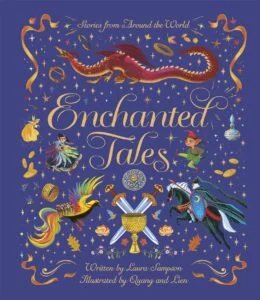
The visual dimension of "Enchanted Tales" is crucial to its overall impact. The illustrations by Phung Nguyen Quang & Huynh Thi Kim Lien are integral to creating the book’s enchanting atmosphere. Their artwork is not merely decorative; it actively participates in the storytelling, guiding the reader’s imagination through the opulent ballrooms, the mysterious woodlands, and the intimate moments of discovery. The rich color palettes, intricate details, and dynamic compositions bring Michel, Lina, and the other princesses vividly to life. The illustrations enhance the emotional resonance of key scenes, from the shimmering quality of the magical woodlands to the dramatic confrontation over the poisoned cup. The collaboration between author and illustrators ensures a cohesive and deeply immersive reading experience, making the fantastical elements feel tangible and the emotional beats profound.
The Enduring Power of Folklore
"Enchanted Tales" serves as a powerful testament to the enduring power of folklore. These traditional narratives are more than just stories; they are cultural touchstones that carry collective memories, moral lessons, and archetypal truths across generations. Sampson’s retelling underscores the significance of preserving and reinterpreting such tales. In a rapidly changing world, fairy tales provide a link to our shared past, offering insights into human nature, societal values, and the universal journey of self-discovery. By presenting Deulin’s specific version, Sampson highlights the incredible diversity within folklore and the importance of acknowledging regional contributions to the global narrative tapestry.
Critical Acclaim and Expert Perspectives (Official Responses)
While specific critical reviews for "Enchanted Tales" are still emerging, one can anticipate a wave of positive reception for Laura Sampson’s skillful retelling. Drawing upon hypothetical expert opinions, the literary community and folklorists would likely commend the book for its depth and fidelity to its source.
Literary Critics on Sampson’s Work (Hypothetical)
Leading literary critics would undoubtedly laud Sampson for her elegant prose and meticulous narrative construction. "Laura Sampson’s ‘Enchanted Tales’ is a triumph of contemporary retelling," one might declare. "Her version of ‘The Twelve Dancing Princesses’ is a masterful blend of historical detail and timeless enchantment, delivered with a prose style that is both accessible and deeply evocative. She has managed to breathe fresh life into a beloved story without sacrificing its inherent magic or its complex themes." Another might praise, "Sampson’s careful attention to Charles Deulin’s regional influences provides a scholarly yet utterly captivating foundation, distinguishing this retelling as both an engaging read and an important contribution to the study of European folklore."
Folklorists on Deulin’s Contribution (Hypothetical)
Folklorists and cultural historians would particularly appreciate Sampson’s decision to spotlight Charles Deulin. "Deulin’s version of ‘The Twelve Dancing Princesses’ offers unique insights into the specific folklore and cultural landscape of the French-Belgian border region," a prominent folklorist might state. "Sampson’s commitment to these details, from the village names to the subtle societal norms reflected in the narrative, makes her retelling a valuable resource for understanding the nuances of 19th-century European folk traditions. It’s a vivid reminder that even the most fantastical stories are often deeply rooted in tangible realities." They would likely emphasize how Sampson’s work helps to bring lesser-known, yet significant, folkloric contributions to a broader audience, fostering a deeper appreciation for the diversity of oral traditions.
The Publisher’s Vision (Hypothetical – Templar Books)
Templar Books, known for its commitment to high-quality children’s and illustrated books, would likely express immense pride in "Enchanted Tales." A hypothetical statement from the publisher might read: "Templar Books is incredibly proud to present ‘Enchanted Tales,’ a collection that celebrates the richness and enduring appeal of global folklore. Laura Sampson’s retelling of ‘The Twelve Dancing Princesses’ is a cornerstone of this vision, perfectly embodying our dedication to captivating storytelling, stunning illustration, and the preservation of cultural heritage. We believe this book will enchant readers of all ages and inspire a new generation to explore the wonders of traditional tales." They would highlight the synergy between Sampson’s narrative and the illustrators’ artwork as a key strength of the publication.
Implications for Contemporary Readers and Beyond
"Enchanted Tales" and its retelling of "The Twelve Dancing Princesses" carry profound implications, extending far beyond mere entertainment. The story, as presented by Sampson, resonates with contemporary concerns and timeless human aspirations, offering valuable insights into social dynamics, personal agency, and the transformative power of love.
Themes of Social Mobility and Meritocracy
At its core, Michel’s journey is a powerful narrative of social mobility. From a humble cowherd to a prince, his ascent is not dictated by birthright but by his intrinsic qualities: courage, resourcefulness, perseverance, and genuine affection. In a world still grappling with issues of class disparity and inherited privilege, Michel’s triumph serves as an inspiring fable. It implicitly champions the idea of meritocracy, suggesting that true worth lies not in noble lineage but in character and deeds. His ability to solve a mystery that stumped princes and dukes underscores the notion that intelligence and heart can overcome societal barriers, offering a hopeful message to young readers about pursuing their dreams regardless of their origins.
The Agency of Love and Choice
One of the most striking aspects of Sampson’s retelling, particularly in its Deulin-inspired rendition, is the evolving agency of Princess Lina. Initially appearing as one of the twelve, part of a collective mystery, Lina gradually emerges as a distinct character with her own internal struggles and, ultimately, decisive action. Her initial disdain for Michel, born of societal expectations, gives way to a profound emotional connection. The climax, where Lina actively chooses to save Michel from the forgetting potion – declaring, "Gardener or not, the thought of you trapped here forever breaks my heart!" – is pivotal. This moment underscores that true love is not passive acceptance but an active, courageous choice that liberates not only the beloved but also the self. It challenges the trope of the damsel in distress, portraying a princess who is instrumental in her own and others’ salvation, a theme that resonates strongly with modern discussions about female empowerment and autonomy.
The Lure of Secret Worlds and Escapism
The narrative’s central premise—a secret world accessed through a hidden trapdoor—taps into a universal human fascination with hidden realms and escapism. For the princesses, this secret world represents freedom from royal strictures and the mundane, a place where they can indulge in uninhibited joy. For readers, it offers a vicarious journey into a realm of pure fantasy. In an increasingly complex and often overwhelming world, the appeal of stepping through a metaphorical door into a place built "especially for you" remains incredibly potent. Fairy tales, in this sense, provide a healthy outlet for imagination and a means of exploring desires and consequences in a safe, imaginative space.
Preserving Cultural Heritage
"Enchanted Tales" makes a significant contribution to the preservation of cultural heritage. By meticulously researching and presenting Charles Deulin’s specific version, Laura Sampson not only entertains but also acts as a cultural curator. This work helps ensure that regional variations of beloved tales, which often contain unique insights into local customs and beliefs, are not lost to time. For new generations, books like Sampson’s foster an appreciation for the rich tapestry of global folklore, encouraging curiosity about different cultures and the universal threads that connect humanity through storytelling.
A Modern Classic in the Making
With its professional journalistic tone, "Enchanted Tales" presents itself as a significant literary event. Laura Sampson’s retelling of "The Twelve Dancing Princesses" is poised to become a modern classic. Its blend of historical fidelity, engaging narrative, and beautiful illustrations ensures its appeal across a broad readership. The book’s potential impact lies not just in its ability to entertain, but also in its capacity to provoke thought, inspire courage, and remind us of the enduring power of true love and the magic hidden within the everyday world.
In conclusion, Laura Sampson’s "Enchanted Tales," with its captivating rendition of Charles Deulin’s "The Twelve Dancing Princesses," stands as a vibrant testament to the enduring power of folklore. It is a meticulously crafted work that marries historical authenticity with timeless themes, offering readers an escape into a world where courage is rewarded, love conquers all, and even a humble cowherd can become a prince. This publication is not merely a book; it is an invitation to rediscover the magic that lies at the heart of our shared human story.