Unveiling the Universal Human Story: "The Treasury of Folklore" Compendium Arrives
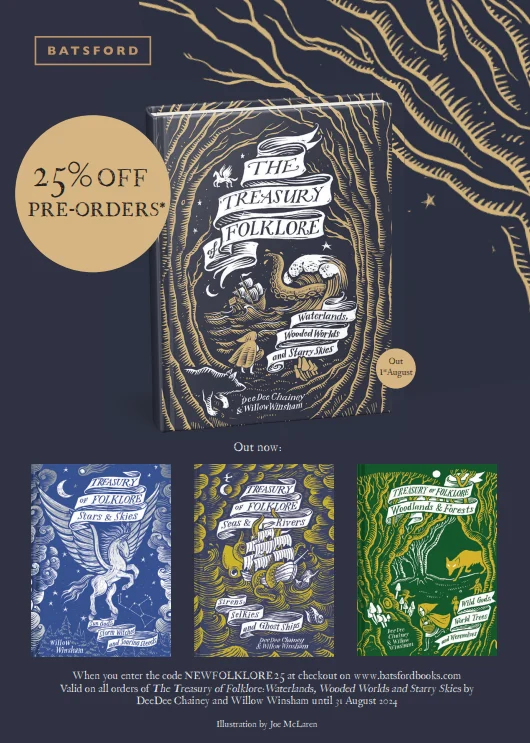
LONDON, UK – July 25, 2024 – Nearly a decade after its initial conception, the ambitious vision of exploring global folklore within a single, unifying volume has finally been realised. Authors Dee Dee Chainey and Willow Winsham, in collaboration with Batsford Books, are set to release The Treasury of Folklore: Waterlands, Wooded Worlds and Starry Skies on August 1st, 2024. This eagerly anticipated compendium brings together the most cherished tales and insights from their acclaimed Treasury of Folklore series, offering readers a richly illustrated journey through humanity’s shared fears, dreams, and profound connection to the natural world.
The new volume, a "hefty tome" featuring a beautifully bound cover and luxurious cream paper, represents the culmination of a deeply personal and intellectually rigorous project. It aims to demonstrate how, despite the vast diversity of cultures and landscapes, humans across the globe construct remarkably similar beliefs and customs around their environments. This special edition compiles key extracts from the three original books: Seas and Rivers, Trees and Woodlands, and Stars and Skies, accompanied by the evocative original illustrations of Joe McLaren.
The Genesis of a Global Narrative: From Concept to Compendium
The journey of The Treasury of Folklore began with a singular, expansive idea: to create a comprehensive book that would encompass the rich tapestry of folklore associated with every physical landscape inhabited by humans worldwide. This initial, grand vision, however, quickly encountered the sheer abundance of material available. The wealth of stories, customs, and beliefs uncovered by Chainey and Winsham proved far too vast to be contained within a single volume, necessitating a modular approach.
A Decade of Discovery and Connection
The authors embarked on their collaborative writing venture almost ten years ago, driven by a profound inspiration drawn from the vibrant online community fostered by the #FolkloreThursday hashtag. This digital platform showcased an overwhelming outpouring of global folklore, highlighting its unifying universality and underscoring the potential for a lasting, meaningful literary contribution. The subsequent release of the individual Treasury of Folklore titles – Seas and Rivers, Trees and Woodlands, and Stars and Skies – met with surprising and heartwarming popularity, resonating deeply with a growing audience eager to explore these ancient narratives. Each book delved into specific environmental themes, revealing how different cultures interpreted the mysteries of their immediate surroundings, from the depths of the ocean to the expanse of the cosmos.
The success of the series prompted a new opportunity: the creation of a compendium. This suggestion immediately rekindled the authors’ original ambition to unite the diverse folkloric threads into a single, cohesive narrative. The extensive process involved meticulously reviewing and re-evaluating material from the existing works, approaching familiar words with fresh eyes to select the most impactful and representative content. The goal was to craft a volume that seamlessly spanned shared landscapes across time and place, fulfilling the initial dream of a unified exploration. The authors expressed immense satisfaction with the final product, describing themselves as "blown away by the end result" and "utterly thrilled" to share this beautifully crafted book with the world.
Supporting Data: Unearthing Universal Truths
The core philosophy underpinning The Treasury of Folklore series, and now its compendium, is the exploration of shared human experiences through the lens of myth and legend. The authors’ research consistently revealed that beneath the surface variations of local customs and named entities, humans everywhere grapple with primal fears and dreams. Whether gazing at a distant horizon, huddling by a campfire, or contemplating the vastness of the night sky, fundamental anxieties and aspirations connect us all. The compendium is meticulously structured into three sections, each reflecting one of the original books and showcasing Joe McLaren’s exquisite illustrations.

Waterlands: Perilous Steeds and the Unseen Depths
The first section plunges into the enigmatic world of waterways, rivers, and lakes, where majestic yet malevolent creatures are said to lurk. These tales often serve as cautionary narratives, reflecting humanity’s ancient reverence and fear of the water’s unpredictable power.
The Enigmatic Water Horses
Among the most captivating figures are the water horses, shapeshifting entities that entice unsuspecting travelers to their doom. The Scottish Kelpie is perhaps the most famous, though often conflated with the each-uisge, a distinct creature inhabiting lochs and lakes. Kelpies, notorious for dragging victims to watery graves, are sometimes depicted as capable of temporary taming through a cross-marked bridle, though this control is fleeting. Tales even suggest they can be killed, often by the universally potent force of red-hot iron. The enduring power of the Kelpie myth is visibly celebrated in the monumental 30-meter-tall sculptures near Falkirk, a modern testament to its hold on the Scottish imagination, further amplified by its appearance in contemporary literature like J.K. Rowling’s Fantastic Beasts.
Interestingly, English folklore appears largely devoid of water horses, a striking absence when compared to its Celtic neighbours. Wales, however, boasts the Ceffyl Dwr, a shapeshifting spirit prevalent into the 19th century. In the north, it adopted various forms, often violent, while in the south, it consistently appeared as an enchanting, small horse. Known for incredible speed, the Ceffyl Dwr would vanish, leaving its hapless rider to drown, with a notable exception for clergymen of any creed, who were said to be immune to its trickery.
Scandinavia offers the bäckahäst, or "brook horse," often seen on foggy days. Described as luminous and majestic, it entices riders before plunging them into the water. Children are frequently its victims, heightening the sense of peril. Yet, like the Kelpie, the bäckahäst could sometimes be outsmarted or put to work, often through wit or an accidental invocation of sacred names, as in the tale where a child’s mispronunciation of "Jesus Christ" saves a group of boys from its clutches. These narratives underscore a universal human fascination with the hidden dangers and transformative power of water.
Wooded Worlds: Guardians, Tricksters, and the Wild Unknown
Leaving the watery depths, the compendium ventures into the dense, verdant realms of forests and jungles, the domain of powerful "Lords of the Wild." These spirits and creatures embody humanity’s complex relationship with untamed nature – a source of sustenance, awe, and profound fear.
Tapio, the Finnish Forest King
From Finland comes Tapio, also known as Metsähine or Hiisi, the venerable king of the forest realm. Tall and thin, clad in ermine or moss, with a moss-laden beard and a gnarled tree-like back, he is both the personification and protector of the woods. Hunters traditionally sought his blessing, pledging respect for the land and its creatures, believing he held sway over their success. Tapio, like many Finnish deities, is part of a divine family, with his benevolent wife Mielikki (or fierce Kuurikki), son Nyrikki who guides hunters, and daughter Tulikki who directs prey. This system reflects an ancient reverence for ecological balance and the need to appease nature’s powerful forces.
The Slavic Leshy: Guardian and Menace
The Slavic leshy (or leshii, lyeshy) is a tutelary spirit, a protector of trees and animals, particularly wolves or bears in some traditions. These creatures hibernate like bears and are known by numerous names, all linking them to the forests and sometimes to the Devil. Visually, they are often likened to Greek satyrs, with horns, claws, bushy green or mossy beards, and cloven feet. They are master shapeshifters, capable of altering their size from a blade of grass to a towering tree, and can mimic any forest dwelling, human, animal, or plant. In human form, they betray themselves by lacking eyelashes or brows, wearing shoes on the wrong feet, or having garments wrapped in reverse. Some possess only one eye, while all are covered in wild hair.

Leshies are fiercely territorial; their bellowing whips up winds, causing creatures to flee. They confuse and lure uninvited humans off paths with shrieking laughter, clapping, or howling, often leading them to be lost forever. As classic trickster figures, they can alter their voices to entice victims, even tickling them to death in some accounts. They can cause illness, abduct women for marriage, and snatch children. Farmers in the Olonetsky District of Russia even sacrificed cows annually to appease them and protect their livestock. However, prayers and offerings of bread or tobacco can ensure safe passage. To banish a leshy, one might turn clothes inside out, swear profusely, or make the sign of the cross. Paradoxically, summoning a leshy involves creating a circle of young trees, standing in the centre without Christian symbols, and calling out to the "grandfather of the forest." These intricate rituals highlight the delicate balance between fear and respect in human interactions with the wild.
Starry Skies: Celestial Visions and Human Destiny
The final section elevates the gaze skyward, focusing on the moon and the myriad tales humanity has woven around its surface. These narratives explore creation, sacrifice, and the very nature of human existence.
The Enduring Myth of the Hare in the Moon
A remarkably widespread motif is that of a rabbit or hare inhabiting the moon, its form often perceived in the lunar maria, such as the Sea of Tranquillity forming its head. This motif appears in diverse cultures, each imbuing it with unique significance.
In the Buddhist Sasa-Jātaka, the hare, along with its friends (otter, jackal, monkey), pledges to give alms on a fast day. When the deity Sakka, disguised as a beggar, tests them, the hare, having only grass, nobly offers itself as food by leaping into a fire. For this ultimate act of faithfulness, Sakka immortalizes the hare by placing its image upon the moon for all to see. Similar stories of self-sacrificing hares exist in Sri Lankan and Japanese folklore, often involving Buddha or a Man in the Moon figure. The Japanese tale of Tsuki no Usagi is particularly popular, recounted to children during the Harvest Moon and Mid-Autumn Festival, emphasizing themes of altruism and divine recognition.
A striking counterpoint comes from a South African tale, where the hare is responsible for humanity’s mortality. The Moon sends Hare to convey that humans, like the moon, would "die" (wane) but return again. However, the flighty Hare misdelivers the message, declaring only that humans would die permanently. Enraged, the Moon attacks Hare with a hatchet, only succeeding in splitting its lip. Hare, in retaliation, scars the Moon’s face, explaining the dark shapes visible to this day. This narrative offers a stark contrast, exploring themes of responsibility, consequence, and the origin of fundamental aspects of human existence.
Official Responses: Authors’ Pride and Gratitude
Dee Dee Chainey and Willow Winsham have consistently expressed their profound gratitude and astonishment at the reception of The Treasury of Folklore series. The popularity of the individual volumes was both "surprising and heartwarming," a testament to the enduring appeal of folklore in an increasingly modern world. The opportunity to compile these works into a single volume was met with immediate enthusiasm, allowing them to finally realize their foundational vision.
The behind-the-scenes work, involving careful curation and a fresh perspective on their own writings, was clearly a labour of love. Their collective response to the finished compendium is one of immense pride: "To say we have been blown away by the end result is an understatement, and we are utterly thrilled to be able to share this beautifully bound volume with you." They laud the book’s physical attributes – its size, the integrated cover design, and the "beautiful cream paper" – describing it as a truly "hefty tome." This sentiment underscores not just the content but also the aesthetic and tactile experience intended for the reader. The authors extend heartfelt thanks to "each and every person who has bought and read these books," acknowledging the vital role of their readership in the series’ success and the realization of this compendium.

Implications: Preserving Heritage, Fostering Connection
The release of The Treasury of Folklore: Waterlands, Wooded Worlds and Starry Skies carries significant implications for cultural preservation, cross-cultural understanding, and the broader appreciation of humanities.
Cultural Preservation and Documentation
In an era of rapid globalisation and digital information overload, projects like The Treasury of Folklore play a crucial role in documenting and preserving ancient oral traditions and belief systems. By carefully compiling and presenting these stories, Chainey and Winsham ensure that these invaluable cultural artefacts remain accessible, preventing their fading into obscurity. The inclusion of Joe McLaren’s illustrations further enhances this preservation, offering visual interpretations that capture the essence of the tales.
Fostering Cross-Cultural Understanding
Perhaps the most profound implication of this compendium lies in its ability to foster empathy and understanding across diverse cultures. By highlighting the universal nature of human fears, dreams, and our relationship with the environment, the book transcends geographical and cultural boundaries. It demonstrates that while the specific names and details of monsters or gods may differ, the underlying human experiences of awe, dread, community, and the search for meaning are deeply shared. This recognition of shared humanity can serve as a powerful tool for bridging divides and promoting global kinship.
Educational and Inspirational Value
The compendium is not merely a collection of stories; it is a rich educational resource. Its structured approach, thematic organisation, and detailed examples make it invaluable for students of folklore, anthropology, and cultural studies. Beyond academia, it serves as an inspiring read for general enthusiasts, sparking curiosity and encouraging further exploration of local and global myths. It invites readers to look at their own surroundings with new eyes, to discover the hidden narratives woven into the landscapes they inhabit.
A Lasting Legacy
The Treasury of Folklore series, culminating in this compendium, establishes a significant legacy in the field of popular folklore studies. It showcases how dedicated research, combined with a passion for storytelling, can transform academic material into engaging, accessible literature. By keeping these ancient tales alive and relevant in the modern era, the authors contribute to a continuous dialogue between past and present, tradition and contemporary interest, epitomised by the very #FolkloreThursday hashtag that ignited their journey.
Availability and Call to Action
The Treasury of Folklore: Waterlands, Wooded Worlds and Starry Skies is now available for pre-order and will be officially released on August 1st, 2024. While it contains no new material, it promises to be a beautiful addition to any bookcase or coffee table, serving as both a conversation starter and a tangible connection to the enduring human story. Readers can explore the wonders of water horses, the mysteries of forest lords, and the celestial tales of the moon, all within the pages of this monumental work.
For those eager to delve into these timeless narratives, pre-orders are currently open via major retailers. Additionally, a special discount of 25% is available when ordering directly from Batsford Books at www.batsfordbooks.com/book/the-treasury-of-folklore/ using the code NEWFOLKLORE25.