The ancient Mesopotamian pantheon was a complex tapestry of deities, each governing a facet of existence, from the heavens above to the fertile earth below. Yet, perhaps no deity commanded as much awe and dread as Ereshkigal, the indomitable Queen of the Dead. Known also as Irkalla and Allatu, her very name, translating to "Queen of the Great Below" or "Lady of the Great Place," underscored her dominion over the vast, inescapable realm of the afterlife. Her primary charge was absolute: to eternally confine the souls of the deceased within her shadowy kingdom and, equally vital, to rigorously bar the living from ever breaching its thresholds and uncovering the mysteries of death.
Ereshkigal’s realm was not "great" in the sense of exceptional splendor, but rather in its immense, boundless scope. This subterranean domain, known variously as Kurnugia ("Land of No Return"), Irkalla, or Allatu (after its sovereign), was believed to lie beneath the "Mountains of Sunset" in the west. It was an unfathomable expanse of perpetual gloom, where the spectral souls of the dead were condemned to a meager existence, subsisting on muddy puddles and dust—a stark, chilling vision of post-mortem reality for the Mesopotamians.
From her ominous palace, Ganzir, strategically positioned at the very entrance of the underworld, Ereshkigal held absolute sway over these mournful spirits. Ganzir itself was a fortress, protected by seven formidable gates, each vigilantly guarded by her loyal, unyielding servant, Neti. For eons, Ereshkigal ruled this desolate kingdom in solitude, her authority unchallenged, until the arrival of the formidable war god Nergal (also known as Erra), who would eventually become her consort and co-ruler for six months of each year, introducing a new dynamic to the somber court of the underworld.
Ereshkigal’s Divine Lineage and Consorts
Ereshkigal’s familial connections placed her firmly within the highest echelons of the Mesopotamian divine hierarchy. She was the elder sister of the vibrant and often tempestuous goddess Inanna (later identified as Ishtar by the Akkadians and Assyrians), a deity whose exploits frequently brought her into direct conflict with her underworld sibling. Ereshkigal’s first known husband was Gugalanna, the majestic Great Bull of Heaven, whose tragic death at the hands of the hero Enkidu in the epic tale of Gilgamesh would set in motion a chain of events with profound consequences for both the mortal and divine realms, including the infamous Descent of Inanna. From her union with Gugalanna, she bore the god Ninazu, another prominent underworld deity.
Later, the god Enlil is also cited as a consort, with whom she had a son, Namtar, the formidable vizier and messenger of the underworld, often associated with fate and disease. By another unnamed consort, she conceived her daughter Nungal (also known as Manungal), an underworld goddess responsible for punishing the wicked, yet also paradoxically associated with healing and retribution. Her most enduring and significant partnership, however, was with Nergal, the only divine mate who willingly committed to sharing her eternal dominion over the land of the dead, albeit on a seasonal basis.
The Enigma of Ereshkigal’s Iconography
Despite her immense power and central role in Mesopotamian cosmology, Ereshkigal presents a peculiar challenge to modern scholars: there is no universally agreed-upon iconography directly depicting her. This scarcity of visual representation is striking for a deity of her stature, especially when compared to the abundant images of gods like Enlil, Enki, or even her sister Inanna.
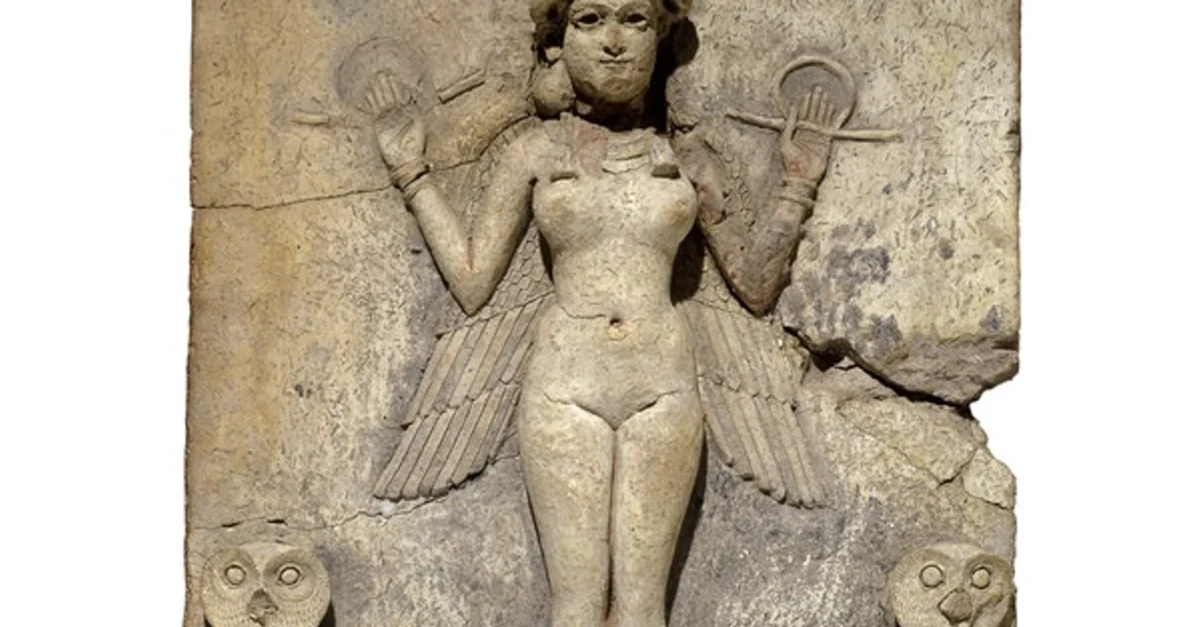
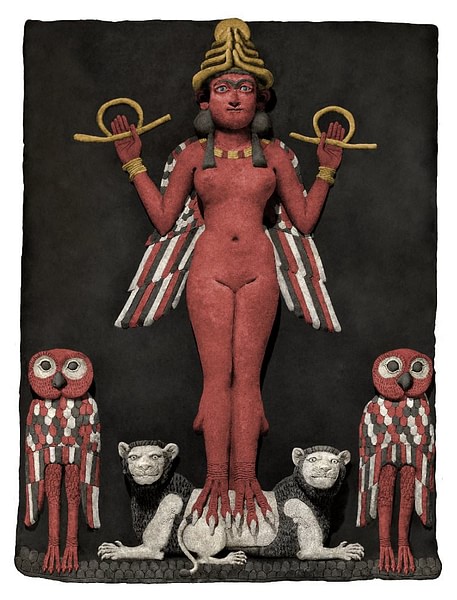
The most compelling, albeit debated, candidate for Ereshkigal’s depiction is the renowned Burney Relief, also famously known as "The Queen of the Night." Dating from the reign of Hammurabi (circa 1792-1750 BCE), this terracotta relief presents a captivating image: a naked, winged woman with talon-like feet, standing majestically upon the backs of two lions, flanked by watchful owls. She grasps symbols of power, and beneath the lions, subtle images of mountains evoke a subterranean or chthonic connection. The downward-pointing wings, the predatory animals, and the nocturnal birds of prey strongly suggest a connection to the underworld and its formidable ruler.
However, scholarly interpretations are not unanimous. Some researchers have argued that the relief might represent Inanna in her darker, more fearsome aspect, or even the demon Lilith, a figure also associated with the night and death. While the balance of evidence and the thematic elements lean towards Ereshkigal, the ongoing debate highlights the interpretative difficulties surrounding Mesopotamian art.
The absence of widespread, unambiguous iconography for Ereshkigal is, paradoxically, entirely consistent with ancient Mesopotamian beliefs. To create an image or statue of a deity was not merely an artistic endeavor; it was a profound act of invocation. Statues were believed to house the very essence of the gods they represented, making them tangible points of connection. Similarly, images on cylinder seals were thought to possess amuletic properties, directing the subject’s attention to the wearer. To create an image of Ereshkigal, the terrifying Queen of the Dead, would have been an invitation of the most undesirable kind – a direct summons of her attention to the creator or owner, a risk few, if any, would willingly take. The profound fear she inspired thus inadvertently contributed to her artistic elusiveness.
Early Mentions and Ereshkigal’s Unique Position
Ereshkigal’s presence in Mesopotamian literature can be traced back to the Sumerian poem The Death of Ur-Nammu, which dates to the reign of Shulgi of Ur (2094 to circa 2046 BCE). While this marks her first definitive textual appearance, it is highly probable that she was known and revered (or feared) much earlier, possibly even during the preceding Akkadian period (2350/2334-2154 BCE), with fragments referencing her Akkadian name, Allatu, hinting at an older origin. By the Old Babylonian period (circa 1894-1595 BCE), her status as the universally recognized Queen of the Dead was firmly established, lending further credence to the interpretation of the Queen of the Night relief from Hammurabi’s era as a depiction of her.
It is worth noting that while later Mesopotamian history saw a gradual diminishment in the prominence of goddesses in favor of male deities, early evidence overwhelmingly demonstrates that many of the most powerful and central figures in the pantheon were originally female. This makes Ereshkigal’s enduring role as the sole female ruler of the underworld particularly unique. In many other contemporary and subsequent ancient cultures, the underworld was typically governed by a male god—Hades in Greek mythology, Osiris in Egyptian myth, or various male chthonic deities in other Near Eastern traditions. Ereshkigal’s singular position persisted even after the ascendancy of male gods, with Nergal being introduced as her consort rather than a replacement, cementing her formidable and unparalleled status.
Ereshkigal in The Descent of Inanna: Justice in the Underworld
Among the rich tapestry of Mesopotamian myths, The Descent of Inanna (circa 1900-1600 BCE) stands as perhaps the most famous narrative involving Ereshkigal, casting her in the role of a stern but righteous judge. Modern interpretations of this poem often frame it as a symbolic journey of self-discovery or a confrontation with one’s shadow self. However, such readings, while valid through a contemporary lens, diverge significantly from the probable original intent and message of the ancient text.
Far from being a heroic epic praising Inanna, the poem, when read without modern biases, portrays Inanna as a figure driven by self-interest and often heedless of the consequences of her actions. This characterization is consistent with other Mesopotamian literature, notably The Epic of Gilgamesh, where Inanna/Ishtar’s spurned advances lead her to unleash the Bull of Heaven, Gugalanna (Ereshkigal’s husband), upon Uruk, resulting in widespread death and setting in motion Enkidu’s demise and Gilgamesh’s quest for immortality. In The Descent, Inanna’s motivation for traveling to the underworld is ostensibly to attend Gugalanna’s funeral—a death she herself indirectly caused—but her true intentions are revealed to be a desire to extend her own dominion over her sister’s realm.
The narrative unfolds with Inanna, adorned in her finest regalia, arriving at the seven gates of the underworld. Ereshkigal, alerted to her sister’s presence, is anything but welcoming. She instructs Neti, the vigilant gatekeeper, to strip Inanna of one article of clothing or ornament at each of the seven gates. By the time Inanna stands before Ereshkigal in the throne room, she is naked, vulnerable, and stripped of all her earthly power and divine attributes.
It is at this pivotal moment that the annuna, the venerable judges of the underworld, convene. They pass judgment against Inanna, recognizing her culpability in Gugalanna’s death and her arrogant disregard for the sacred boundaries of the underworld. The text vividly describes Ereshkigal’s reaction:
"The annuna, the judges of the underworld, surrounded her
They passed judgment against her.
Then Ereshkigal fastened on Inanna the eye of death
She spoke against her the word of wrath
She uttered against her the cry of guilt
She struck her.
Inanna was turned into a corpse
A piece of rotting meat
And was hung from a hook on the wall."
(Wolkstein and Kramer, 60)
Ereshkigal, acting as the ultimate enforcer of justice, executes her sister for her transgressions. Inanna’s eventual resurrection is not a testament to her own heroism, but rather to her shrewd foresight in instructing her loyal servant Ninshubur to seek help from the gods Enki and Enlil should she not return. Ninshubur’s desperate pleas eventually reach Enki, who, recognizing the imbalance caused by Inanna’s death, crafts two galla—androgynous demons—from the dirt under his fingernails and sends them to the underworld.
These galla slip into Kurnugia "like flies" and find Ereshkigal in a state of profound distress, experiencing the pains of labor, a striking image of suffering and vulnerability. The poem describes her disheveled state:
"No linen was spread over her body
Her breasts were uncovered
Her hair swirled around her head like leeks."
(Wolkstein and Kramer, 63-66)
The galla, following Enki’s precise instructions, empathize with Ereshkigal’s suffering. In gratitude, she offers them any gift they desire. They request "only the corpse that hangs from the hook on the wall," and Ereshkigal, bound by her promise, grants it. The galla revive Inanna with the "food and water of life," allowing her to ascend from the dead.
However, the laws of Kurnugia are immutable: no soul can leave without a replacement. Inanna is compelled to find a substitute, and in an act that further underscores her self-serving nature, she chooses her own husband, Dumuzi, to take her place. His devoted sister, Geshtinanna, volunteers to share his fate, leading to the seasonal cycle where Dumuzi spends six months in the underworld and Geshtinanna the other six, while Inanna, the instigator of all this suffering, resumes her life unburdened.
The poem concludes not with praise for Inanna, but with a resounding affirmation of Ereshkigal’s power and renown:
"Holy Ereshkigal! Great is your renown!
Holy Ereshkigal! I sing your praises!"
(Wolkstein and Kramer, 89)
This ending strongly suggests that Ereshkigal is the true central figure of the work, representing the unwavering, if harsh, cosmic justice. The underlying message for an ancient audience would have been clear: even a powerful goddess like Inanna cannot defy the laws of the underworld or escape accountability for her actions. If Ereshkigal, the formidable queen, could endure injustice (the manipulation to release Inanna) and still uphold the divine order, then human beings were expected to demonstrate similar piety and adherence to societal and cosmic laws.
Ereshkigal and Nergal: A Marriage of Necessity
Ereshkigal’s solitary reign over Kurnugia ends with the arrival of Nergal, the volatile god of war and pestilence. While some versions suggest a passionate seduction where Nergal visits the underworld, engages in seven days of lovemaking, and then returns to stay with her for six months annually, the most detailed and well-known account, dating from the Neo-Babylonian period (circa 626-539 BCE), reveals a more intricate narrative orchestrated by the cunning god Enki. Versions of this myth have also been found in earlier contexts, such as the Amarna Letters from 15th-century BCE Egypt and at Sultantepe, an ancient Assyrian city, dating to the 7th century BCE.
The story begins with the gods preparing a grand banquet, to which Ereshkigal, unable to leave her realm, cannot attend. The gods, in turn, cannot descend to the underworld without forfeiting their ability to return. Enki, ever the strategist, proposes a solution: Ereshkigal should send a servant to collect her share of the feast. She dispatches her son, Namtar, to the divine gathering. Upon Namtar’s arrival, all the gods rise in deference to Ereshkigal, except for the impetuous war god Nergal. Namtar, insulted by this blatant disrespect, returns to his mother to report the slight.
Enraged by Nergal’s arrogance, Ereshkigal demands that he be sent to the underworld so she can exact her retribution. The other gods, recognizing the legitimacy of her claim, acquiesce. However, Enki, having anticipated this outcome, secretly provides Nergal with fourteen powerful demon escorts, two for each of the underworld’s seven gates, along with specific instructions.
When Nergal arrives at the gates of Kurnugia, Neti announces his presence. Namtar informs his mother that the disrespectful god has arrived. Ereshkigal, intent on her revenge, orders that Nergal be admitted through each gate, which is then to be barred behind him, ensuring his inescapable fate. But as Nergal passes through each gate, he posts two of his demon escorts to keep it open, defying Ereshkigal’s command.
Upon reaching the throne room, Nergal, far from being a helpless victim, swiftly overpowers Namtar and drags Ereshkigal to the floor. Raising his great axe, he is poised to sever her head. In a desperate plea, Ereshkigal begs for her life, promising to be his wife and share her immense power with him if he spares her. Nergal, perhaps swayed by her plea or by a sudden pang of remorse, consents. The poem concludes with the two deities kissing, a symbolic union sealing their shared dominion.
The Marriage of Ereshkigal and Nergal carries profound symbolic weight, echoing themes found in the Greek myth of Demeter and Persephone. In the Greek tale, Persephone’s abduction by Hades and her consumption of the fruit of the dead necessitate her spending half the year in the underworld, during which time her mother Demeter mourns, causing winter. Similarly, the seasonal nature of Nergal’s co-rule with Ereshkigal—spending six months on the surface and six months in the underworld—served to explain the cycles of life and death, particularly the seasons of war and peace. It is suggested that Enki orchestrated the entire scenario to manage Nergal’s destructive tendencies on Earth; by binding him to the underworld for half the year, the frequency and intensity of warfare among mortals could be regulated. Since Nergal entered the underworld of his own accord (albeit under duress) and was invited to stay as consort, he was uniquely able to leave without the need for a replacement, a privilege not afforded to Inanna.
Ereshkigal’s Enduring Significance: Order, Piety, and the Cult of the Dead
Ereshkigal’s significance in Mesopotamian religion extended far beyond her mythological narratives. She was consistently represented in prayers and rituals as a goddess of immense power, often forgiving injustice or wrongs in the interest of the greater cosmic good. In this capacity, she served as a potent moral exemplar, encouraging piety and adherence to divine will among her worshippers. If even a formidable goddess like Ereshkigal could suffer an injustice (as in the case of Inanna’s return) and still diligently perform her sacred duties in accordance with the will of the higher gods, then human beings were expected to demonstrate no less devotion and resilience in their own lives.
Her paramount significance, however, lay in her role as the unyielding ruler of the underworld. She was not only understood to reward the virtuous and punish the wicked, but, more crucially, to maintain the inviolable boundary between the living and the dead. The seven gates of Kurnugia served a dual purpose: to prevent the living from illicitly entering the realm of the dead and to ensure that all souls who belonged there remained within its confines.
A pervasive "cult of the dead" developed around Ereshkigal, designed to honor the deceased and ensure their comfort in her grim domain. Recognizing that the souls of the dead subsisted on muddy water and dust, the living performed regular rituals of remembrance. Food offerings were placed on tombs, and fresh water was poured over them, believed to trickle down to the mouths of the departed. Scholar E. A. Wallis Budge elaborates on these practices:
"The tears of the living comforted the dead and their lamentations and dirges consoled them. To satisfy the cravings of the dead these offerings were sometimes made by priests who devoted their lives to the cult of the dead, and the kinsmen of the dead often employed them to recite incantations that would have the effect of bettering the lot of the dead in the dread kingdom of Ereshkigal…The chief object of all such pious acts was to benefit the dead but underneath it all was the fervent desire of the living to keep the dead in the underworld. The living were afraid lest the dead should return to this world and it was necessary to avoid such a calamity at all costs."
(Budge, 145)
Ereshkigal, like all the gods of Mesopotamia, was a bulwark against the forces of chaos. The natural order dictated that souls who departed the world of the living were not to return. Ereshkigal rigorously enforced this cosmic law. If a ghost were to haunt the living, it was usually understood to be for a specific, divinely sanctioned reason, or it was a restless fugitive who had somehow managed to evade the Queen’s vigilant gaze. The primary reasons for such hauntings included improper burial, neglect of daily rituals of remembrance by the living, or unpunished impious acts. As the ultimate queen and guardian of the dead, Ereshkigal stood as a powerful, ever-present reminder to the living to observe proper rites and rituals, to honor their ancestors, and to act justly within their communities, lest they incur the wrath of the one who held their final fate in her hands.
In conclusion, Ereshkigal remains one of the most compelling and formidable figures in the Mesopotamian pantheon. Her unyielding reign over the Land of No Return, her role as the arbiter of divine justice, and her unique position as a female ruler of the underworld underscore her profound significance. While inspiring fear, she also commanded immense respect as the maintainer of cosmic order, ensuring the sacred boundaries between life and death were eternally preserved, a testament to her enduring power in the ancient world.
FOR IMMEDIATE RELEASE London, UK – [Insert Date of Publication] – A groundbreaking new compendium, "Fascinating Folklore," is set to captivate audiences worldwide, offering an unprecedented
ATHENS, GREECE – In the annals of Greek mythology, few figures command as much admiration and scholarly intrigue as Penelope, the formidable queen of Ithaca, wife of the resourceful Odysseus, and moth
London, UK – Folklore, far from being a collection of static, ancient tales, constitutes a vast, living web that subtly underpins our cultures and societies. Much like the unseen mycelial network of f





Leave a Comment