Unveiling the Universal Soul: A New Compendium Explores Humanity’s Shared Folklore
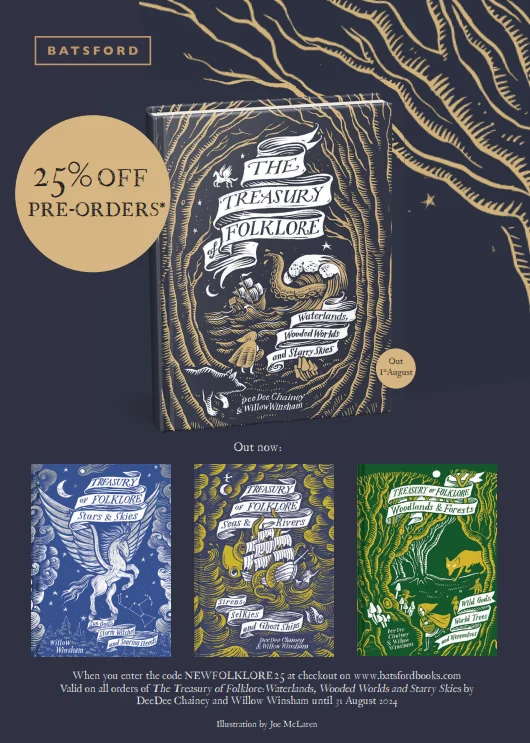
LONDON, UK – [Date of Publication] – Nearly a decade after embarking on a journey into the mystical realms of global folklore, authors Dee Dee Chainey and Willow Winsham are set to release a monumental new volume that promises to be a cornerstone for enthusiasts and newcomers alike. The Treasury of Folklore: Waterlands, Wooded Worlds and Starry Skies is not merely a collection; it is a meticulously crafted compendium, born from an initial vision to unite the diverse tapestry of human beliefs and tales into a single, definitive tome. Set for release on August 1st, 2024, this beautifully bound edition brings together the most cherished entries from their acclaimed three-book series, offering a profound exploration of our shared primal fears, dreams, and the awe-inspiring narratives that bind humanity across continents and centuries.
Main Facts: The Grand Compendium of Human Imagination
The Treasury of Folklore: Waterlands, Wooded Worlds and Starry Skies is an ambitious new publication by Dee Dee Chainey and Willow Winsham, consolidating the most beloved content from their popular trilogy: Seas and Rivers, Trees and Woodlands, and Stars and Skies. This special volume aims to fulfill the authors’ original ambition of presenting a comprehensive overview of global folklore rooted in physical landscapes within a single book. The compendium, published by Batsford Books, is a "hefty tome" featuring a combined cover design and printed on high-quality cream paper, promising a tactile and visually engaging experience.
Far from offering new material, the strength of this compendium lies in its curated selection, presenting existing text directly from the original three books. It is divided into three distinct sections, each corresponding to the previous volumes and richly adorned with the wonderful original illustrations by Joe McLaren, whose evocative artwork has become synonymous with the series. The book serves as an ideal coffee table companion or a striking addition to any bookcase, designed to spark conversations and foster a deeper connection to the world’s diverse cultural heritage. Pre-orders are currently open, with the official release scheduled for August 1st, 2024. For a limited time, readers can enjoy a 25% discount when ordering from Batsford Books using the code NEWFOLKLORE25.
Chronology: From Hashtag to Hefty Tome
The genesis of The Treasury of Folklore series traces back almost a decade, ignited by a fervent online community. The authors, Dee Dee Chainey and Willow Winsham, were profoundly inspired by the overwhelming outpouring of narratives and discussions generated through the #FolkloreThursday hashtag. This vibrant digital space served as a powerful testament to the enduring human fascination with myths, legends, and local customs, revealing a universal thread connecting disparate cultures. It was this unifying universality that spurred Chainey and Winsham to create something tangible, meaningful, and lasting—a series that would reflect and celebrate this global phenomenon.
Their initial concept was grand: a single, all-encompassing volume that would traverse every type of physical landscape inhabited by humans worldwide, cataloguing the folklore born from these environments. However, the sheer volume and richness of the material they began to uncover quickly surpassed the confines of a single book. This led to the creation of the celebrated trilogy, each volume dedicated to a specific natural domain. The first, Seas and Rivers, delved into the mysteries of aquatic environments. This was followed by Trees and Woodlands, exploring the arboreal wonders and their associated tales, and finally, Stars and Skies, which gazed upwards to the celestial narratives that have captivated humanity since time immemorial.
The popularity of these individual books was, by the authors’ own admission, both surprising and heartwarming. Each release resonated deeply with readers, affirming the universal appeal of folklore and validating their pursuit of understanding how humans across the globe forge customs, beliefs, and tales around the places they inhabit. The consistent positive reception and engagement from readers cultivated a loyal following, cementing the series’ place in contemporary folklore literature.
It was against this backdrop of success that the idea of a compendium emerged. The suggestion to bring out a single volume encapsulating the essence of the trilogy immediately struck a chord with the authors. It offered a poignant opportunity to realize their original, singular vision. The subsequent behind-the-scenes work was extensive, involving a meticulous review of their already familiar words with fresh eyes. The challenge lay in carefully curating what to include and what to omit, ensuring that the selected material flowed seamlessly, creating a cohesive narrative that effectively spanned shared landscapes across time and place. The culmination of this effort has, as the authors attest, left them "blown away" by the end result, eagerly anticipating sharing this beautiful synthesis with their dedicated readership.

Supporting Data: Unearthing Universal Archetypes
The core of the Treasury of Folklore series, and by extension this new compendium, lies in its exploration of how diverse cultures interpret and interact with their natural surroundings through myth. The authors discovered that while the specific details of beliefs and customs vary dramatically, fundamental human experiences—primal fears, profound dreams, and an innate sense of wonder—remain constant. Whether gazing at the vast ocean or huddling around a campfire in a dark forest, humans across the globe grapple with the unknown, yearn for prosperity, and ponder their fleeting existence under ancient stars. The following excerpts from the compendium vividly illustrate these universal threads through distinct cultural lenses.
The Perilous Steeds of the Deep: Water Horses
From the shimmering surfaces of lochs to the murky depths of rivers, water horses represent a potent blend of allure and danger in folklore. These majestic yet malevolent creatures are found in numerous traditions, serving as both cautionary tales and manifestations of humanity’s respect and fear for untamed waters.
One of the most renowned is the Scottish Kelpie. Often conflated with general "water horses," the Kelpie specifically inhabits rivers, luring unsuspecting travelers, particularly children, to their watery demise. Its allure lies in its beautiful, often wet and glistening, equine form. Once mounted, the victim is unable to dismount, dragged inexorably into the depths. Yet, folklore also offers glimmers of hope: a bridle marked with a cross could seemingly tame a Kelpie, though this control was always fleeting, and the creature would ultimately return to its domain. The legend’s enduring power is physically manifested in "The Kelpies" sculptures near Falkirk, towering 30-meter steel structures that have commanded attention since 2013, a modern testament to an ancient fear. Its presence in contemporary literature, from Lari Don to J.K. Rowling’s Fantastic Beasts, further solidifies its cultural footprint. Interestingly, English folklore largely lacks such aquatic equines, a curious lacuna in its rich mythological landscape.
Across the border in Wales, however, the Ceffyl Dwr fills this mythological gap. Remaining a staple of Welsh belief into the 19th century, this water horse exhibits regional variations. In the north, it was a shapeshifting spirit, often violent, capable of assuming various forms. In the south, it consistently appeared as a small, enchanting horse, whose speed was legendary, covering vast distances in impossibly short times before vanishing, leaving its rider to drown. A unique exception to its malevolent nature was its treatment of clergymen of any creed, who were said to be able to ride it safely to their destination, a fascinating example of ecclesiastical privilege in the supernatural realm.
Scandinavia offers its own variant: the bäckahäst, or "brook horse." Typically seen amidst fog, this luminous and majestic creature mirrors its Celtic counterparts in luring riders to their doom beneath the water, from which dismounting is impossible. Tales often feature children as victims, heightening the sense of peril. A popular narrative involves boys playing by a frozen river who are saved from a bäckahäst when the last child, in awe, mispronounces a phrase that rhymes with "Jesus Christ," a name the creature abhors, causing it to vanish. Like the Kelpie, the bäckahäst could sometimes be tricked and put to work, highlighting a common folkloric trope of human cunning overcoming supernatural power. These water horses collectively underscore humanity’s ancient apprehension of deep, untamed waters and the powerful, unseen forces lurking within.
Guardians of the Green: Lords of the Wild
Venturing from the perilous waters to the verdant heart of the forest, we encounter the "Lords of the Wild"—powerful spirits and creatures that personify and protect the untamed aspects of nature. These figures embody humanity’s complex relationship with forests: places of profound beauty and sustenance, yet also of mystery, danger, and the unknown.
In Finnish mythology, Tapio, also known as Metsähine or Hiisi, reigns as the king of the forest. Depicted as tall and slender, with a coat of ermine fur or moss, and a head crowned with a hat, he mirrors the "green man" or foliate heads of European lore. His bushy eyebrows of moss and lichen, and a great beard, often of straggling black hair, further emphasize his deep connection to the arboreal world. From the front, he appears human, but his back is said to resemble a gnarled tree, symbolizing his dual nature as both personification and protector of the forest. Hunters traditionally sought his blessing for a successful chase, pledging respect for the wilderness, its creatures, and its delicate balance. Tapio, along with his benevolent wife Mielikki (or the less benevolent Kuurikki), his pathfinding son Nyrikki, and prey-directing daughter Tulikki, embodies the Finnish reverence for nature and the belief in its sentient, powerful spirits.

Slavic folklore introduces the Leshy (or leshii, lyeshy), a tutelary spirit and protector of the woods, its trees, and its animals, with a particular affinity for wolves or bears. The Leshy, known by many names, is a shapeshifting trickster figure, able to alter its size from that of a blade of grass to taller than a tree, and assume the guise of any forest dwelling creature, human, or plant. When in human form, it possesses tell-tale signs: no eyelashes or brows, shoes worn on the wrong feet, or clothing wrapped contrary to local fashion. Some even bear cloven feet, horns, or a tail, linking them to satyrs or even the Devil. Their bellowing can whip up great winds, and their shrieking laughter, clapping, or howling serves as a warning to intruders. Those who disregard these warnings risk being led astray, confused, and lost forever in the wilderness.
Leshies are notorious for their trickery, mimicking voices, tickling victims to death, or inflicting illness. They abduct women and children, curse farms, and are known gamblers, often playing cards (excluding clubs due to their resemblance to the Christian cross) with squirrels. To guard against a Leshy’s wrath, offerings of bread or tobacco are made, and prayers recited before entering the forest. Should one encounter a Leshy, traditional defenses include turning one’s shirt inside out and shoes on the wrong feet, or even swearing profusely, which is said to make them laugh and return the lost to their path. Conversely, summoning a Leshy involves cutting young trees (birch preferred) and arranging them in a circle, then standing in the center, devoid of Christian symbols, and calling out to the "grandfather of the forest." These figures highlight a deep-seated respect for nature’s power, its capacity for both nurture and peril, and the ancient wisdom embedded in understanding and appeasing its spirits.
The Celestial Scribe: The Hare in the Moon
Looking upwards, humanity has long projected its narratives onto the celestial canvas, none more so than the Moon. A recurring motif across various cultures is the image of a rabbit or hare residing on its surface, with features like the Sea of Tranquility often interpreted as its head, and the Seas of Fertility and Nectar as its ears. This universal recognition speaks to a shared human tendency to find patterns and meaning in the cosmos.
In the Buddhist Sasa-Jātaka, the hare, alongside its friends the otter, jackal, and monkey, resolves to give alms on a fast day. When the deity Sakka (ruler of Trāyastriṃśa heaven and a protector of Buddhism) descends disguised as an old man to test them, the otter, jackal, and monkey offer what they have. The hare, having only grass, nobly offers itself as sustenance, leaping into a fire. Sakka, moved by its faithfulness, saves the hare and etches its image onto the moon for eternity, sometimes by squeezing a mountain’s essence to draw it. This narrative emphasizes themes of self-sacrifice, compassion, and unwavering devotion.
Similar tales echo across Asia. In Sri Lanka, Buddha, lost and hungry, encounters a hare who offers itself as food. When Buddha conjures a fire, the hare selflessly leaps in, only to be saved by Buddha’s powers and sent to the moon. In Japan, the rabbit, known as Tsuki no Usagi (Moon Rabbit), features in a comparable story where it sacrifices itself for a beggar (the Man in the Moon in disguise) after its animal companions offer other foods. The beggar then reveals his true form and takes the rabbit to live with him on the moon, a popular tale recounted to children during the Harvest Moon and Mid-Autumn Festival in September, celebrating gratitude and selflessness.
A starkly different narrative emerges from South Africa, where the hare is cast in a more mischievous, even tragic, role. Here, the Moon dispatches the Hare to deliver a message to humankind: that like the Moon’s monthly cycle of fading and renewal, so too would humanity experience death and rebirth. However, the flighty Hare misdelivers the message, telling people they would simply die, without the promise of return. Enraged, the Moon attacks the Hare with a hatchet, only managing to split its lip. In retaliation, the Hare lashes out, scarring the Moon’s face—scars visible as the dark shapes on the moon today. This tale attributes human mortality to a messenger’s folly and provides an etiology for lunar markings, showcasing the varied symbolic interpretations of the same celestial body across different cultural narratives. These diverse hare-on-the-moon stories collectively illustrate humanity’s deep connection to the celestial cycles, weaving themes of sacrifice, mortality, and the very fabric of existence into the night sky.
Official Responses: Authors’ Reflection and Publisher’s Vision
The journey of The Treasury of Folklore series has been a deeply personal and professionally rewarding one for authors Dee Dee Chainey and Willow Winsham. Reflecting on their initial aspirations nearly a decade ago, they express profound astonishment at how far their exploration of folklore has taken them. The overwhelming engagement inspired by the #FolkloreThursday hashtag, which first spurred their creative impulse, has been consistently reciprocated by readers. The enduring popularity of Seas and Rivers, Trees and Woodlands, and Stars and Skies has been a source of immense pride and gratitude for the authors, who extend their heartfelt thanks to every individual who has purchased and read their books.

The decision to create this compendium was met with immediate enthusiasm by the authors, seeing it as a long-awaited opportunity to finally bring their original vision to fruition: a single, unified volume. The process of re-engaging with their own work, reading through familiar words with fresh eyes, was a delicate balancing act of discerning what to include and what to omit. Their aim was to distill the essence of the trilogy into a coherent, compelling narrative that would resonate as strongly as the individual volumes. The authors are "utterly thrilled" with the end result, describing it as a "beautifully bound volume" with a cover that skillfully combines the themes of the original three books and printed on exquisite cream paper. The physical manifestation of the book—a "hefty tome"—is clearly a point of pride, embodying the gravitas and richness of its content.
While acknowledging that the compendium contains no new material, the authors position it as more than just a re-packaging. It is presented as an artifact in its own right, a beautiful addition to any home, designed to be a "conversation starter, a way to connect." This aligns with their overarching philosophy that folklore is a universal language, a means by which people can understand themselves and each other better. The continued partnership with illustrator Joe McLaren, whose original artwork graces the pages, underscores the consistent quality and aesthetic appeal that readers have come to expect from the series. Batsford Books, the publisher, implicitly shares this vision, recognizing the market demand for a definitive collection that consolidates the beloved series and offers a comprehensive gateway into the captivating world of folklore.
Implications: Bridging Worlds Through Ancient Tales
The release of The Treasury of Folklore: Waterlands, Wooded Worlds and Starry Skies carries significant implications for the preservation and popularization of folklore. In an increasingly globalized yet often fragmented world, the book serves as a powerful reminder of humanity’s shared cultural heritage and the profound commonalities that underpin our diverse societies.
Firstly, the compendium reinforces the idea that folklore is not merely archaic superstition but a living, evolving narrative that reflects universal human experiences. The authors’ initial quest for understanding—how humans create customs, beliefs, and tales around their environments—culminated in the profound realization that "in so many ways, we are all inherently the same." This insight, showcased through the juxtaposition of water horses, forest spirits, and lunar legends from disparate cultures, fosters cross-cultural empathy and highlights the enduring relevance of these ancient stories to contemporary life. They speak to primal fears of the unknown, the universal awe of nature’s grandeur, and the perennial human struggle to find meaning in a vast, indifferent universe.
Secondly, by bringing together the highlights of the original trilogy, the compendium makes the rich tapestry of global folklore more accessible to a broader audience. For those new to the series, it offers a comprehensive entry point, a single, attractive volume that encapsulates the essence of the authors’ work. For existing fans, it provides a cherished consolidated edition, perfect for display and repeated enjoyment. This consolidation ensures that these stories continue to be shared, discussed, and passed down, fulfilling folklore’s intrinsic purpose.
Finally, the physical presentation of the book itself, described as a "hefty tome" with "beautiful cream paper" and Joe McLaren’s exquisite illustrations, elevates the appreciation of folklore. It positions these tales not just as academic subjects but as works of art and cultural treasures deserving of a premium format. In an age dominated by digital media, the tactile experience of a beautifully bound book reinforces the value of cultural heritage and encourages a deeper, more reflective engagement with the narratives it contains. Ultimately, The Treasury of Folklore: Waterlands, Wooded Worlds and Starry Skies stands as a testament to the enduring power of storytelling, inviting readers to explore the collective human imagination and discover the threads that connect us all.