The Neural Frontier: PiEEG XR and the Quest for Camera-Free Expressive VR
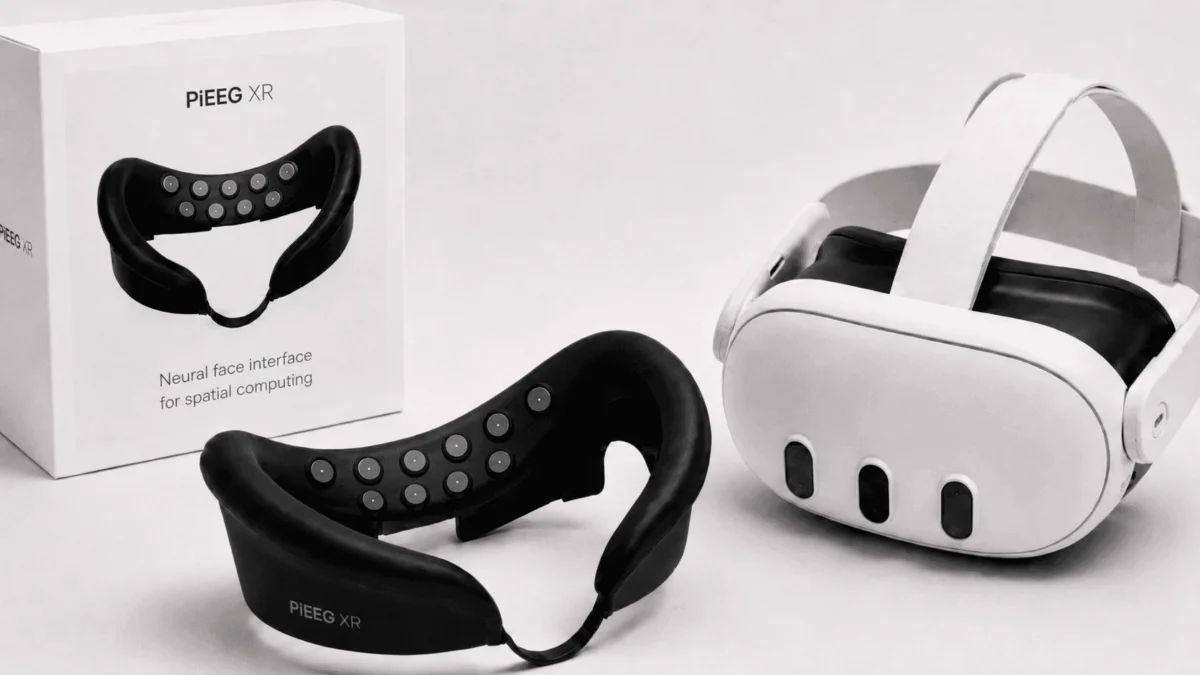
Main Facts: A New Paradigm for Spatial Computing Input
In the rapidly evolving landscape of extended reality (XR), the quest for authentic human expression has hit a significant hardware bottleneck. While high-end enterprise headsets like the Meta Quest Pro and the Apple Vision Pro have integrated sophisticated camera arrays for eye and face tracking, the consumer-grade Meta Quest 3—the current market leader—omitted these features to maintain a competitive price point and a svelte form factor. Enter PiEEG XR, an ambitious upcoming accessory designed to bypass the need for cameras entirely by tapping directly into the user’s biological signals.
PiEEG XR is a specialized facial interface replacement for the Meta Quest 3. Unlike traditional tracking solutions that rely on computer vision to interpret muscle movements or pupil dilation, PiEEG XR utilizes a suite of sensors embedded within the headset’s frame. These sensors capture biosignals—specifically Electromyography (EMG) for muscle activity and Electroencephalography (EEG) for brain activity—directly from the wearer’s face and forehead.
Developed by Ildar Rakhmatulin, the device is positioned not as a plug-and-play consumer peripheral, but as an open-source neural interface. It targets a niche but influential demographic: developers, researchers, neuroscientists, and the "power-user" community within social VR platforms like VRChat. The primary value proposition lies in its ability to stream raw biosignal data into software, allowing users to train custom machine-learning models to map those signals to VR avatar expressions, mixed-reality triggers, or even experimental control schemes.
Key Technical Specifications at a Glance:
- Form Factor: Replacement facial interface for Meta Quest 3 and 3S.
- Sensing Modalities: 8-channel biosignal acquisition (EEG, EMG, and potentially ECG/EOG).
- Data Integration: Supports Open Sound Control (OSC) and WebSocket protocols.
- Open Source: Hardware and software designs intended for community modification.
- Target Market: Research and development (R&D), accessibility experimentation, and social VR enthusiasts.
Chronology: From Brain-Computer Interfaces to VR Integration
The journey toward PiEEG XR did not begin in the VR space, but rather in the broader field of Brain-Computer Interfaces (BCI). The developer, Ildar Rakhmatulin, has spent years refining low-cost, high-efficacy neural sensing hardware.
The Foundation: IronBCI and PiEEG
Before the XR-specific iteration, the project existed as IronBCI, an 8-channel wearable device designed for general-purpose biosignal monitoring. IronBCI gained traction in the research community for its ability to provide high-quality EEG data at a fraction of the cost of medical-grade equipment. This was followed by the original PiEEG, a shield for Raspberry Pi that democratized neuroscience experiments for hobbyists.
The Quest 3 Catalyst (Late 2023)
When Meta released the Quest 3 in October 2023, the VR community was divided. While the headset offered superior pancake lenses and a powerful chipset, the removal of the Quest Pro’s face and eye-tracking sensors was seen as a regression for social presence. This gap in the market provided the impetus for Rakhmatulin to adapt his BCI technology into a wearable form factor compatible with the Quest 3.
The Prototype Phase (Mid-2024)
Throughout early and mid-2024, early prototypes of the PiEEG XR began appearing in developer circles. Initial demos focused on the "Smile Test"—a proof of concept showing that EMG sensors around the cheeks could detect muscle contractions associated with smiling and translate them into a digital avatar’s facial movement in real-time.
Current Status (Late 2024)
The project has recently moved into a more public phase, with hands-on demonstrations and a growing presence on platforms like Reddit and YouTube. The developer has shifted focus from simple expression mapping to more complex "focus-to-action" scenarios, where the headset detects cognitive load or concentration levels to trigger digital effects.
Supporting Data: How Biosignals Transcend Camera Limits
To understand why PiEEG XR is a significant technological pivot, one must examine the data it collects versus traditional optical tracking.
The Limitations of Optical Tracking
Camera-based face tracking (as seen in the Quest Pro) requires an unobstructed view of the lower face and eyes. This adds weight, consumes significant battery power, and raises privacy concerns regarding constant video monitoring of the user’s environment. Furthermore, cameras can only track what is visible; they cannot anticipate an action before the muscle moves or detect internal states like "focus" or "stress."
The Biosignal Advantage
PiEEG XR utilizes EMG (Electromyography) to detect the electrical potential generated by muscle cells. Because these sensors are in direct contact with the skin of the face, they can detect micro-expressions that might be too subtle for a low-resolution internal camera to catch.
Data from early testing suggests:
- Lower Latency: Electrical signals from muscles are often detectable milliseconds before visible movement occurs, potentially allowing for faster avatar response times.
- Cognitive State Monitoring: By utilizing EEG (Electroencephalography) channels on the forehead, the device can monitor alpha and beta brain waves. This data can be used to quantify a user’s level of engagement or relaxation—metrics that are invisible to a camera.
- Hardware Efficiency: Reading electrical resistance and potential requires significantly less computational overhead than processing high-frame-rate video feeds through a computer vision AI model.
Mapping and Training
The efficacy of PiEEG XR relies on a calibration phase. In a featured demo, the system is "trained" by having the user smile several times while the software records the specific electrical signature of those muscles. Once the baseline is established, the system uses a mapping algorithm to trigger the corresponding blend shape on a VR avatar. This "learning" approach allows the device to be highly personalized, accommodating different facial structures and signal intensities.
Official Responses and Industry Context
The development of PiEEG XR takes place against a backdrop of varying strategies from the giants of the industry.
Meta’s Stance on Quest 3 Accessories
Meta’s Chief Technology Officer, Andrew Bosworth, has been vocal about the difficulties of adding face tracking as an aftermarket accessory. In various "Ask Me Anything" (AMA) sessions, Bosworth argued that there was no "credible way" to add high-quality eye or upper-face tracking to the Quest 3 via an accessory because of the precise alignment required for cameras and the lack of high-bandwidth data ports on the faceplate area.
However, PiEEG XR sidesteps Bosworth’s critique by not using cameras. By utilizing the facial interface—a part designed to be removed and replaced—PiEEG XR creates a direct skin-to-sensor contact point that does not rely on the optical alignment that Meta’s engineers found so challenging.
The VRChat Ecosystem
The social VR platform VRChat has become the de facto testing ground for this technology. VRChat recently added native support for eye tracking and has a robust community of "OSC-link" users who use external hardware to drive avatar expressions. The VRChat developer community has expressed significant interest in PiEEG XR, as it provides a path for Quest 3 users to achieve "Pro-level" expressiveness without buying a new $1,000+ headset.
Ethical and Privacy Considerations
While the developer emphasizes the open-source nature of the project, the collection of neural data is a sensitive topic. Unlike video data, which can be anonymized, neural patterns are often as unique as fingerprints. The project currently emphasizes local data processing, but as these devices move closer to consumer availability, the industry will likely face calls for strict "Neuro-rights" protections to ensure that brain and muscle activity data is not harvested by third-party platforms.
Implications: The Future of Human-Computer Interaction
The successful deployment of a device like PiEEG XR could signal a major shift in how we interact with spatial computers. The implications extend far beyond making an avatar smile in a virtual bar.
1. Beyond Human Limits: The "Third Arm" Concept
One of the most provocative discussions surrounding the PiEEG XR involves "extra-human" controls. Because the device can map any biosignal to any digital output, a user could theoretically train themselves to control a third virtual arm or a set of wings by using specific facial muscle combinations or focus states. This taps into the concept of neuroplasticity, where the human brain learns to treat a digital appendage as a part of the biological body.
2. Accessibility and Hands-Free Navigation
For users with motor impairments that prevent them from using standard VR controllers, PiEEG XR offers a revolutionary alternative. The ability to navigate menus or interact with objects through "focus-to-click" or jaw-clench triggers could make VR and AR significantly more inclusive.
3. Emotional Analytics in Research and Education
In educational settings, PiEEG XR could allow researchers to monitor a student’s cognitive load during a VR lesson. If the EEG data shows a spike in frustration or a drop in attention, the VR environment could theoretically adapt in real-time—simplifying the task or providing a break—to optimize learning.
4. The "Prosumer" Hackability Trend
PiEEG XR represents a growing trend of "hackable" hardware. By keeping the platform open-source, Rakhmatulin is betting that the community will find uses for the hardware that a single company like Meta or Apple never would. This grassroots innovation is reminiscent of the early days of the PC revolution, where enthusiasts paved the way for the consumer features of the future.
Conclusion: A Bridge to the Future
PiEEG XR is not yet a polished product for the average gamer, but it is a vital piece of experimental infrastructure. It challenges the assumption that we need more cameras to be more human in digital spaces. By looking inward at our own biological signals, PiEEG XR may provide the most direct link yet between the human mind and the machine, turning the Quest 3 into a window not just into a virtual world, but into the user’s own cognitive state. As the project moves toward its official launch, the VR industry will be watching closely to see if the future of interaction is seen through a lens—or felt through a sensor.