Unveiling Capitalism’s Global Roots: Sven Beckert’s Monumental Work Reviewed, as World History Encyclopedia Seeks Crucial Support
FOR IMMEDIATE RELEASE
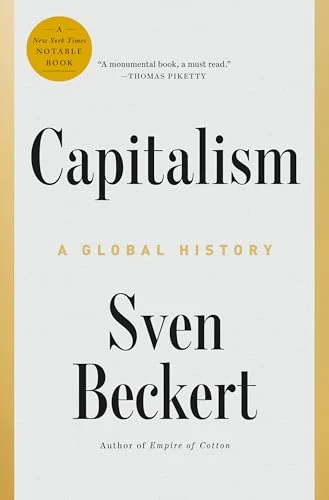
[City, State] – [Date, e.g., October 26, 2024] – In a groundbreaking new publication that promises to redefine our understanding of global economic history, Harvard University’s Sven Beckert challenges the Eurocentric narrative of capitalism in his epic new book, "Capitalism: A Global History." This monumental 1,344-page work, reviewed by Shankar Chaudhuri for the World History Encyclopedia, posits that capitalism is not merely a European invention but a complex system with deeply interwoven global origins, shaped by state power, warfare, and coercion across continents.
The World History Encyclopedia, a non-profit organization dedicated to providing free, meticulously researched historical content, is currently highlighting Beckert’s significant contribution while simultaneously appealing to its global readership for support. The organization faces annual server costs of $20,000 to maintain its extensive online archives and educational resources, with the "Server Costs Fundraiser 2026" currently having secured $9,391 towards its critical goal. This fundraising effort underscores the vital role independent platforms play in disseminating knowledge and fostering informed public discourse, particularly on complex historical subjects like global capitalism.
Main Facts: A Sweeping Reappraisal of Capitalism
Sven Beckert’s "Capitalism: A Global History" is lauded as an indispensable resource for anyone seeking to understand the true origins and evolution of the economic system that dominates the modern world. The book, rated a perfect five stars by reviewer Shankar Chaudhuri, a writer, researcher, and former adjunct professor of history, is described as both professional in its audience and surprisingly accessible in its "easy" difficulty, despite its considerable length. Published by Penguin Press, this forthcoming or recently released work (listed as 2025) draws on an immense volume of primary and secondary research, spanning multiple continents and centuries.
Beckert’s central thesis is a radical departure from conventional narratives. He argues that capitalism, defined as "an economic logic in which privately owned capital is invested with the primary goal of producing more capital," did not emerge solely from European ingenuity or enlightenment ideals. Instead, it was a global phenomenon, connecting disparate regions and fueled by a potent mix of state intervention, military might, and coercive labor practices. The review, published by the World History Encyclopedia, emphasizes Beckert’s elegant narrative style, which makes complex historical processes comprehensible to a broad readership, including scholars, researchers, and general enthusiasts.
Crucially, the World History Encyclopedia’s ability to host and share such insightful reviews and historical articles depends entirely on community support. The ongoing "Server Costs Fundraiser 2026" is a direct appeal to readers to help cover the $20,000 annual expenditure required to keep their free, high-quality content accessible worldwide. As of the latest update, $9,391 has been raised, highlighting both the community’s engagement and the remaining need. The organization encourages purchasing books through its website, which, as an Amazon Associate, earns a commission, or by direct donation and membership, which also removes promotional messages from printouts.
Chronology: Capitalism’s Global Journey Through Power and Coercion
Beckert meticulously traces capitalism’s trajectory, beginning not in the bustling markets of nascent European powers, but in a network of global merchant communities.
Early Seeds and Benign Beginnings (12th Century)
Beckert suggests that capitalism’s nascent forms emerged as a "benign force" around the 12th century. These early manifestations were found within isolated merchant communities across a vast geographical expanse, including cities like Aden, Cairo, and Surat in the East, Guangzhou in China, and Florence and Genoa in Europe. These societies, at this stage, were largely centered around subsistence economies, with merchant activities representing a distinct, albeit limited, economic logic. This initial phase highlights capitalism’s truly multi-polar origins, challenging any singular point of genesis.
The Mid-Millennium Acceleration: A Union of State and Capital
The narrative takes a significant turn around the mid-millennium. As the feudal order began its decline in Europe, a new alliance formed between capital-rich European merchants and emerging states. This symbiotic relationship, Beckert argues, acted as a powerful catalyst, "turbocharging capitalism into novel spaces." This period marks a crucial shift where private capital began to leverage state power, paving the way for unprecedented expansion and transformation.
Colonial Exploitation and the First Industrial Revolution
The book vividly illustrates how this new alliance manifested in brutal colonial ventures. Spanish colonialism in the New World, particularly in Potosí, Bolivia, became a central pillar of early global capitalism. Potosí, an estimated source of 60% of all silver mined globally, generated immense wealth for the Spanish monarchy. This wealth, however, came at an horrific human cost, with indigenous miners succumbing to mercury, arsenic, and silica poisoning due to exploitative labor practices.
Concurrently, in the Caribbean, the burgeoning sugar plantations became another engine of capitalist growth. Here, the systematic use of enslaved labor created enormous wealth for European owners, directly fueling the nascent Industrial Revolution in Europe. This connection underscores Beckert’s argument that the wealth accumulation necessary for industrialization was inextricably linked to violence and exploitation on a global scale.
Post-Slavery Coercion: The Second Industrial Revolution’s Dark Side
Even after the abolition of slavery, the demand for cheap labor persisted, leading to new forms of coercion. European plantation owners, particularly in the Caribbean and other colonial territories, imported approximately 2.2 million indentured laborers from India, China, and other countries. These laborers were forced to work under conditions often as brutal as those faced by enslaved people. Beckert asserts that the wealth generated by this indentured labor facilitated the Second Industrial Revolution, again demonstrating capitalism’s reliance on exploitative labor practices, even in its "modern" forms.
The East India Companies’ Imperial Ascendancy
On the Asian front, Beckert details the formidable power wielded by state-chartered entities like the Dutch East India Company (VOC) and the British East India Company (EIC). These were not mere trading companies; they were empowered to build fortifications, wage war, and establish monopolies. The VOC, for instance, used military force to secure spice monopolies, resulting in the death or enslavement of an estimated one million people.
The EIC’s trajectory was even more profound, transforming from a trading company into the de facto ruler of India. Beckert, referencing recent research, claims an astounding $45 trillion of India’s wealth was transferred to Britain between 1765 and 1938. Furthermore, the EIC strategically used India as a base to export opium to China as a form of currency, addressing its significant trade deficit with the Qing Empire. This practice highlights how capitalist expansion frequently involved geopolitical manipulation and the imposition of devastating social costs. Beckert pointedly notes that this historical reality stands in stark contrast to the idealized vision of free markets espoused by Enlightenment thinkers.
The Scramble for Resources and a "Monumental Turning Point"
By the late 19th century, Beckert narrates, European nations intensified their quest for territorial control over mineral resources across the globe. Africa, in particular, was re-imagined as "another America, lying fallow and ready to yield rich harvests." The pace of colonial expansion was staggering: in 1870, only 10% of Africa was under European control; by 1900, this figure had surged to 90%.

This relentless push into Africa coincided with the rise of new, integrated enterprises in sectors like iron, steel, electricity, and transport. Beckert designates this era as "the most monumental turning point in the global history of capitalism." The rapid industrial expansion, however, often came at the cost of severe worker exploitation, which in turn spurred the rise of powerful trade unions and socialist parties advocating for greater social justice and economic equality.
Challenges to the Capitalist Order and Neoliberal Reshaping
Beckert identifies several grave threats to capitalism throughout the 20th century: the Bolshevik Revolution, the Great Depression, and the burgeoning nationalistic colonial movements. In the United States, the New Deal era represented a significant response, characterized by an expansion of the welfare state, empowerment of trade unions, and reforms to the financial system, aiming to stabilize and humanize capitalism.
However, the three decades following the Oil Crisis of 1973 and the demise of the Bretton Woods Monetary System saw a radical restructuring of the post-war economic order. A new neoliberal paradigm emerged, championing the privatization of state enterprises, deregulation of finance, and the export of manufacturing to the Global South. Beckert argues that this shift has led to skyrocketing inequality, citing that the top one percent’s share of US income roughly doubled from eight percent in 1973 to 18 percent in 2008, leaving millions of Americans facing increased financial insecurity and insolvency.
Supporting Data and Empirical Evidence
Beckert’s narrative is not merely a theoretical construct but is firmly grounded in a vast array of empirical data. The review highlights his "staggering amount of primary and secondary research on several continents," a testament to the rigor and depth of his scholarship. Specific figures underscore the scale of historical exploitation and wealth transfer:
- Potosí’s Silver: An estimated 60% of all silver mined globally came from Potosí, Bolivia, illustrating the immense material wealth extracted by colonial powers.
- Wealth Transfer from India: The claim of an estimated $45 trillion transferred from India to Britain between 1765 and 1938, referencing "recent research," provides a staggering quantification of colonial economic impact. While specific sources for this figure aren’t detailed in the review, its inclusion by Beckert suggests robust economic historical analysis.
- The Scramble for Africa: The dramatic shift from 10% to 90% European control of Africa between 1870 and 1900 offers a stark statistical representation of aggressive territorial and resource acquisition.
- Neoliberal Inequality: The doubling of the top one percent’s share of US income from 8% in 1973 to 18% in 2008 provides a concrete measure of increasing economic disparity in the neoliberal era.
Beckert’s previous work, "Empire of Cotton" (2015), which earned him the Bancroft Prize, further attests to his capability in assembling comprehensive, data-rich historical narratives. His ability to synthesize such diverse and extensive information into an "elegant and easily comprehensible language" is a significant achievement, making this complex history accessible without sacrificing academic depth.
Critical Engagement and Broader Perspectives
While praising Beckert’s "gripping historical narrative," reviewer Shankar Chaudhuri also offers important critical nuances and suggestions for further exploration, demonstrating the rigorous academic discourse fostered by platforms like the World History Encyclopedia. These points serve not as rebuttals but as invitations for a more comprehensive understanding of capitalism’s multifaceted nature.
Chaudhuri argues that Beckert’s analysis, while powerful in its critique of capitalism’s coercive dimensions, might present an overly negative picture. He suggests that "not everything about capitalism is simply doom and gloom," pointing out that the system has also given rise to positive developments such as fair trade practices, corporate social responsibility initiatives, and innovative employee-owned business models. These aspects represent attempts to mitigate capitalism’s harsher effects and align it with more ethical considerations, which are also part of its historical evolution.
Furthermore, Chaudhuri highlights a perceived omission in Beckert’s analysis: the "religious dimensions of capitalism." He notes that historians have documented the significant role of religious institutions and figures in economic development. For example, Cistercian monks were renowned as exceptionally successful medieval entrepreneurs and innovators, demonstrating advanced agricultural and industrial practices. Similarly, clerics were involved in financing Iberian explorations in the New World and often accompanied explorers, playing a part in the expansion of early global trade and colonialism. Incorporating these religious aspects, Chaudhuri implies, could provide a more holistic understanding of the cultural and ideological underpinnings that influenced capitalism’s trajectory. This critical engagement reinforces the idea that historical inquiry is an ongoing dialogue, inviting readers to consider multiple perspectives.
Implications for Understanding Global History and Economics
Sven Beckert’s "Capitalism: A Global History" carries profound implications for how we understand both the past and the present. By meticulously dismantling the myth of capitalism’s purely European, benign origins, the book compels readers to confront the often-uncomfortable truths about its foundational role in colonialism, slavery, and global inequality.
The book’s emphasis on state power, warfare, and coercion as integral to capitalism’s development challenges idealized notions of free markets and purely voluntary exchange. This perspective is particularly relevant in contemporary discussions about global trade, international relations, and the legacies of colonialism that continue to shape economic disparities today. For policymakers, economists, and citizens alike, Beckert’s work provides a critical historical framework for understanding persistent issues such like wealth concentration, the exploitation of labor in global supply chains, and the uneven distribution of resources.
Moreover, by highlighting the "monumental turning point" of the late 19th century and the subsequent neoliberal restructuring, Beckert offers a historical lens through which to analyze current economic crises and the widening gap between the rich and the poor. The reviewer’s call for a more balanced perspective, acknowledging capitalism’s potential for fair trade and social responsibility, further enriches this dialogue, suggesting that the future of capitalism is not predetermined but subject to ongoing ethical and societal negotiation.
Ultimately, "Capitalism: A Global History" serves as an essential read for anyone grappling with the complexities of the global economy. It not only educates on historical facts but also provokes critical thought about the ethical responsibilities inherent in economic systems. The World History Encyclopedia’s role in disseminating such a significant review underscores its commitment to fostering informed historical understanding and its contribution to global intellectual discourse.
Conclusion and Call to Action
Sven Beckert’s "Capitalism: A Global History" is a landmark achievement, offering an unflinching, globally-informed account of one of history’s most powerful forces. Shankar Chaudhuri’s insightful review for the World History Encyclopedia effectively captures the book’s immense scope and critical arguments, while also providing valuable additional perspectives.
The World History Encyclopedia remains a vital resource for millions worldwide, offering free access to meticulously researched and reviewed historical content. However, the continuation of this invaluable service depends on the generosity of its readers. The ongoing "Server Costs Fundraiser 2026," with its goal of $20,000 to cover essential operational expenses, is a direct appeal to support the mission of making history accessible to all.
Readers are encouraged to support the World History Encyclopedia by purchasing books through their website, thereby leveraging their Amazon Associate status, or by making direct donations at www.worldhistory.org/donate/. Becoming a supporting member at www.worldhistory.org/membership/ not only aids the organization but also provides benefits such as removing promotional messages from printouts. Your support ensures that critical historical analyses, like the review of Beckert’s "Capitalism: A Global History," continue to enrich global understanding.