The Cinematic Voyage of Christopher Nolan: Matt Damon and the Multilayered Ambition of ‘The Odyssey’
The announcement that Christopher Nolan, the architect of mind-bending spectacles like Inception and the Academy Award-winning Oppenheimer, would be turning his lens toward classical antiquity has sent shockwaves through the film industry. Universal Pictures has confirmed that Nolan’s next grand-scale project is a direct, traditional adaptation of Homer’s The Odyssey. While the project was initially shrouded in the director’s trademark secrecy, recent insights from the film’s star, Matt Damon, have begun to peel back the layers of what is arguably the most anticipated cinematic event of 2026.
In an exclusive dialogue, Damon provided a window into Nolan’s philosophical approach to the source material, suggesting that the film aims to be far more than a mere historical recreation. Instead, it is being positioned as a thematic Rorschach test for modern audiences, designed to resonate with personal experiences ranging from the trauma of war to the enduring power of love.
Main Facts: A New Chapter in Auteur Cinema
Christopher Nolan’s The Odyssey is currently slated for a theatrical release on July 17, 2026. This date follows Nolan’s established tradition of mid-July releases, a window that has previously seen the success of The Dark Knight, Dunkirk, and Oppenheimer. Produced by Universal Pictures, the film represents a significant investment in the "sword and sandal" genre, albeit filtered through Nolan’s specific technical and narrative sensibilities.
Key highlights of the production include:
- The Lead: Matt Damon takes on the role of Odysseus, the cunning King of Ithaca. This marks another collaboration between Damon and Nolan following their work on Interstellar and Oppenheimer.
- Technical Ambition: Nolan is reportedly utilizing IMAX 70mm film to capture the Mediterranean landscapes and mythological encounters.
- Creative Inspiration: The director has cited the legendary stop-motion pioneer Ray Harryhausen as a primary influence, suggesting a blend of practical effects and cutting-edge technology to bring the poem’s monsters to life.
- Narrative Scope: The film is expected to cover the ten-year journey of Odysseus as he attempts to return home following the fall of Troy.
Chronology: From the Ashes of Troy to the Shores of 2026
The journey toward this adaptation began shortly after the historic success of Oppenheimer at the 96th Academy Awards. Having secured his legacy as a filmmaker capable of turning dense, intellectual subject matter into a billion-dollar global phenomenon, Nolan sought a project that allowed for a different kind of "scratching of an itch."
Early 2024: The Selection
Rumors began to circulate that Nolan was looking at various scripts, ranging from a remake of The Prisoner to a high-concept aviation thriller. However, the allure of the "hero’s journey" in its most primal form led him to Homer. Reports suggest Nolan felt a creative deficit in his filmography regarding pure, fantastical adventure—a gap he intended to fill by revisiting the foundation of Western literature.
Late 2024: Casting and Pre-Production
The casting of Matt Damon was a pivotal moment. Damon’s ability to portray both intellectual grit and physical exhaustion made him the ideal candidate for a character defined by "metis" (cunning intelligence). During this period, Nolan’s production team began scouting locations across the Ionian islands, seeking to ground the mythological tale in a tangible, rugged reality.
2025: Principal Photography
Production is scheduled to be an intensive, globe-trotting affair. Leveraging the IMAX format, the crew is tasked with recreating the various islands of the Odyssey—from the lotus-eaters’ shores to the jagged cliffs of the Cyclops—with a focus on practical sets and minimal reliance on digital environments.
![The Odyssey Star Matt Damon Explains What Christopher Nolan's New Movie Is Really About [Exclusive]](https://www.slashfilm.com/img/gallery/the-odyssey-star-matt-damon-explains-what-christopher-nolans-new-movie-is-really-about-exclusive/l-intro-1783085677.jpg)
July 17, 2026: The Scheduled Release
Universal has locked in this prime summer real estate, anticipating that the combination of the Nolan brand and the universal familiarity of the source material will dominate the global box office.
Supporting Data: The Enduring Power of the Epic
To understand the magnitude of Nolan’s undertaking, one must look at the history of The Odyssey in popular culture. It is not merely a poem; it is the blueprint for the "Hero’s Journey" as defined by Joseph Campbell.
Historically, The Odyssey has been adapted into various forms, demonstrating its extreme versatility:
- Literature: James Joyce’s Ulysses transposed the epic into a single day in Dublin, proving the story’s themes are independent of their Bronze Age setting.
- Film: The Coen Brothers’ O Brother, Where Art Thou? (2000) reimagined the tale as a Depression-era folk comedy, focusing on the theme of redemption.
- Animation: Even The SpongeBob SquarePants Movie (2004) followed the structural beats of the epic, highlighting its accessibility to all age groups.
Nolan’s version, however, appears to be the first major studio attempt in decades to treat the material with the gravity of a historical epic while embracing the supernatural elements. By invoking Ray Harryhausen, Nolan is signaling a return to "tactile" fantasy—the kind where monsters like the Scylla or the Charybdis feel like physical threats rather than weightless CGI constructs.
Official Responses: Matt Damon on the "Beauty of Homer"
In an exclusive press day for the film, Matt Damon addressed the inevitable question: What is this version of The Odyssey really about? His response suggested that Nolan is leaning into the inherent ambiguity of the original text.
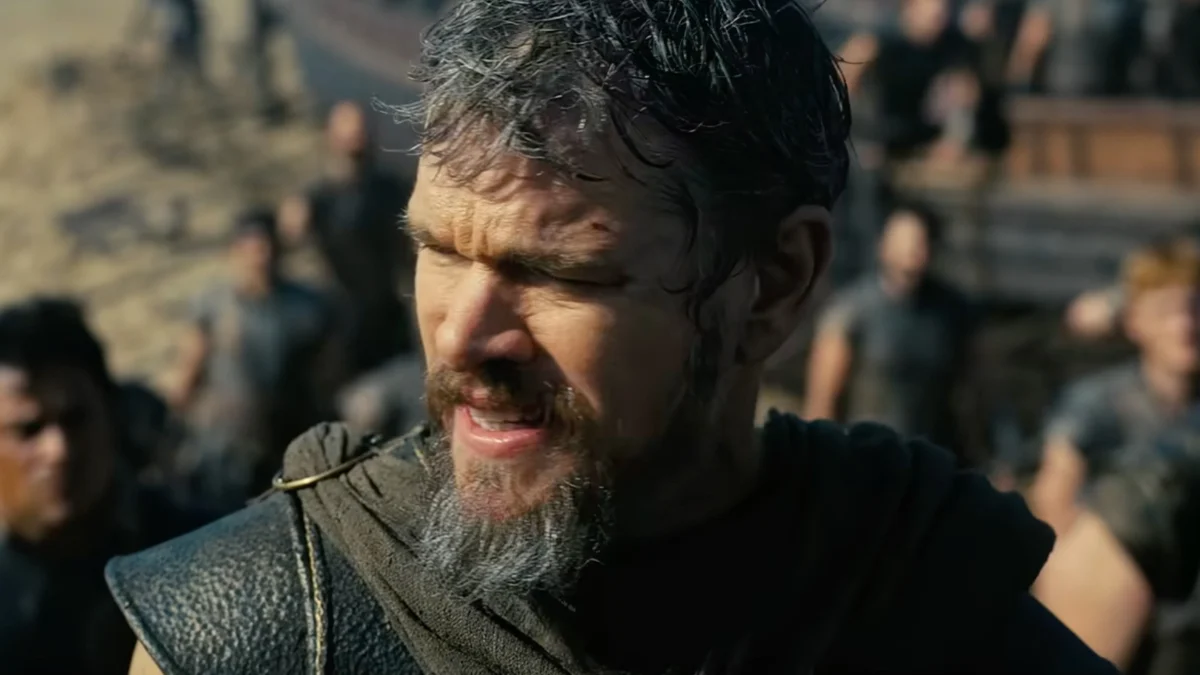
"I think people, depending on the experience, the personal experience you bring into the theater, things are going to hit you in different ways, because it’s so many stories in one," Damon explained. He noted that the production has become a melting pot of interpretations.
Damon shared a poignant anecdote from the set: "One of the people working on the film was a veteran, and he thought it was—he said this is all about PTSD. And I think it really depends on what you carry into it, and that’s the beauty of Homer."
This "PTSD" angle is particularly significant. In the original poem, Odysseus is a man who has spent ten years in a brutal war (the Iliad) and another ten years trying to navigate the consequences of his actions. By focusing on the psychological toll of the journey, Nolan may be looking to bridge the gap between the historical realism of Dunkirk and the high-concept storytelling of his earlier work.
![The Odyssey Star Matt Damon Explains What Christopher Nolan's New Movie Is Really About [Exclusive]](https://www.slashfilm.com/img/gallery/the-odyssey-star-matt-damon-explains-what-christopher-nolans-new-movie-is-really-about-exclusive/intro-1783085677.jpg)
Damon further characterized the film as a "love story" for some and a "story about war" for others. This suggests a non-linear or multi-tonal approach to the narrative, consistent with Nolan’s previous work in Memento and The Prestige, where the "truth" of the story is often found in the eye of the beholder.
Implications: A Paradigm Shift for the Blockbuster
The production of The Odyssey carries several significant implications for the future of cinema and the trajectory of Christopher Nolan’s career.
The Revival of the Classical Epic
For years, the "Sword and Sandal" genre has struggled to find its footing, often relegated to streaming services or lower-budget productions. Nolan’s entry into this space, backed by the full weight of Universal’s marketing machine, could signal a renaissance for large-scale historical and mythological filmmaking. If successful, it may encourage studios to move away from established comic book franchises and toward the vast, untapped library of classical mythology.
The Evolution of Nolan’s Visual Language
Nolan has long been a proponent of the "theatrical experience." By adapting a story that involves gods, sirens, and monsters, he is challenging his own preference for grounded realism. The implication is a new hybrid style: "Grounded Fantasy." If Nolan can make a Cyclops feel as real and terrifying as a Spitfire in Dunkirk or a rotating hallway in Inception, he will have pushed the boundaries of what practical cinematography can achieve in the 21st century.
The Thematic Culmination of "The Journey Home"
Themes of "home" and "time" have haunted Nolan’s filmography. In Interstellar, Cooper travels across the galaxy to return to his daughter; in Inception, Cobb’s entire motivation is to see his children’s faces again. The Odyssey is the ultimate expression of this motif. It allows Nolan to explore the concept of Nostos (the Greek word for homecoming) on the grandest possible stage.
As the industry looks toward the summer of 2026, the consensus is clear: Christopher Nolan is not just making a movie about a man on a boat. He is attempting to capture the essence of human struggle, the volatility of memory, and the grueling process of transformation. As Matt Damon suggested, the film’s true meaning will not be found in the script, but in the hearts of the millions who will witness Odysseus’s long-awaited return to the big screen.