"Orchid Rain on the Underground": Chris "Daze" Ellis Captures the Enduring Spirit of NYC’s Urban Canvas at PPOW Gallery
New York, NY – PPOW Gallery is currently hosting "Orchid Rain on the Underground," the electrifying third solo exhibition by the celebrated artist Chris "Daze" Ellis. This expansive showcase, running through April 25, 2026, delves deep into the pulsating heart of New York City, offering a vibrant testament to the enduring legacy of its graffiti art movement and the city’s indomitable creative spirit. Featuring a compelling new series of paintings, an immersive multimedia installation, and a striking site-specific mural, Ellis masterfully blends the raw, spontaneous energy of his formative years with a meticulously honed artistic practice cultivated over five decades.
While the gritty, burgeoning New York of the 1970s and 80s, the crucible that forged Ellis’s artistic identity, might seem like a distant memory, the works presented in "Orchid Rain on the Underground" serve as irrefutable evidence of its lasting impact. Ellis, born in Brooklyn in 1962, draws a direct lineage from the pioneers of early graffiti writing, artists like Blade, Lee Quiñones, and the visionary PHASE 2, whose work he encountered while a student at the High School of Art and Design in the mid-1970s. This exhibition is not merely a retrospective; it is a dynamic re-envisioning of that foundational energy, demonstrating its continued relevance and profound influence on the creative landscape that continues to thrive throughout the city today.
The Genesis of an Urban Artist: From Subway Cars to Studio Practice
Daze’s artistic journey began not in the hushed halls of galleries, but on the moving canvases of New York City’s subway cars. The mid-1970s, a period of economic hardship and urban decay, paradoxically became a fertile ground for artistic expression, particularly within the burgeoning graffiti art scene. Ellis, inspired by the burgeoning movement, began to establish his own artistic voice. His formative years were deeply intertwined with the city’s vibrant nightlife, frequenting legendary establishments that would later become iconic landmarks of New York’s cultural history.
Places like the Lit Lounge in the East Village, Danceteria on West 21st Street, and the infamous Mudd Club in Tribeca were more than just venues; they were vital incubators of social and artistic experimentation. These spaces often doubled as informal galleries and performance hubs, fostering a cross-pollination of ideas and a sense of community that fueled the creative endeavors of a generation. It was within this electrifying milieu that the foundations of Daze’s early works were laid. By the early 1980s, a significant shift began to occur. Ellis, while still deeply connected to the raw energy of graffiti, started to transition from tagging subway cars to developing a more formalized studio practice. This evolution allowed him to encapsulate the very ethos of the city – its dynamism, its grit, its resilience, and its ceaseless pulse – within the controlled environment of the studio, translating the ephemeral into the enduring.
Honoring the Urban Soul: Artistic Influences and the Essence of New York
"Orchid Rain on the Underground" is a profound exploration of Daze’s artistic lineage, weaving together diverse influences to create a unique visual language. His work pays homage to the gritty realism of early 20th-century urban artists, drawing inspiration from figures like John Sloan of the Ashcan School and Reginald Marsh, whose depictions of New York City captured the raw essence of its streets and the lives of its inhabitants. Daze, much like these predecessors, views New York City’s streets and subways not merely as backdrops, but as crucial sites of his creative evolution.
Simultaneously, his canvases resonate with the lyrical abstraction and expressive brushwork of Abstract Expressionist titans like Joan Mitchell and Willem De Kooning. This juxtaposition is a hallmark of Daze’s distinctive style. He masterfully combines bold, gestural swathes of acrylic and spray paint, echoing the spontaneous energy of graffiti, with meticulously rendered details of subway car interiors, the shadowy depths of tunnels, and the bustling anonymity of stations. This fusion creates a dynamic tension, a dialogue between the raw and the refined, the ephemeral and the permanent.
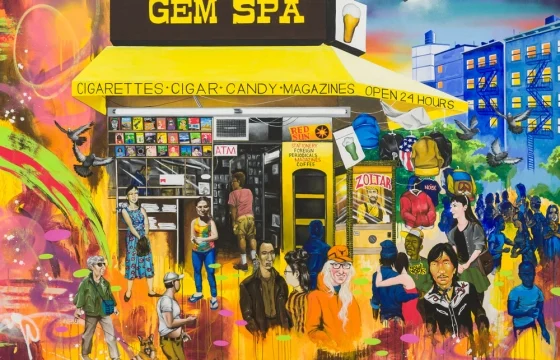
A standout piece exemplifying this synthesis is "Gem Spa In the 80s" (2025). This painting vividly captures the now-iconic Gem Spa, a newspaper stand and candy store that once stood at the corner of St. Mark’s Place and Second Avenue. Gem Spa was far more than a commercial establishment; it was a vital nexus for the city’s diverse subcultures, a gathering point for artists, musicians, and writers. Its significance is echoed in the writings of literary giants like Jack Kerouac and Allen Ginsberg, the latter famously describing it as a "nerve center" of the city.
In "Gem Spa In the 80s," Daze populates the scene with figures who are not only integral to the painting’s narrative but also to his own life and artistic journey. The critic and curator Carlo McCormick, a key figure in documenting and promoting the downtown art scene, and the influential artist Martin Wong, whose work often explored urban themes and marginalized communities, emerge from the bustling crowd in the foreground. Their presence imbues the painting with a sense of personal history and artistic camaraderie, reinforcing the idea of New York as a city built on interconnectedness and shared creative endeavors.
Beyond specific landmarks and individuals, Daze’s work consistently explores themes of resilience and beauty in unexpected places. In other works within the exhibition, technicolor explosions of flowers erupt from heaps of urban rubble. These striking motifs serve as powerful metaphors for optimism amidst inequality and the inherent beauty that can emerge from destruction and decay. The juxtaposition of vibrant tropical flora with local flowers from the artist’s home in upstate New York creates poignant memorials to what has been lost – whether it be specific places, people, or eras – while simultaneously offering hopeful testaments to the enduring capacity for beauty and creativity that can still be discovered around every corner of the city.
An Immersive Experience: Bringing the Streets Indoors
"Orchid Rain on the Underground" transcends the traditional gallery experience, offering visitors a multi-sensory immersion into Daze’s artistic world. A significant element of the exhibition is a site-specific mural that transforms the gallery’s interior. This mural, stretching across the walls of a hallway, acts as a conduit, leading viewers towards the final, climactic room of the exhibition.
This concluding space houses a meticulously crafted multimedia installation designed to transport visitors directly into a composite scene from the artist’s formative years. The installation is a vibrant tapestry of sensory elements: a pulsating light-up dance floor, a shimmering disco ball casting kaleidoscopic patterns, and actual subway car seats that invite visitors to pause and reflect. The auditory landscape is equally crucial, featuring a curated soundtrack that seamlessly fuses the infectious rhythms of house, disco, and hip-hop with the electrifying energy of club music.
This installation is not merely decorative; it is a profound statement about the freedom and creative inspiration that characterized these urban spaces and their paramount importance to Daze’s personal and artistic development. By recreating these environments, Ellis invites viewers to understand the genesis of his art not just visually, but experientially. It underscores the idea that art is deeply rooted in its context, and that the vibrant, often chaotic, energy of New York City’s nightlife and public transportation systems were the true classrooms for his artistic education.
Through this exhibition, Chris "Daze" Ellis masterfully synthesizes disparate elements from throughout his illustrious career. "Orchid Rain on the Underground" stands as a powerful affirmation of his ongoing exploration of daily life in New York City, a city he has consistently documented and celebrated. More than that, it is a heartfelt and dynamic homage to the people, the places, and the enduring spirit that together comprise its vibrant and perpetually evolving cultural heartbeat. The exhibition serves as a powerful reminder that even as the city transforms, the creative energy that defined its past continues to resonate and inspire, finding new forms and expressions in the present and future.