The Digital Anachronism: How Retro3D is Using Cutting-Edge Mixed Reality to Resurrect Century-Old Stereoscopy
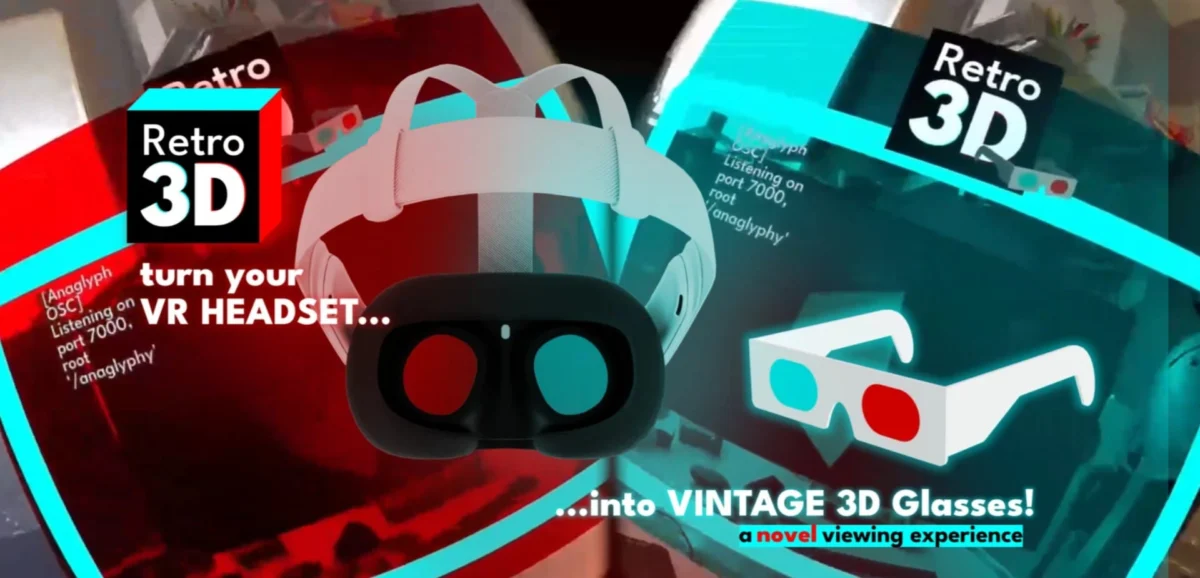
In the rapidly evolving landscape of spatial computing, the trend is almost exclusively toward the future—higher resolutions, photorealistic volumetric captures, and AI-driven depth mapping. However, a new application titled Retro3D is taking a paradoxical approach. By leveraging the advanced color passthrough capabilities of the Meta Quest 3 and Quest 3S, the app allows users to trade high-fidelity immersion for the flickering, color-tinted nostalgia of mid-20th-century anaglyph 3D.
While the concept of using a $500 mixed-reality headset to emulate the effect of a $0.50 pair of cardboard glasses may seem absurd on the surface, it represents a growing niche in the VR community: the use of modern hardware as a universal lens for historical media preservation.
Main Facts: High-Tech Hardware Meets Low-Tech Optics
Retro3D, currently in Early Access, is a specialized utility designed for the Meta Quest ecosystem. Unlike traditional VR applications that render fully digital environments, Retro3D acts as a sophisticated optical filter for the real world.
The application utilizes the Quest 3’s dual 4MP RGB cameras to stream a real-time feed of the user’s surroundings into the headset. It then applies a digital post-processing layer: the left eye’s feed is filtered with a red tint, while the right eye receives a cyan (blue-green) filter. This digital "lens replacement" allows the wearer to view "anaglyph" content—3D images or videos where two offset perspectives are printed or projected in overlapping red and cyan layers—on any external surface.
Key Features of Retro3D:
- Passthrough Integration: Real-time filtering of the physical world, allowing users to look at TVs, monitors, or physical prints.
- Multi-Modal Input: Support for both Meta Quest Touch controllers and optical hand tracking.
- Minimalist Interface: A simple toggle system to activate or deactivate the filters, ensuring the headset remains usable for navigating external devices.
- Hardware Compatibility: Specifically optimized for the Quest 3 and Quest 3S due to their low-latency color passthrough, though technically functional on any headset with similar capabilities.
The Chronology of Stereoscopy: From Wheatstone to Quest
To understand the appeal of Retro3D, one must look at the long, often fragmented history of three-dimensional media. The desire to replicate human binocular vision in art and media dates back to the mid-19th century.
The 1800s: The Birth of the Stereoscope
In 1838, Sir Charles Wheatstone demonstrated that the brain integrates two slightly different images from each eye into a single three-dimensional view. By the late 1800s, the Victorian stereoscope—a handheld device for viewing twin photographs—became a staple of middle-class entertainment.
The 1950s: The Golden Age of Anaglyph
While stereoscopes required a bulky viewer for every user, the 1950s brought 3D to the masses via the anaglyph method. By printing images in red and cyan and providing audiences with filtered glasses, studios could project 3D films in standard theaters. This era birthed classics like The Creature from the Black Lagoon (1954) and It Came from Outer Space (1953). These films relied on the brain’s ability to "decode" the overlapping colors, though the process often resulted in "ghosting" (crosstalk between eyes) and significant eye strain.
The 2020s: The VR Renaissance
Today, VR headsets like the Quest 3 provide "true" stereoscopy by showing a completely different digital image to each eye. However, much of the world’s 3D history—spanning from NASA’s Mars rover photos to mid-century cinematic archives—remains trapped in the anaglyph format. Retro3D bridges this gap, allowing modern users to access this archive without hunting for vintage cardboard glasses that are often flimsy, uncomfortable, and easily lost.
Supporting Data: The Technical Mechanics of Digital Filtering
The efficacy of Retro3D relies on the technical leap between the Quest 2 and the Quest 3. The Quest 2 utilized grainy, monochromatic (black and white) cameras primarily for tracking. The Quest 3, however, features a high-resolution color passthrough that approximates human vision with enough fidelity to read text on a phone or watch a television screen through the lenses.
Optical Challenges
In a traditional anaglyph setup, the physical red/cyan filters block specific wavelengths of light. For example, the red lens blocks the cyan image, and vice-versa. Retro3D replicates this digitally. By manipulating the RGB values of the passthrough video feed before it reaches the user’s retinas, the app ensures that the "separation" occurs at the software level.
Content Accessibility
Because Retro3D does not currently host its own content library, users must rely on external sources. This highlights a massive, often overlooked repository of 3D media:
- YouTube 3D: The platform contains thousands of legacy 3D videos, ranging from 1950s trailers to modern experiments.
- Scientific Archives: NASA has released numerous anaglyph images of the lunar surface and the Martian landscape, providing a sense of scale that 2D photos lack.
- Physical Media: Users can print anaglyph images from the internet or view vintage 3D comic books, with the Quest 3 acting as a hands-free magnifying glass and filter.
Official Responses and Developer Roadmap
The development of Retro3D is being driven by a community-centric approach. According to interactions on platforms like Reddit, the developer has expressed a commitment to expanding the app’s utility beyond simple color filtering.
The In-App Browser
One of the primary criticisms of the current version of Retro3D is the "external screen requirement." Users currently have to position themselves in front of a TV or laptop. The developer confirmed that a prototype for an in-app browser is already functional. This would allow users to stream YouTube or browse 3D galleries directly within the headset, eliminating the need for an external display and making the experience entirely self-contained.
The Pulfrich Effect Integration
Responding to user suggestions (notably from Reddit user zhuliks), the developer is exploring the implementation of the Pulfrich effect. This is a psycho-optical phenomenon where the brain perceives 2D lateral motion as 3D if one eye’s view is slightly darkened.
The darker image is processed by the visual cortex slightly slower than the brighter image. If an object is moving sideways, the "delayed" eye sees it at a previous position, creating a synthetic binocular disparity. Adding this mode would allow Retro3D to "convert" certain types of 2D footage—such as videos shot from a moving train or car—into a 3D experience without any specialized recording equipment.
Implications: Why Retro-Tech Matters in a High-Tech World
The existence of Retro3D points to several broader trends in the technology and media sectors.
1. The Preservation of Stereoscopic History
As we move toward "Spatial Personas" and volumetric video, there is a risk that older forms of 3D media will be forgotten. Retro3D serves as a digital bridge, ensuring that the anaglyph experiments of the 1950s and the 3D web boom of the early 2010s remain accessible to new generations. It turns the Quest 3 into a "Universal 3D Viewer."
2. Convenience Over Fidelity
While cardboard glasses are cheaper, they are rarely "at hand." For the VR enthusiast, the headset is a permanent fixture of their desk or living room. By moving the filtering process into the headset, Retro3D removes the friction of finding physical peripherals. It is an example of "convergent technology," where a single powerful device absorbs the functions of dozens of smaller, specialized tools.
3. The "Mixed Reality" Pivot
Retro3D is a prime example of the shift from Virtual Reality (VR) to Mixed Reality (MR). Rather than taking the user away from their world, the app enhances their interaction with the physical objects already in it—their TV, their computer, and even their printed books. This represents a more grounded, utilitarian approach to wearable technology.
4. AI and the Future of 2D-to-3D Conversion
The app arrives at a time when Meta is already experimenting with AI-driven depth estimation to convert standard Instagram Reels into 3D. While Meta’s official tools use complex neural networks to "guess" depth, Retro3D uses the "honest" depth already encoded in anaglyph content. In the future, these two paths may converge, with headsets offering a suite of "Legacy 3D" and "AI 3D" modes to ensure that no piece of media is ever "just" flat again.
Conclusion
Retro3D is a testament to the versatility of modern mixed-reality hardware. It proves that the "bleeding edge" doesn’t always have to look forward; sometimes, it can be used to look back with greater clarity. By transforming the Meta Quest 3 into a sophisticated set of 3D glasses, the app honors a century of optical innovation, providing a simple, fun, and educational way to engage with the history of the third dimension. As the app moves out of Early Access and introduces features like the Pulfrich effect and internal browsing, it may well become an essential tool for film historians and 3D enthusiasts alike.