"Fascinating Folklore": A Deep Dive into Ancient Tales with Modern Comic Luminaries
FOR IMMEDIATE RELEASE
LONDON, UK – In an ambitious and visually stunning new compendium, "Fascinating Folklore," acclaimed comic world luminaries John Reppion and PJ Holden invite readers on an extraordinary journey through the timeless tales and enigmatic figures that have shaped human culture for millennia. Born from a vibrant creative pact and ignited by the popular #FolkloreThursday movement, this groundbreaking work seamlessly blends scholarly essays with breathtaking comic art, offering an unparalleled and immersive pathway into the enchanting realm of folklore.
The book, published by Liminal11, promises a sensory feast for both seasoned enthusiasts and curious newcomers, delving into legends as diverse as the defiant Queen Boudicca and the legendary hero Beowulf. It explores the esoteric secrets of plantlore, where the mythical Mandrake, the versatile Willow, and the mysterious Yedua whisper ancient wisdom. Readers will also encounter haunting spectral figures like Japan’s vengeful Okiku, the ancient Wandjing spirits of Western Australia, and the resolute Greek deity Anteros, guardian of slighted love. "Fascinating Folklore" is more than a collection; it is an invitation to be spellbound by the enduring magic of human storytelling.
Main Facts: A Modern Compendium of Ancient Wisdom
"Fascinating Folklore" represents a significant contribution to the popularization and understanding of global mythologies. Co-created by writer John Reppion and artist PJ Holden, the book stands out for its unique format: a meticulous fusion of scholarly, informative essays and dynamic, original comic strips. This dual approach ensures that the rich historical and cultural contexts of each tale are thoroughly explored, while Holden’s evocative artwork provides a powerful visual dimension, bringing these ancient narratives to life in a contemporary and engaging manner.
The genesis of this project lies in a shared passion for folklore, catalyzed by the widespread engagement with the #FolkloreThursday hashtag on social media. What began as a collaborative agreement between Reppion and Holden quickly evolved into a comprehensive collection, demonstrating a profound commitment to showcasing the depth and diversity of global folklore. The compendium aims to not only entertain but also educate, revealing the profound impact these stories have had on human societies, beliefs, and artistic expressions across different eras and geographies. The selection of tales ranges from well-known epic heroes and historical figures to lesser-known deities, plant lore, and spectral entities, ensuring a broad appeal and a truly global perspective on the subject.
Chronology: From Hashtag Inspiration to Published Masterpiece
The journey of "Fascinating Folklore" began not in a traditional publishing house, but in the digital ether of social media. The #FolkloreThursday hashtag, a weekly online phenomenon encouraging the sharing of myths, legends, and folk tales, served as the initial spark. Both John Reppion and PJ Holden, already established figures in the comic world with a shared interest in the arcane and the mythical, found common ground in this collective appreciation for ancient narratives.
This shared enthusiasm soon blossomed into a formal creative pact. The idea was to move beyond mere social media snippets and craft a more substantial, enduring work that could capture the essence and complexity of folklore. The collaborative process involved Reppion meticulously researching and crafting the detailed essays, ensuring historical accuracy and cultural sensitivity, while Holden simultaneously translated these narratives into visually compelling comic sequences. This parallel development allowed for a symbiotic relationship between text and art, where each element enriches the other. The rigorous selection process for the featured tales aimed for both geographical diversity and thematic resonance, covering common human experiences such as love, loss, fear, and wonder. The project culminated in its publication by Liminal11, a publisher known for its distinctive approach to esoteric and cultural subjects, bringing this ambitious vision to fruition and making it available to a global audience in late 2023, as indicated by the promotional materials.
Supporting Data: Unpacking the Myths Within
The true strength of "Fascinating Folklore" lies in its ability to take well-trodden myths and lesser-known legends and present them with fresh insight, enhanced by stunning visuals. The excerpts provided offer a glimpse into the diverse tapestry of stories explored within the book.
The Island Monster: A Deceptive Leviathan
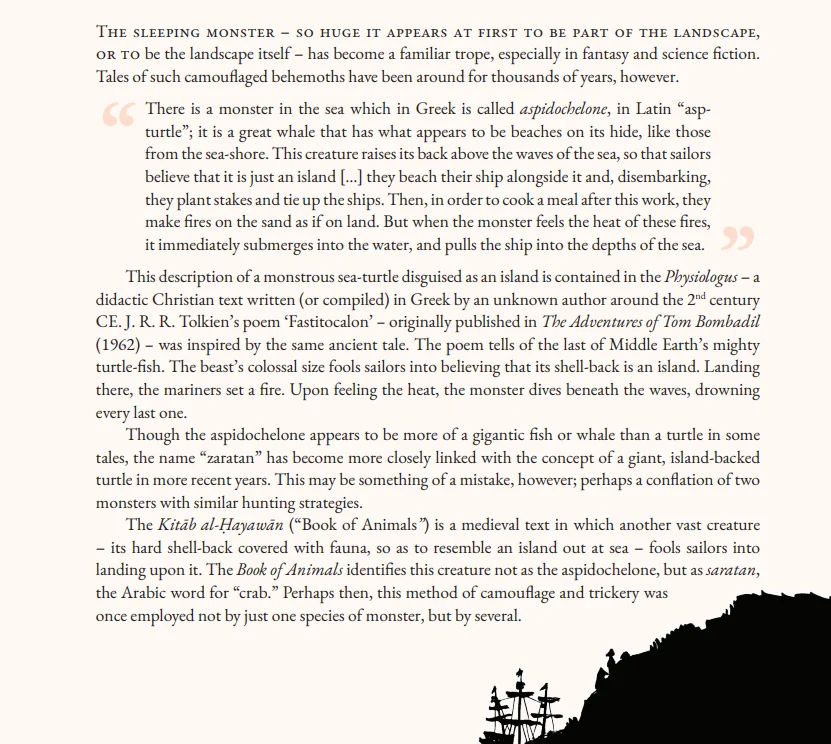
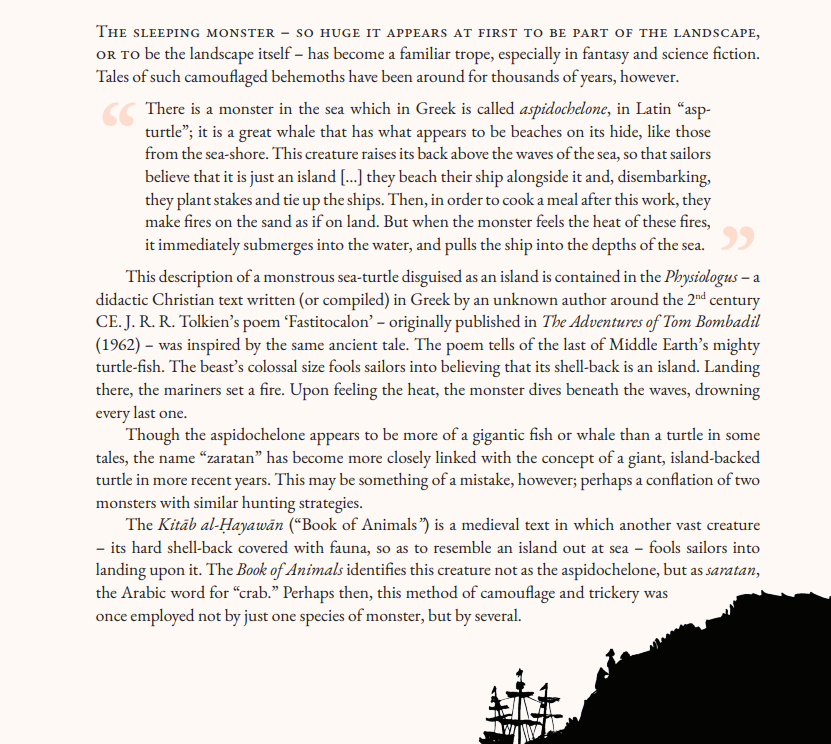
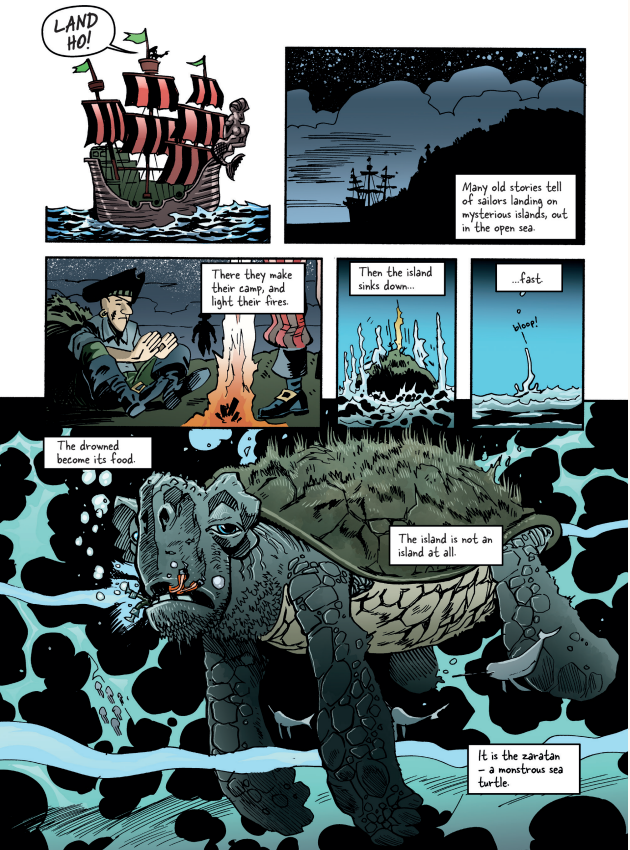
One captivating entry explores the myth of the "island monster," a creature so vast it camouflages itself as terra firma, luring unsuspecting sailors to their doom. The text introduces the aspidochelone, a Greek term meaning "asp-turtle," describing a colossal whale or sea beast with a hide resembling beaches. Sailors, mistaking it for an island, land their ships, make fires, and prepare meals, only for the creature to submerge, dragging them to the ocean depths.
This ancient tale is primarily sourced from the Physiologus, a didactic Christian text compiled around the 2nd century CE. The Physiologus was a foundational work in medieval natural history and allegory, often imbuing animals with symbolic Christian meanings. The aspidochelone, for instance, served as an allegory for the devil, who deceives humanity with false promises of safety before leading them to destruction. The enduring power of this myth is evident in its modern reinterpretations, most notably J.R.R. Tolkien’s poem "Fastitocalon" in The Adventures of Tom Bombadil (1962), which directly draws from this ancient narrative, depicting the last of Middle-earth’s mighty turtle-fish in a similar deceptive act.
The excerpt also delves into the fascinating linguistic and mythical evolution of the creature, addressing the potential conflation of "aspidochelone" with "zaratan." While "zaratan" has become popularly associated with giant island-backed turtles, the Kitāb al-Ḥayawān ("Book of Animals"), a medieval Arabic text, identifies a similar camouflaged creature not as an aspidochelone but as a saratan, the Arabic word for "crab." This highlights the dynamic nature of folklore, where similar tropes can emerge across different cultures and be attributed to various monstrous forms, suggesting a universal human fear of the deceptive unknown lurking beneath the surface, whether it be a whale, a turtle, or a giant crab. The story serves as a cautionary tale against hubris and the dangers of misinterpreting appearances in the vast, untamed wilderness of the sea.
Anteros: The Avenger of Unrequited Love
Another intriguing section introduces Anteros, the lesser-known brother of the more famous Eros (who later evolved into the cherubic Cupid). While Eros embodies passionate desire, Anteros, whose name means "love returned," assumes the crucial role of punishing those who fail to reciprocate affection. This duality reveals a sophisticated understanding of love in ancient Greek mythology, where it was not merely about pursuit but also about balance and reciprocity.

Anteros is one of the Erotes, the winged gods who assisted Aphrodite, the goddess of love, beauty, and procreation. Alongside his brothers—Hedylogos (sweet talk), Pothos (longing), Hymenaeus (weddings), and Hermaphroditus (fertility)—Anteros completed the complex spectrum of love’s expressions. His specific mandate to avenge slighted love underscores a sense of justice within the romantic sphere. As described in Thomas Swinburne Carr’s A Manual of Classical Mythology (1846), Anteros is depicted as a "Deus ultor" or avenging deity, sometimes shown contending with Eros, symbolizing the conflict or balance between giving and receiving love. He was armed with arrows of lead or a club of solid gold, tools reflecting the heavy consequences of emotional neglect.
Perhaps the most compelling detail about Anteros is his unexpected presence in modern iconography. The famous statue atop the Shaftesbury Memorial Fountain in Piccadilly Circus, London, is widely, but mistakenly, known as Eros. Cast in aluminum in 1892, the figure is, in fact, Anteros. It was chosen to symbolize "love given blindly, or without expectation of return," reflecting the philanthropy of Lord Shaftesbury, to whom the fountain is dedicated. This historical misattribution perfectly illustrates how the nuances of ancient myths can be lost or simplified over time, yet also how these figures continue to resonate and inspire, even if their original meanings are obscured. Reppion and Holden’s exploration brings this complex deity back into the spotlight, reminding us that love, in all its forms, carries responsibilities and consequences.
Okiku: The Enduring Vengeance of a Broken Spirit
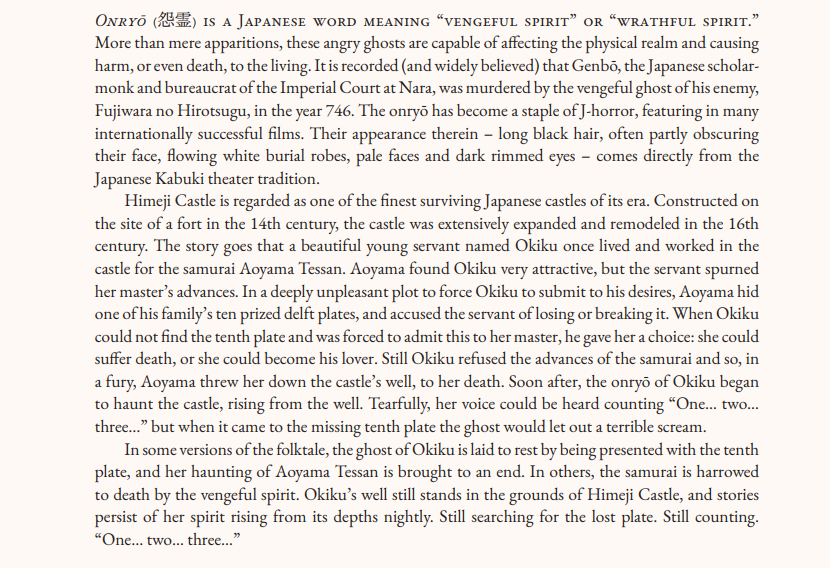
The compendium also journeys to Japan to recount the chilling legend of Okiku, a quintessential onryō—a Japanese vengeful spirit. This tale, set within the historic walls of Himeji Castle, is a poignant narrative of injustice, betrayal, and relentless spectral retribution. Okiku, a beautiful young servant, spurns the advances of her master, the samurai Aoyama Tessan. In a cruel attempt to force her submission, Aoyama hides one of his family’s ten prized delft plates, then accuses Okiku of its loss. Faced with the impossible choice between becoming his lover or facing death, Okiku courageously refuses. Enraged, Aoyama throws her down the castle well, ending her life.
Soon after, Okiku’s onryō begins to haunt the castle, rising from the well each night. Her mournful cries fill the air as she counts the plates: "One… two… three…" but when she reaches the missing tenth, her voice erupts into a terrifying scream. This haunting, rooted in a specific act of cruelty and injustice, resonates deeply within Japanese folklore. Onryō are distinct from mere ghosts; they are powerful, wrathful spirits capable of affecting the physical world and causing harm or death, often driven by a desire for vengeance for a wrongful death or injustice. The legend of Genbō, a Japanese scholar-monk believed to have been murdered by an onryō in 746 CE, underscores the ancient belief in their potent malevolence.

Okiku’s story has had a profound impact on Japanese popular culture, particularly in the realm of J-horror. The visual archetype of the onryō—long black hair partially obscuring a pale face, flowing white burial robes, and dark-rimmed eyes—is directly drawn from traditional Japanese Kabuki theatre and is famously seen in internationally successful films like Ring and The Grudge. Okiku’s well at Himeji Castle still stands, a physical testament to the enduring power of her legend, where stories persist of her spirit rising nightly, forever searching for the lost plate, forever counting, a haunting echo of her tragic fate. The tale serves as a powerful reminder of the consequences of abuse of power and the enduring human need for justice, even beyond the grave.
Official Responses: Creators’ Vision and Publisher’s Commitment
While specific direct quotes from John Reppion and PJ Holden are not provided in the original text, the enthusiasm and dedication evident in the project’s scope and execution speak volumes. One can infer that Reppion, as the primary essayist, would emphasize the importance of rigorous research and the desire to present these stories with their full cultural and historical weight, perhaps stating something along the lines of, "Our aim was to bridge the gap between academic understanding and popular accessibility, showing that folklore is not just ancient tales, but living narratives that continue to inform our world." His deep dive into sources like the Physiologus and A Manual of Classical Mythology reflects a scholarly commitment.
PJ Holden, as the artist, would likely highlight the creative challenge and joy of visually interpreting diverse myths. He might articulate his approach to capturing the essence of each story, from the monstrous majesty of the aspidochelone to the spectral terror of Okiku and the classical grace of Anteros, saying, "Bringing these timeless stories to life through comics allowed us to explore the emotional core and visual drama inherent in folklore, making them immediate and visceral for a modern audience."
Liminal11, the publisher, would undoubtedly position "Fascinating Folklore" as a cornerstone publication that aligns with their mission to publish thought-provoking and beautifully designed books that explore esoteric and cultural themes. A representative might comment on the book’s unique blend of scholarship and art, stating, "Liminal11 is proud to present ‘Fascinating Folklore,’ a testament to the enduring power of storytelling. Reppion and Holden have created a masterpiece that is both deeply informative and visually stunning, making ancient wisdom accessible and engaging for a new generation of readers." The publication itself serves as an "official response" to the demand for high-quality, engaging content that explores the rich tapestry of human myth.
Implications: The Enduring Resonance of Folklore
"Fascinating Folklore" carries significant implications for how we perceive and engage with ancient narratives in the 21st century. Firstly, it underscores the enduring relevance of folklore as a mirror to human fears, desires, and moral codes. These tales, whether they describe monstrous sea creatures, avenging deities, or vengeful spirits, speak to universal aspects of the human condition, offering insights into our collective psychology and cultural evolution. By presenting them in a contemporary format, Reppion and Holden demonstrate that folklore is not a relic of the past but a dynamic, living tradition that continues to resonate and adapt.
Secondly, the book champions the interdisciplinary approach to understanding culture. By marrying scholarly essays with graphic novel artistry, it breaks down traditional barriers between academic study and popular entertainment. This format makes complex anthropological, historical, and literary concepts digestible and exciting for a broad audience, from dedicated folklorists to casual comic book readers. It suggests a powerful model for future educational and cultural projects seeking to engage diverse demographics with rich subject matter.
Furthermore, "Fascinating Folklore" highlights the power of digital communities like #FolkloreThursday in revitalizing interest in traditional knowledge. What began as a social media trend has, through the creative vision of its authors, materialized into a tangible, comprehensive work, demonstrating how digital engagement can foster significant cultural production. The book serves as a testament to the idea that collective enthusiasm, when channeled effectively, can lead to remarkable creative outputs that enrich our cultural landscape.
Finally, the compendium’s global scope, covering figures from ancient Greece and Anglo-Saxon England to Japan and Indigenous Australia, emphasizes the interconnectedness of human storytelling. It reveals common themes and archetypes that transcend geographical and cultural boundaries, fostering a deeper appreciation for the shared heritage of humanity. "Fascinating Folklore" is more than just a book; it is a celebration of human imagination, a meticulously crafted bridge between ancient wisdom and modern understanding, and a powerful argument for the continued exploration and preservation of the world’s rich mythological traditions. It invites readers to reflect on their own place within this vast narrative tapestry, proving that the magic of folklore is, indeed, spellbinding.