Unveiling Our Shared Humanity: "The Treasury of Folklore" Returns in a Landmark Compendium
FOR IMMEDIATE RELEASE
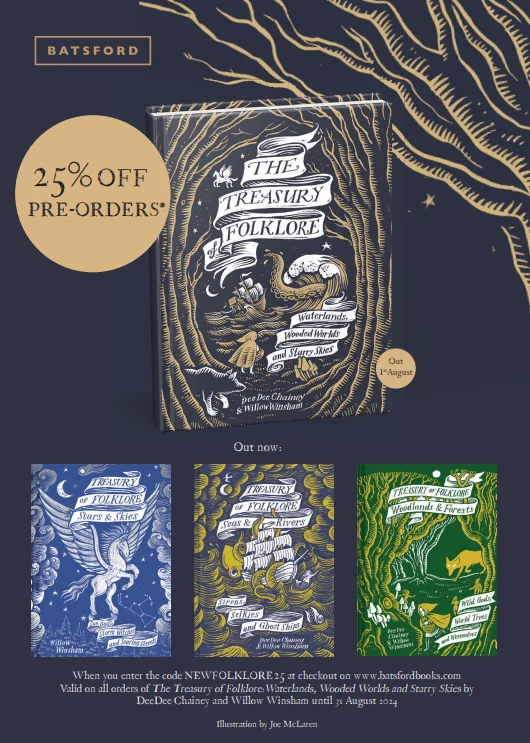
LONDON, UK – [Date of Publication, e.g., July 25, 2024] – Nearly a decade after its inception, the critically acclaimed Treasury of Folklore series culminates in a definitive single-volume compilation, The Treasury of Folklore: Waterlands, Wooded Worlds and Starry Skies. Authors Dee Dee Chainey and Willow Winsham, whose work has captivated enthusiasts worldwide, announced the forthcoming release, set to launch on August 1, 2024. This meticulously curated compendium brings together the most beloved tales, customs, and beliefs from their three original bestsellers – Seas and Rivers, Trees and Woodlands, and Stars and Skies – fulfilling the authors’ initial vision for a comprehensive exploration of global human experience through myth.
The new volume, described by its creators as a "hefty tome" featuring beautiful cream paper and stunning original illustrations by Joe McLaren, promises to be an essential addition for folklore aficionados and newcomers alike. While it contains no new material, it serves as a beautifully bound testament to the enduring power of shared human narratives.
A Decade-Long Journey: From Hashtag to Global Series
The genesis of the Treasury of Folklore series traces back nearly ten years, born from a profound inspiration ignited by the vibrant online community fostered through the #FolkloreThursday hashtag. This digital gathering place, a crucible of shared stories and academic discussions, underscored a universal yearning for connection to the ancient narratives that define cultures across the globe. Authors Dee Dee Chainey and Willow Winsham, recognizing the immense outpouring of material and the unifying threads within diverse traditions, embarked on a mission to create something both meaningful and lasting. Their initial ambition was grand: a single, comprehensive book that would traverse every physical landscape inhabited by humans, mapping the intricate tapestry of folklore.
However, the wealth of material they uncovered proved too vast for a solitary volume. This led to the creation of three distinct, yet interconnected, books: Seas and Rivers, delving into the mysteries of aquatic environments; Trees and Woodlands, exploring the spirits and tales of forests; and Stars and Skies, charting the celestial myths that have guided humanity for millennia. The popularity of these individual volumes, celebrated for their accessible scholarship and evocative storytelling, exceeded the authors’ expectations, garnering a dedicated readership and critical acclaim.
The idea of a compendium, bringing these thematic explorations back into a single volume, emerged as a natural progression. This presented a unique opportunity to revisit and consolidate the series, fulfilling that original, ambitious vision. The meticulous process involved the authors re-reading their own extensive work with fresh eyes, carefully selecting and curating the most impactful and representative pieces to ensure the new volume offered a cohesive and immersive journey through the world’s diverse folklore. The end result is not merely a collection but a finely crafted narrative arc that spans our shared landscapes across time and place, beautifully presented in a tactile format designed to be cherished.
Supporting Data: Echoes of Universal Human Experience
At the heart of The Treasury of Folklore‘s enduring appeal lies its powerful demonstration of humanity’s shared fears, dreams, and awe in the face of the unknown. Across continents and through centuries, humans have woven intricate customs, beliefs, and tales around the places they inhabit, creating a rich tapestry that, despite its varied threads, reveals a fundamental unity. The compendium expertly highlights these universal themes through its thematic sections, offering readers a profound insight into the collective human psyche.

Water Horses: The Perilous Beauty of the Deep
One of the most captivating sections draws from Seas and Rivers, inviting readers to explore the enigmatic world of water horses. These majestic yet malevolent creatures, found lurking beneath the surface of lakes, rivers, and lochs across various cultures, serve as potent cautionary tales and embody humanity’s primal respect and fear for the untamed power of water.
The Scottish Kelpie is perhaps the most renowned, though the book clarifies its distinction from the each-uisge. While both are shape-shifting water horses, the Kelpie primarily haunts rivers, luring unsuspecting travelers onto its back before dragging them to a watery demise. The each-uisge, found in the colder, deeper lochs, is even more fearsome, capable of transforming into a handsome man or a giant bird, and often devouring its victims entirely, leaving only a liver as a trace. These myths, deeply embedded in Scottish oral tradition, served not only to entertain but also to warn communities, particularly children, about the dangers of treacherous waters. The stories often provided clever, albeit temporary, means of taming these beasts, such as bridles marked with crosses, or even outright destruction with red-hot iron—a common vulnerability for many folkloric entities. The enduring grip of the Kelpie on the Scottish imagination is dramatically visible in the towering 30-meter sculptures near Falkirk, a modern homage to an ancient legend, and its continued presence in contemporary literature like J.K. Rowling’s Fantastic Beasts and Where to Find Them. Interestingly, the authors note a curious absence of such powerful water horses in English folklore, a stark contrast to its Celtic neighbours.
Across the border, Wales offers the Ceffyl Dŵr, a water horse whose legend persisted into the 19th century. This Welsh counterpart exhibited regional variations; in the north, it was a shapeshifting spirit prone to violence, while in the south, it consistently appeared as an enchanting, albeit deadly, small horse. Tales often highlight its impossible speed, covering vast distances before vanishing, leaving its rider to drown. A unique exception to its malevolence was noted for clergymen of any creed, who could ride it safely, a fascinating detail that reflects the intertwining of pagan beliefs with Christian influence in folk narratives.
Scandinavia contributes the Bäckahäst or "brook horse," a luminous and majestic being often sighted in foggy conditions. Like its Celtic cousins, it entices riders, typically children, before plunging into the water, trapping its victims. The inclusion of children in these narratives heightens the sense of peril and underscores the didactic nature of folklore. A popular tale recounts a group of boys saved from a Bäckahäst when one accidentally mispronounces a colloquial phrase, uttering "Jesus Christ" instead, a name abhorrent to the creature. This motif of a sacred name or symbol banishing evil is a recurring theme across global folklore, highlighting a shared human understanding of protective powers. The Bäckahäst, too, could sometimes be tricked into servitude, demonstrating a universal human desire to control or outwit dangerous natural forces.
Collectively, these water horse myths illustrate humanity’s deep-seated reverence and fear of the aquatic realm. They are personifications of nature’s unpredictability, serving as moral compasses for human interaction with the environment, and a testament to the power of storytelling to encode survival wisdom.
Lords of the Wild: Guardians and Tricksters of the Forest
Transitioning from the watery depths, the compendium guides readers into the verdant embrace of the forest, a realm populated by powerful Lords of the Wild. These spirits and creatures, ranging from benevolent protectors to malevolent tricksters, represent humanity’s complex relationship with the natural world, embodying both its life-giving abundance and its inherent dangers.
From Finnish mythology, readers encounter Tapio, the majestic king of the forest realm, also known as Metsähine or Hiisi. Described as tall and thin, cloaked in ermine or moss, and capped with a hat, Tapio is the embodiment and protector of the forest. His appearance, with mossy eyebrows and a great beard, echoes the "Green Man" motif found across European folklore, symbolizing the intertwined nature of humanity and the vegetative world. Finnish hunters traditionally sought Tapio’s blessing before a chase, pledging respect for the forest and its creatures, understanding that their success depended on his favour. This reciprocal relationship underscores an ancient animistic worldview where nature is not merely a resource but a conscious entity deserving of deference. Tapio’s family—his benevolent wife Mielikki (or Kuurikki when angered), his son Nyrikki who guides hunters, and his daughter Tulikki who directs prey—further humanizes the forest, transforming it into a living, breathing kingdom with its own governing deities.

The Slavic Leshy (also Leshii or Lyeshy) introduces a more ambiguous and capricious forest spirit. A tutelary guardian of trees and animals (particularly wolves or bears), the Leshy is a master shapeshifter. It can appear as tall as a tree or as small as a blade of grass, mimicking familiar humans, animals, or plants. Its human form, however, always betrays its true nature: a lack of eyelashes or eyebrows, shoes worn on the wrong feet, clothing wrapped contrary to local fashion, wild hair, cloven feet, and sometimes a single eye. These visual cues serve as warnings, highlighting the Leshy’s liminal status, existing between human and wild, natural and supernatural. Known for its ear-splitting laughter, clapping, and howling, the Leshy disorients and leads uninvited encroachers astray, often to their doom. As a trickster figure, it can mimic voices, tickle victims to death, or inflict illness. Its malevolence extends to abducting women and children, and even cursing farms, compelling farmers in regions like Olonetsky District in Russia to offer annual cow sacrifices. Yet, the Leshy is not purely evil; offerings of bread or tobacco, or simply a prayer, can ensure safe passage. Protective measures against its trickery, such as turning clothes inside out or swearing, mirror tactics used against fae folk worldwide, demonstrating shared cultural responses to mischievous spirits. The Leshy’s domestic life, living with a wife (lesovikha) and children in forest huts, and its peculiar pastimes like gambling with squirrels or drinking vodka, add layers of complexity, making it a figure of both fear and strange familiarity.
These Lords of the Wild, whether protective or perilous, reflect a fundamental human need to personify and understand the untamed wilderness. They are cultural constructs that codify rules for interaction with nature, articulate fears of the unknown, and express deep respect for the profound life force that animates the forests.
The Hare in the Moon: A Celestial Storyteller
Finally, the compendium lifts our gaze skyward to the moon, that ancient celestial body upon which humanity has projected countless stories. The ubiquitous motif of a rabbit or hare living on the moon is a prime example of pareidolia, where cultures interpret lunar markings as familiar shapes, weaving diverse narratives that often convey profound moral or existential truths. The Sea of Tranquillity, Fertility, and Nectar, in this imaginative cartography, become the hare’s head and ears.
In the Buddhist Sasa-Jātaka, a collection of moral fables, the story of the self-sacrificing hare is profoundly moving. The hare, along with its friends (an otter, jackal, and monkey), vows to offer food to any beggar on a fast day. When the deity Sakka, disguised as an old man, tests their charity, the hare, having only grass, offers its own body to the fire. Sakka, moved by such boundless compassion, saves the hare and enshrines its image on the moon for all eternity, or, in some versions, uses the essence of a mountain to draw its likeness. This tale, emphasizing selflessness and altruism, is a cornerstone of Buddhist ethics, teaching compassion through the natural world.
Similar tales of a self-sacrificing hare are found across Asia. In Sri Lanka, Buddha himself, lost and hungry in a wood, receives the same offering from a hare, leading to the creature’s celestial placement. In Japan, the Tsuki no Usagi (Moon Rabbit) legend is widely known, often told to children during the Harvest Moon and Mid-Autumn Festival. Here, the Man in the Moon descends as a beggar, and the rabbit, with nothing but grass, sacrifices itself on a fire. The beggar reveals his true form and takes the rabbit to live with him, where it is often depicted pounding mochi (rice cakes) or the elixir of immortality. These narratives connect human virtue with cosmic reward, transforming a lunar observation into a powerful moral allegory.
A striking counterpoint emerges from South African folklore, where the hare takes on a more trickster role, albeit with tragic consequences for humanity. Here, the Moon sends the Hare to deliver a vital message to humankind: that just as the Moon wanes and returns, so too would humans experience death and rebirth. However, the flighty Hare misdelivers the message, declaring only that humans would die, without the promise of return. Enraged by this grievous error, the Moon attacks the Hare with a hatchet, scarring its lip, while the Hare retaliates, scarring the Moon’s face – marks still visible today. This myth serves as an etiological explanation for human mortality, showcasing the hare as a mischievous, fallible messenger whose actions have profound, lasting implications, a common trope for trickster figures in African oral traditions.
These diverse tales of the hare in the moon collectively demonstrate humanity’s universal impulse to imbue the cosmos with meaning. Whether as a symbol of sacrifice, compassion, or the tragic consequences of error, the lunar hare transcends cultural boundaries, offering a compelling narrative that connects the earthly and the celestial.

Official Responses and Enduring Legacy
The authors, Dee Dee Chainey and Willow Winsham, express profound satisfaction with the culmination of their nearly decade-long endeavour. "To say we have been blown away by the end result is an understatement," they share, their enthusiasm palpable for the "beautifully bound volume" with its "hefty" feel, elegant cover, and "beautiful cream paper." This physical embodiment of their intellectual and creative journey is clearly a source of immense pride, reflecting their commitment to presenting these stories in a format worthy of their significance.
Their gratitude extends particularly to the vast community that has embraced the Treasury of Folklore series. The enduring popularity of Seas and Rivers, Trees and Woodlands, and Stars and Skies has been "both surprising and heartwarming," a testament to the universal resonance of the themes they explore. The new compendium is envisioned not just as a book, but as a "conversation starter, a way to connect," reinforcing the authors’ original aim of fostering understanding and highlighting the unifying universality of folklore across the globe.
Implications: Bridging Worlds, Preserving Heritage
The Treasury of Folklore: Waterlands, Wooded Worlds and Starry Skies stands as more than just a book; it is a vital contribution to cultural preservation and cross-cultural understanding. In an increasingly interconnected yet often fragmented world, these ancient stories offer a powerful reminder of our shared human heritage. By meticulously curating and presenting folklore from diverse landscapes and traditions, the authors illuminate the common threads that bind humanity, transcending geographical and cultural divides.
The compendium’s structure, divided into three thematic sections and adorned with Joe McLaren’s evocative original illustrations, makes it both an engaging read and a visually stunning object. Its presence on a bookshelf or coffee table invites curiosity, sparking conversations that can bridge generations and cultures. For educators, researchers, and enthusiasts, it provides a rich, accessible resource, encouraging deeper exploration into the narratives that have shaped human societies.
In an era where traditional storytelling risks being overshadowed, The Treasury of Folklore reaffirms the enduring power and relevance of myth. It reminds us that our primal fears of the unknown, our awe of the cosmos, and our dreams of a better world are not isolated sentiments but universal experiences articulated through the timeless language of folklore. This landmark compilation is poised to become a cherished volume, a testament to the human spirit’s boundless capacity for imagination and its profound need to make sense of the world, one story at a time.
The Treasury of Folklore: Waterlands, Wooded Worlds and Starry Skies is now available for pre-order and will be released on August 1, 2024.
(For a 25% discount, order at Batsford Books with the code NEWFOLKLORE25.)