
The Suez Canal: A Century of Geopolitical Strife and Imperial Decline
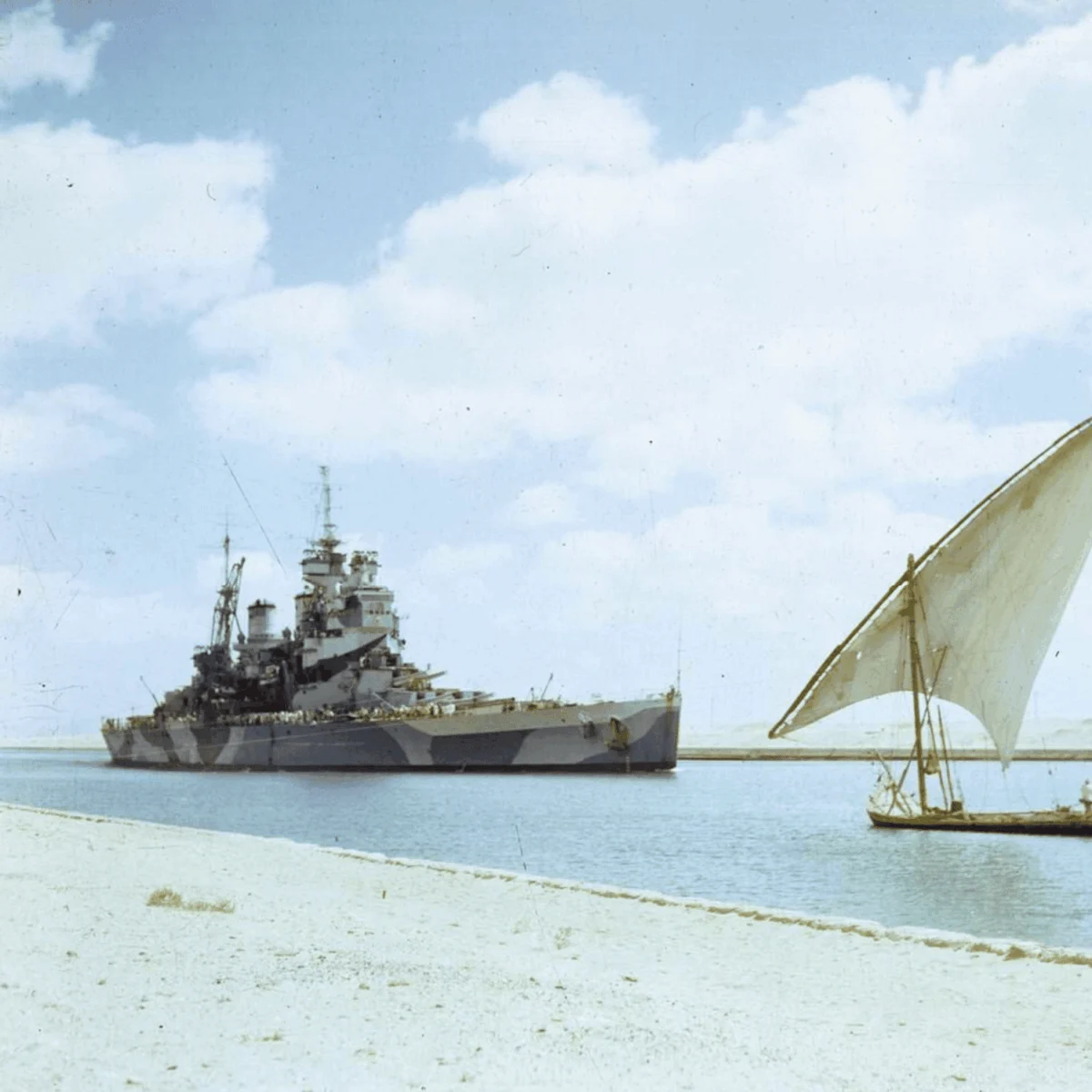
The Suez Canal, a man-made marvel linking the Mediterranean Sea to the Red Sea, has for over 150 years served as a critical artery of global commerce and a flashpoint for international power struggles. Its strategic importance, particularly for European empires, led to a contentious history marked by ambition, intervention, and ultimately, the decline of colonial power. From its ambitious construction in the mid-19th century to its dramatic nationalization in 1956, the Suez Canal stands as a testament to the shifting tides of geopolitics, with Britain playing a central, often controversial, role.
The Strategic Lifeline: Conception and Construction
Ancient Ambitions, Modern Realities
The vision of an artificial waterway connecting the Mediterranean and Red Seas was not new, having been entertained by rulers in antiquity. However, it was in the 19th century that this ancient dream became a modern imperative. The primary purpose was to drastically reduce sailing times between Europe and Asia, circumventing the arduous and lengthy route around the Cape of Good Hope in Southern Africa. This shortcut promised to shave approximately 3,000 sea miles off journeys, such as that from London to Bombay (now Mumbai), and facilitate trade between East African states and Europe.
Prior to the canal’s completion, alternative routes were devised. From the 1840s, a British-organized overland route across the Isthmus of Suez, championed by Lieutenant Waghorn, allowed travellers and goods to disembark at Alexandria, cross to Suez via river boats and animal transport, and re-embark on the Red Sea. While cumbersome and unsuitable for heavy cargo, this "overland route" saved a remarkable four weeks compared to the Cape passage. Improvements came in the 1850s with the construction of a railway from Alexandria to Cairo by the renowned engineer George Stephenson, famous for building the world’s first passenger-carrying steam train. Yet, the undeniable advantage of a direct waterway, allowing the same ship to complete the entire journey with any type of cargo, remained the ultimate goal.
A French Vision, Egyptian Labor
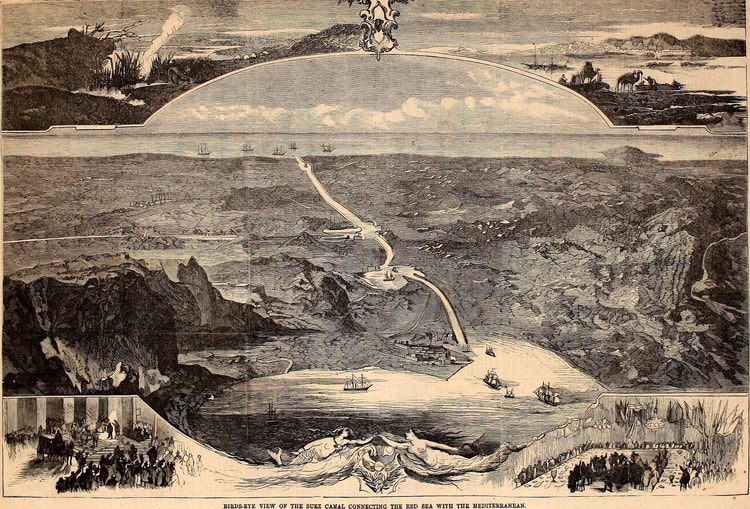
The monumental task of building the Suez Canal was undertaken by a private French company, the Compagnie Universelle du Canal Maritime de Suez, commencing in 1859. The project was spearheaded and meticulously supervised by the visionary French engineer Ferdinand de Lesseps. The Egyptian government, then under Ottoman suzerainty, leased the land for 99 years and held a substantial 45% stake in the canal company’s shares. Ironically, Britain initially opposed the project, fearing that a rival power might seize control and obstruct British shipping, or even use the canal to threaten its vast colonial possessions. There was also considerable British skepticism regarding the feasibility of such a colossal engineering feat.
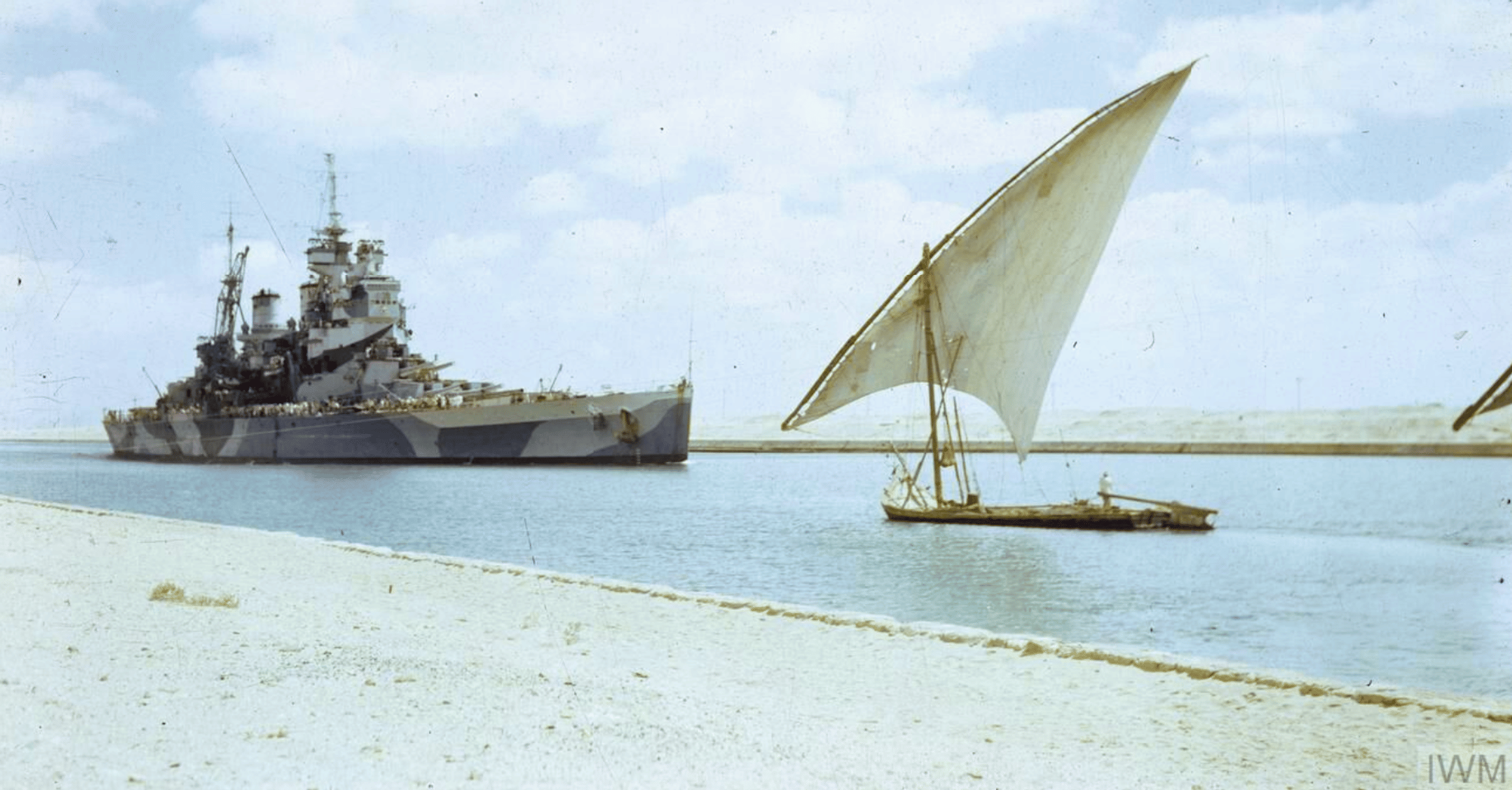
Fortunately, the predominantly flat and sandy terrain of the Isthmus of Suez presented fewer excavation challenges than anticipated, and crucially, no locks were required. The canal, stretching approximately 100 miles (160 km) in length, was completed in a decade, opening with a lavish ceremony on November 17, 1869.
An Immediate Success and Growing Importance
The Suez Canal proved an immediate and resounding success, its impact amplified by the contemporaneous invention of steamships. While sailing ships still constituted 90% of the British merchant fleet, the world’s largest at the time, and the Cape route continued to thrive initially, the canal’s traffic surged dramatically as steam steadily replaced sail. In its first full year of operation, the canal accommodated around 436,000 tons of shipping. A mere decade later, this figure had rocketed to over 5 million tons, and by 1910, more than 16 million tons of shipping traversed the waterway. The burgeoning strategic and economic importance of the canal to both Britain and France was underscored by the permanent presence of their advisors within the Egyptian government, foreshadowing future interventions.
British Hegemony: The 1882 Takeover
A Jewel in the Imperial Crown
For the burgeoning British Empire, with its vast network of possessions stretching across Asia and beyond—most notably British India, China, and Australasia—the Suez shortcut quickly became an indispensable lifeline. It cemented Britain’s global commercial and naval dominance, drastically reducing the transit time for goods, troops, and communications. This vital artery became so integral to imperial power that its security was deemed non-negotiable.
Crisis and Intervention: The Justification
It was for this very reason that Britain controversially seized control of the canal and, by extension, Egypt in 1882. The pretext for intervention was a confluence of factors: Egypt, nominally a part of the decaying Ottoman Empire, had plunged into bankruptcy due to costly colonial expeditions in Sudan. This financial distress fueled a fervent nationalist revolt against the government, led by Colonel Ahmed Urabi.
The British government, citing the need to protect its substantial financial interests and the canal itself, launched a decisive military operation. On July 11, a British naval force bombarded Alexandria for ten devastating hours, unleashing some 3,000 shells. This was followed in August by a land invasion of 40,000 men commanded by General Garnet Wolseley, who swiftly captured the canal. Wolseley then crushed Urabi’s nationalist forces at the Battle of Tel-el-Kebir on September 13. While the French government had also considered military intervention, the idea failed to gain endorsement from the French National Assembly, leaving Britain to act unilaterally. Urabi was subsequently exiled to Ceylon (Sri Lanka), and a permanent British garrison of 5,000 men was established at the canal, marking the beginning of a prolonged occupation.
Economic Leverage and Imperial Ambition
In the ensuing power vacuum, the British government abandoned its initial stated intention of a temporary occupation, instead opting to rule Egypt as a de facto protectorate. Britain rationalized its audacious takeover through several arguments. Crucially, in 1875, the cash-strapped Egyptian ruler, the Khedive Isma’il Pasha, had sold his 177,000 shares in the canal company to the British government for a sum of £4 million (equivalent to over £400 million today). This gave Britain significant, though not majority, ownership of the canal company. A more potent, albeit overtly imperialistic, justification was the undeniable fact that 82% of the shipping traversing the canal was British-owned, and a staggering 13% of Britain’s global trade passed through this single waterway.
As historian P. Curtin noted, the British government found itself in a dilemma: "To withdraw would endanger the Suez route to India and annoy Egypt’s creditors in Britain, but to stay left Britain rather than the Khedive face to face with those same creditors in Europe." The outcome was an "informal British protectorate that lasted until 1914 under a variety of legal fictions," effectively establishing British control over Egypt while navigating international pressures from other European powers. Most of Egypt’s substantial debt, significantly, was owed to British banks, further solidifying London’s leverage. The Khedive’s institution was restored, but British influence was paramount. A British officer was appointed as sirdar (commander-in-chief) of the Egyptian army, and the most powerful civilian position was the British Agent and Consul-General, who possessed the authority to appoint and dismiss Egyptian government members, including the prime minister, and whose advice was considered binding. In practice, the Khedive retained considerable autonomy in non-commercial domestic affairs.
International Backlash and Diplomatic Repercussions
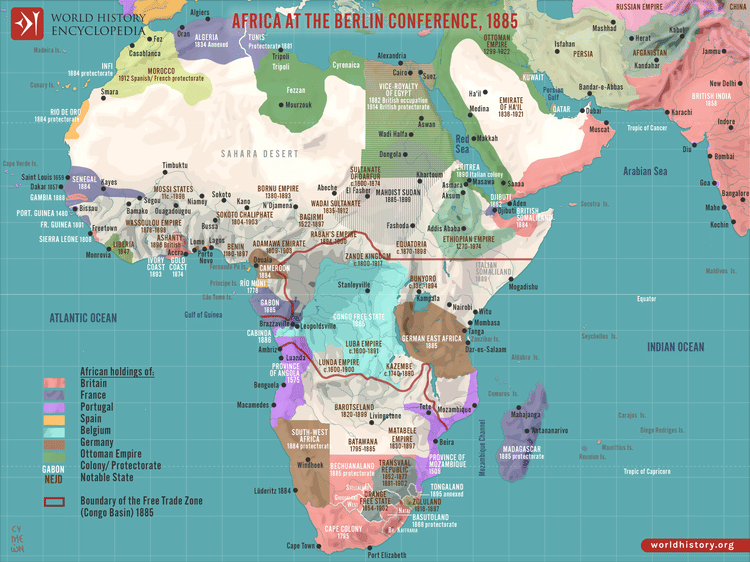
The French government, which had long viewed Egypt as its own sphere of colonial influence, reacted with considerable indignation to the events of 1882. This diplomatic crisis, alongside other unresolved colonial disputes, directly precipitated the Berlin Conference of 1884-85. This landmark conference established the rules by which European powers could legitimately acquire new colonies, thereby accelerating the infamous "Scramble for Africa."
By 1888, Britain concluded that an indefinite presence in Egypt was necessary to safeguard the canal and the country from the dominance of other powers, particularly Russia. To allay fears of a British monopoly, the Suez Canal Convention was signed in 1888 by the major European powers, formally preserving the canal’s neutrality and ensuring free passage for all nations in times of peace and war. However, the underlying friction between Britain and France over Egypt continued to manifest in exaggerated rivalries elsewhere in Africa, notably in the Fashoda Incident of 1898, where France’s bold claim to southern Sudan ultimately failed against British resolve. Despite these diplomatic complexities, the Suez Canal remained unequivocally vital to British trade interests, a fact only reinforced by the burgeoning oil industry in the Middle East.
Maintaining Control Through Global Conflicts
The Canal in Two World Wars
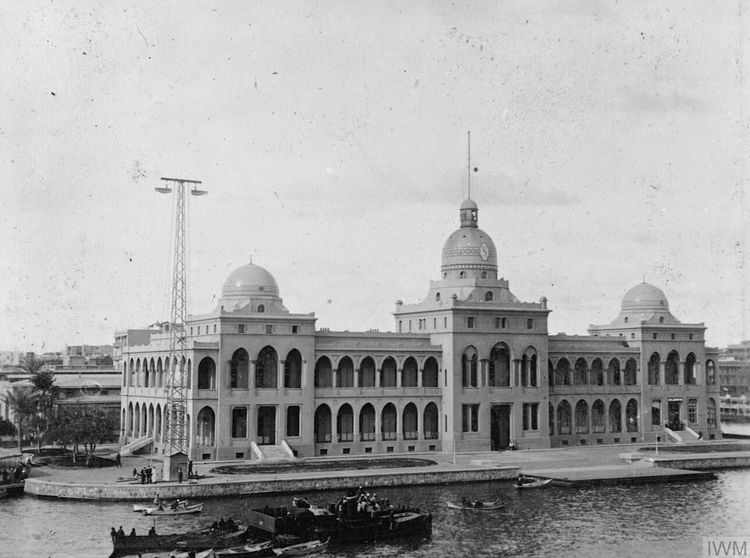
The outbreak of the First World War (1914-18) saw Britain solidify its control, declaring Egypt a protectorate and unilaterally ending the canal’s status as an international waterway. Throughout the war, the Suez Canal was indispensable for moving troops and supplies to various fronts, particularly the Middle East and India.
In the post-war world, as the British Empire began its slow unraveling, Egypt was granted nominal independence in 1922. However, Britain retained significant control over Egypt’s foreign and defense policies, and British military occupation persisted until 1936, with the signing of the Anglo-Egyptian Treaty. A critical exception to this withdrawal was the Suez Canal Zone, which, despite the canal’s renewed international waterway status, maintained a substantial British military presence, housing a garrison of approximately 38,000 personnel. With aggressive imperialist expeditions by Italy and Japan in the 1930s, the canal’s strategic value remained as paramount as ever for Britain’s ability to rapidly deploy forces to East Africa or the Far East. Throughout this tumultuous decade, two-thirds of all ships transiting the canal were British.
During the Second World War (1939-45), Britain staunchly defended Egypt against Italian and German forces in the North Africa Campaign. Egypt served as Britain’s principal base in the Middle East and Eastern Mediterranean theaters. The most decisive engagement, ensuring the Suez Canal remained in British hands, was the Second Battle of El Alamein (October-November 1942). Here, the British Eighth Army, under General Bernard Montgomery, achieved a pivotal victory against General Erwin Rommel’s German Afrika Korps, securing this critical waterway for the Allies.
Post-War Shifts and Rising Nationalism
Even after India gained independence in 1947, the Suez Canal’s importance to British trade interests remained high, particularly with the accelerating development of the Middle East’s oil industry. However, the post-WWII era heralded a new wave of decolonization. Britain’s global influence was waning, its economy no longer robust enough to sustain a coercive military presence worldwide, and public opinion increasingly favored decolonization.
Anglo-Egyptian relations, already strained, deteriorated further due to Britain’s involvement in the creation of the state of Israel and its Cold War alliances with Iraq and Turkey, perceived as hostile by many Arab nations. The stage was set for a dramatic confrontation.
The 1956 Suez Crisis: A Defining Moment
Nasser’s Challenge and Nationalization
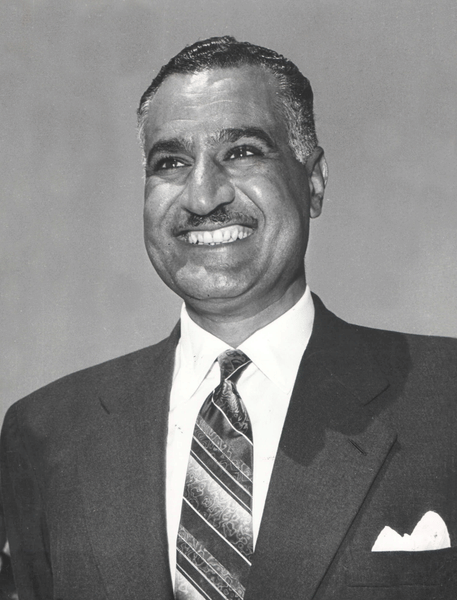
In July 1956, Egypt’s charismatic and fiercely nationalist leader, Colonel Gamal Abdel Nasser (1918-1970), delivered a seismic shock to the international order: he declared the nationalization of the Suez Canal Company. Nasser had seized power in a military coup four years earlier, overthrowing the unpopular King Farouk, whose pro-British policies had alienated his subjects. Nasser’s bold move was, in part, a retaliatory measure. The United States and Britain had abruptly canceled funding for the proposed Aswan Dam, a crucial development project, after discovering Nasser was purchasing arms from Cold War rivals, the USSR and the Eastern Bloc.
The Tripartite Conspiracy
Nasser’s nationalization triggered what became known as the Suez Crisis (also the Second Arab-Israeli War, Suez War, or Tripartite Aggression). The canal remained vital for British shipping, especially oil tankers. British Prime Minister Anthony Eden (1897-1977) famously described Nasser as having "his hand on our windpipes," viewing him as a dangerous nationalist bent on expelling all Western influence from the Arab world, thereby opening the door for Soviet expansion. Eden sought support from US President Dwight D. Eisenhower (1890-1969) to depose Nasser and install a pro-Western government. However, Eisenhower refused to involve the US military, believing that American public opinion would not condone such an intervention and that the United Nations was the appropriate forum for resolution. Furthermore, the US was not entirely displeased to see British influence wane in the Middle East, as the two Western allies were increasingly rivals in the lucrative and rapidly expanding regional oil business.
Undeterred by Washington’s stance, Britain, France, and Israel secretly conspired to regain control of the canal and oust Nasser. The British saw Nasser’s pan-Arab nationalism as a direct threat to their remaining Middle Eastern interests. France resented his support for the FLN (National Liberation Front) in its war for Algerian independence. Israel, for its part, was eager to strike a blow against any movement that might unite the Arab world against it.
Under a secret agreement, code-named Operation Musketeer, Israel was to launch an attack on Egypt. This would then provide a pretext for Britain and France to intervene as "mediators" and "protectors" of the canal. Israeli forces invaded Egypt on October 29. Britain and France promptly issued an ultimatum demanding that Egypt withdraw its military from the Canal Zone (10 miles/16 km either side of the canal). When the Egyptian government rejected this demand, British and French aircraft began bombing Egypt on October 31. From November 5, Anglo-French troops launched an amphibious assault from the Mediterranean, landing at Port Said and capturing a section of the canal. In response, Egypt deliberately sank ships in its portion of the waterway to block passage, effectively shutting down international shipping.
International Condemnation and Humiliation
The actions of the aggressors were met with widespread international condemnation. Both the United States and the USSR, strange bedfellows in this instance, denounced the invasion at the United Nations. A UN motion called for an immediate ceasefire. The Suez War thus concluded after a mere two weeks of fighting. Britain was, humiliatingly, forced to withdraw entirely from Egypt in December. The Egyptian government, under Nasser, promised to compensate shareholders in the Canal Company, and the canal was eventually cleared and reopened for international traffic by April 1957.
Legacy and Implications
A Fading Empire
The Suez Crisis inflicted irreparable damage on Anthony Eden’s reputation, leading to widespread criticism for diplomatic incompetence and misleading Parliament. He resigned as prime minister in January 1957, citing health issues. The crisis also triggered a damaging run on the British pound, which was only propped up by a crucial US loan, granted on the explicit condition that Britain withdraw its forces from Egypt. While Anglo-US relations were eventually repaired, many Persian Gulf states developed a deep suspicion of Britain’s involvement with Israel in a war against an Arab nation.
The Suez Crisis served as a stark, undeniable lesson to the British that their days of empire and global unilateral influence were unequivocally over. It dramatically accelerated the process of decolonization and underscored Britain’s diminished status on the world stage. Henceforth, Britain would only be able to significantly influence world affairs through partnerships, primarily with emerging superpowers like the United States.
Enduring Geopolitical Significance
The Suez Canal, though its political control had definitively shifted to Egypt, continued to be an enduringly vital artery for global trade and energy transport. The crisis of 1956 remains a pivotal historical case study in the complexities of post-colonial power struggles, the limits of traditional imperialism in a new Cold War era, and the ascendance of new global hegemons. It marked a watershed moment, not just for Britain and Egypt, but for the broader international order, redefining relationships and setting the stage for a new geopolitical landscape.


Leave a Comment