Beyond the Duel: Unveiling the Thrill of Three-Player Conquest: First Blood
Introduction: A New Frontier in Tabletop Warfare
Tabletop wargames, by their very design, often pit two adversaries against each other in a clash of tactics and wills. This foundational structure, while fostering intense competition, occasionally leaves a third player relegated to the sidelines, a mere spectator in the grand spectacle. However, a recent experiment in the world of Conquest: First Blood has not only challenged this convention but has also opened a vibrant new avenue for multi-player engagement. Fuelled by camaraderie, three enthusiasts embarked on a unique three-way skirmish, meticulously adapting the rules to accommodate a dynamic battle royale. This report delves into their innovative approach, chronicling the unfolding drama on the battlefield and extracting invaluable lessons for the broader wargaming community.
The journey into the realm of Conquest for this author was, as for many, a path paved by friendship. The shared enthusiasm of two friends, both named Josh, formed the initial impetus. Yet, the inherent two-player design of most wargames, including Conquest, often necessitated a rotation, leaving one friend observing the unfolding conflict. This inherent limitation sparked a compelling question: could a three-player Conquest game be not just possible, but genuinely engaging and balanced? The answer, as discovered through this ambitious endeavor, is a resounding yes.
The Strategic Shift: Why First Blood Paved the Way
The Conquest universe offers two distinct rule sets: The Last Argument of Kings (TLAOK), a rank-and-flank mass battle game, and First Blood, its skirmish-level counterpart. The choice of First Blood for this three-player experiment was not arbitrary; it was a strategic decision rooted in the fundamental differences between the two systems. TLAOK’s rigid movement mechanics, which involve rectangular blocks of models wheeling and pivoting, inherently complicate facing multiple opponents. Maneuvering in TLAOK is predominantly optimized for a singular "forward" direction, making the complexities of engaging two separate fronts almost insurmountable.
First Blood, conversely, boasts a far more fluid and intuitive free-movement system. This crucial distinction proved to be the linchpin for the three-player adaptation. Without the constraints of rigid formations and movement templates, units in First Blood can respond dynamically to threats from any direction, making the prospect of a multi-front war not only feasible but strategically rich. Recognizing this inherent flexibility, the group seized the opportunity to forge a new path for Conquest gameplay.
Adapting the Battlefield: Crafting a Three-Player Scenario
While First Blood offers greater movement flexibility, its scenario setup, much like TLAOK, is still fundamentally designed for two players. This necessitated a careful and considered adaptation of the core mission and territory rules. To maintain clarity and streamline the experimental process, the group opted to entirely forgo the "Encounters" and "Tactics" elements, which typically introduce narrative adjustments and asymmetric rule modifications. Instead, their focus narrowed to developing bespoke three-person alternatives for the "Mission" and "Territories."
Custom Mission: Proving Grounds Enhanced
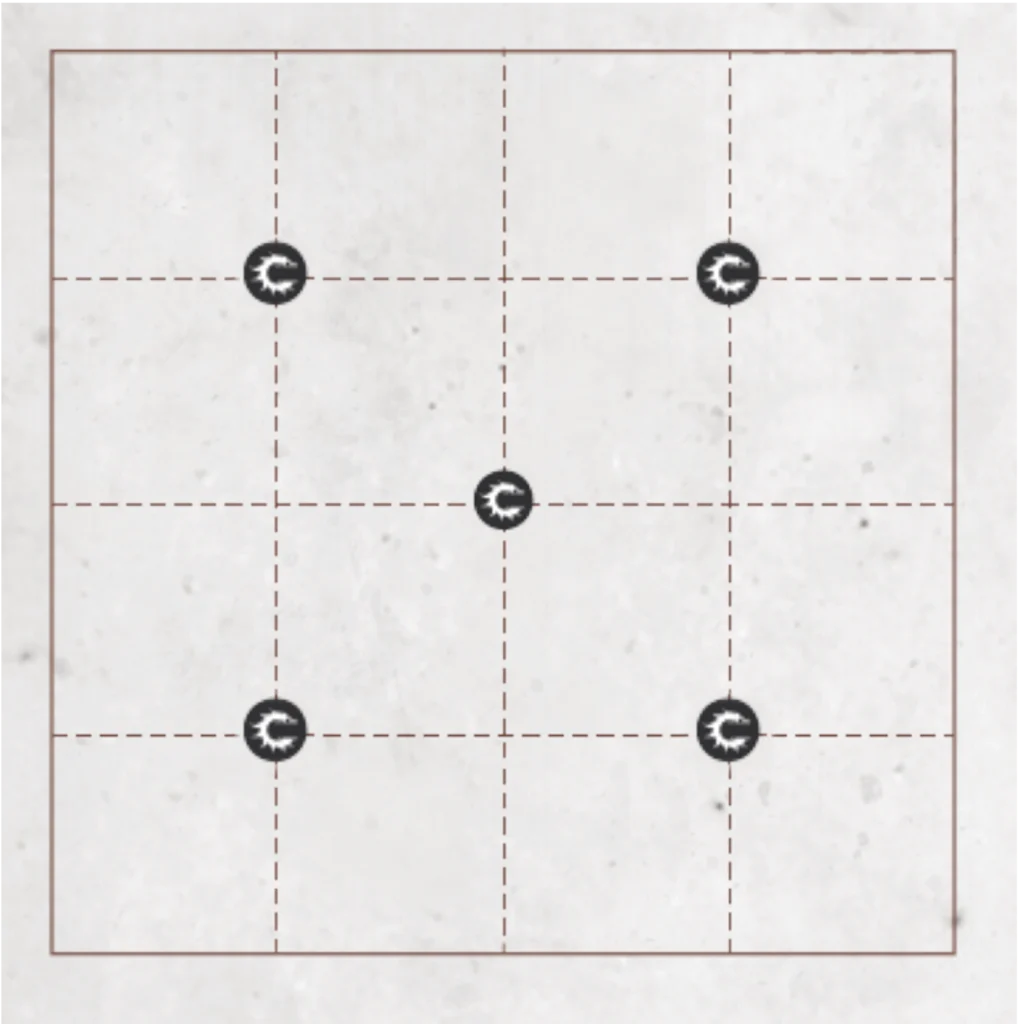
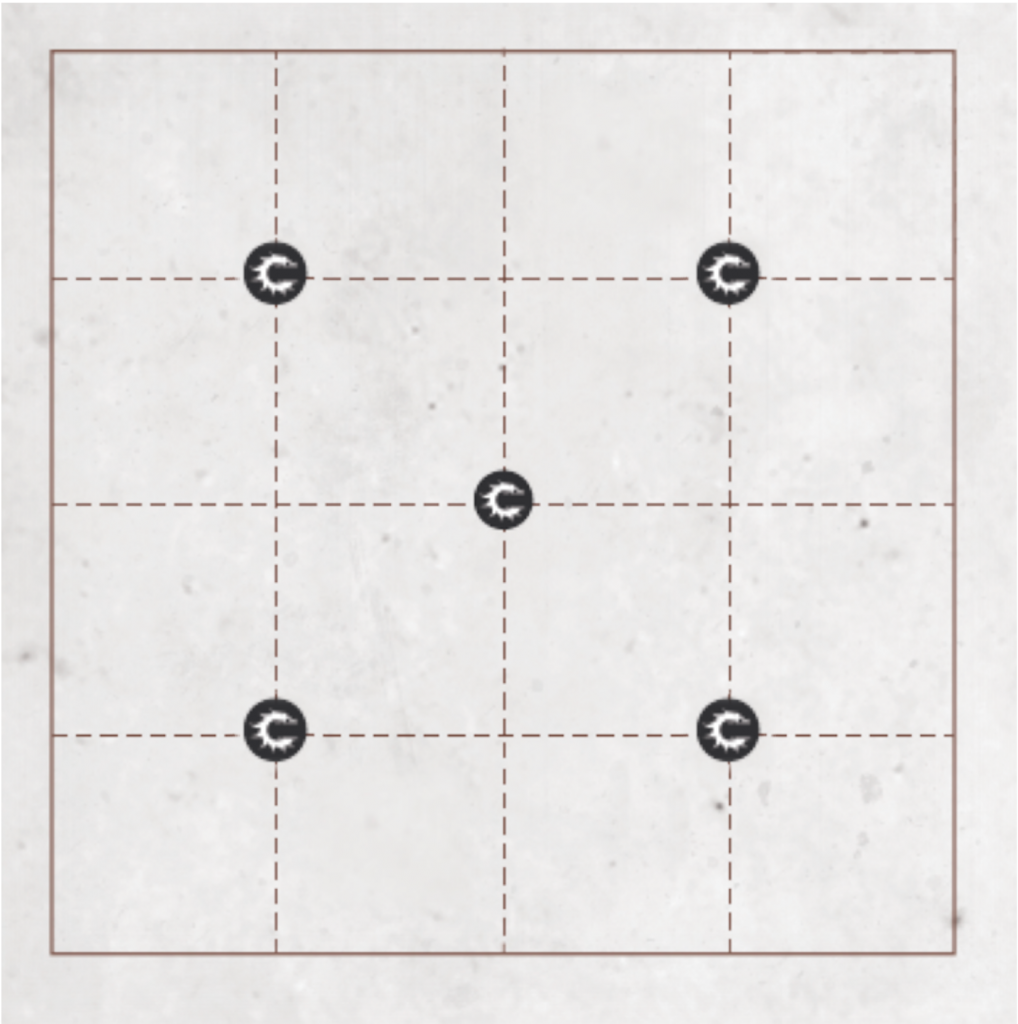
The chosen mission, "Proving Grounds" (Mission 5 from the rulebook), was selected for its objective-based scoring system, which proved amenable to expansion. The original mission features three Artefacts as key objectives. To accommodate three players and ensure ample contested ground, the group augmented this by adding two more Artefacts, strategically spreading them across the 4’ x 4’ battlefield. This increased density of objectives provided more points of contention, encouraging interaction across all three factions.
The scoring mechanics remained elegantly simple: control of an Artefact at the end of each round yielded points. This straightforward approach minimized complexity while maximizing the strategic value of objective control.
Territory Allocation: A Balancing Act
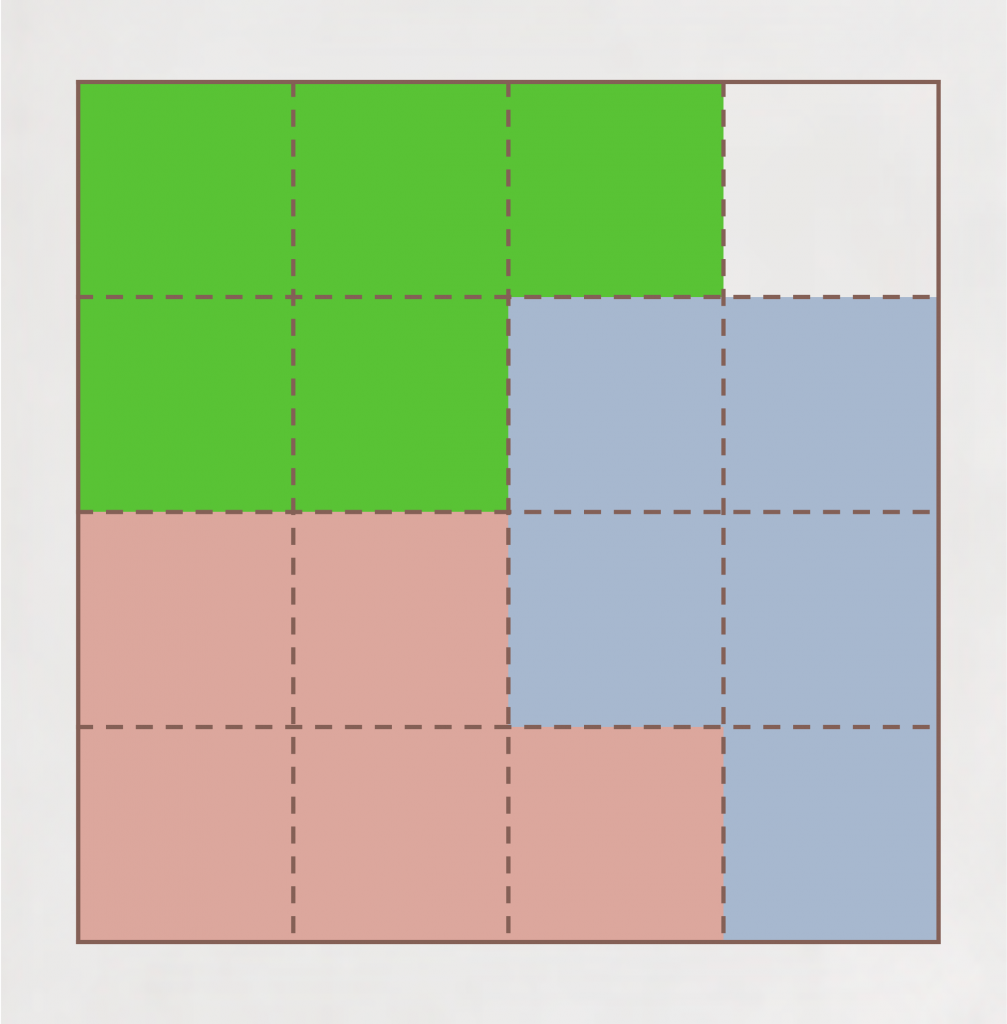
Designing a balanced deployment scheme for three players on a grid-based map presented a unique challenge. After careful deliberation, a 16-square layout was devised, aiming for relative equity in starting positions. The resultant setup saw two players, designated "Green" and "Red," each beginning with one Artefact entirely within their secure deployment zone. The third player, "Blue," occupied a more central position, sharing a deployment boundary with Green for one Artefact and with Red for another, with all three initially contesting the crucial central Artefact.
This configuration, while appearing to place Blue at a slight disadvantage due to contested boundaries, was mitigated by First Blood‘s deployment rules. These rules allow for the strategic placement of facedown cards to protect boundary Artefacts, providing the Blue player with opportunities to secure their contested objectives from the outset. The strategic implications of these starting positions ensured that the initial roll-off for deployment zones held significant weight, adding another layer of tactical depth.
The Narrative and Terrain: Setting the Stage
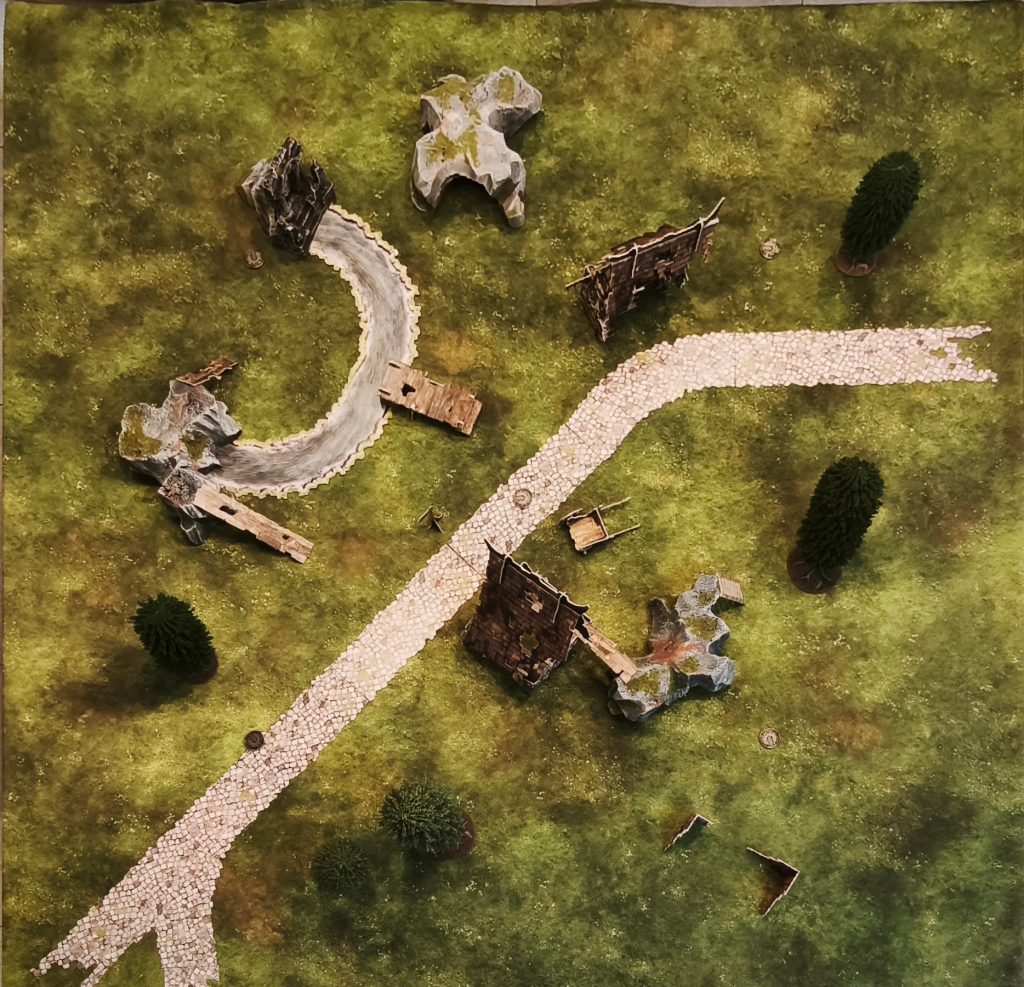
To imbue the battle with a sense of purpose and provide strategic cover, a narrative was crafted: a caravan, laden with valuable contents (the Artefacts), had been attacked and abandoned, its precious cargo scattered across the map after something had startled the bandits. This storyline naturally dictated the terrain setup. A prominent road bisected the battlefield, flanked by clustered rocks, ruined buildings, and dense trees, offering ample opportunities for concealment and ambush. A serene water feature occupied one corner, further shaping movement and line-of-sight. As anticipated, this carefully constructed terrain immediately influenced the strategic flow of the game, dictating flanking maneuvers and choke points.
Forces Assembled: A Clash of Factions
The three warring factions brought diverse armies to the field:
- Author (Spires): Known for their advanced constructs and horrifying biological warfare.
- Josh (Hundred Kingdoms – 100K): Representing the stalwart knights and disciplined forces of humanity.
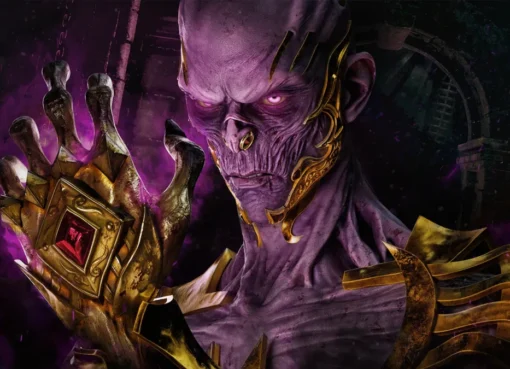
- Josh (Old Dominion – OD): Unleashing the unholy might of the undead legions and ancient constructs.
The initial roll-off for deployment zones followed an A-B-C-C-B-A scheme, designed to prevent any single player from being unduly disadvantaged. The Hundred Kingdoms player (100K) emerged victorious, selecting the advantageous green deployment area. The author, playing Spires, opted for the red zone, leaving the Old Dominion player (OD) with the central blue area.
OD’s initial deployment card immediately secured the hotly contested central Artefact, signaling their aggressive intent. The author, confident in securing their deep-territory Artefact, focused on contesting the objective near OD’s boundary. 100K mirrored this strategy. The subtle influence of terrain became apparent as OD, noting a 2-inch disadvantage against the author due to a terrain feature, heavily invested forces along their shared boundary. With cards placed, models revealed, and units meticulously positioned, the stage was set for an epic three-way confrontation.
Deployment Unveiled: Armies on the Brink
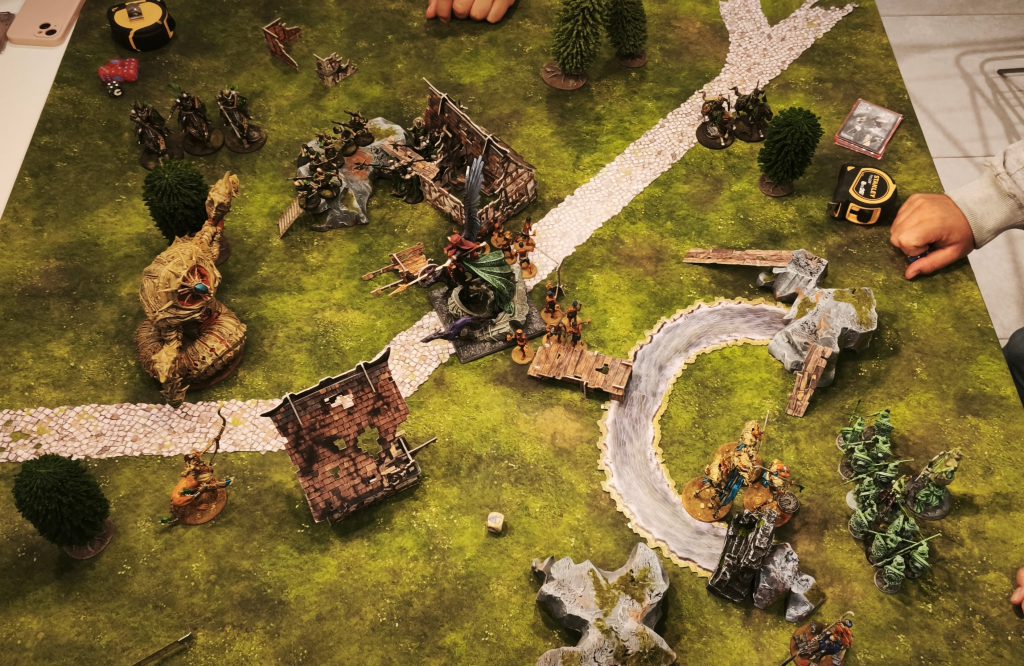
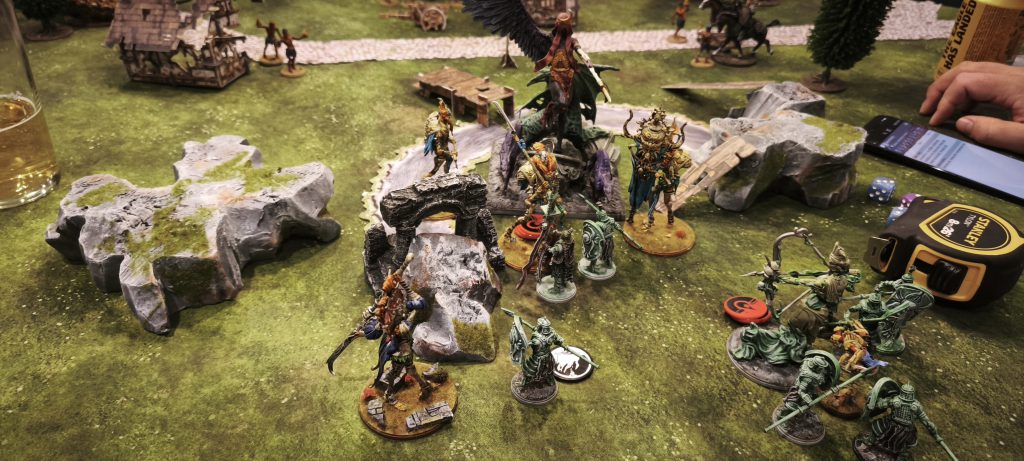
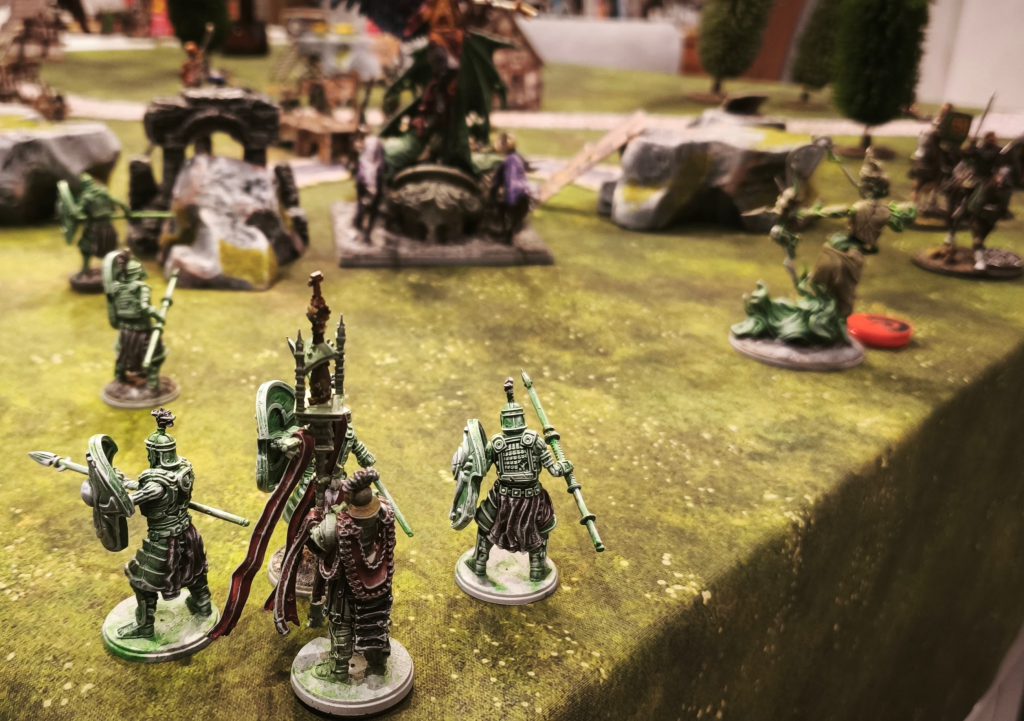
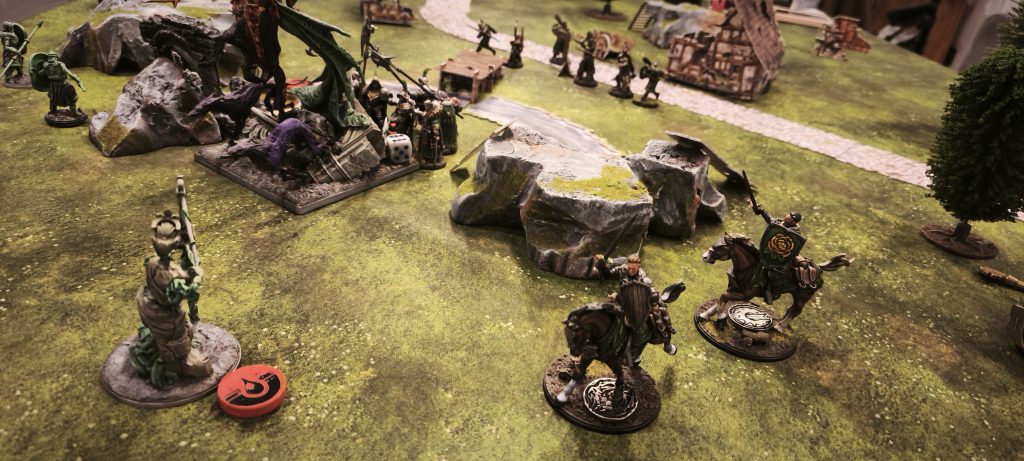
The initial deployment painted a vivid picture of impending conflict. At the heart of the central contested zone stood OD’s menacing Fallen Divinity, flanked by a screen of Moroi (proxied by Ghols, as the painted Moroi were not yet ready for battle), threatening to overwhelm the author’s Siegebreaker Behemoth. Across from this monstrous confrontation, 100K’s formidable Crimson Tower stood poised, providing a protective presence for the author’s lone Leonine Avatara.
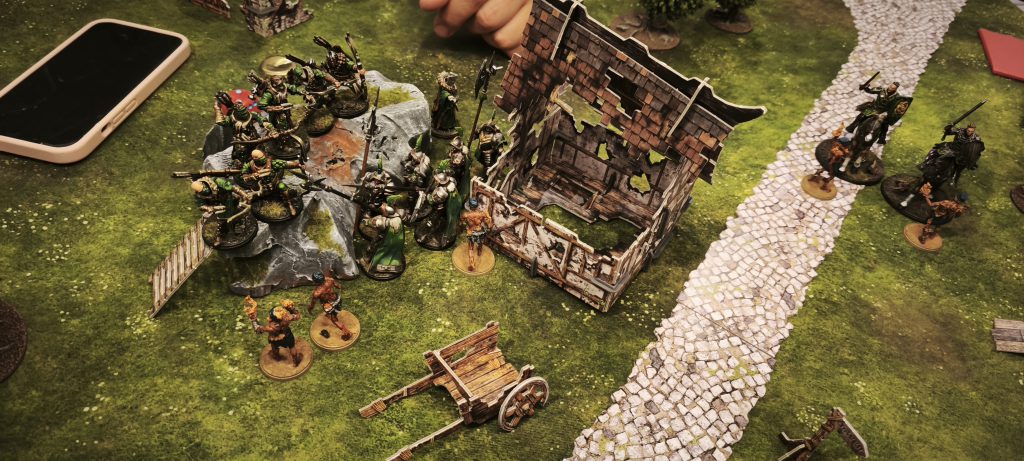
Further afield, 100K’s Longbowmen occupied a strategic elevated rock, offering covering fire for their Household Guard and a Theist Priest. Two Mounted Squires held a solitary flank. In another corner, the author’s Lineage Highborne and Avatara prepared to face off against OD’s Profane Sepulchre, a Karyatid, and a regiment of Legionnaires. The tension was palpable as the armies glared across the table, each player strategizing their opening moves.
A Battle Report: Chronicle of the "Proving Grounds"
Turn 1: The First Strike and Ill Omens
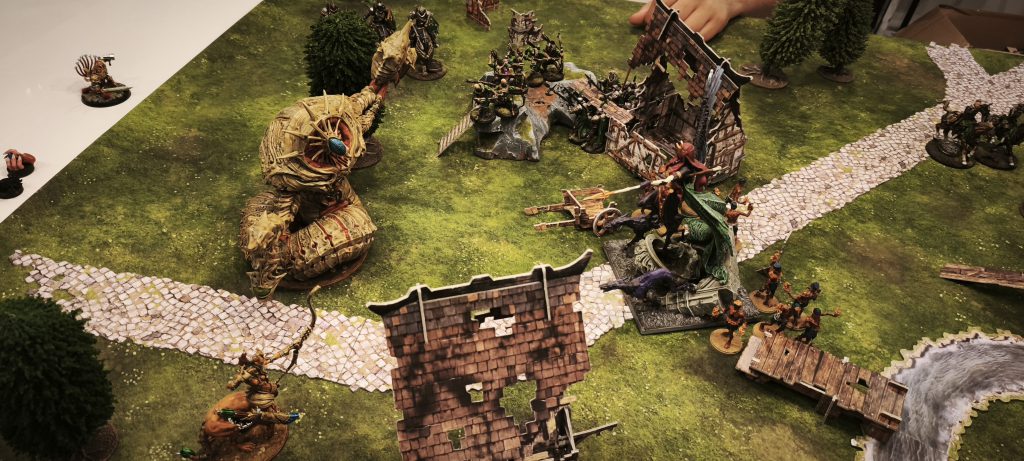
The author won the crucial first turn roll-off, seizing the initiative. A Mimetic Assassin, a creature of stealth and precision, launched a surprise attack against OD’s repulsive Karyatid. However, the dice, as they often do, proved capricious. A string of abysmal rolls foreshadowed a challenging game for the Spires commander, setting a disheartening precedent for the turns to come.
OD’s strategy was clear and brutal: the Moroi, critical for generating Dark Power, surged forward in multiple directions, forming a protective screen for the Fallen Divinity. Legionnaires split their advance, some encircling the Mimetic Assassin, others targeting the author’s Avatara. The Fallen Divinity itself moved menacingly towards the author’s lines, its gaze fixed on the coveted Artefact.
Early Engagements and Shifting Fortunes (Turns 2-3)
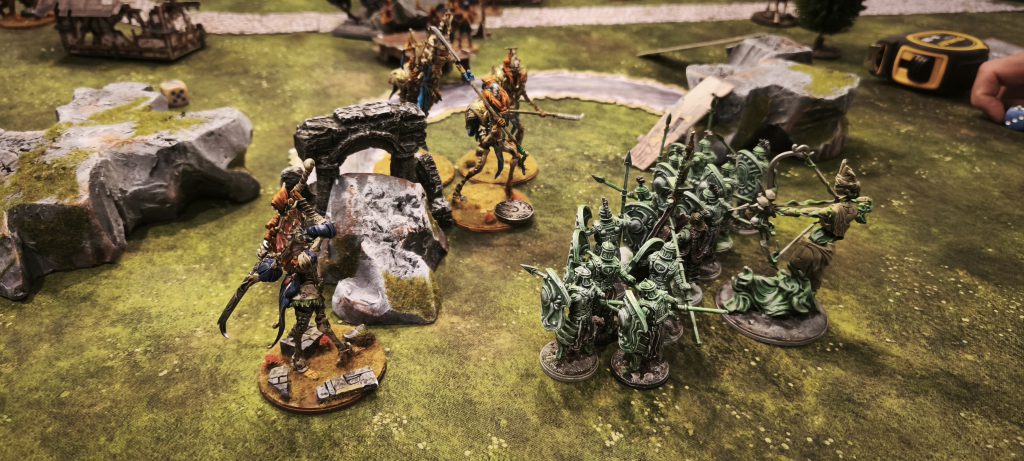
The author’s Avatara, despite being outnumbered, fought with commendable bravery, holding its ground for several turns. The Mimetic Assassin, however, succumbed to the relentless assault of OD’s forces by Turn 3, granting the Old Dominion the first two victory points of the game. On the opposite flank, the author’s powerful Siegebreaker Behemoth, ideally suited to engage the Fallen Divinity, instead diverted its attention to the threat of 100K’s Crimson Tower bearing down on the vulnerable Leonine Avatara. Another series of frustrating dice rolls meant the Behemoth struggled to make an immediate impact, despite its formidable presence.
100K’s Longbowmen initially attempted to target the Fallen Divinity but, finding little success, shifted their volleys towards the Moroi. This change of target, however, came too late to prevent 100K’s Household Guard from becoming effectively trapped between a building and a rock, limiting their mobility and strategic options.
Pivotal Maneuvers and Enduring Resilience (Turns 4-5)
Turn 4 saw a moment of tactical brilliance from the author. The Lineage Highborne, a formidable Spires leader, bravely challenged the Fallen Divinity to a duel. This audacious move strategically placed her between the now-vulnerable Avatara and the relentless Legionnaires, buying the Avatara a critical extra turn of survival. Though the Highborne herself was severely wounded in the process, she heroically passed her Resolve check, even with a forced reroll, and managed to extricate herself from the deadly engagement in Turn 5, retreating to safety.
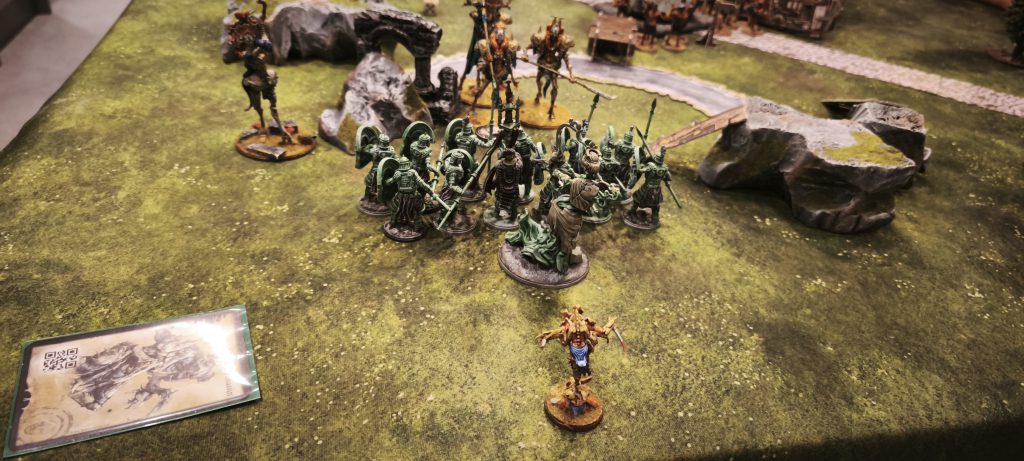
Monsters in the new First Blood ruleset are undeniably potent, rightly limited to one per 1,000-point army. The author’s Siegebreaker Behemoth proved to be the Spires’ most effective unit. It finally managed to slay the Crimson Tower’s leader in Turn 4, earning a point for 100K (bringing the score to OD 2 – Author 1 – 100K 0). However, the Behemoth remained tied up for too long, preventing it from reaching more critical engagements.
By Turn 5, 100K’s Longbowmen began to make a significant impact, clearing a path for their Mounted Squires to disengage from the Moroi and allowing the Household Guard to press their advance towards the Fallen Divinity. Meanwhile, the combined might of the Fallen Divinity and Legionnaires proved too much for the author’s Avatara. Though the Leonine Avatara bravely held onto its Artefact after dispatching two Moroi, the author found themselves firmly in last place. The Siegebreaker Behemoth, finally free, effortlessly finished off the Crimson Tower, claimed the Artefact it carried, and burrowed away, poised for a more decisive impact in the next turn.
The Climax: A Thrilling Turn 6
Turn 6 proved to be the most exhilarating phase of the game. OD won the roll-off, immediately directing the full fury of his remaining forces against the author’s Siegebreaker Behemoth, which had just emerged dramatically from the ground behind OD’s Karyatid. The Behemoth, despite its power, was swiftly overwhelmed and destroyed.

The Hundred Kingdoms’ Household Guard then engaged the Fallen Divinity with brutal efficiency. The author, recognizing the inevitable demise of the monstrous construct and the depletion of OD’s dark power pool, strategically stepped aside, allowing 100K to deliver the killing blow. In a dramatic final act, a lone Longbowman, with a desperate last shot, dealt the single additional wound needed to fell the Fallen Divinity. This pivotal moment propelled 100K into the lead, with the score now standing at OD 3 – Author 2 – 100K 1.
The Final Turns: Desperation and Triumph (Turns 7-8)
The momentum had undeniably shifted to the Hundred Kingdoms. In Turn 7, the author won the roll-off, but with the Theist Priest now broken, the best strategic option was to challenge it to an unavoidable duel. The Mounted Squires, meanwhile, charged the Karyatid on the opposite flank, a battle that could only have one outcome. OD’s Profane Sepulchre retreated into a corner, relying on its undead entourage for protection. 100K’s overperforming Longbowmen continued their deadly work, finally eliminating the Leonine Avatara, securing another Artefact for the Hundred Kingdoms.
Turn 8 saw the author win the roll-off again, managing a desperate charge at the Household Guard leader and killing it, a small burst of dopamine amidst the Spires’ dwindling forces. However, this exposed the Lineage Highborne to a devastating barrage from the entire unit of Longbowmen, sealing her fate.
Final Score: A Decisive Victory for the Hundred Kingdoms
As the final whistle blew, the Old Dominion held two Artefacts, accumulating a respectable 6 points. The author’s Spires army, having been entirely wiped out, held no Artefacts, finishing in a dismal last place with 5 points. However, the clear victor by a significant margin was the Hundred Kingdoms player. 100K commanded three Artefacts and had successfully dispatched both opposing warlords, culminating in a triumphant score of 12 points.
Post-Battle Analysis: Lessons Learned and Future Implications
The three-player Conquest: First Blood experiment proved to be an unqualified success, offering valuable insights into the game system and the dynamics of multi-player wargaming.
Viability of Three-Player Gameplay:
The most significant takeaway is the undeniable viability of First Blood for three players. The free movement system genuinely enables multi-front engagements without the frustrating positional limitations of rank-and-flank games. The minor adaptations made to the mission and territory rules, particularly the supremacy roll-off mechanism, worked seamlessly, demonstrating the inherent flexibility of First Blood‘s core design. Despite the game lasting approximately four hours, primarily due to lively conversation and refreshment, the pace remained engaging, and the strategic depth was consistently present.
Ruleset Observations and "Beta" Feel:
While immensely enjoyable, the current iteration of First Blood rules does exhibit characteristics of a system still undergoing refinement. The "swingy" nature of dice rolls, where a single ‘1’ or ‘6’ can have an outsized impact, creates moments of dramatic tension but can also lead to perceived imbalances. Specific unit interactions highlighted this "beta" stage:
- Moroi: Their ability to generate two Dark Power per model makes them disproportionately valuable for their cost, providing a potent engine for OD’s faction abilities.
- Karyatid: The random handful of additional wounds it can inflict, despite its cost being comparable to units like the Leonine Avatara, feels aggressively powerful and potentially unfair in certain matchups.
Rules Misinterpretations and Their Impact:
The intensity of the game, combined with the newness of the rules, inevitably led to some misinterpretations. A notable instance involved forgetting that Monsters cannot be pushed back or broken if they are not injured. This oversight had a direct impact on the outcome, as the Laurean Lance ability, which should not have affected an uninjured Monster, was incorrectly applied. This highlights the complexity of new rulesets and the importance of thorough understanding, suggesting that perhaps the author "should have won" had the rules been applied perfectly.
Personal Performance and List Building:
The author’s pre-game list building strategy, driven by the desire to deploy "as few models as possible," proved to be suboptimal. While the Siegebreaker Behemoth was a star performer, the overall list lacked the resilience and redundancy needed to withstand a multi-front assault. The ill-fated Siegebreaker-Crimson Tower matchup, prolonged by poor dice rolls, exemplified the consequences of this list design, tying up a key asset and preventing its more impactful deployment elsewhere.
Factional Balance and Player Experience:
The Old Dominion, with their relentless attrition and Dark Power mechanics, proved to be a challenging adversary, eliciting the common sentiment that they are "horrible to play against" due to their resilience and ability to overwhelm. Despite the author’s persistent struggles with dice rolls, the overarching experience was overwhelmingly positive. The thrill of adapting the game, the strategic depth of a three-way conflict, and the sheer joy of playing with friends solidified the hobby’s appeal.
Conclusion: A Triumphant Experiment
The three-player Conquest: First Blood experiment was a resounding success, proving that with minimal adaptations, the game can deliver a compelling and dynamic multi-player experience. The freedom of movement in First Blood is its greatest asset in this regard, unlocking new strategic possibilities beyond the traditional two-player format. While the rules may still possess a few rough edges, the core gameplay loop remains incredibly fun and engaging. The challenges of balancing forces, adapting scenarios, and navigating multi-front warfare only added to the excitement. This innovative approach to Conquest is highly recommended for any gaming group looking to expand their tabletop horizons, promising laughter, strategic depth, and memorable battles. The unanimous decision to repeat the experiment speaks volumes about its success.
As always, if you want to get 10% off and support Tabletop Battles you can make your Conquest purchase by clicking here. You’ll also need to enter code ‘goonhammer’ at checkout.
Have any questions or feedback? Drop us a note in the comments below or email us at [email protected]. Want articles like this linked in your inbox every Monday morning? Sign up for our newsletter. And don’t forget that you can support us on Patreon for backer rewards like early video content, Administratum access, an ad-free experience on our website and more.