
The Architecture of Absence: A Twenty-Year Retrospective on Alison Bechdel’s Fun Home
By Abel Reyes
Special Report for The Comics Journal
Two decades have passed since the publication of Fun Home: A Family Tragicomic, a work that did more than merely popularize the graphic memoir; it codified the medium as a legitimate vessel for high-literary inquiry. When Alison Bechdel released the book in 2006, the landscape of sequential art was already shifting, but Fun Home acted as a structural keystone, bridging the gap between the underground "comix" tradition and the hallowed halls of the literary canon.
Today, the memoir is viewed not just as a coming-of-age story or a queer manifesto, but as a complex architectural feat of memory. As we revisit the work twenty years later, the focus shifts from its initial shock—the dual coming-out of daughter and father—to its enduring formal tension. At the heart of this tension lies the book’s final page, a "leap of faith" that remains one of the most scrutinized sequences in contemporary literature.
I. Main Facts: The "Tragicomic" Legacy
Fun Home is a memoir that operates on multiple frequencies: it is a detective story, a bibliographical catalog, and a clinical dissection of a dysfunctional family. Born in 1960 in Lock Haven, Pennsylvania, Alison Bechdel was raised in a house that was simultaneously a home, a museum of Victorian restoration, and a funeral parlor—the titular "Fun Home."
The narrative is anchored by two central figures: Alison, who identifies her lesbianism during her college years, and her father, Bruce Bechdel. Bruce was a man of stifled brilliance—an English teacher and mortician who spent his life meticulously restoring a Gothic Revival house while hiding his own clandestine affairs with men and teenage boys.
The book’s primary conflict is not merely the discovery of these secrets, but the "cumulative renunciatory effect" of a life lived in the closet. Shortly after Alison came out to her parents, Bruce stepped in front of a Sunbeam Bread truck. His death, officially ruled an accident but suspected by Alison to be a suicide, serves as the "pressure point" of the memoir. Through a dense web of literary allusions—ranging from James Joyce and Marcel Proust to the myth of Icarus—Bechdel attempts to reconstruct a father she never truly knew, using the very books he left behind as a map.
II. Chronology: From Lock Haven to the Library of Congress
The timeline of Fun Home is non-linear, mirroring the way trauma and memory loop back upon themselves. However, the real-world chronology of the events and the book’s subsequent impact follow a clear trajectory:
- 1960–1970s: Alison grows up in the "Fun Home" in Pennsylvania. Her father, Bruce, obsessively restores their Victorian house, a process Alison later identifies as a physical manifestation of his internal repression.
- 1980: Alison enters college and discovers the word "lesbian" in a dictionary, an epiphany that leads to her coming out. Weeks later, her mother reveals Bruce’s history of "indiscretions."
- July 1980: Bruce Bechdel dies after being struck by a truck. This event becomes the "fixed point" around which Alison’s adult life and eventual memoir revolve.
- 2006: After seven years of meticulous labor—which involved Bechdel photographing herself in every pose to ensure anatomical accuracy—Fun Home is published by Houghton Mifflin. It is an immediate critical sensation.
- 2007–2012: The book is named a finalist for the National Book Critics Circle Award and wins the Eisner Award for Best Reality-Based Work. It becomes a staple of university syllabi, though it also faces various "banning" attempts in conservative districts, cementing its status as a provocative cultural touchstone.
- 2013–2015: The memoir is adapted into a Broadway musical, winning five Tony Awards, including Best Musical. This adaptation introduces Bechdel’s story to a global audience beyond the comics community.
- 2026: On its 20th anniversary, Fun Home is recognized as a foundational text of the 21st century, studied for its "autographic" style and its role in the "Graphic Medicine" movement.
III. Supporting Data: The Mechanics of the Leap
The brilliance of Fun Home lies in its formal density. Bechdel does not merely tell her story; she archives it. The memoir is filled with "documents"—reproduced letters, diary entries, and maps—all drawn with a cool, documentary distance. This aesthetic choice serves as a counterweight to the emotional volatility of the subject matter.
The Icarus/Daedalus Matrix
Bechdel utilizes the Greek myth of Icarus as a primary metaphor. In her rendering, Bruce is Daedalus—the "artful artificer" who builds a labyrinth of Victorian moldings and literary pretension to hide his true self. Alison is the child who must fly to escape the labyrinth. However, the memoir complicates this: if Bruce is the architect who fails, he is also the Icarus who falls. The "tricky reverse narration" of the book asks whether the child can ever truly fly when the father’s wings have already melted.
Visual Analysis: The Final Page
The final page of Fun Home consists of two panels that represent the memoir’s ultimate wager.
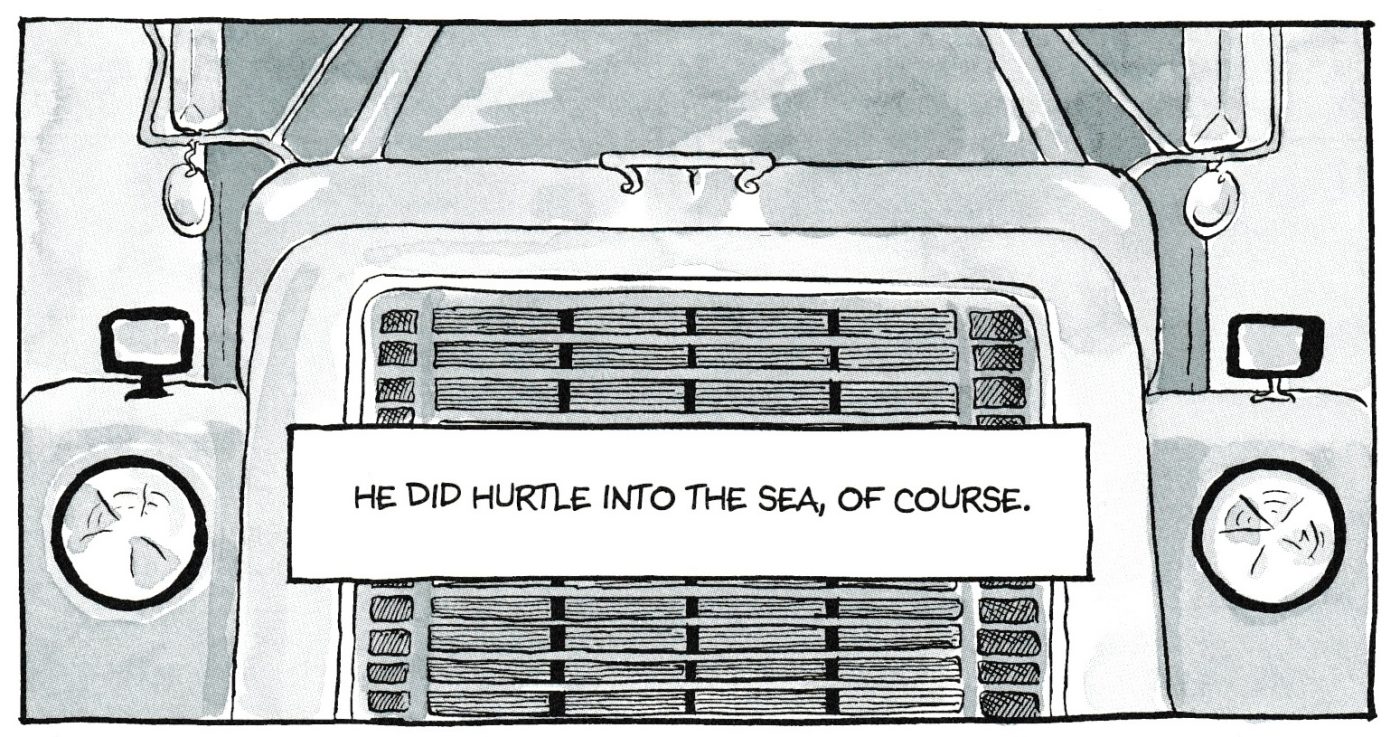
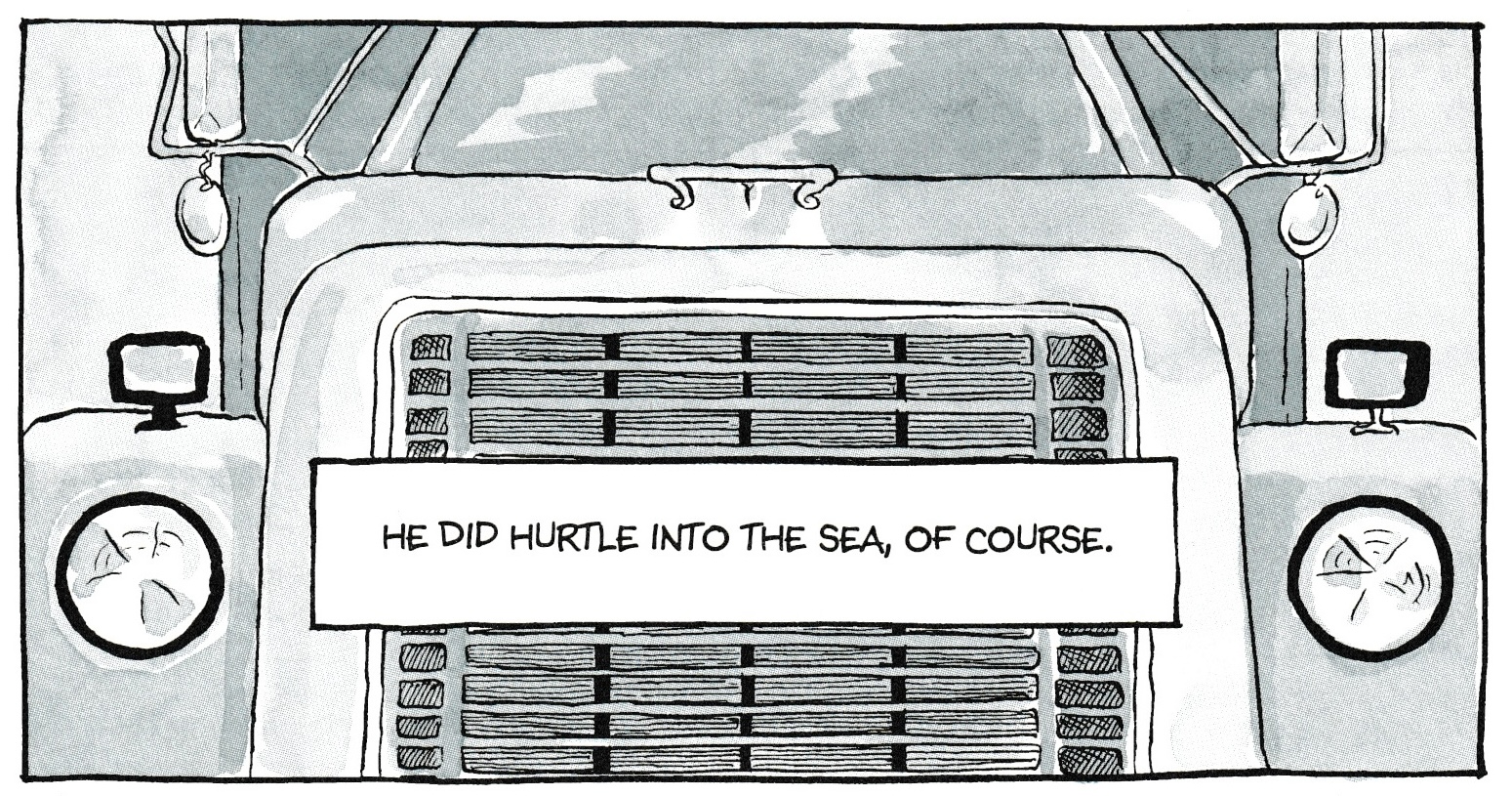
- The Upper Panel: A stark, industrial rendering of the Sunbeam Bread truck. It is a "blunt machinery" of fact. There is no poetry here, only the "unadorned force of accident."
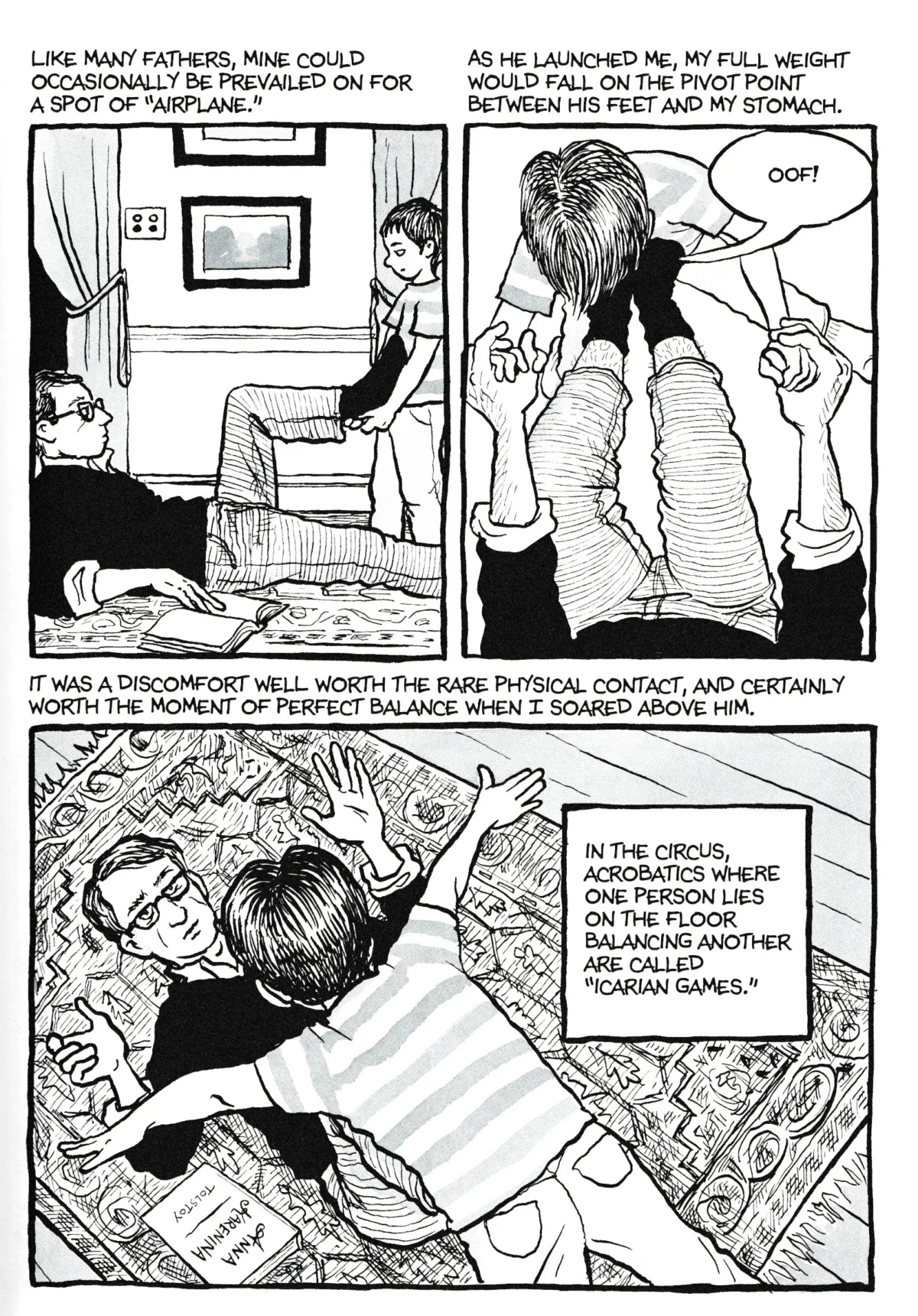
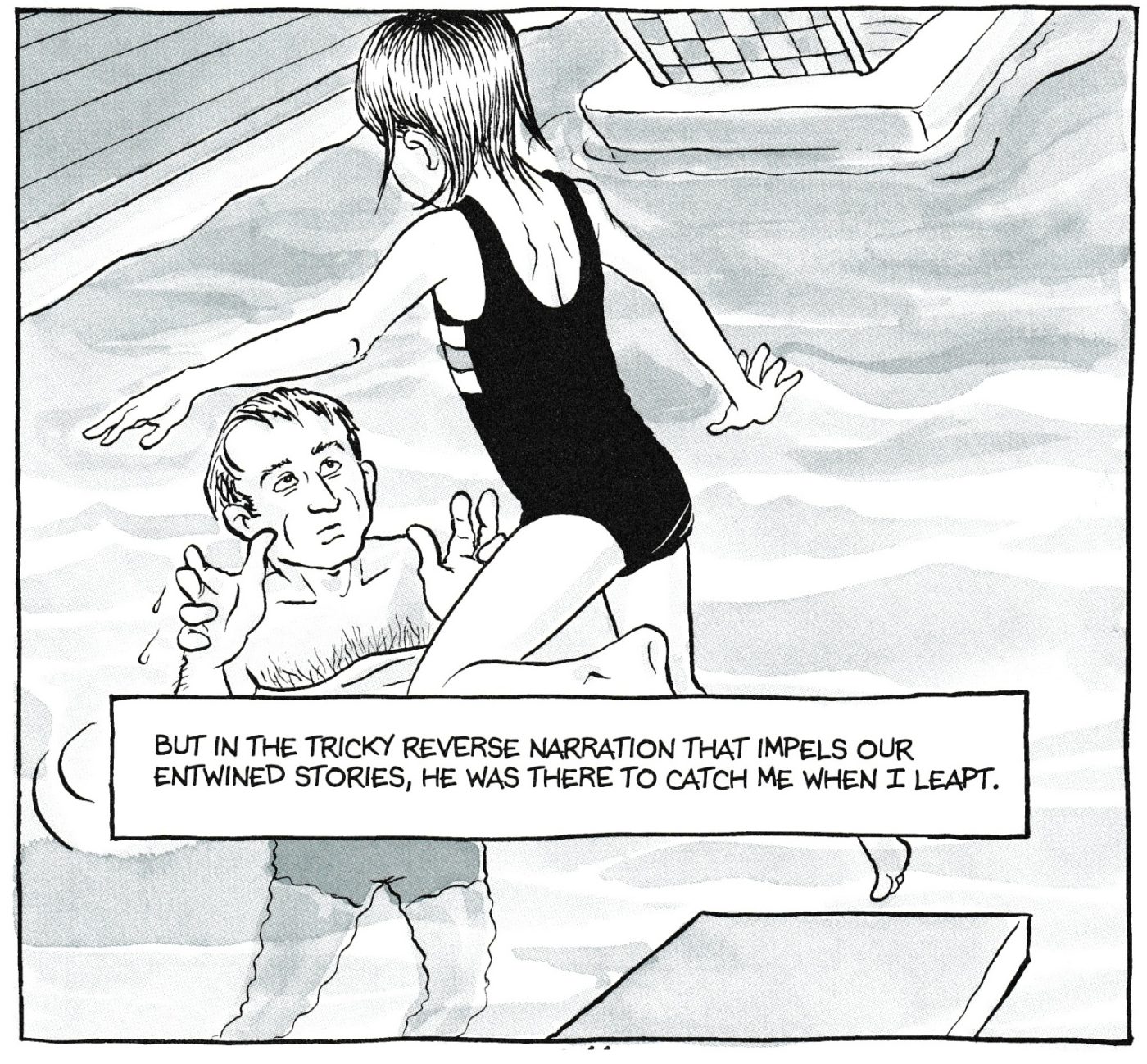
- The Lower Panel: A childhood memory of a game called "airplane." Alison is suspended in mid-air, her father lying on his back below her, arms outstretched to catch her.
The data of the drawing reveals a profound dissonance. The caption states: "He was there to catch me when I leapt." Yet, the drawing freezes the moment before the catch. As noted in the original analysis, the text declares a completed action (redemption) while the image preserves a state of suspension (uncertainty).
IV. Official Responses: Critical Reception and Evolution
Upon its release, the critical response was almost universally laudatory, though often characterized by a sense of surprise that a "comic book" could achieve such depth.
The New York Times (2006):
George Gene Gustines, writing for The New York Times, highlighted the ending as a moment of emotional resolution. He suggested that the juxtaposition of the truck and the leap offered the author a way to "finally end her longing." This reading viewed the book as a successful exorcism of grief—a way for Bechdel to "fix" the narrative of her father’s life.
The Academic Shift:
In the years following, scholars like Hillary Chute (author of Graphic Women) began to analyze Fun Home through the lens of "trauma studies." They argued that the book’s power comes not from closure, but from its refusal to provide it. The "official response" from the academic community has been to treat Fun Home as a postmodern masterpiece that questions the very possibility of knowing another person.
The "Banned Books" Controversy:
The memoir has frequently appeared on the American Library Association’s list of challenged books. Official challenges often cite "graphic images" and "LGBTQ+ themes." However, defenders of the work argue that these challenges ignore the book’s profound moral and literary seriousness, inadvertently proving the book’s point about the destructive nature of enforced silence.
V. Implications: Why Fun Home Still Matters in 2026
The legacy of Fun Home is visible in the explosion of the graphic memoir genre. Without Bechdel’s success, it is difficult to imagine the mainstream acceptance of works like Gender Queer by Maia Kobabe or The Best We Could Do by Thi Bui.
The Preservation of Longing
The most significant implication of Fun Home twenty years later is its rejection of easy catharsis. While early reviewers saw the ending as a "choice" between appreciation and yearning, contemporary readers often see it as a preservation of both. The memoir suggests that we are all "amputees feeling pain in a missing limb." The father is gone, yet he remains a "flesh-and-blood presence streaming off the wallpaper."
The "Graphic" as Intellectual Rigor
Bechdel proved that the "graphic" in graphic memoir refers not just to the visual, but to the visceral and the precise. Her work implies that some truths—specifically those involving the intersection of sexuality, shame, and family history—cannot be captured in prose alone. They require the "thin interval" between the word and the image.
In 2026, Fun Home stands as a reminder that the stories we inherit are often labyrinths of someone else’s making. The "leap" at the end of the book is not just a childhood memory; it is the act of writing the memoir itself. It is the risk of jumping into the past, hoping that the structure of the story will be enough to catch us. Whether Bruce Bechdel was "there" or not becomes secondary to the fact that Alison Bechdel built a world where he could be.


Leave a Comment