Fungalpunk Thriller "A Murder Most Fungal" Serves Up a Six-Course Culinary Catastrophe
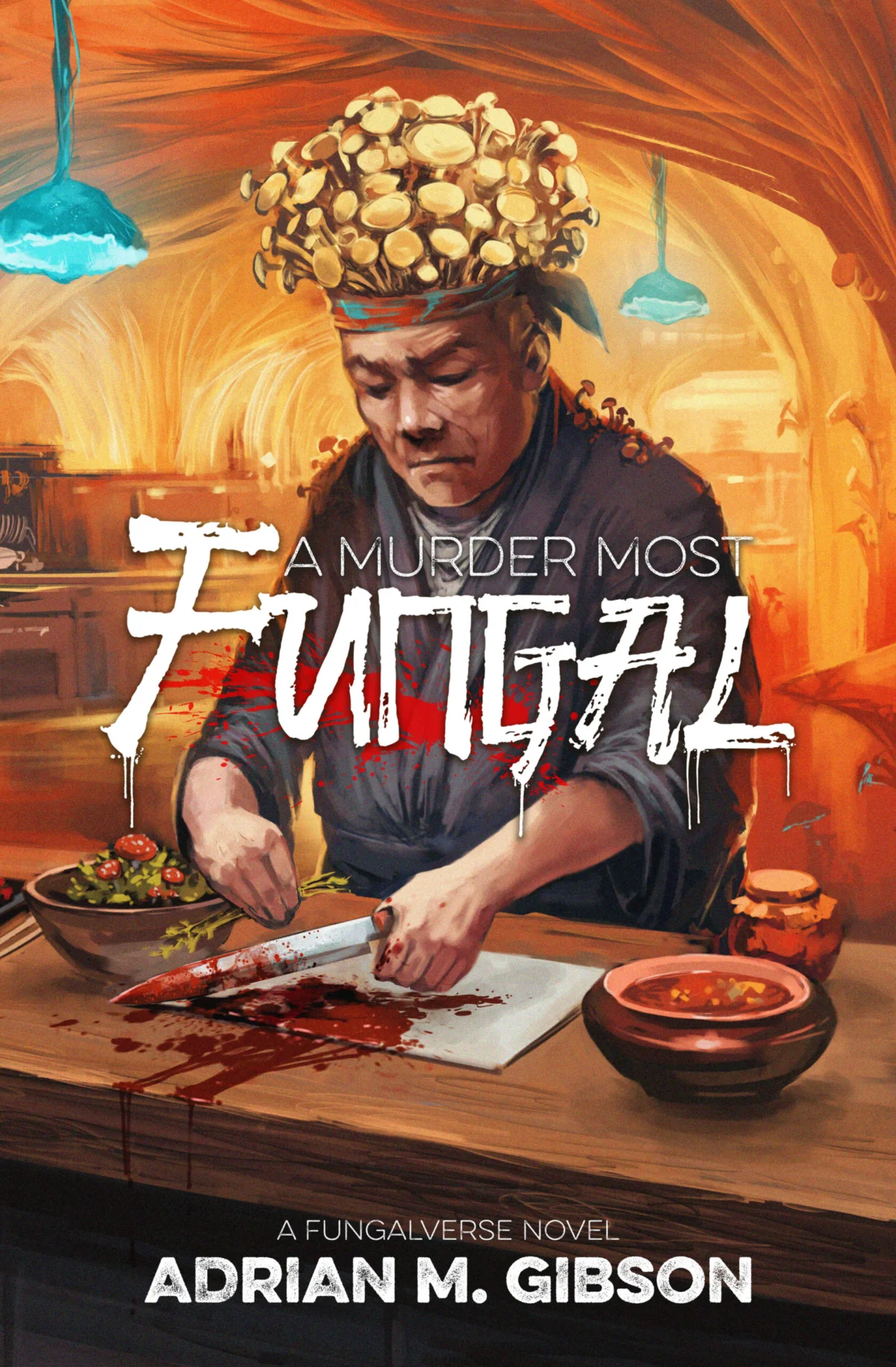
Neo Kinoko, Håppon – June 16, 2026 – In the dimly lit, spore-dusted alleys of Neo Kinoko, a city reeling from the brutal "Fuyu Massacre," a new narrative is unfolding. Adrian M. Gibson, author of the critically acclaimed "Mushroom Blues," returns to his unique Fungalverse with "A Murder Most Fungal," a standalone novel that plunges readers into a world of high-stakes crime, culinary artistry, and a looming threat of fungal body horror. This ambitious work, drawing parallels to the meticulous precision of "Jiro Dreams of Sushi," the frantic energy of "The Bear," and the pulse-pounding tension of Hong Kong crime sagas, promises a Michelin-star tragedy served with a side of existential dread.
Set several months after the devastating events that shook the Håpponese capital, "A Murder Most Fungal" navigates a landscape fractured by civil unrest and the suffocating grip of a foreign military occupation. Amidst this turmoil, Pocho Jiro, a once-celebrated makizushi chef, finds himself in a precarious position, serving as the personal chef and indentured servant to Duncan MacArthur, the formidable Coprinian Military Governor of Håppon. What begins as a desperate bid for survival quickly escalates into a perilous game of cat and mouse when a chance encounter with dangerous fungal gangsters forces Pocho into an impossible bind: assassinate MacArthur or witness the horrific demise of his beloved sister. The question hangs heavy in the humid air of Neo Kinoko: will Pocho wield his chef’s knife as a weapon for his final, fatal dish?
The Sophomore Slump: A Creator’s Crucible
The journey from a lauded debut to a highly anticipated follow-up is often fraught with unexpected challenges, a phenomenon author Adrian M. Gibson experienced firsthand. In a candid reflection on the writing process, Gibson admits that his meticulously planned publishing timeline crumbled faster than a dry puffball.
"Writing a second book can actually be as challenging as people say," Gibson stated in a recent interview. "The ‘Sophomore Slump,’ ‘Sequelitis,’ ‘Second Book Blues’ – whatever you want to call it, it’s real."
Gibson’s debut, "Mushroom Blues," garnered significant success, including thousands of copies sold, numerous award nominations and wins, and a commendable second place in Mark Lawrence’s tenth Self-Published Fantasy Blog-Off (SPFBO) competition. While these accolades represent a triumph for a project that began as an experiment, they also cast a long shadow of expectation.
"I put so much of my mental and emotional energy into that book that I didn’t leave room to enjoy the achievement of debuting," Gibson explained. "The aftermath of my debut was riddled with starts and stops, ideas that burst into my brain, only to fizzle away after a few self-conscious pages." This period was marked by debilitating self-doubt, with Gibson questioning if "Mushroom Blues" was a fluke and if he could recapture the magic. The prospect of a second book felt increasingly distant, almost unattainable.
The key to breaking free from this creative paralysis, Gibson discovered, was not to force a direct sequel but to explore a standalone narrative within the established Fungalverse. "A Murder Most Fungal is proof that I was able to write, finish, edit and publish a second novel, but it took me not writing a direct sequel to get there," he emphasized. This realization allowed him to shed the perceived requirements of being a debut author and reconnect with his core identity as a creator.
Creativity’s Reawakening: The Perils of Perpetual Marketing
A significant factor contributing to Gibson’s creative drought was an extended period of relentless marketing for "Mushroom Blues." For over eighteen months, his focus remained solely on promoting his existing work, creating a tunnel vision that stifled new creative output.
"I was so wrapped up in making that book a success that I created this tunnel vision scenario for myself, where nothing felt as important as the thing that already existed," Gibson admitted. "I repeated to myself again and again, ‘I can hustle and get that book into more readers’ hands!’"
However, this intense marketing focus eventually reached a point of diminishing returns. As the book’s word-of-mouth momentum stabilized and his creative wellspring began to run dry, a critical realization dawned: the most effective marketing strategy for a writer is to consistently produce new, compelling work.
"The creative parts of my brain were screaming at me to ‘WAKE THE FUCK UP AND WRITE!’" Gibson recounted. "I realized I couldn’t market this book forever, and the best marketing I could and should do was write and publish the next book." This epiphany marked a turning point, prompting a period of deep self-reflection and a renewed commitment to nurturing his creative spirit.
Gibson found rejuvenation through various projects, including drafting "A Murder Most Fungal," contributing to "The Book of Spores" anthology with his folktale novelette "The Stem-Cutter’s Daughter," and collaborating on a graphic novel and an audio drama with friends. This multifaceted approach allowed him to rediscover the joy of creation, repositioning marketing as a supportive element rather than the driving force of his career.

Culinary Canvas: Food as a Worldbuilding Engine
At the heart of "A Murder Most Fungal" lies a meticulous exploration of food and its profound cultural significance, particularly within the unique context of the fungal people of Neo Kinoko. While initially hesitant about centering a narrative around cuisine and a chef protagonist, Gibson found that food served as an exceptionally fertile ground for worldbuilding.
"Food is a fundamental pillar of most any culture (real, fantasy or otherwise), and it can reveal so much about a people once it becomes cuisine," Gibson explained. He elaborated on how food can illuminate a society’s geography, available resources, agricultural practices, and even the structures of governance and control. Moreover, recipes passed down through generations act as a form of "adaptive, edible history," and culinary traditions are often interwoven with celebrations, festivals, and religious practices.
Gibson masterfully employs this concept in "A Murder Most Fungal" by embedding subtle, piecemeal details about the world through the characters’ interactions with food. For instance, the mention of "fungalfin tuna" prompts readers to contemplate the broader implications for other animal life in this fungal-infused ecosystem. This layered approach, both by the author and the reader, contributes to a more immersive and believable world.
The Kitchen Crucible: A Stage for High-Stakes Drama
The confined and high-pressure environment of a restaurant kitchen provides a potent backdrop for the intense narrative of "A Murder Most Fungal." Gibson initially harbored reservations about the narrative potential of such a limited setting but soon discovered its inherent dramatic possibilities.
"Kitchens are the modern-day equivalent of a pirate ship," Gibson analogized. "You throw a bunch of random people together, each of whom has a unique background, temperament, skillset, et cetera, and you push them to produce high quality products in a high-stress environment (plus, that environment is filled with things that can burn and stab you)." This dynamic, he argues, fosters intense camaraderie, potential for conflict, and even burgeoning romantic or antagonistic relationships, making it a "narrative goldmine."
Gibson drew inspiration from a diverse range of cinematic and television portrayals of kitchen life, from the comedic charm of Pixar’s "Ratatouille" and the fiery intensity of Gordon Ramsay’s shows to the quiet perfectionism of "Jiro Dreams of Sushi" and the anxiety-inducing family dynamics of "The Bear." These influences highlight how kitchens, in their inherent messiness and high-stakes nature, are perfectly suited for compelling storytelling.
The Fungal Embrace: A Deep Dive into Body Horror
A recurring and potent theme woven throughout Gibson’s Fungalverse, and particularly amplified in "A Murder Most Fungal," is his fascination with fungal body horror. This genre, characterized by its visceral and unsettling exploration of the human body’s transformation and deformation, finds a particularly disturbing resonance in the context of fungal infection.
Gibson’s fascination was deeply influenced by the groundbreaking video game and television series "The Last of Us," which vividly depicted the insidious spread of spores and mycelia, turning hosts into grotesque fungal zombies. Equally influential was Jeff VanderMeer’s Southern Reach Trilogy, which delved into the psychological and philosophical implications of minds being overtaken by alien entities.
"A Murder Most Fungal" elevates this obsession by intertwining it with the novel’s culinary focus. Gibson muses on how the fusion of food and fungi can create truly horrifying scenarios, promising a climax that pushes the boundaries of body horror within his narrative. The exploration of how fungi can alter both the physical form and the mental landscape of their hosts remains a captivating, albeit terrifying, cornerstone of his fictional universe.
Author’s Background
Adrian M. Gibson is an accomplished Canadian SFF author, podcaster, book designer, illustrator, and tattoo artist. He is the creator and co-host of the SFF Addicts podcast, renowned for its in-depth interviews with science fiction and fantasy authors and its writing masterclasses. Gibson also serves as the Publishing Project Manager at Grimdark Magazine, overseeing their fantasy and science fiction novella line. He currently resides in Quito, Ecuador, with his family.
Contact Information:
- Website: https://adrianmgibson.com/
- Instagram: https://www.instagram.com/adrianmgibson/
- SFF Addicts Podcast: https://linktr.ee/SFFAddicts
- YouTube: https://www.youtube.com/@fanfiaddict
"A Murder Most Fungal" Availability:
- Amazon: [Link to Amazon listing – placeholder as actual link not provided in article]
- The Broken Binding: https://www.thebrokenbinding.co.uk/product-page/a-murder-most-fungal-numbered-adrian-m-gibson