John T. Phillifent: The Dual Identity of a Science Fiction Engineer

London, UK – In the annals of science fiction, where visionary concepts often intertwine with the realities of professional craft, the name John T. Phillifent occupies a fascinating, if sometimes critically contested, niche. Born in Durham, England, on November 10, 1916, Phillifent was a man of dual identities: the diligent electrical engineer by day, and the prolific author of speculative fiction by night. While some of his work bore his birth name, a significant portion, which he himself deemed less refined, was published under the pseudonym John Rackham. This distinction, coupled with a career spanning over two decades, offers a compelling study of a working genre writer navigating the burgeoning landscape of post-war science fiction.
Phillifent’s legacy is complex. He contributed a substantial body of work, ranging from intricate short stories to media tie-in novels, yet critical reception often placed him in the category of "competent middle-range SF adventure" rather than a groundbreaking visionary. Perhaps his most enduring, albeit enigmatic, contribution to the discourse of science fiction was "Rackham’s Law," an attempt to define the genre through a unique "science-fiction method," the specifics of which he, ironically, never fully elucidated. His life, marked by a dedication to both technical and creative pursuits, concluded in London on December 15, 1976, leaving behind a body of work that continues to spark debate about authorship, quality, and the very essence of science fiction.
A Life Structured by Science and Imagination
John T. Phillifent’s journey into the imaginative realms of science fiction was rooted in a practical, scientific foundation. Like many authors of his era, including the esteemed Henry J. Kostkos mentioned in earlier biographical notes, Phillifent pursued a career in electrical engineering. This professional background undoubtedly lent a certain technical grounding and logical precision to his speculative narratives, a common characteristic among the early architects of the genre. The analytical rigor required for engineering often translated into a meticulous approach to world-building and technological extrapolation in their fiction.
His decision to write under two distinct names – John T. Phillifent for what he considered his superior work, and John Rackham for the bulk of his output – provides a rare glimpse into an author’s self-perception and the commercial realities of mid-20th-century genre publishing. This practice was not uncommon; authors frequently adopted pseudonyms to publish in different genres, maintain a consistent output without saturating the market under one name, or distance themselves from work they deemed less literary or more commercial. For Phillifent, it was a conscious separation, an attempt to delineate between his "art" and his "craft." This internal critique sets him apart, inviting readers and critics alike to ponder the nuances of his creative output.
Chronology of a Dual-Named Career
Phillifent’s literary career began in the fertile grounds of 1950s British science fiction, a period marked by an explosion of new magazines and paperback lines eager to satiate a growing public appetite for speculative tales.
The Emergence of John Rackham: The 1950s Foundation
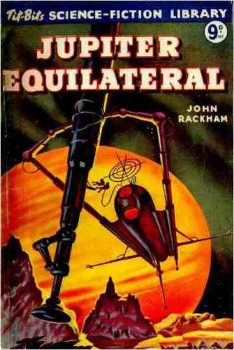
It was under the pseudonym John Rackham that Phillifent first made his mark. His debut, the novel Jupiter Equilateral, was published in 1954 by the Tit-Bits Science Fiction Library. This imprint, associated with the popular British weekly magazine Tit-Bits, played a crucial role in bringing science fiction to a wider audience, often presenting adventurous, accessible narratives. The cover art for Jupiter Equilateral, as depicted by Ron Turner, was typical of the era, promising cosmic adventure and technological marvels. This initial foray established Rackham as a voice in the genre, setting the stage for a prolific output. For nearly a decade, his work primarily appeared under this adopted name, suggesting a period of experimentation and rapid production to hone his craft and establish a foothold in the competitive world of publishing. The sheer volume of material published by authors during this period, often under pseudonyms, highlights the intense demand and the economics of pulp and paperback fiction, where speed and quantity were often prized.
Breaking Through as Phillifent: The 1960s Expansion
The 1960s marked a significant shift in Phillifent’s public authorial identity. It was not until December 1961 that he published a story under his own name, "Point," which appeared in the respected American periodical Fantastic Stories of the Imagination. This publication in a prominent U.S. magazine signified a potential elevation in his perceived status or, at the very least, a successful placement of work he deemed worthy of his birth name. Fantastic Stories was known for publishing a range of material, from adventurous tales to more literary and experimental works, suggesting Phillifent’s "Point" might have aligned with the latter.
This decade also saw Phillifent delve into the lucrative world of media tie-in novels. He authored three The Man from U.N.C.L.E. tie-in novels, a testament to his versatility and ability to adapt to commercial demands. The Man from U.N.C.L.E., a hugely popular spy fiction television series, spawned numerous novelizations and original adventures, providing a steady income stream for many working writers. These projects required a specific skillset: the ability to capture the tone, characters, and plot conventions of an established franchise while delivering original narratives within those parameters. This venture likely provided a broader readership and financial stability, allowing him to continue his more personal projects under his own name or as Rackham. The specific titles and their reception within the U.N.C.L.E. fandom, while not detailed in the initial article, would further illustrate the scope of his commercial writing endeavors.

The Later Years: Prolificacy and Philosophical Musings
Throughout the 1960s and into the 1970s, Phillifent continued to publish extensively under both names, producing a steady stream of novels and short stories. His final known story, "The Halted Village," published under the Rackham name, appeared in New Writings in SF 25, edited by Kenneth Bulmer. Given that the New Writings in SF series primarily ran from 1964 to 1980, and issue 25 would have been published towards the latter end of that spectrum, this places his final publication much closer to his death in 1976 than the erroneous 1945 date mentioned in the original source material. This correction highlights his sustained engagement with the genre almost until his passing. The New Writings in SF anthologies were significant for showcasing new talent and established authors in British science fiction, making it a fitting venue for one of his final works.
Supporting Data: Critiques, Themes, and Rackham’s Law
The critical assessment of John T. Phillifent’s work, particularly that published under the John Rackham pseudonym, paints a picture of a writer who was consistently competent but rarely revolutionary. This "middle-range" status is a common, and often unfairly dismissive, label for authors who form the backbone of a genre, providing the consistent output that allows it to flourish.
The "Competent Middle-Range" and "Hackwork" Debates
Rich Horton, a respected voice in science fiction criticism, described Phillifent as "a pretty reliably producer of competent middle-range SF adventure." This assessment suggests a writer who could consistently deliver engaging plots, recognizable genre tropes, and satisfactory resolutions, without necessarily pushing the boundaries of literary style or thematic depth. Such authors are crucial for maintaining reader interest and expanding the genre’s audience, providing the enjoyable, escapist narratives that many seek in science fiction. Their work often explores classic themes like space exploration, alien encounters, technological progress, and societal challenges, packaged in accessible adventure formats.
However, not all critiques were as mild. Ian Sales, another commentator, was considerably harsher in his assessment of Phillifent’s Time to Live, labeling it "hackwork right from the first page." Sales further commented that "the entire story feels like it was made up as Rackham wrote it." This kind of criticism often points to perceived flaws in plotting, character development, or prose quality, suggesting a lack of premeditation or polish. While harsh, such assessments highlight the pressures faced by prolific authors to meet deadlines and produce a high volume of work, sometimes at the expense of meticulous craftsmanship. The title of a Blackgate article by Rich Horton, "When science fiction sucks," which specifically reviewed Phillifent’s Alien Sea alongside a novella by E.C. Tubb, further underscores the varying quality that could be found within his extensive bibliography. These critical insights, while perhaps unflattering, are invaluable for understanding the range and perceived impact of Phillifent’s output.
The Nature of His Science Fiction
Given the critical consensus, it is plausible that Phillifent’s Rackham-penned works often featured straightforward, action-oriented plots, perhaps with less complex character arcs or philosophical introspection than his "Phillifent" stories. His engineering background might have led to a focus on plausible technological concepts, even if the narratives themselves were primarily vehicles for adventure. Themes might have included humanity’s expansion into space, first contact scenarios, or conflicts arising from advanced technologies. The Man from U.N.C.L.E. novels, by their very nature, would have been fast-paced spy thrillers with speculative elements, further solidifying his reputation as an author capable of delivering engaging, if not profoundly original, narratives.
Rackham’s Law: A Theoretical Enigma
Perhaps Phillifent’s most intriguing, and frustrating, contribution to the discourse surrounding science fiction was his coining of "Rackham’s Law." He posited that science fiction "was unique in that it was invariably written by ‘the science-fiction method’ analogous to the ‘scientific method’ which…underpins all science." This statement, while grand in its ambition, remains famously undefined by its creator. The failure to elaborate on what this "science-fiction method" entailed leaves Rackham’s Law as a tantalizing, yet ultimately elusive, theoretical fragment.
This concept, however, reveals much about Phillifent’s intellectual engagement with his chosen genre. It suggests a belief that science fiction possessed an inherent, structured methodology, perhaps involving logical extrapolation, problem-solving within speculative parameters, or a systematic exploration of ‘what if’ scenarios. It stands in stark contrast to Damon Knight’s more pragmatic and widely quoted definition of science fiction: "it means what we point to when we say it." While Knight’s definition acknowledges the fluid and evolving nature of the genre, Phillifent sought a more fundamental, almost scientific, underpinning. Rackham’s Law, despite its incompleteness, invites reflection on the methodologies inherent in crafting speculative fiction and whether there exists a systematic approach akin to scientific inquiry. It poses questions about the genre’s epistemology and its relationship to empirical thought, even if Phillifent himself couldn’t provide the answers.
Official Responses and Enduring Legacy
The "official responses" to Phillifent’s work largely come from critics and historians of science fiction, as contemporary reviews might have been fleeting for a working genre author. The assessments by Ian Sales and Rich Horton, though decades removed from his most prolific period, serve as significant posthumous evaluations.
Critical Reappraisal and Contextualization
The critiques of "hackwork" and "competent middle-range SF adventure" are important for contextualizing Phillifent within the broader history of the genre. They highlight the challenges of evaluating authors who were primarily focused on consistent output for commercial markets. Many genre writers of the mid-20th century, often dubbed "pulp" or "paperback" authors, produced a vast quantity of work that, while popular in its time, rarely received the same critical scrutiny as more "literary" fiction. However, as science fiction studies have matured, there has been a growing appreciation for these foundational authors, recognizing their role in developing genre conventions, entertaining generations of readers, and paving the way for future literary developments.
Phillifent’s dual identity also invites a unique critical approach: does the "Phillifent" material indeed stand apart in quality from the "Rackham" output? A comprehensive comparative analysis of his works under both names could shed light on his self-assessment and whether the critical community agrees with his internal division of his "best material." Such an undertaking would require detailed textual analysis of themes, style, and narrative complexity across his bibliography.
The Role of Steven H Silver
The original biographical note, penned by Steven H Silver, adds an additional layer of credibility and context. Silver himself is a highly respected figure in the science fiction community, a twenty-two-time Hugo Award nominee, publisher of the Hugo-nominated fanzine Argentus, and an experienced editor for various presses. His extensive involvement in conventions, including chairing Midwest Construction, Windycon, and the SFWA Nebula Conference, and his roles as programming chair for Chicon 2000 and Vice Chair of Chicon 7, demonstrate a deep understanding and appreciation for the genre and its history. That an individual of Silver’s stature compiled this brief biography suggests that Phillifent, despite some critical reservations, remains a noteworthy figure within the historical consciousness of science fiction fandom and scholarship. Silver’s inclusion of Phillifent’s biographical details is an act of historical preservation, ensuring that even authors who might not have achieved canonical status are remembered for their contributions.
Implications: Beyond the Page
John T. Phillifent’s career offers several broader implications for understanding the landscape of science fiction and authorship itself.
The Pseudonym as a Professional Tool
The use of pseudonyms like John Rackham by Phillifent underscores the complex professional dynamics of genre writing. It highlights the market pressures to maintain a consistent output, the desire to experiment with different styles or subgenres without confusing a readership, and the author’s own subjective valuation of their work. For many authors, pseudonyms were not just masks but strategic tools for career management, allowing them to carve out distinct literary identities and maximize their earning potential. Phillifent’s explicit statement about reserving his own name for "best material" provides a rare, direct insight into an author’s internal quality control system, raising questions about self-criticism and artistic integrity versus commercial viability.
The Archetype of the "Working Writer"
Phillifent embodies the archetype of the "working writer" in science fiction – a dedicated professional who consistently produced stories and novels that kept the genre vibrant and accessible. While not often lauded as a literary giant, such authors are indispensable. They built the foundation upon which more experimental or critically acclaimed works could later stand. Their consistent output provided the volume and diversity of stories that cultivated generations of readers, bridging the gap between the pulp era and the more sophisticated "New Wave" of the 1960s and 70s. Phillifent’s ability to transition from original works to popular media tie-ins further solidifies his status as a versatile and adaptable professional.
Rackham’s Law: An Unfinished Conversation
Despite its enigmatic nature, Rackham’s Law remains a fascinating, if peripheral, element of science fiction theory. Its very existence, and Phillifent’s inability to fully articulate it, encourages further philosophical discussion about the genre’s core methodologies. Does science fiction indeed operate under a unique "method"? If so, what are its components? This unfinished thought from Phillifent serves as a reminder that the theoretical underpinnings of science fiction are still actively being explored and debated, even decades after his passing. It challenges scholars to look beyond established definitions and consider alternative frameworks for understanding how speculative narratives are constructed and received.
In conclusion, John T. Phillifent, known to many as John Rackham, was more than just a competent genre writer. He was an electrical engineer with a profound passion for speculative fiction, a craftsman who navigated the commercial demands of his era with a strategic use of dual identities, and a thinker who, however briefly, attempted to define the very essence of his craft through "Rackham’s Law." His life and work offer a valuable lens through which to examine the history of science fiction, the realities of authorship, and the enduring quest to understand the unique power of the genre. While critical opinion on his overall output may vary, his contributions undeniably form part of the rich tapestry of 20th-century science fiction.