The Architecture of Absurdity: Mel Brooks and the Philosophy of the ‘Open Sewer’

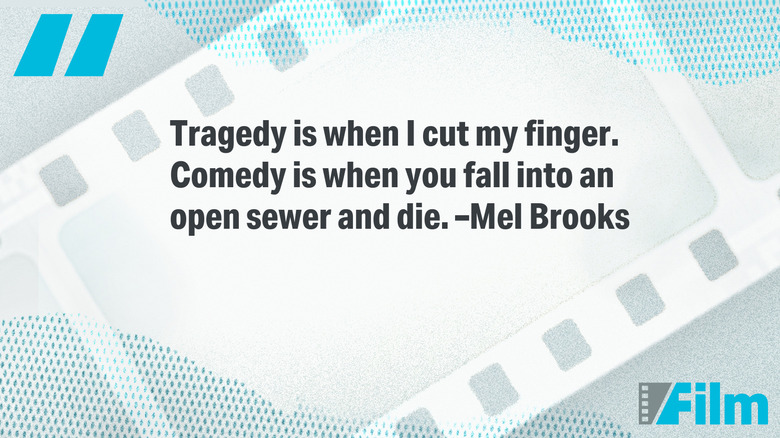
Mel Brooks, the centenarian titan of American comedy, has spent over seven decades dismantling the boundaries of good taste, social decorum, and cinematic convention. While his filmography—ranging from the subversive western Blazing Saddles to the Gothic parody Young Frankenstein—serves as a blueprint for the modern spoof, his personal philosophy of humor is perhaps best encapsulated in a single, deceptively simple maxim: "Tragedy is when I cut my finger. Comedy is when you fall into an open sewer and die."
This quote is more than a witty aphorism; it is a profound observation on the human condition, the nature of empathy, and the inherent selfishness of the ego. To understand the weight of these words, one must look at the life of the man who uttered them—a life forged in the crucible of personal loss, global conflict, and the high-pressure writer’s rooms of television’s Golden Age.
A Chronology of the Comic Mind: From Brooklyn to the Catskills
Mel Brooks was born Melvin James Kaminsky on June 28, 1926, in the Brownsville neighborhood of Brooklyn. His entry into the world was marked by a profound absence that would define his psychological landscape: his father, Max Kaminsky, died of tuberculosis when Mel was only two years old. Brooks has frequently cited this early tragedy as the primary engine of his comedy. In his view, humor was not merely a career choice but a survival mechanism—a way to "get even" with a world that had dealt him a cruel blow before he was old enough to understand it.
The War and the Writer’s Room
Before he was a filmmaker, Brooks was a soldier. During World War II, he served in the U.S. Army as a combat engineer, tasked with the harrowing job of defusing landmines. Witnessing the visceral reality of death and destruction in Europe provided him with a perspective that few of his contemporaries possessed. When he returned to New York, the trivialities of polite society seemed absurd, and the only logical response was laughter.
He began his career as a drummer and social director in the "Borscht Belt" resorts of the Catskill Mountains, a legendary training ground for Jewish comedians. It was here that Melvin Kaminsky became Mel Brooks, a name change intended to avoid confusion with the jazz trumpeter Max Kaminsky. By the early 1950s, his razor-sharp wit earned him a seat at one of the most prestigious tables in entertainment history: the writing staff of Sid Caesar’s Your Show of Shows. Alongside future legends like Carl Reiner, Neil Simon, and Larry Gelbart, Brooks honed the art of the "sketch," learning how to find the jugular of a joke with surgical precision.
The Rise of a Brand
Brooks’ transition from writer to cultural icon began in earnest with "The 2,000 Year Old Man," a routine developed with Carl Reiner that utilized Brooks’ improvisational brilliance. However, it was his 1967 directorial debut, The Producers, that established him as a filmmaking force. The film, which featured a musical number about Adolf Hitler, was initially met with shock and trepidation. Yet, it earned Brooks an Academy Award for Best Original Screenplay, proving that the public was hungry for a brand of comedy that was as intellectual as it was irreverent.
The 1970s marked Brooks’ "Golden Era." In 1974 alone, he released both Blazing Saddles and Young Frankenstein, two films that routinely top lists of the greatest comedies ever made. These works solidified his reputation as a "comedy maestro," a director who could deconstruct entire genres while maintaining a frantic, vaudevillian energy.
Supporting Data: Deconstructing the ‘Open Sewer’
The "Open Sewer" quote has been analyzed by psychologists and comedy theorists alike as a perfect distillation of Schadenfreude—the experience of pleasure, joy, or self-satisfaction that comes from learning of or witnessing the troubles, failures, or humiliation of others. However, Brooks’ own interpretation adds a layer of radical honesty regarding human narcissism.

The PBS American Masters Interpretation
In an interview for the PBS American Masters series, Brooks elaborated on the quote by linking it to "innate, incredible selfishness." He argued that human beings are, by nature, "head over heels in love" with themselves. When we witness someone else’s catastrophe, the comedy arises from the subconscious relief of the ego: At least it isn’t happening to me.
Brooks famously illustrated this during the interview by attempting to kiss the back of his own hand, declaring, "You’re adorable. I love you." This performance highlights his belief that all comedy is rooted in the tension between our self-preservation and the external chaos of the world. If tragedy is personal (the cut finger), comedy is the distance we maintain from someone else’s ultimate demise (the open sewer).
The Mechanics of the Joke
To Brooks, the "open sewer" is the ultimate comedic equalizer. It is messy, undignified, and final. By using the word "die" in the punchline, Brooks pushes the boundary of what is considered funny. It suggests that even the most horrific events can be viewed through a comedic lens if the observer is sufficiently removed from the victim. This philosophy allowed Brooks to tackle subjects that were previously considered "off-limits," such as the Holocaust (The Producers), racial prejudice (Blazing Saddles), and the Inquisition (History of the World, Part I).
Official Responses and the Industry’s Verdict
Throughout his career, Brooks has been both a lightning rod for controversy and a darling of the critical establishment. His work often drew "official" rebukes from various conservative and religious groups who found his treatment of sensitive subjects sacrilegious or offensive. However, the industry’s response has been one of overwhelming validation.
The EGOT Elite
Mel Brooks is one of the few individuals to have achieved "EGOT" status—winning an Emmy, a Grammy, an Oscar, and a Tony. This achievement speaks to his versatility and the universal appeal of his "selfish" comedy.
- Oscar: Best Original Screenplay for The Producers (1968).
- Emmy: Multiple wins, including for his guest role on Mad About You.
- Tony: A record-breaking sweep for the musical adaptation of The Producers in 2001.
- Grammy: Best Comedy Album for The 2,000 Year Old Man in the Year 2000.
Critics have often noted that Brooks’ brilliance lies in his ability to combine low-brow slapstick with high-brow satire. As the late critic Roger Ebert once observed, Brooks’ films work because they are "fearless." He was willing to risk total failure to secure a laugh, a trait that earned him the AFI Life Achievement Award in 2013 and a Kennedy Center Honor in 2009.
Implications: The Legacy of ‘Inappropriate’ Laughter
The implications of Brooks’ philosophy are more relevant today than ever. In an era of "cancel culture" and heightened sensitivity regarding what can and cannot be joked about, Brooks remains an unapologetic defender of the offensive. He has frequently argued that the only way to truly defeat monsters like Hitler is to laugh at them—to reduce them to ridiculous, singing-and-dancing caricatures.
The Moral Utility of the Open Sewer
Brooks’ "open sewer" philosophy suggests that laughter is a vital release valve for the anxieties of living. By laughing at the misfortunes of others—in a fictional, heightened context—we process our own fears of mortality and failure. It is a form of "benign violation," a psychological theory which suggests that humor occurs when something that is typically seen as a threat or a violation of social norms is rendered harmless.
Furthermore, Brooks’ work paved the way for the "shock comedy" of the 21st century. Without the campfire scene in Blazing Saddles, there is no South Park. Without the cynical showbiz satire of The Producers, there is no 30 Rock or Curb Your Enthusiasm. He taught a generation of writers that the most "tragic" things in life are often the funniest, provided you have the courage to stand at the edge of the sewer and look down.
Conclusion: The King of Comedy
At nearly a century old, Mel Brooks remains a "quote machine" and a living testament to the power of the Jewish comedic tradition. His career serves as a reminder that while tragedy is an inevitable part of the human experience, comedy is the choice we make to keep going. Whether he is playing a bumbling governor, a neurotic scientist, or a 2,000-year-old man, Brooks’ message remains the same: Life is rough, it’s unfair, and it’s often cruel—but as long as it’s happening to the other guy, it’s hilarious.