The Enduring Haunt: Deconstructing the "Indigenous Burial Ground" Trope in North American Pop Culture
Main Facts
In North America, the phrase "built on an Indian burial ground" has become a ubiquitous explanation for paranormal phenomena, particularly in horror narratives. This urban legend, deeply embedded in popular culture, posits that disturbances in a home or location are the result of desecrated Indigenous sacred sites, thereby invoking the wrath of spirits. What began as a chilling literary device has evolved, over decades, into a comedic cliché and, more recently, a pervasive internet meme. However, beneath its surface-level entertainment value, this trope harbors a problematic history of cultural appropriation, factual inaccuracy, and the perpetuation of harmful stereotypes against Indigenous peoples. It reflects a complex interplay of settler guilt, colonial anxieties, and a fundamental misunderstanding, if not outright disregard, for Indigenous cultures and spiritual traditions. Far from being a mere fictional construct, the "Indigenous burial ground" trope has actively shaped perceptions, influenced entertainment industries, and, in many cases, obscured the true histories and injustices faced by First Nations, Native American, and Indigenous communities across the continent. This article will delve into the origins, evolution, societal impact, and critical implications of this persistent cultural narrative.
Chronology: The Trope’s Genesis and Pervasive Spread
The journey of the "Indigenous burial ground" trope from a nascent idea to a cultural touchstone is a fascinating, if troubling, chronological progression, largely fueled by popular media.
The Amityville Seed and the Shinnecock Falsification
While many erroneously attribute the trope’s origin to Jay Anson’s 1977 bestseller, The Amityville Horror: A True Story, this seminal work nonetheless played a pivotal role in popularizing the concept of haunted land tied to Indigenous presence. Anson’s narrative claimed the infamous Amityville house was situated on an old Shinnecock "enclosure for the sick, mad, and dying," where individuals were "penned up" until they died of exposure, their bodies left unburied due to a Shinnecock belief that the land was demon-infested.
The narrative took a more sinister turn later that year with the involvement of celebrity TV ghost hunter Hans Holzer. Along with medium Ethan Johnson Meyers, Holzer investigated the Amityville house, subsequently claiming that the ghost of an Indigenous chief had contacted Meyers, confessing to possessing Ronald Defeo Jr. and orchestrating the murders of his family. This sensational claim, which shifted blame from the actual perpetrator to a spectral Indigenous entity, provided a seemingly supernatural explanation for a horrific crime. Crucially, the 1979 Amityville Horror movie adaptation incorporated Holzer’s unsubstantiated claims into its script, cementing this fabricated narrative in the public consciousness. This marked a significant moment where an "Indigenous ghost" became the "real culprit," a narrative strategy that would recur in subsequent paranormal investigations.
However, these claims were swiftly and unequivocally refuted. Numerous statements from the Shinnecock Nation clarified that their people had never inhabited the Amityville area, nor was it part of their traditional territory. There was no archaeological evidence or oral history to support the existence of a burial ground or an "enclosure" on the site. Holzer and Meyers had successfully leveraged a lesser-known but convenient Indigenous burial ground story to lend legitimacy to their own roles as paranormal experts, adding a layer of manufactured Indigenous "taint" to Anson’s original story.
Disney’s Mass Exposure and Cinematic Entrenchment
The late 1970s and early 1980s saw the trope gain even wider traction, reaching millions through new avenues. Disney theme parks, a bastion of family entertainment, launched their Big Thunder Mountain Railroad rides in California in 1979 and Florida in 1980. The ride’s backstory, though evolving over the years, consistently features a runaway train navigating a haunted mine and ghost town purportedly built on Indigenous burial grounds. A 2020 Disney blogger recounted an employee claiming to hear Indigenous spirits chanting on the ride, despite the blogger only perceiving drums. This integration into such a high-profile, widely accessible attraction exposed hundreds of thousands, if not millions, of people to the "Indigenous burial ground" trope, normalizing it within mainstream culture.
Simultaneously, the trope found a powerful advocate in the realm of horror literature and cinema. In 1983, Stephen King famously employed an Indigenous burial ground as a central literary device in Pet Sematary. King further appropriated a version of the Algonquian wendigo story, weaving it into a narrative that explored themes of grief, resurrection, and forbidden ground. The book’s rapid adaptation into a successful movie further solidified the trope’s place in the horror canon. As Renee L. Berland notes in The National Uncanny: Indian Ghosts and American Subjects, while earlier American writers had explored themes of Indigenous ghosts, King’s Pet Sematary became "one of the most popular novels that has ever been published," thus giving the trope unprecedented visibility.
Other prominent films of the era also touched upon the concept. Stanley Kubrick’s 1980 adaptation of King’s The Shining included mentions of the Overlook Hotel’s possible Indigenous history. Interestingly, the 1982 film Poltergeist, while featuring a house built on a burial ground, notably clarified that the haunting was not caused by Indigenous spirits but by a greedy developer who moved headstones but not the bodies, adding a layer of nuance often missing in other portrayals.
From Horror to Humor: The Trope’s Ubiquity
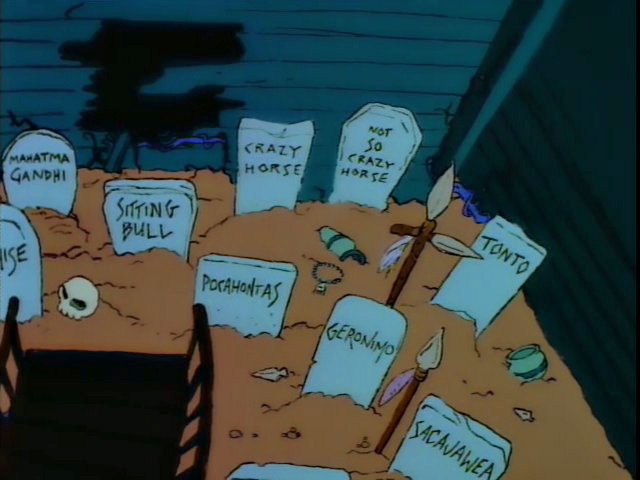
By the late 20th and early 21st centuries, the "Indigenous burial ground" trope had permeated virtually every facet of popular culture. It appeared in television series like Buffy the Vampire Slayer and The Real Ghost Busters cartoon, as well as in numerous other books and games. Its widespread recognition eventually led to its embrace in comedic contexts, signaling its transformation into a self-aware cliché. Popular comedy series such as The Simpsons, Friends, South Park, Family Guy, and Parks and Recreation have all satirized the trope. Seth Grahame-Smith’s How to Survive a Horror Movie humorously suggests a key indicator of a haunted house: "Are Native Americans constantly showing up to ask, ‘What happened to our cemetery?’" This evolution from frightening premise to comedic punchline underscores the trope’s deep entrenchment in the collective cultural consciousness.
Modern ghost hunting TV shows, however, continue to treat the trope with unsettling seriousness. Programs like Ghost Adventures frequently invoke Indigenous burial grounds as an explanation for "demonic" entities, often adhering to a formula that leads them to conclude Indigenous ghosts are to blame. This perpetuates Holzer’s "shift-the-blame-to-nonwhite-ghosts" strategy, making it more mainstream than ever and reinforcing harmful narratives.
The trope’s ultimate transformation into an internet meme speaks to its undeniable cultural resonance. In 2011, the satirical news source The Onion released a video titled "Report: Economy Failing Because U.S. Built on Ancient Indian Burial Grounds," a brilliant piece of comedy still available on YouTube. The video features panelists gravely discussing a congressional report attributing national problems, including poverty, to the nation’s construction on ancient burial grounds, with one suggesting Republicans are painting Obama as "soft on poltergeists." This satire highlights the absurdity and pervasiveness of the idea. Since then, thousands of social media posts, Reddit threads, image macros, and videos have echoed this sentiment, demonstrating the trope’s evolution into a common, often uncritical, cultural shorthand for unexplained misfortune. While awareness of the trope’s problematic nature has grown thanks to articles, the original stories and memes that fueled its spread have rarely received the same critical scrutiny.
Supporting Data: Disentangling Fact from Fabricated Folklore
A critical examination of the "Indigenous burial ground" trope necessitates a deeper dive into its underlying assumptions, its historical context, and the stark contrast between settler narratives and genuine Indigenous spiritual beliefs.
The Disconnect from Indigenous Realities
The widespread settler stories of haunted Indigenous burial grounds are predominantly fictional. They rarely align with historical or archaeological evidence and often serve to project traditional Christian fears onto "uncivilized" people. These narratives frequently incorporate settler ideas about consecrated ground, the power of Christ’s name against paranormal activity, and Heaven as a place exclusively for denominational believers. This projection reveals more about settler anxieties and colonial worldviews than it does about Indigenous spirituality. While real burial grounds exist and some Indigenous people do believe certain sites hold spiritual significance, the sensationalized, vengeful ghost narratives are largely a settler invention, a misinterpretation and appropriation of Indigenous sacredness.
Early Precursors and Local Legends in British Columbia
The fear of Indigenous spirits, though not always directly linked to burial grounds, predates the widespread popularity of the trope. In the 1890s, colonial newspapers reflected widespread dread surrounding the Ghost Dance movement, a ceremonial dance meant to raise the spirits of recently deceased tribe members for protection against settler injustices. This fear culminated in the tragic Wounded Knee Massacre, where the U.S. Army killed 150-300 Lakota people, predominantly women, children, and Elders. The colonists feared resurrected ghosts, yet showed no compunction in creating new ones.
Local folklore in regions like British Columbia, Canada, also offers early examples of the evolving trope. The oldest report of an Indigenous grave causing a haunting in B.C. dates back to 1924. The Victoria Daily Times reported that seven road builders abandoned their camp after four nights of "whishing" sounds and rapping noises between 8 PM and 2 AM. Unable to find any physical explanation, they concluded their camp was built on the grave of a "Red Indian."
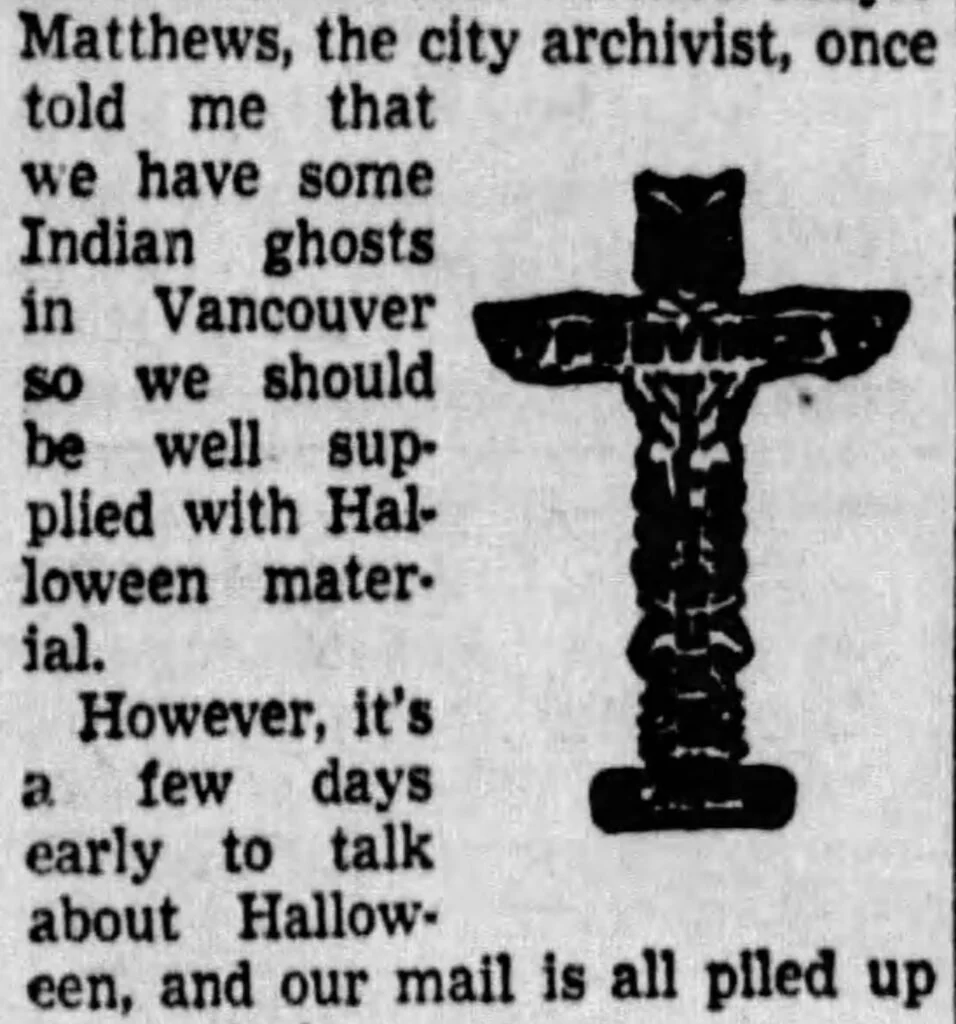
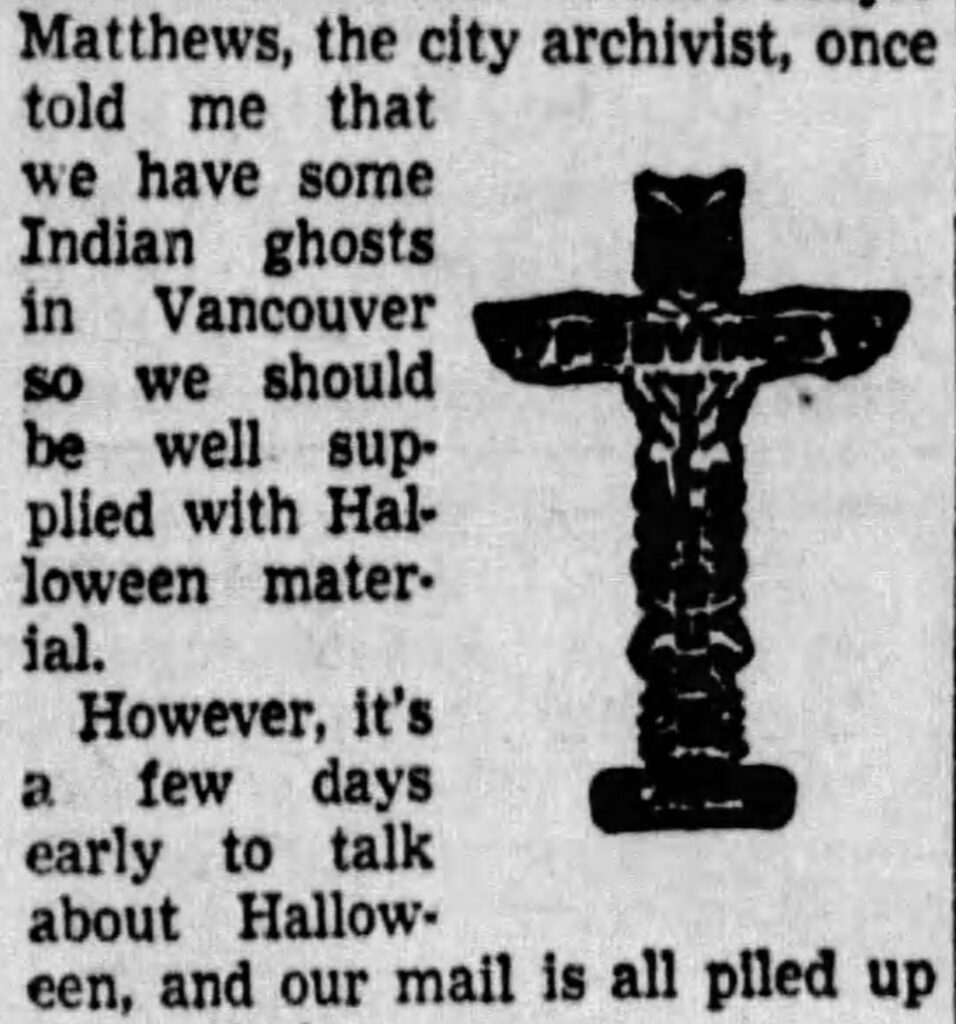
By 1940, City Archivist Major Mathews casually mentioned "Indian ghosts" in Vancouver to a Province reporter, albeit without elaboration, in a section dedicated to Halloween. This fleeting reference suggests a nascent, unexamined acceptance of the idea within local lore.
An intriguing Ontario story appeared in the Vancouver Sun in 1946, describing a headless woman’s ghost seen near the rumoured, secret grave site of Tecumseh. Tecumseh, a revered chief who sought to unite Indigenous groups against American expansion and allied with the British in the War of 1812, became a romanticized folk hero after his death in 1813. The connection of a haunting to his powerful legacy, even if the ghost was not his own, indicates the growing association of Indigenous figures with supernatural occurrences.
The pulp writer Bjarne Kirchhoff further contributed to the early trope with "The Ghost of Graveyard Flats" in the Vancouver Sun in 1950. Notably, Kirchhoff’s Indigenous burial ground was haunted by a wendigo, a full 33 years before Stephen King’s Pet Sematary, demonstrating earlier, lesser-known instances of this cultural borrowing.
The Comox haunting, reported by The Times Colonist in 1966 and later making its way into several books, illustrates how these stories morph over time. Earlier 1940s accounts described a mist-like apparition, which one witness claimed transformed into a dancing woman. By the 1960s, this "Bloody Mary" figure had evolved into an Indigenous woman described as "young and well-stacked," later named Dancing Mary. The narrative further convoluted to include either her grave or a massacre site, intertwining with other paranormal reports and a settler cemetery, showcasing the fluid and often contradictory nature of such legends.
The Problematic Rise of Ghost Tourism in Victoria
The provincial capital of Victoria, B.C., provides a stark example of how the "Indigenous burial ground" trope is exploited for commercial gain. In 1958, reporter Bert Benny lamented the scarcity of hauntings to write about in Victoria. However, by the 1980s, thanks to local ghost hunters Robin Skelton and Jean Kozacari, both claiming psychic abilities, Victoria rapidly transformed into a "very haunted" city, eventually marketed as one of Canada’s most haunted. The two most common explanations offered for this purported hauntings were the city’s proximity to water and, problematically, its construction on an Indigenous burial ground.
While the "water theory" is often dismissed as simplistic, the burial ground stories are particularly egregious. Recent news articles, quoting historians, continue to propagate this claim, referencing well-known burial mounds in Beacon Hill Park, around Cadboro Bay, and on Saltspring Island. However, closer scrutiny reveals significant inaccuracies. Before Victoria’s tourism boom, Beacon Hill Park was said to have 23 mounds, none of which were ever built upon. The Cadboro Bay area, located in a neighboring city, supposedly had around a hundred, rendering it irrelevant to Victoria’s "haunted" core. Saltspring Island is even less relevant.
More importantly, these claims fundamentally misunderstand local First Nations burial practices. For 1500 years, local First Nations primarily used cairns in ancient times, and later placed bodies in trees, on raised platforms, or within shoreline caves, not in widespread burial mounds. Early settlers, tragically, often collected Indigenous bones as souvenirs. While Indigenous remains are occasionally discovered, the notion that Victoria was built upon a "mega burial ground" is unsubstantiated. Compared to the tens of thousands of non-Indigenous bodies interred in settler cemeteries, the singular power attributed to an "Indigenous grave" in these narratives highlights a clear bias.
Further examples of this problematic appropriation are found in Skelton and Kozacari’s 1989 book, Gathering of Ghosts. Their chapter "The Indian Inheritance" claims "tainted land" was responsible for a cult’s actions near Nanaimo. The authors incorrectly identified the territory as Kwakiutl [sic] and a "slave-body dump site," then asserted: "It seems not unlikely that the long history of Indian raids, feasts, and ritual killings accounted in part for the way in which Brother Twelve’s initially peaceful and gentle community became disturbed… The problem was the land and its history. It was crying out for blood. The evil was in the earth itself." These "facts," like those in Amityville, were untrue. Yet, Indigenous ghosts or, in this case, their "evil soil made sentient," were painted as the real culprits. The depictions of "body dumps," "ritual killings," and "evil feasts" are not only hateful but particularly disturbing given Skelton’s respected position as a university professor and public figure.
Urban Legends and the Source of Dissemination
The "Indigenous burial ground" stories often qualify as urban legends, with less formal documentation. Anecdotal evidence, such as the author’s personal experience of hearing about MacArthur Drive in Prince Albert, Saskatchewan, being built on an Indigenous burial ground, illustrates their pervasive nature. The source of these stories often shifts, attributed to a different adult each time, frequently featuring the ghost of an Indigenous chief appearing to a resident—a recurring motif of "Indigenous royalty" appearing to common folk.
Beyond Victoria, similar claims abound regarding places like the South Crescent Neighbourhood in Port Alberni, a road in Courteney, and the old Forbidden Plateau ski resort, many likely lacking factual basis. The hallmark of these urban legends, besides the "friend-of-a-friend" source, is their dissemination primarily by people of European background, reinforcing a colonial lens through which Indigenous history is viewed.
These fabricated narratives stand in stark contrast to genuine Indigenous spiritual accounts associated with ancestral remains in museums or at archaeological digs. Such accounts, often intentionally private, are not typically conducive to "consumerism" or sensationalized storytelling. Indigenous communities have designated storytellers and knowledge keepers who follow strict protocols for sharing stories. Beyond settler clichés of "ancient people dancing around in regalia" (as opposed to everyday attire), many traditional beliefs hold that merely speaking about a deceased person can inadvertently cause a haunting. The abusive residential school system further complicated these beliefs, instilling in children the notion that Jesus was the only cure for evil, often supplanting or distorting traditional spiritual understandings.
Official Responses and Cultural Context
While formal "official responses" from Indigenous governments directly addressing every instance of the trope are rare, their collective stance on cultural appropriation, the sanctity of burial sites, and the importance of accurate representation constitutes a powerful rebuttal to the pervasive "Indigenous burial ground" narrative.
Shinnecock Nation’s Refutation and the Importance of Protocol
The explicit denial by the Shinnecock Nation regarding the Amityville claims serves as a direct official response against a specific, high-profile instance of the trope. Their statements underscore the fundamental inaccuracies at the heart of many such stories. This highlights a broader principle: Indigenous communities are the authoritative sources on their own histories, territories, and spiritual beliefs.
The distinction between "traditional belief" and "myth or legend" is crucial. For Indigenous peoples, these are living spiritual and historical narratives, not fictional tales. The term "lore" itself can be tricky, often carrying connotations of folklore rather than profound cultural knowledge. The devastating impact of colonization, which led to the erasure of entire cultures and the permanent loss of countless languages and stories, makes respectful engagement with what remains even more imperative. The legal recognition of copyright protection for petroglyphs, for example, signals a growing awareness of Indigenous intellectual property and cultural rights.
Using respectful and accurate terminology is paramount. While "Indigenous" is widely preferred today, terms evolve, and preferences can differ between countries (e.g., U.S. and Canada) and across generations. What might be considered offensive by younger community members might have been a common label for older generations. Beyond the disrespectful "burial ground" terminology, appropriation is a constant concern. Learning and adhering to Indigenous protocol for recording and sharing oral histories, as exemplified by the Alutiiq Museum chart used by the University of Fairbanks, is the only ethical path forward. This respectful approach contrasts sharply with the casual and often exploitative use of Indigenous themes in popular culture.
Settler Guilt and the Delegitimization of Real Injustices
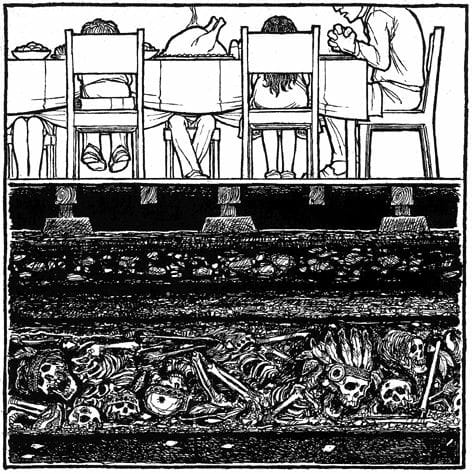
A significant psychological factor contributing to the trope’s persistence is "Settler Guilt." The theory that ghosts are spirits of people wronged in life, perhaps even murdered, resonates deeply when considering the historical atrocities committed against Indigenous peoples by colonial ancestors. If current generations "reap the benefits in resources, food, and trade" from lands acquired through historical injustices, then the idea of being "haunted on some level" can be a powerful, albeit often misdirected, expression of this guilt. Ron Cobb’s 1968 illustration, "Thanksgiving in America," depicting a family at dinner above skeletal remains, powerfully captures this sentiment. The idea that present-day hardships are caused by "Indian ghosts" (as The Onion satirized) can be a way for some settlers to acknowledge, however superficially, the "sins of our forefathers and foremothers."
However, even when driven by a misguided sense of sympathy, the widespread claim that "all places are Indigenous burial grounds" is profoundly harmful. It actively delegitimizes actual Indigenous burial sites, which deserve genuine respect and protection. Moreover, it minimizes real historical crimes and ongoing injustices—from individual acts of violence like the Defeo murders to systemic genocidal policies that led to the residential school graveyards. By generalizing and fictionalizing, the trope diverts attention from the tangible, verifiable harms and the urgent need for reconciliation and justice.
Implications: The Lasting Impact and a Call for Respect
The "Indigenous burial ground" trope is far more than a harmless cultural quirk; it carries profound implications for Indigenous peoples, settler societies, and the broader understanding of history and spirituality.
Perpetuating Harmful Stereotypes and Erasure
The most damaging implication is the perpetuation of harmful stereotypes. By portraying Indigenous ghosts as vengeful, demonic, or inherently tied to evil, the trope reinforces colonial narratives that demonized Indigenous peoples as "savage," "uncivilized," or inherently threatening. This dehumanizing imagery denies the richness, diversity, and spiritual profundity of Indigenous cultures, replacing them with a simplistic, fear-based caricature. It suggests that Indigenous spirits are fundamentally different from settler ghosts—less peaceful, more malevolent—reflecting a deeply ingrained racial bias.
Furthermore, the trope contributes to the erasure of actual Indigenous histories and spiritual beliefs. When fictional "burial grounds" are invoked to explain paranormal activity, the focus shifts away from genuine sacred sites, traditional practices, and the devastating impacts of colonization. It reduces complex cultures to a single, sensationalized motif, overshadowing the ongoing struggles for land rights, cultural revitalization, and justice. The constant need to correct these fabricated narratives places an undue burden on Indigenous communities, forcing them to defend against misrepresentations rather than being able to share their authentic stories on their own terms.
Cultural Appropriation and the Need for Ethical Engagement
The widespread, unauthorized use and misrepresentation of Indigenous spiritual concepts and imagery constitute clear cultural appropriation. It extracts elements of Indigenous culture without understanding, respect, or permission, often distorting them for commercial or entertainment purposes. This not only disrespects the cultural significance of these elements but also denies Indigenous communities the right to control their own narratives and benefit from their intellectual property.
The question of why these stories remain so popular compels us to reflect on deeper societal issues. What does it say about North American mainstream culture that its go-to explanation for evil hauntings is the ghosts of the very people whose ancestors were wronged? It suggests a collective subconscious grappling with unresolved historical trauma, yet channeled through a problematic and ultimately disrespectful lens.
A Path Forward: Respect, Accuracy, and Reconciliation
Moving beyond the "Indigenous burial ground" trope requires a fundamental shift towards respect, accuracy, and ethical engagement with Indigenous cultures. This entails:
- Challenging Misinformation: Actively debunking false claims and educating the public about the true histories and diverse spiritual beliefs of Indigenous peoples.
- Amplifying Authentic Voices: Prioritizing and supporting Indigenous storytellers, historians, and cultural knowledge keepers who can share their narratives on their own terms.
- Promoting Critical Media Literacy: Encouraging audiences to critically evaluate representations of Indigenous peoples in popular culture and to recognize cultural appropriation.
- Supporting Indigenous Rights: Recognizing that true respect for Indigenous burial sites and sacred lands is intrinsically linked to broader efforts for Indigenous self-determination, land rights, and reconciliation.
Indigenous people are not evil or demonic. Their traditional versions of heaven and the afterlife are often far more beautiful, nuanced, and less judgmental than many settler beliefs. Embracing these authentic narratives, acknowledging historical truths, and fostering respectful relationships are not just acts of cultural sensitivity; they are essential steps towards building a more just and equitable society. The continued proliferation of the "Indigenous burial ground" trope stands as a stark reminder of the work that remains to be done. Being respectful, engaging thoughtfully, and listening with an open mind is, indeed, the only way forward.