The Evolution of Virtual Athletics: Just Hoops 2.0 and the Frontier of Hand-Tracked Sports
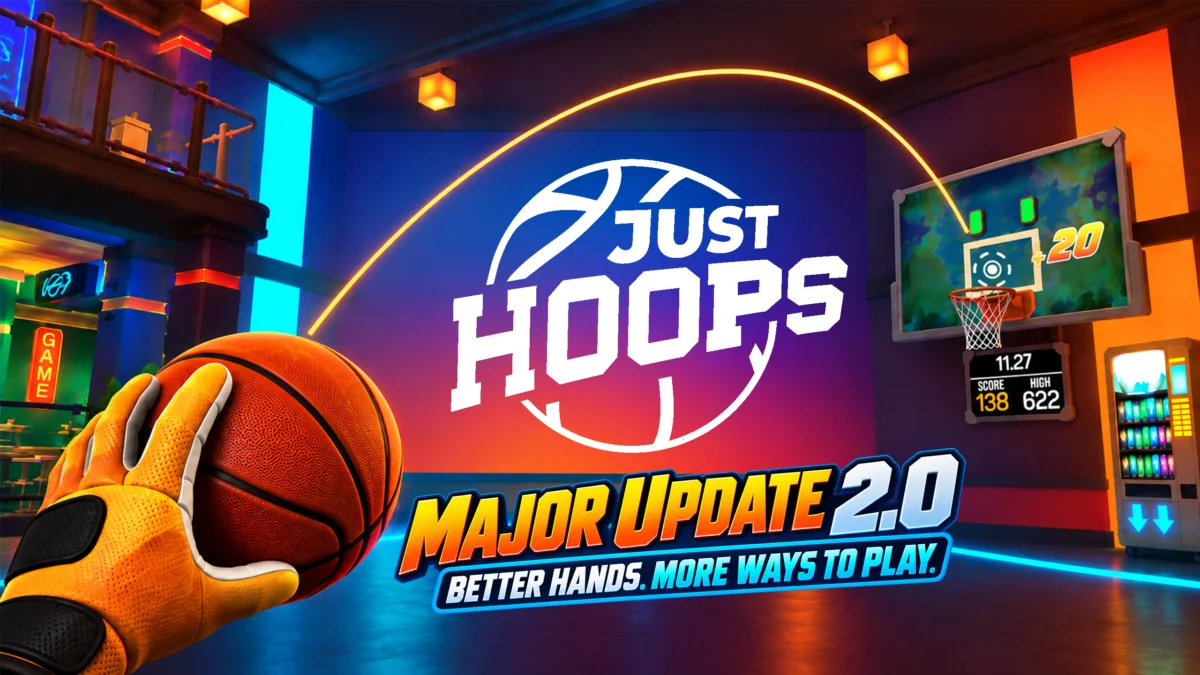
The virtual reality (VR) landscape is currently undergoing a transformative shift, moving away from the tethered, controller-reliant experiences of the past decade toward a more intuitive, "frictionless" future. At the heart of this transition is the refinement of hand-tracking technology—a feature that once felt like a novelty but is rapidly becoming the standard for spatial computing. This week, in a strategic alignment with the Meta Connect conference, developer Realcast launched the "Just Hoops 2.0" update. This overhaul is not merely a content patch; it represents a fundamental reimagining of the top-ranked basketball simulator, designed to leverage the latest advancements in Meta’s hardware ecosystem.
Main Facts: A New Era for Virtual Basketball
Just Hoops 2.0 arrives as a comprehensive reconstruction of the original arcade-style basketball experience. While the core loop of the game remains centered on the timeless appeal of the hoop-and-ball mechanic, the 2.0 update introduces a suite of features that prioritize accessibility, immersion, and mixed reality (MR) integration.
The most significant addition is the sophisticated implementation of hand tracking. While many VR titles struggle with the "physics of the release"—the difficult task of calculating exactly when a player lets go of a virtual object without a physical trigger—Just Hoops 2.0 introduces two distinct shooting methodologies: "Natural Shot" and "Pointer Shot."
Furthermore, the update introduces a robust Mixed Reality mode titled "Trickshots," which allows players to superimpose basketball hoops and obstacles onto their actual physical environment. This is complemented by a "Zen Mode" for low-pressure practice, a 1970s-inspired retro environment, and a completely redesigned user interface (UI) and progression system. Currently, the update is live for the Meta Quest platform, with no confirmed timeline for the Steam VR version, highlighting a growing trend of platform-specific optimization in the VR industry.
Chronology: From Feedback to Feature-Complete
The journey to Just Hoops 2.0 has been a year-long endeavor, characterized by a close feedback loop between the developer, Realcast, and its community.
- Late 2023 – Early 2024: The Feedback Phase: Following the initial success of Just Hoops on the Quest store, Realcast began collecting data on player retention and accessibility. A common theme emerged: while players loved the arcade feel, the reliance on controllers occasionally broke the immersion of a sport that, in real life, is entirely tactile and hand-based.
- Spring 2024: Prototyping Hand Tracking: Realcast began working on the "Natural Shot" engine. This involved solving the complex telemetry of hand movements. Unlike a controller, which has a binary "press/release" state, hand tracking must interpret the velocity and finger splay of a human hand to determine the trajectory of the ball.
- Summer 2024: Meta’s Strategic Involvement: As Meta began preparing for its Connect 2024 event, the tech giant took a "vested interest" in Just Hoops. With Meta’s internal roadmap focusing heavily on the newly revealed "Orion" AR glasses and the push for controller-free interaction, Just Hoops served as a perfect case study for how legacy sports genres could be adapted for a controller-less future.
- September 2024: The 2.0 Launch: The update was timed to coincide with the Meta Connect announcements, positioning Just Hoops as a flagship title for the next generation of Meta’s hand-tracking software.
Supporting Data: Mechanics, Scoring, and Environmental Design
The technical depth of the 2.0 update is best understood through its granular mechanics. Realcast has implemented a tiered shooting system that balances realism with "gamified" assists.
The Shooting Matrix
- Natural Shot: This mode is designed for the purist. By using the Quest’s external cameras to track the user’s hands in real-time, players reach out, grasp a virtual ball, and perform a traditional shooting motion. To mitigate the inherent difficulty of throwing in VR, Realcast included optional assists.
- The Scoring Incentive: To encourage mastery, the game utilizes a dynamic scoring system. A basket made with zero assists using Natural Shot can award up to eight points. Conversely, as players enable more assists (such as trajectory guidance or magnetic rim pulling), the point value decreases. This creates a high-skill ceiling that rewards physical practice.
- Pointer Shot: Aimed at casual users or those in restricted environments (such as seated play on a plane or couch), this mode uses a gesture-based system. Players point at the target and perform a flicking motion. While accessible, this mode is capped at two points per basket, ensuring that competitive leaderboards remain dominated by those using the more difficult Natural Shot.
Environmental and UI Overhaul
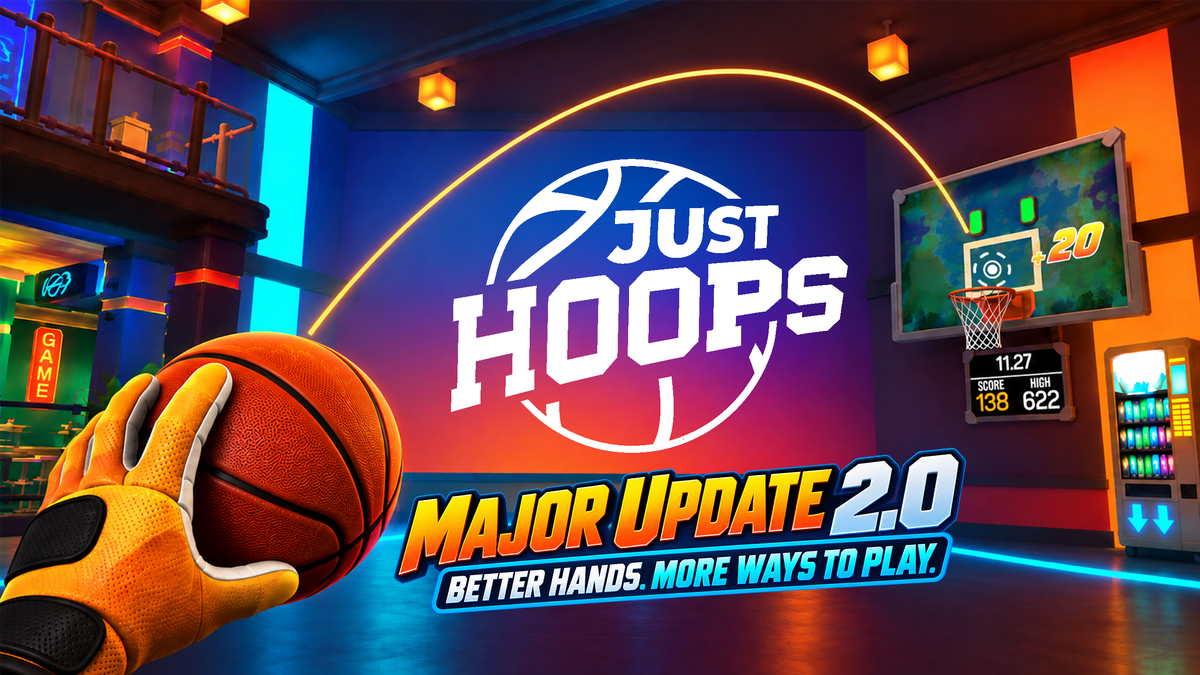
The update also expands the game’s aesthetic horizons. The new 1970s-inspired retro environment moves away from the sterile "tech" look of many VR games, embracing a warm, disco-era arcade aesthetic. This is paired with a redesigned UI that replaces clunky floating menus with a more integrated, spatial interface. The progression system has also been linearised, providing clear "Series" and "Challenges" that guide the player through the game’s increasingly dynamic levels.
Official Responses and Developer Philosophy
Realcast has been vocal about the role of player feedback in shaping this update. According to the developer, the goal was to create an "inclusive basketball experience" that could be enjoyed by everyone from professional athletes to casual VR enthusiasts.
Meta’s role in the development cannot be overstated. By providing technical support and early access to refined hand-tracking APIs, Meta has used Just Hoops as a proof-of-concept. During the Meta Connect reveals, it became clear that Meta views the controller as a transitional tool rather than a permanent fixture. By supporting developers like Realcast, Meta is ensuring that when users eventually transition to controller-free hardware like the Meta VR Glasses, there is already a library of high-quality, "hand-first" content available.
Realcast’s decision to focus on "Zen Mode" also reflects a broader trend in the gaming industry toward mental wellness and "low-stakes" gaming. By removing the timer and scoring pressure, the developers are catering to a demographic that uses VR for relaxation and light physical movement rather than intense competition.
Implications: The Future of Spatial Sports
The release of Just Hoops 2.0 carries significant implications for the future of the VR industry and the sports gaming genre at large.
1. The Decline of the Controller
For years, the VR controller has been a barrier to entry for non-gamers. The abstract nature of buttons and joysticks can be intimidating to those who didn’t grow up with a console. Just Hoops 2.0 proves that complex physical actions—like the flick of a wrist in a jump shot—can be accurately replicated without hardware in the palm. This suggests a future where "fitness VR" and "sports VR" will become almost entirely controller-free, relying on the user’s natural body mechanics.
2. Mixed Reality as the New Playground
The "Trickshots" mode in Just Hoops 2.0 is a harbinger of the "Spatial Playground" concept. By allowing players to turn their living rooms into basketball courts, Realcast is tapping into the "Nothing But Net" nostalgia of the 1990s (famously depicted in the Michael Jordan and Larry Bird McDonald’s commercials). This shift from "Virtual Reality" (replacing the world) to "Mixed Reality" (enhancing the world) is where the industry is currently seeing the most significant growth.
3. The Platform Divide
The uncertainty regarding the Steam VR version of the 2.0 update highlights a growing rift. PC-based VR often relies on lighthouse tracking and physical controllers, whereas the Quest ecosystem is pivoting toward mobile-first, hand-tracked MR. If Just Hoops 2.0 remains a Quest exclusive, it may signal that the "hand-tracking revolution" will be a mobile-VR-led phenomenon, leaving PC VR as a niche for high-fidelity, controller-based simulations.
4. Accessibility and Seated Play
The inclusion of "Pointer Shot" for seated play is a major win for accessibility. It acknowledges that not every VR user has the physical ability or the floor space to perform full-body shooting motions. By normalizing seated, gesture-based play in a sports title, Realcast is setting a standard for how developers can accommodate players with disabilities or limited mobility without compromising the fun of the game.
Conclusion
Just Hoops 2.0 is more than just a sequel to an arcade game; it is a sophisticated experiment in human-computer interaction. By bridging the gap between the physical and the virtual through refined hand tracking and mixed reality, Realcast has provided a glimpse into the future of spatial computing. As Meta continues to push the boundaries of wearable technology, titles like Just Hoops will serve as the essential software that proves the hardware’s worth. For now, Quest users can step onto the virtual court and experience a version of basketball that feels less like a video game and more like a natural extension of their own movements.